5,043  PAGES BROWSED TODAY PAGES TODAY • 0 ANTIQUES UPLOADED TODAYNEW ARRIVALS
GIFTS
LATEST STOCK
Sort Order
Items Per Page
Browse Categories
Sort order
Relevant Links
Items per page
ID #SA1210072
SOLD
Email Phone
Save
Early 18th Century ‘Bizarre’ Silk
Sold by Textile Antiques
sold SA1210072
Sorry, but this item has been sold.
Textile Antiques

Textile Antiques

Sellingantiques Verified Since Jul 2025
Browse dealers 48 items
  • About Us
    Fine european textiles and tapestries of the period spanning the 15th century to the early 20th century.
Id #SA1210072
PDF SHARE
SAVE

Early 18th Century ‘Bizarre’ Silk

18th century
Sold 1 January 1900 · Textile Antiques
This “Early 18th Century ‘Bizarre’ Silk” found a buyer.

It was listed by Textile Antiques. Sold pieces stay on Sellingantiques as a record of what has passed through, and the next one is rarely far away.

Description

Italy or France, circa 1705-1710

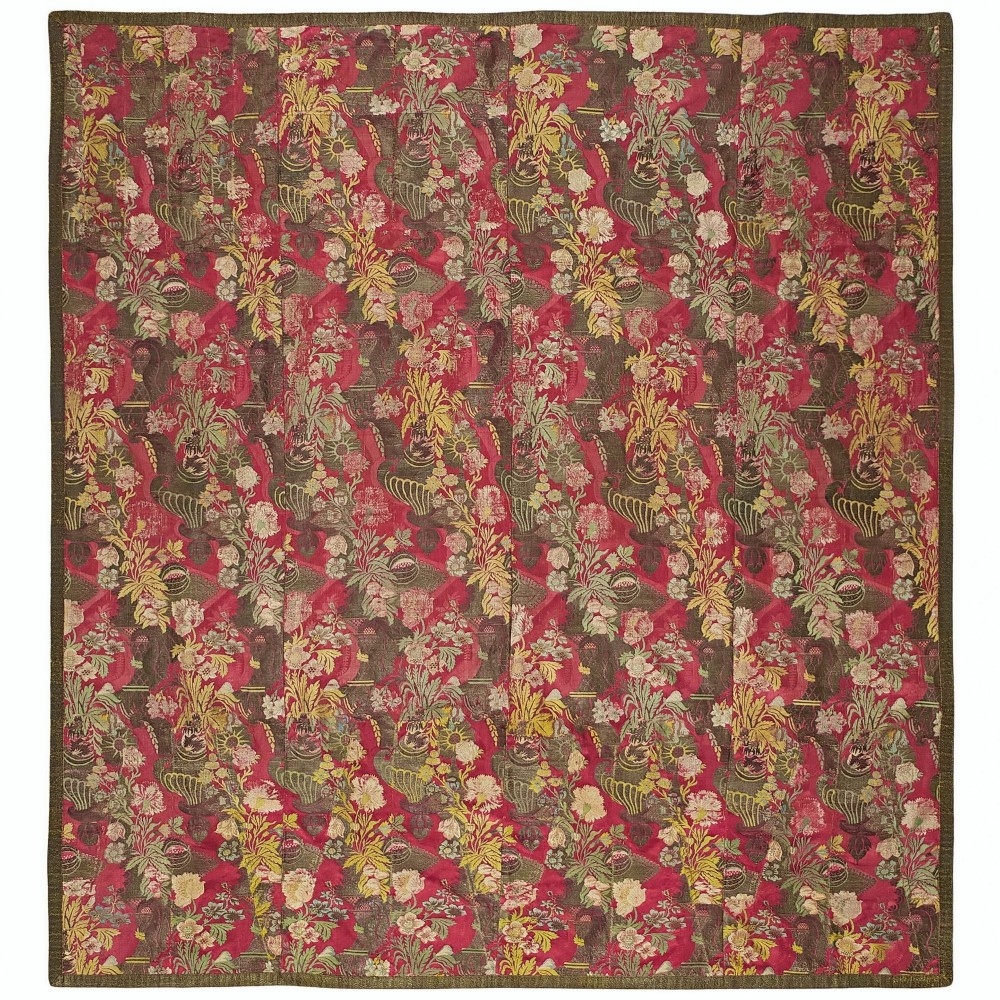
The red silk damask ground brocaded in metal thread and silk, with a design of gadrooned urns and waisted vases holding pomegranates and flowers set amid abstracted tapering scrolls. Hans Cristoph Ackermann, in ‘Seidengewebe des 18. Jahrhunderts - I: Bizarre seiden’, publ. Abegg Stiftung, Riggisberg 2000, pp. 219-263, dates this type of ‘Bizarre’ design, with semi-natural depictions of flowers, vases and architectural elements, to the years 1705-1711.

The term ‘Bizarre’, now commonly applied to silks of this type, was bestowed by Vilhelm Slomann, who first classified them as a distinct group (Bizarre Designs in Silks, publ. Ejnar Munksgaard, Copenhagen, 1953), and offered a mistaken theory that they were woven in India. The name persisted, and later work confirmed their European origin and dated them to the period between 1690 and 1720. Elements of the extraordinary designs were determined to be derived from Japanese, Ottoman and Indian textiles - one of which influences is suggested here by the rather Japanese repeated circle motif put into the brocade. There is evidence for the weaving of ‘Bizarre’ silks in London and the Netherlands, but France and Italy were the pre-eminent sources.

The fashion for ‘Bizarre’ silk was superseded by that for the symmetrical and regular ‘Lace patterns’, which became popular from around 1715, before finding some small echoes in the combined large floral motifs and small architectural vignettes of the ‘Naturalistic’ silk designs of the 1730’s. This level of extravagant abstraction was not seen again in European design, however, until the early 20th century.

Made up of four full loom widths, each 50cm wide and consisting of panels adapted from previous use as a dress fabric.

Bordered with metal braid and backed with green silk.

Date of Manufacture

Textile Antiques has dated this Antique Bizarre Silk Textile to the 18th Century.

Physical Dimensions
Height
217cm (85.43")
Width
204cm (80.32")
Reference Numbers
Sellingantiques Reference
SA1210072
Dealers Internal Reference
133
Description
Italy or France, circa 1705-1710
“
The red silk damask ground brocaded in metal thread and silk, with a design of gadrooned urns and waisted vases holding pomegranates and flowers set amid abstracted tapering scrolls.
Textile Antiques

Hans Cristoph Ackermann, in ‘Seidengewebe des 18. Jahrhunderts - I: Bizarre seiden’, publ. Abegg Stiftung, Riggisberg 2000, pp. 219-263, dates this type of ‘Bizarre’ design, with semi-natural depictions of flowers, vases and architectural elements, to the years 1705-1711.

The term ‘Bizarre’, now commonly applied to silks of this type, was bestowed by Vilhelm Slomann, who first classified them as a distinct group (Bizarre Designs in Silks, publ. Ejnar Munksgaard, Copenhagen, 1953), and offered a mistaken theory that they were woven in India. The name persisted, and later work confirmed their European origin and dated them to the period between 1690 and 1720. Elements of the extraordinary designs were determined to be derived from Japanese, Ottoman and Indian textiles - one of which influences is suggested here by the rather Japanese repeated circle motif put into the brocade. There is evidence for the weaving of ‘Bizarre’ silks in London and the Netherlands, but France and Italy were the pre-eminent sources.

The fashion for ‘Bizarre’ silk was superseded by that for the symmetrical and regular ‘Lace patterns’, which became popular from around 1715, before finding some small echoes in the combined large floral motifs and small architectural vignettes of the ‘Naturalistic’ silk designs of the 1730’s. This level of extravagant abstraction was not seen again in European design, however, until the early 20th century.

Made up of four full loom widths, each 50cm wide and consisting of panels adapted from previous use as a dress fabric.

Bordered with metal braid and backed with green silk.

Date of Manufacture

Textile Antiques has dated this Antique Bizarre Silk Textile to the 18th Century.

Height
217cm (85.43")
Width
204cm (80.32")
Reference Numbers
Sellingantiques Ref
SA1210072
Dealers Internal Ref
133
Textile Antiques
Textile Antiques
Sellingantiques verified Since Jul 2025

Fine european textiles and tapestries of the period spanning the 15th century to the early 20th century.

Dealer Profile

You can view the stock and full dealer information on the Textile Antiques Profile Page
PDF SHARE
SAVE
An early 18th-century square Bizarre silk textile panel featuring vertical stitched sections with asymmetrical crimson, gold, and green floral patterns. SOLD6+ MONTHS AGO
1 / 1
Archive I An early 18th-century square Bizarre silk textile panel featuring vertical stitched sections with asymmetrical crimson, gold, and green floral patterns. SOLD6+ MONTHS AGO

Early 18th Century ‘Bizarre’ Silk

Enlarged Archival View
Telephone 01279 816 869
Location
Stansted Mountfitchet
Essex
United Kingdom
Verified Since Jul 2025
Items For Sale 48
Items Sold 24
Textile Antiques
Textile Antiques
Verified Since Jul 2025
View Dealer Info
Location: Stansted Mountfitchet, Essex, United Kingdom
Verified
Jul 2025
For Sale
48
Sold
24
An early 18th-century square Bizarre silk textile panel featuring vertical stitched sections with asymmetrical crimson, gold, and green floral patterns.
Early 18th century ‘Bizarre’ silk
Ref: SA1210072
An early 18th-century square Bizarre silk textile panel featuring vertical stitched sections with asymmetrical crimson, gold, and green floral patterns.
Archival Detail
Every single antique dealer on our platform is individually approved by our internal team. We verify their professional trade history, ethical standards, and photographic quality to ensure a secure, high-standard buying environment. Upon joining, every dealer agrees to a strict 9-point code of conduct. While issues can occasionally arise, our dealers typically resolve them swiftly and directly with the buyer. In fact, since our founding in 2002, Sellingantiques has only had to step in to help resolve an issue on roughly five occasions—a true testament to the quality of our dealers and their dedication to your happiness.
Our dealers are highly experienced in packing and shipping fragile, high-value antiques. Because you are in direct contact with the dealer, you will be able to easily go through all available shipping and insurance options together to ensure your item arrives safely.
Antiques are the ultimate green purchase. By choosing historical pieces over newly manufactured goods, you completely eliminate the carbon footprint of modern mass production while preserving exceptional, timeless craftsmanship.
Written by Sellingantiques from the dealer’s photographs and listing
  • ObjectAntique Textiles
  • Period18th century
  • StyleBaroque
  • MaterialSilk, Metallic Thread
  • ColourCrimson Red
  • MotifsAsymmetrical flora, exotic architectural elements, diagonal scrolling patterns
  • SizeH 217 cm (85 in) x W 204 cm (80 in)

Bizarre silk refers to a distinct style of European woven silk fabric produced between roughly 1695 and 1720, characterised by large-scale, asymmetrical motifs combining Oriental, botanical, and abstract architectural influences.

These textiles were woven on drawlooms using high-grade cultivated silk thread, frequently incorporating brocaded metallic threads made of gold or silver foil wrapped around silk cores.

Authentic pieces exhibit narrow loom widths (typically around 50 to 55 centimetres), hand-stitched seam joins, distinct diagonal composition axes, and period-accurate dyes alongside natural fiber degradation.

Historic silk panels are frequently mounted on padded acid-free boards, framed behind UV-protective glass, and hung as focal artwork above sideboards, mantels, or beds.

Preservation requires keeping textiles away from direct sunlight, maintaining stable humidity levels between 45 and 55 percent, and avoiding dry cleaning or wet washing.
items
Add keywords to the filter
Price
£100
£250000
Era
Period
Style
Material
Origin
Stock Location
Recently Added
Online Payments
Categories