


Antique Chess
Antique chess covers the pieces people played with and the boards they played on, made from the eighteenth century onward in turned wood, bone and ivory for the domestic table.

What Is Antique Chess?
Two things sit under the heading, and they overlap. There are playing sets, usually supplied in a box, and there are boards sold on their own. Board is the commonest word in these titles, at just under a third of them, so you're about as likely to meet a board without pieces as a full set.
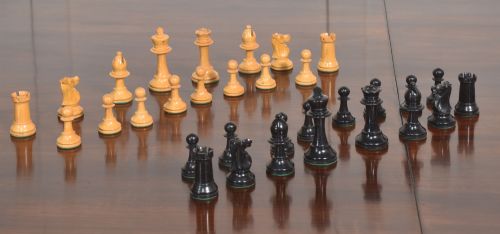
The set you'll meet most often is Staunton pattern in boxwood against ebony or ebonised wood, turned, frequently lead-weighted in the base, and housed in a wooden box. That pattern was introduced in London in the mid nineteenth century to give tournament players pieces that were easy to tell apart and stable enough to push around a board. Staunton appears in a quarter of titles on Sellingantiques.
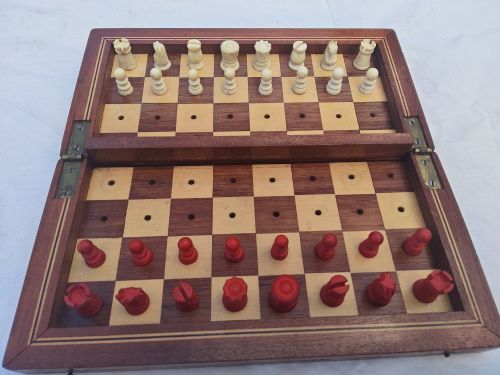
Around the edges sit several smaller groups. Travelling and miniature sets, roughly one in ten, fold board, box and pieces into a single portable object, and include the pegged 'In Statu Quo' cased types. Bone and ivory sets account for about one in eight, among them ornamental turned patterns such as Barleycorn and the plain Edinburgh Upright. Games compendia and combined backgammon or draughts boards, where chess is one game among several, are catalogued here too.
Dating is loose. The dealers' own date field runs 1800 to 1930, but fewer than half the listings commit to a clean year: '19th Century' is the largest single bucket, with 'Victorian' behind it and 'Edwardian' after that. Decade buckets cluster late, in the 1900s, 1910s, 1920s and 1930s. A handful of titles reach further back, including an ivory set given as circa 1780, a French set inscribed Paris 1826 and a Canton export set dated 1836. Read a bare '19th Century' as an estimate.
The Range
The clearest divide is between a named pattern and a generic one. The lower part of the range is thick with sets described as Staunton style or Staunton type. The upper end names its pattern outright: Barleycorn, Edinburgh Upright, St George, Selenus, Whittington, Washington. That variety of named patterns is unusual for a category this size.
Size and material do most of the rest of the work. King height is stated in some titles, and four-inch and four-and-a-half-inch tournament sets sit at the top while miniature travelling sets sit low. Ivory and worked bone concentrate in the upper half; stained boxwood and sets described only as wooden gather near the bottom. Weighted pieces in a fitted mahogany box run well above the middle.
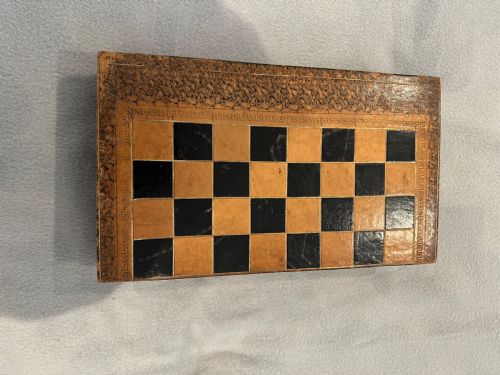
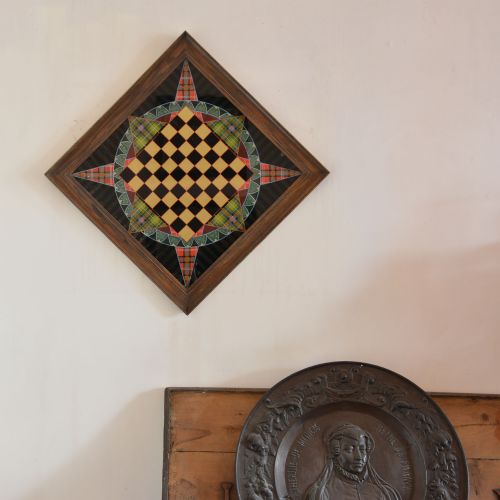
Boards follow the same logic through their substrate. A plain wooden board sits low. Above it come rosewood, mahogany and sycamore combinations, marquetry and parquetry, mother of pearl, and then the specialist materials: malachite, Carrara marble, bloodstone, painted and reverse-painted glass, and tooled leather. Folding leather 'library' boards, bound to shelve spine-out among real books, are a persistent thread.
Retail Price Guide 2026
Typical UK retail prices for chess, calculated from the Sellingantiques database of over a million retail prices indexed since 2003. This retail price guide relies exclusively on Sellingantiques data; no external sources or auction records are used, so the figures do not describe the wider market.
The top sale of the last year on Sellingantiques was an unusual double-sided English chess board, late 19th century, sold in December 2025.

The Antique Chess Glossary
- Staunton pattern
- The standard nineteenth-century English playing pattern, with a knight's head, a bishop's mitre and a coronet queen. It is the single commonest descriptor in these titles.
- Weighted
- Lead inserted into the base of a piece so it stands firm on the board. Named in a good number of titles, often alongside a mahogany box.
- Boxwood and ebony
- The usual pairing of light and dark turned pieces. Where a listing says ebonised, that means stained wood rather than true ebony.
- In Statu Quo
- A cased travelling set whose pieces peg or slot into the board, so a game can be broken off and carried away mid-play.
- Library board
- A folding leather board, bound and tooled to look like a book so it can be shelved among real volumes.
- Barleycorn
- An ornamental turned bone pattern with a distinctive grain-like column, one of the named bone types at the upper end.
Frequently Asked Questions
What is the most common type of antique chess set?
A Staunton-pattern set of turned pieces in boxwood against ebony or ebonised wood, supplied in a wooden box. Staunton is named in a quarter of titles on Sellingantiques.
Weighting is a frequent companion to that description, with lead let into the bases. Boxed and cased sets together account for a large slice of the titles.
Are boards sold separately from the pieces?
Often. Board is the commonest single word in these titles, at close to a third, so boards on their own make up roughly the same portion of the category as playing sets.
They range from plain folding wooden boards through marquetry and parquetry timber to marble, malachite, glass and tooled leather.
Which patterns other than Staunton turn up?
The archive is unusually varied on this point. Besides Staunton, it has carried St George, Old English, Barleycorn, Whittington, Edinburgh Upright, Selenus, Regence, Lyon, Burmese and Washington patterns.
St George is the English pattern that preceded Staunton and ran alongside it. Selenus is a German type of stacked, disc-turned pieces.
How old are most antique chess sets on the market?
The dealers' date field spans 1800 to 1930. Fewer than half of the listings give a clean year, and the rest fall back on '19th Century', 'Victorian' or 'Edwardian'.
Where decades are stated, they cluster late, in the 1900s through the 1930s, with far fewer in the 1850s and 1860s.
A few titles go earlier, including ivory sets given as circa 1780 and circa 1830.
What is a travelling chess set?
Board, box and pieces combined in one portable object. Travelling appears in about a tenth of titles, often paired with leather or with the word folding.
The 'In Statu Quo' types peg or slot their pieces into the board so a game survives the journey. At the smallest end are miniature sets whose whole board folds into a pocket case.
Do bone and ivory chess sets appear often?
They make up roughly one in eight of the listings, with bone slightly ahead of ivory. Carved sets are a smaller group again.
This is where the ornamental named patterns sit, Barleycorn among them, and ivory concentrates in the upper half of the range.