
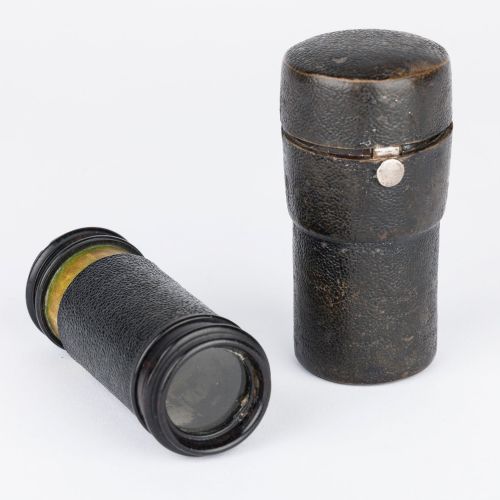


Antique Opera Glasses
Small twin-barrelled glasses, worn as much as used, carried to the theatre so an audience could see a face across a darkened house.
Antique Opera Glasses
A pair of short brass or aluminium barrels with a central focusing wheel, sheathed in something decorative: mother-of-pearl, bone, enamel, skin. Low power, light enough to hold up through an act. Short binoculars of this kind came in during the middle of the nineteenth century, once the twin telescope could be made small enough to be a dress accessory.
The default on Sellingantiques is shell. "Mother" appears in 69 of 113 titles and "pearl" in 67, so mother-of-pearl is what you'll meet more often than anything else, usually described as a pair, frequently French, and in a quarter of titles tied to Paris. Some arrive with the fitted case they were sold in.
Around one in eight listings names a lorgnette handle, a stem that screws in or detaches so the glasses can be held on one hand rather than pressed to the face. A smaller run carries guilloche or Viennese enamel, named by colour: yellow, amethyst, golden. Brass, bone and leather-covered pairs make up another slice, and crocodile skin, lizard, ivory, abalone and faux tortoiseshell each surface once or twice.
Dates cluster hard. Ninety-one listings carry a clean year, and the 1900s alone account for 46, with the 1910s and the Edwardian label filling in around them. The 1920s and 1890s follow. A single-barrel viewing monocular and an eighteenth-century pocket spyglass sit inside the heading as strays from the binocular norm.
Where The Range Splits
Covering does most of the work. Guilloche and Viennese enamel pairs, and the darker figured abalone shell, sit in the upper half of what has sold. Plain brass gilt and bone pairs sit at the lower end. Between them, ordinary mother-of-pearl on gilt brass is the middle of the market and it is a crowded middle.
Description separates otherwise similar pairs. A title that says French, or names Paris, or carries an engraved name on the body, sits above the flat "pair of mother of pearl opera glasses" that anchors the bottom. Nine titles record a signed name. Since 21 dealers have handled these, that difference in how much is known about a pair shows up plainly across listings.
Two features lift a pair beyond its covering. A lorgnette handle, particularly a detachable one, puts glasses in the upper half. And the top of the range isn't optical at all: a platinum and diamond Art Deco lorgnette stands several times above the cased mother-of-pearl pairs that cluster in the middle.
Antique Opera Glasses Retail Price Guide 2026
Typical UK retail prices for opera glasses, calculated from the Sellingantiques database of over a million retail prices indexed since 2003. This retail price guide relies exclusively on Sellingantiques data; no external sources or auction records are used, so the figures do not describe the wider market.
The 1900s is the period label used most on Sellingantiques for opera glasses, with the 1910s next and Edwardian third.
The Antique Opera Glasses Glossary
- Pair
- The standard title word for a complete binocular set, used in just over half the listings in this category.
- Mother of pearl
- Iridescent shell veneer applied in panels to the barrels, and the commonest covering by a wide margin.
- Lorgnette handle
- A stem, sometimes detachable or screw-in, letting the glasses be held up on one hand instead of held to the eyes.
- Guilloche enamel
- Translucent enamel laid over an engine-turned metal ground, recorded here by colour: yellow, amethyst, golden.
- Brass gilt
- Gilded brass mounts and barrel ends, the usual metal body underneath a decorative covering.
- Abalone
- A darker, more strongly figured shell used in place of standard mother-of-pearl, and scarce in this archive.
Antique Opera Glasses: Frequently Asked Questions
What are opera glasses usually made of?
Mother-of-pearl over gilt brass is the default. Two-thirds of the titles on Sellingantiques name shell, applied in panels to the two barrels.
Beyond that: enamel over engine-turned metal, bone, leather, aluminium. Crocodile skin, lizard skin, ivory, abalone and faux tortoiseshell each appear only once or twice across the whole run.
When were most antique opera glasses made?
The dated listings run from 1880 to 1930, and the mass sits early in the twentieth century. The 1900s account for 46 listings on their own.
Add the 1910s and the Edwardian label and the first two decades cover the bulk of what comes to market. The 1920s and 1890s trail behind, with only a couple reaching back to the 1880s.
Why do some pairs have a handle?
A lorgnette handle is a stem the glasses sit on, so they can be raised on one hand. Some are fixed, some screw in or detach.
Fourteen titles name one, several specifying it as detachable. It's a recurring option rather than an oddity, and handled pairs sit in the upper half of the range.
Are French opera glasses different from English ones?
French pairs dominate the category. "French" appears in 46 titles and "Paris" in 25, often together as a single phrase.
English and German-marked examples turn up too, in smaller numbers. French and Paris attribution sits above pairs described only as mother-of-pearl.
Do opera glasses come with their original case?
Some do. A handful of titles call out a case, usually a fitted leather or covered box made for the pair.
The majority don't mention one, which suggests cases parted from their glasses more often than they survived alongside them.
What sells for the most in this category?
Not a pair of glasses. A platinum and diamond Art Deco lorgnette holds the top, several times above everything else.
Below that, enamelled and abalone-shell pairs lead. The cased mother-of-pearl pairs that make up the bulk of the category cluster tightly in the middle.