
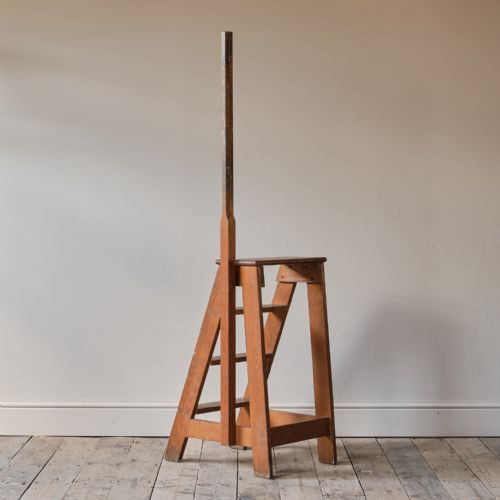


Antique Ladders
Wooden steps and ladders made for reaching things: library shelves, shop stock, orchard branches and mill floors.
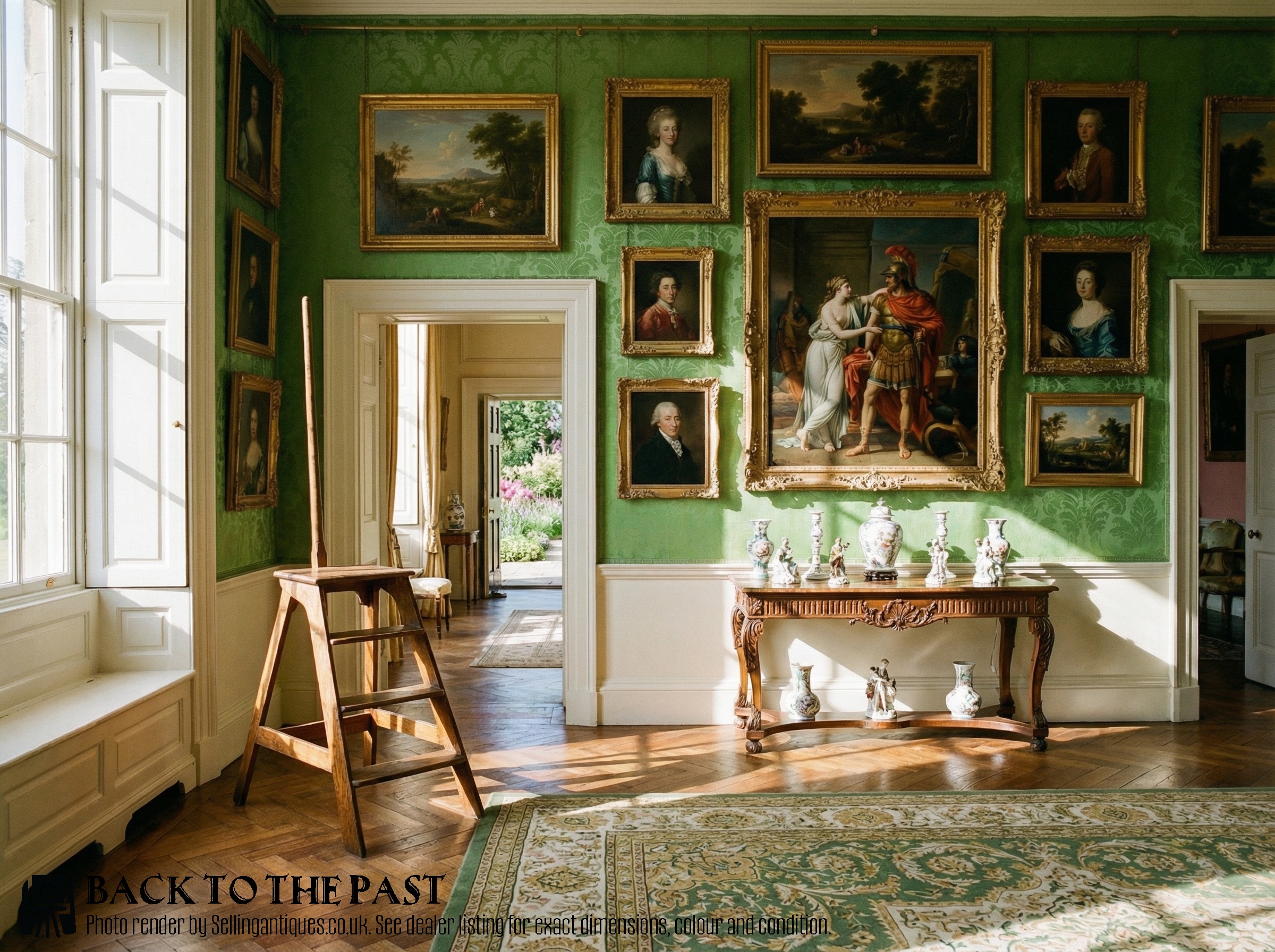
What Are Antique Ladders?
A mixed group of wooden climbing furniture. At one end, joined hardwood library steps with flat treads; at the other, plain painted softwood trade ladders. Between them sit folding step ladders, straight and pole ladders, and free-standing flights made to stand alone in a room.
Use gets named more often than timber. "Library" appears in 47 of 111 titles on Sellingantiques, well ahead of pine, and shop, kitchen, decorators, fruit picking, ships and mill work all turn up as descriptions. Purpose-made library steps came with the tall bookcase-lined room; trade and orchard ladders of the same period were built for stock, decorating and picking, and folding and patent mechanisms were developed so they could be put away.
The piece you're most likely to meet is a Victorian or early 20th-century pine or oak step ladder or set of steps, sold for library or shop use. Library steps are the largest branch and the bulk of current stock. Trade and shop steps make up around a seventh, folding and patent ladders another seventh, with pole and straight ladders a visible minority and orchard, cheese, mill, ships and railway ladders as scattered one-offs.
Dating is broad. Fifty-six of 111 listings carry a clean year, the field runs 1800 to 1940, and the commonest single entry is the vague "19th Century", used 34 times. Precise decades cluster in the early 20th century, the 1920s ahead of the rest. Georgian and 18th-century attributions appear only as isolated samples, so anything earlier than Victorian is exceptional in this category.
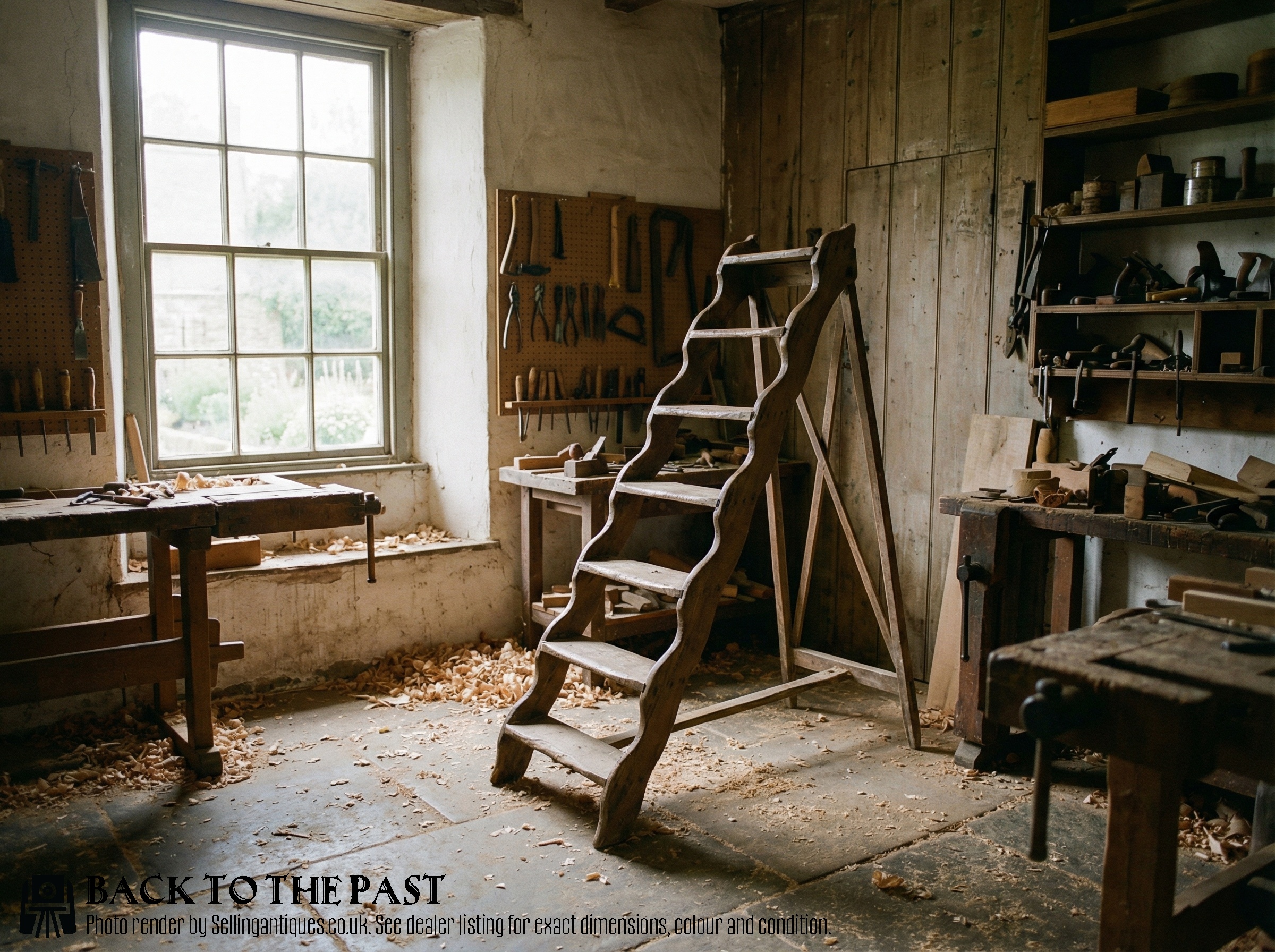
Where The Range Splits
Timber and purpose do most of the work. Pine dominates the naming and sits low and mid; oak, mahogany, teak, fruitwood and golden oak sit at the top. Every top-of-range sample is a set of library steps, while shop, decorators and plain folding trade ladders sit lower. The very highest are large golden oak and Gothic oak library steps, an order of magnitude above the plain folding shop steps at the bottom.
Then joinery. Spiral steps, turned supports, Gothic detailing, A-frame construction and leather-topped treads occur only in the upper samples. Spiral library steps appear twice across the whole archive, once with leather tops and once with turned supports, both near the top. Plain hinged trade steps carry no such work.
Scale and surface lift things within a type. Titles reaching for "huge", "tall", "of large proportion" or a stated 14 feet recur across the upper half. Among softwood, original green paint or original paint sits above undescribed plain steps, and a named patent mechanism puts a folding ladder in the middle to upper-middle rather than the bottom.
Retail Price Guide 2026
Typical UK retail prices for ladders, calculated from the Sellingantiques database of over a million retail prices indexed since 2003. This retail price guide relies exclusively on Sellingantiques data; no external sources or auction records are used, so the figures do not describe the wider market.
The tallest ladder to give a figure on Sellingantiques was a straight one of 14 foot. Others just say huge, tall or of large proportion.
The Antique Ladders Glossary
- Library steps
- A free-standing flight of treads made for reaching high shelves. The phrase appears in 25 titles, and the branch holds the bulk of current stock.
- Tread
- The flat surface you stand on, as opposed to a round rung. One set in the archive is leather-topped.
- Step ladder
- A self-supporting ladder with flat treads, usually hinged or folding. "Folding" appears in 16 titles.
- Pole ladder
- A ladder with a single central pole or narrow taper. Several are described as folding, including a teak folding pole library ladder.
- Lattislap
- A criss-cross expanding side structure used on certain patent folding ladders, and one of several trade names that recur without any firm dominating.
- Epicerie
- French for grocer's shop, used on a set of French pine shop steps. French origin is named in a small run of titles, mostly shop pieces.
- Jacob's ladder
- Trade name in several titles for a long straight ladder, one of them 14 feet.
Frequently Asked Questions
What wood are antique ladders usually made from?
Pine is the most commonly named timber, in 19 titles, and it runs through the trade and shop steps as well as plenty of library sets. Oak comes next, and accounts for a good share of live stock.
Ash, teak, mahogany, fruitwood, golden oak and pitch pine all appear too. Metal is almost absent: wrought iron ladders turn up once in a category otherwise entirely wooden.
How many come up for sale each year?
Roughly ten a year come to market on Sellingantiques. Fifty different dealers have listed one, so almost nobody carries more than a handful at a time.
That spread is why the forms vary so much from listing to listing.
Are library steps different from a step ladder?
Library steps are a free-standing flight of treads made for reaching upper shelves, and they were made as room furniture. They're the largest branch here and take in A-frames, spiral sets and flights with turned supports.
A step ladder is the self-supporting hinged or folding form with flat treads. Plenty were made for shops, decorating and kitchen use rather than for a library.
What unusual types turn up in this category?
The one-offs are the interesting part: a cheese ladder, a flour mill ladder, ships ladders, Great Northern Railway steps, a trench ladder and a Japanese folding step ladder.
Faux bamboo appears three times across the whole archive, once in ash and once described as Regency.
Do patent folding ladders carry maker names?
Some do. Simplex, Lattislap, Hatherley, Jones's Patent, Youngmans Steadfast and Hampton's combined easel-and-step patent each appear in only one or two titles.
No single firm dominates the group. Named mechanisms tend to sit in the middle and upper-middle of the range rather than the bottom.
How tall do antique ladders get?
The tallest measured piece stated is a 14 foot straight ladder. Other titles reach for words instead of figures: huge, tall, of large proportion.
Size tracks with the upper half of the range, so the big flights and long straight ladders sit above the compact folding steps.