


Antique Letter Rack
A small desk or wall fitting with upright divisions, made to hold incoming letters, envelopes and writing paper sorted and standing.

What Is A Letter Rack?
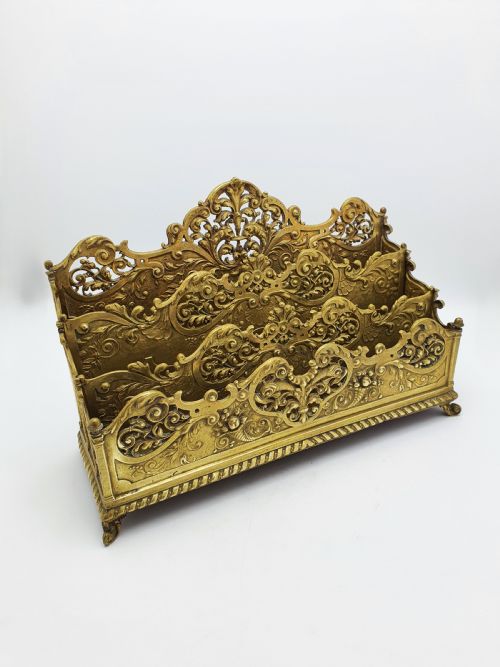
The form is simple: two or more upright divisions rising from a flat base. They came in with private correspondence and, from the middle of the 19th century, cheap prepaid postage, which put far more paper on the average desk than before. Dealers title the same object letter rack, letter and document rack, stationery rack, letter holder or desk tidy.
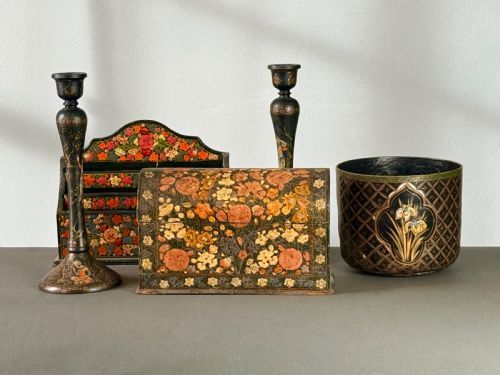
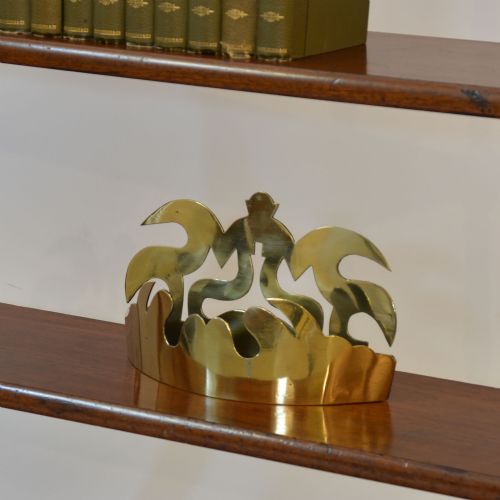
Brass dominates. It is named in just over half of all titles on Sellingantiques, pierced or fretted, sometimes cast, sometimes worked in wire or mesh. Oak is named in a quarter of titles and mahogany in one in nine, and the two materials often meet in the same piece, brass uprights on an oak base. The rack you are most likely to meet is a late Victorian or Edwardian pierced brass one standing on a desk, with circa 1890 and circa 1905 the dates repeated most often.
Dealer dating runs from 1800 to 1930. The heaviest clusters are the 1900s and the 1890s, then the 1880s, with only a handful before 1870; the earliest is a brass-bound mahogany waterfall rack put to the George III period. A large block carries only a reign or a century, so Victorian, Edwardian and '19th Century' listings should be read as approximate.
Beyond the standing desktop rack there are smaller groups. Only 11 titles in 153 describe a rack made to hang, including wall pockets with a closed front. Racks paired with inkwells, pen trays, blotters and inkstands make up around a tenth, and a distinct slice sits under Arts and Crafts, Art Nouveau and Art Deco, in copper, bronze, brass and marble. Racks also come to market in pairs fairly often.
Range And Ambition
With brass, the difference is how much work went into the metal. A plain sheet two-division rack sits at the bottom of the range. Deeply pierced scrollwork, classical mask motifs and heavy cast sides sit well above it, because casting and modelling take skill that stamping and folding do not.
In timber the same logic runs through the wood itself. Plain oak wall racks are the modest end. Burr yew, plum pudding mahogany, coromandel, brass inlay and inlaid decoration lift a piece, and so does size: large multi-division stationery, newspaper and mail racks sit high, as do racks that still have their inkwells, trays or blotter.
Top of the range is figural and sculptural work rather than any material on its own. Cold painted Vienna bronze, bronze in the Grand Tour manner, figural stationery racks and novelties such as a cricket-themed rack in brass and mahogany are the pieces that stand apart. Imported work is thin throughout, with French the only foreign origin appearing more than once or twice.
Retail Price Guide 2026
Typical UK retail prices for letter rack, calculated from the Sellingantiques database of over a million retail prices indexed since 2003. This retail price guide relies exclusively on Sellingantiques data; no external sources or auction records are used, so the figures do not describe the wider market.
About fifteen letter racks are listed on Sellingantiques each year, and 46 different dealers have offered one.
The Antique Letter Rack Glossary
- Division
- One compartment of the rack. Two-division examples are the plainest form named in titles, and larger racks are described by how many they carry.
- Pierced or fretted
- Brass cut through with a decorative pattern rather than left solid. The commonest treatment in the category.
- Cast brass
- Brass poured into a mould, which gives heavier, more sculptural sides than sheet brass folded or stamped to shape.
- Waterfall
- Graduated stepped divisions rising towards the back. It recurs on the timber racks, including the earliest piece in the archive.
- Wall pocket
- A hanging rack with a closed front, used for letters or newspapers. Part of the small minority made to hang.
- Standish
- An inkstand. The word turns up in titles where a rack incorporates ink bottles as part of a desk set.
Frequently Asked Questions
What are antique letter racks made of?
Brass is the defining material, named in just over half of all titles, worked pierced, fretted, cast, or in wire and mesh.
Timber accounts for roughly a third: oak most often, then mahogany, with walnut, burr yew and coromandel appearing too. Brass and oak are frequently combined in one piece.
Copper shows up on the Arts and Crafts examples, and bronze, papier mache, cast iron and toleware each turn up occasionally.
How old are most of these racks?
Dealer dating spans 1800 to 1930, with the heaviest clusters in the 1900s and 1890s, then the 1880s.
Victorian and Edwardian are the two labels used most in titles, so late Victorian and Edwardian work dominates. Pre-1850 examples are scarce.
A fair number of listings give only a reign or '19th Century' rather than a year.
Are letter racks meant to stand or hang?
Standing desktop racks are the norm. Only 11 titles in 153 describe a rack made to hang.
Those that do include wall-mounted and wall-hanging racks, plus wall pockets, which have a closed front and were used for letters or newspapers.
Which makers turn up on letter racks?
Named makers are not a feature of this category. A scan of the archive for maker candidates returned nothing that holds across it.
What does appear instead is registration and patent marking: a patent number on an Edwardian oak rack, a registered butterfly design, and a figural stationery rack registered in 1887. That is the closest the archive gets to a dated attribution.
What is a desk set with a letter rack?
Around a tenth of listings pair the rack with other desk fittings: inkwells, pen trays, blotters, inkstands and standishes.
Some are sold as a matched set, some as a single casting with wells built into the base. Racks that still have those parts sit higher in the range than the rack alone.
The word 'desk tidy' is used for the smaller combinations.
Do unusual letter racks come up?
They do, one at a time. A cold painted Vienna bronze rack, an English mosaic-inlaid rack, a cast iron wall-hanging rack, a cricket-themed novelty in brass and mahogany and a floral toleware stand each appear once.
Pairs are less unusual than you might expect: chinoiserie racks, 19th-century oak racks, Regency Gothic hanging racks and Regency papier mache letter stands have all come to market in twos.
Around 15 letter racks are listed on Sellingantiques a year, offered by 46 different dealers.