



Antique Pole Screens
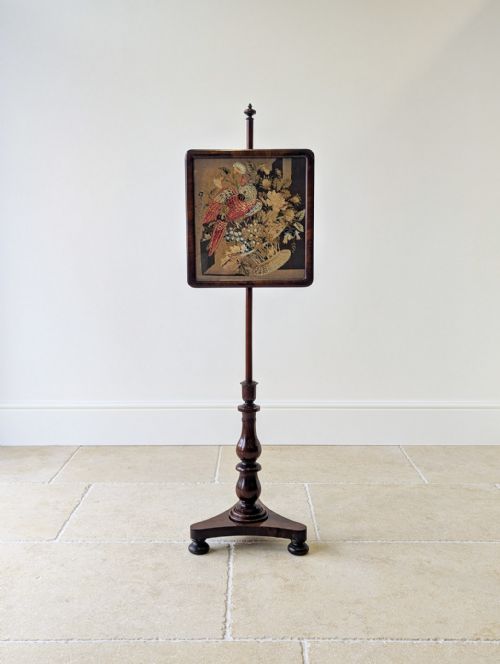
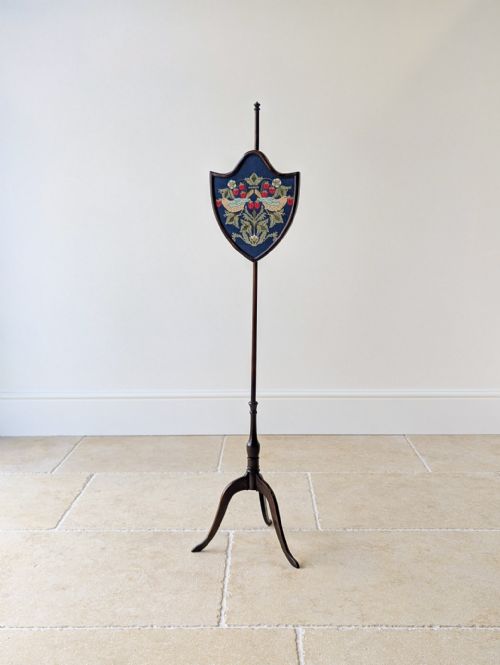
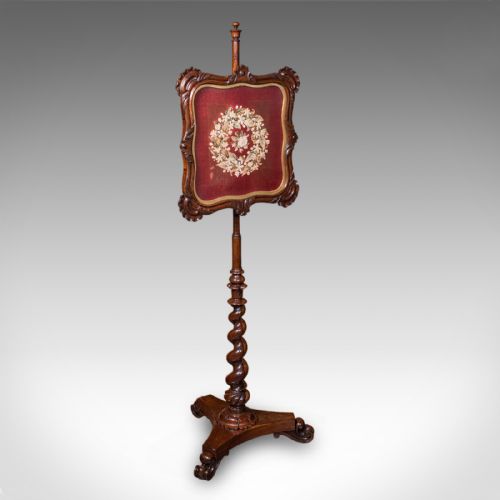
A pole screen is a small panel that slides up and down an upright pole on a tripod base, set between a seated person and the heat of an open fire.

What Is A Pole Screen?
The form came into use in the 18th century as fireside furniture. The panel could be raised or lowered on the stem to shield a sitter's face from a coal or wood fire, and it stayed a standard drawing-room fitting right through the 19th century. The panel itself became a natural place to show off domestic needlework.
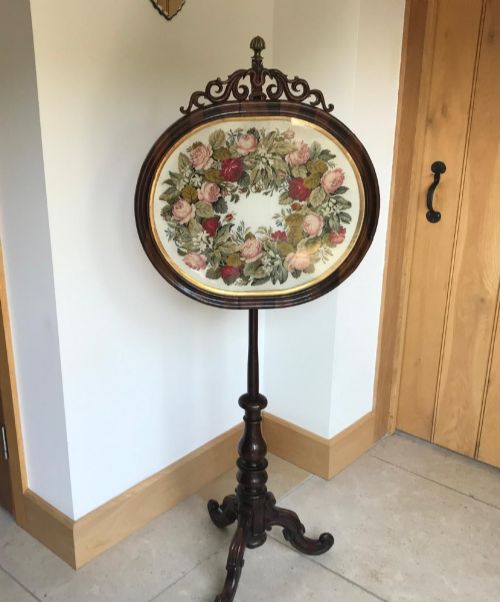
What turns up on Sellingantiques is overwhelmingly English and early to mid 19th century. Mahogany and rosewood are the two standard timbers, roughly level with each other in the titles, and the panel is most often a worked textile: needlepoint and tapestry between them account for most of the named panels, with embroidery, silk and woolwork behind them. Walnut appears in a smaller run of listings, satinwood occasionally.
Regency is the commonest label by a distance, followed by plain "19th Century" and then Victorian. Those brackets are used loosely by dealers, though. Regency-described pieces get filed under 18th Century and a William IV screen under Georgian, so read them as approximations. Only a minority of listings carry a clean year, and the dated range stops at 1900. Genuine 18th-century examples are scarce, a handful of listings, the earliest sampled described as circa 1760.
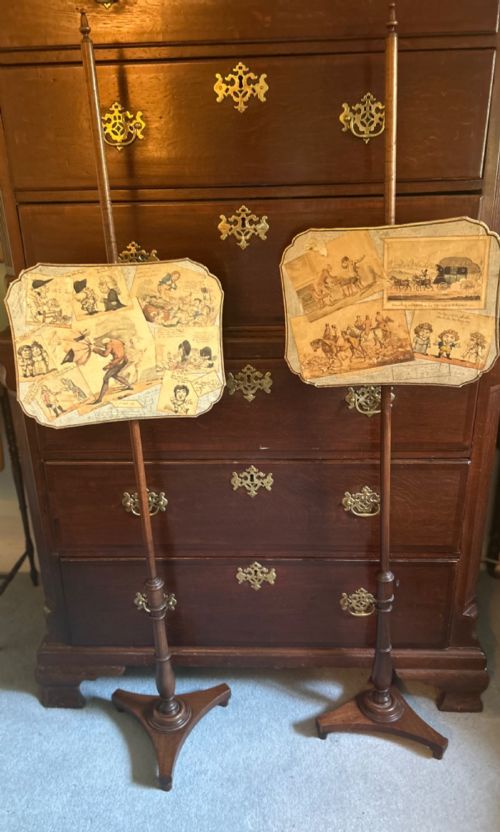
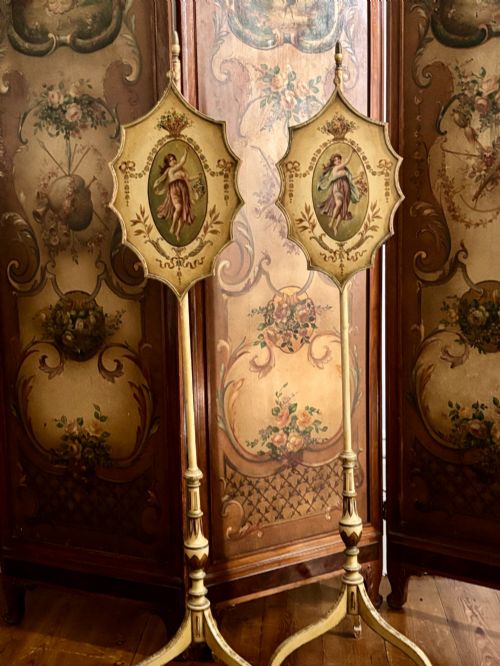
Two side branches are worth knowing. Around a fifth of listings offer a pair rather than a single screen. And a smaller group is described as fire screens or fireside screens, sold on the adjustable heat-shielding function, a wording that is more common in current stock than in what has already sold.
Where The Range Sits
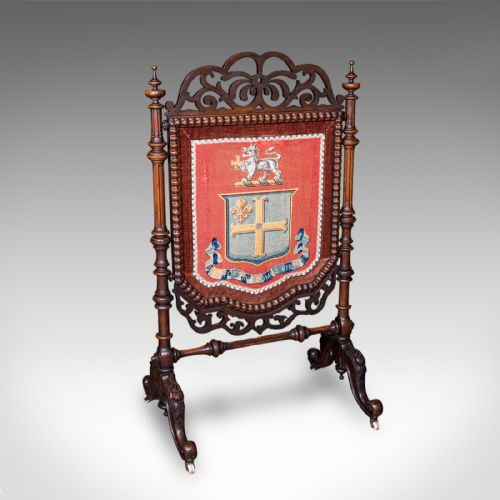
The panel is where the variety lives, and it does most of the work on price. Plain screens with no panel named at all sit at the bottom of the sampled range. Above them come the worked textiles, and above those the pictorial and unusual ones: satirical prints, an armorial embroidery, a sampler reused as a panel, crewelwork, pokerwork, painted decoration.
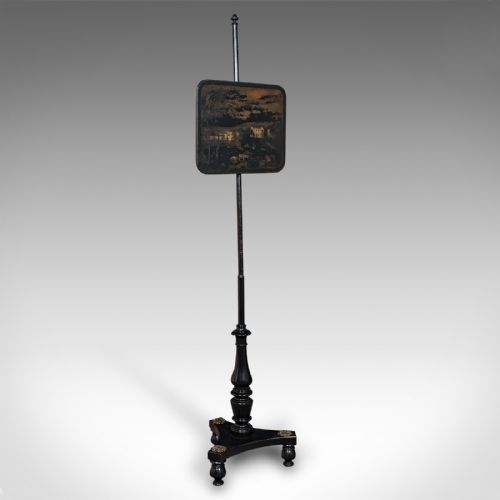
Timber and surface follow the same pattern. Mahogany and rosewood are the staples, and anything beyond them tends to sit higher: satinwood, giltwood, parcel gilt, ebonised chinoiserie, brass inlay, papier mâché. Carving pushes in the same direction, with carved and figural bases and spade feet named in the upper part of the range.
Pairs push upward on their own account. They cluster in the top half of the sampled range, and so does earliness, with the George III and 18th-century pieces sitting high. A Welsh pair in papier mâché, painted with Haverfordwest scenes, sits at the very top.
Retail Price Guide 2026
Typical UK retail prices for pole screens, calculated from the Sellingantiques database of over a million retail prices indexed since 2003. This retail price guide relies exclusively on Sellingantiques data; no external sources or auction records are used, so the figures do not describe the wider market.
Mahogany and rosewood account for most of the pole screens listed on Sellingantiques, with walnut some way behind and satinwood now and then.
The Antique Pole Screens Glossary
- Pole screen
- An adjustable panel on an upright pole and base, set between a sitter and the fire. The pole usually rises from a tripod or a small platform.
- Fire screen, fireside screen
- Used interchangeably with pole screen in these titles, and often paired with wording about adjustable height or reflected heat.
- Needlepoint
- A worked canvas panel, and the single most-named panel type in the category. Frequently combined in titles as "needlepoint tapestry".
- Tapestry
- Applied loosely by dealers to woven or worked panels alike, rather than to true woven tapestry only.
- Parcel gilt
- Woodwork gilded in part rather than all over. It shows up on the chinoiserie and tapestry-panelled examples.
- Goncalo alves
- A dense figured timber, named exactly once across the whole category and an outlier among the mahogany and rosewood.
Frequently Asked Questions
What were pole screens used for?
They shielded a seated person from the direct heat of an open fire. The panel slides on the pole and sets at whatever height suits the sitter's face.
By the 19th century they were a standard drawing-room fitting, and the panel doubled as a place to display needlework.
Which woods are most common?
Mahogany and rosewood, running close to level with each other across the titles. Walnut appears in a smaller run.
Satinwood, giltwood, ebonised and painted finishes turn up too, but only in the upper part of the range.
Are pairs of pole screens usual?
Around a fifth of listings offer two screens together, so pairs are a real feature of the category rather than an oddity.
They cluster in the upper half of the range, alongside the carved and earlier examples.
How old are most of them?
Early to mid 19th century. Regency is the commonest label, then plain "19th Century", then Victorian, and nothing in the evidence is dated later than 1900.
Eighteenth-century examples are the scarce end, only a handful of listings, with sample titles citing circa 1760, 1770 and 1790.
What kinds of panels turn up?
Needlepoint and tapestry between them account for most named panels, with embroidery, silk and woolwork behind them.
The less usual ones make the interest: a sampler, pokerwork, crewelwork, satirical prints, an armorial embroidery, papier mâché and a glass reflector all appear.
Do pole screens carry maker's names?
Not in this evidence. Nothing across the category has come through with a stamped, labelled or attributed maker.
Dealers describe them by period, timber and panel instead, which is what the titles are built around.