




Antique Calendars
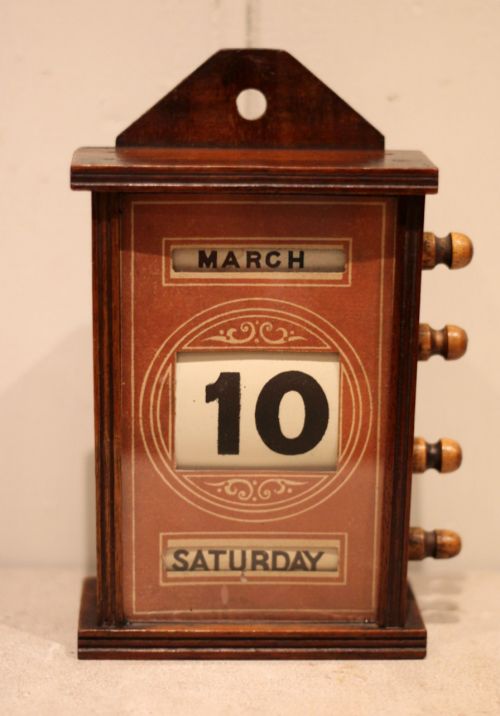
A perpetual calendar is a stand or wall plate with rotating or sliding date, day and month indicators that you reset by hand, so one object serves any year.
Antique Calendars
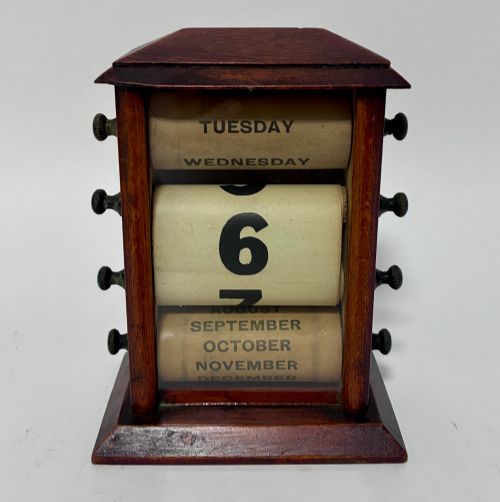
Almost all of them are perpetual. The word appears in 244 of 303 titles on Sellingantiques, which makes the hand-reset calendar the definition of the category rather than a variant inside it. Dates and days are carried on rollers, drums or sliding plates, and the same piece works year after year.
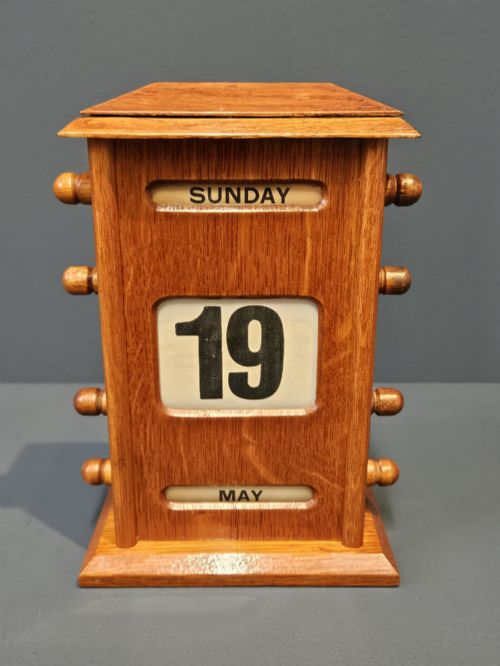
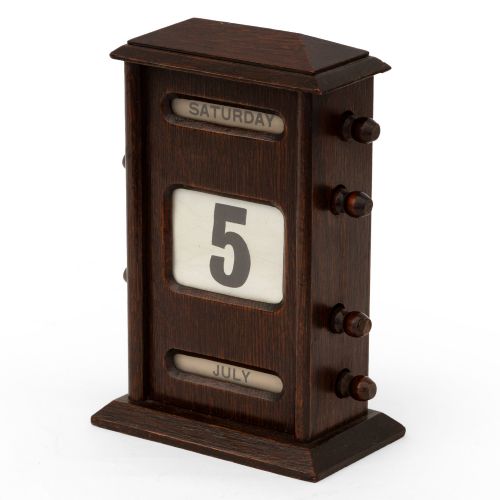
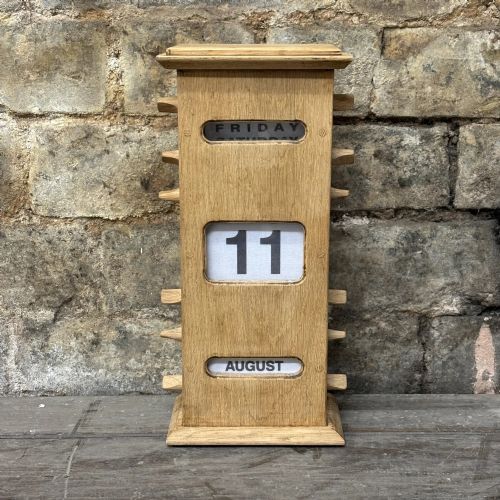
The one you are most likely to meet is an English polished-oak perpetual desk calendar of the Edwardian or late Victorian years. Desk appears in 202 titles and oak in 162, and 'oak perpetual' alone accounts for 131. Heights quoted in listings run from around 8 inches upward.
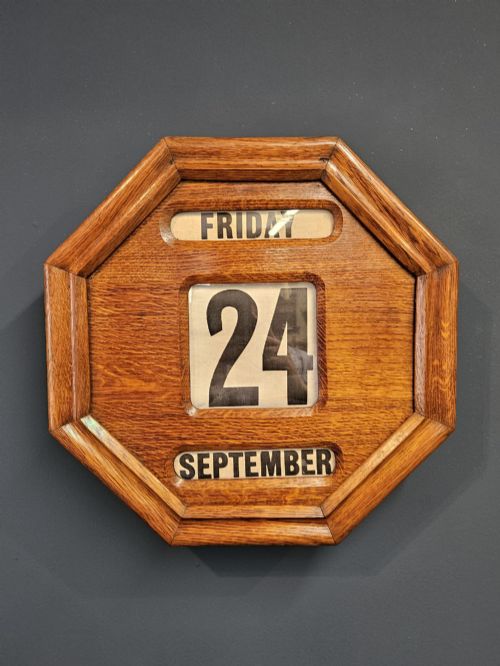
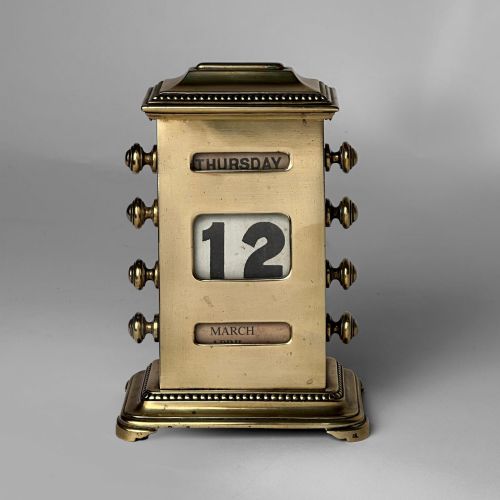
Mahogany and walnut make up the next group, roughly a fifth between them. Wall-hanging plaques are about one listing in eight, including an octagonal plaque and one made with an outsized font. Brass, chrome, nickel-plate and tin-plate examples are a smaller strand again.
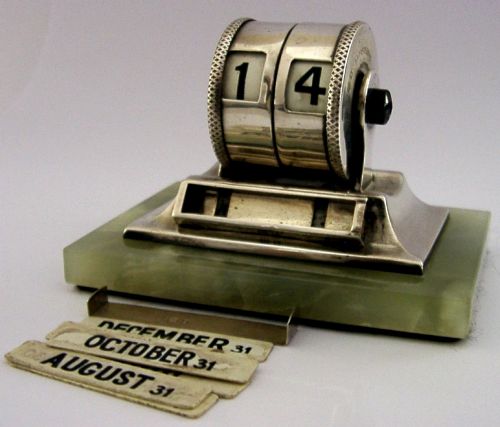
These were desk furniture for offices and counting houses, sitting alongside inkstands and letter clips. The dated field clusters hard on the turn of the century, with 97 listings in the 1900s and 68 in the 1910s. Art Deco is the one clearly later group, 11 titles, bringing chrome plate, green onyx, marble and sterling silver.
Range And Price
Height is the currency at the top. 'Large' appears in 57 titles against 'small' in 27, and the sampled heights climb steadily from 8 1/4 inches in the lower and middle band through 13 1/4, 15 1/2 and 18 inches to a tallest recorded example of 24 1/2 inches. Size does more work here than almost anything else.
Timber and finish move things upward too. Oak is the mainstream, so mahogany and walnut sit above it, and within oak the descriptions that specify figured or golden oak read differently from plain polished oak. The oversized mahogany pieces occupy the upper end of the sampled range.
Below that sits the densest band in the archive: the undifferentiated Edwardian oak perpetual desk calendar, with no size, no grain description and no named retailer. At the other extreme are one-off materials and novelty forms, tortoiseshell, boulle, a leather-and-nickel-plate drum, a horseshoe letter clip, hand-painted French porcelain, each appearing once and each in the upper half.
Antique Calendars Retail Price Guide 2026
Typical UK retail prices for calendars, calculated from the Sellingantiques database of over a million retail prices indexed since 2003. This retail price guide relies exclusively on Sellingantiques data; no external sources or auction records are used, so the figures do not describe the wider market.
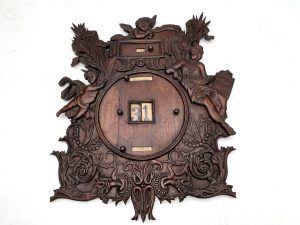
Wall-hanging calendars are a minority strand on Sellingantiques, thirty-seven titles in all, among them an octagonal plaque and one made with an outsized font.
The Antique Calendars Glossary
- Perpetual
- Reset by hand for any year rather than printed for one. It is the word that carries the great majority of titles in this category.
- Desk calendar
- A free-standing or slanted form made for a desktop, and the commonest type in the archive. 'Desk-top' and 'desktop' are used interchangeably with it.
- Wall calendar
- A plaque or frame made to hang rather than stand, about one listing in eight.
- Solid oak
- Distinguished in 11 titles from veneered or laminated construction. Separate from 'polished oak', which describes the finish and pairs those two words in 38 titles.
- Figured oak
- Oak chosen for pronounced grain or medullary figure. 'Golden oak' is the warm-toned finish noted on several Edwardian examples.
- Boulle
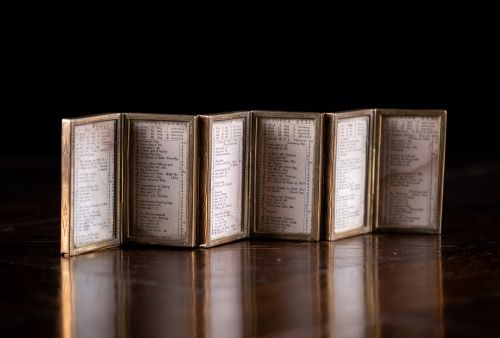
- Brass-and-shell inlay, present on one example in the samples. An almanac, the printed annual companion form, appears once as a folding brass travelling mount.
Antique Calendars: Frequently Asked Questions
How does a perpetual calendar work?
Rotating or sliding indicators for date, day and month are turned by hand, so the display can be set to any year. Nothing needs replacing annually.
The listings describe the form rather than the mechanism, so how the indicators are driven is not something the archive records.
What wood are they usually made from?
Oak dominates. It appears in 162 of 303 titles, often as polished oak, sometimes specified as solid, golden or figured oak.
Mahogany follows with 46 titles and walnut with 21. One yew wood example turns up. Outside timber altogether, there are brass, chrome-plated, nickel-plate and tin-plate pieces, and Art Deco examples with onyx or marble bases.
When were most of these made?
The dated field runs 1800 to 1950, and 208 listings carry a clean year. Two thirds of those fall in the 1900s and 1910s.
Edwardian is the usual period label with 92 titles, Victorian 48. The samples show the labels used loosely, with Edwardian titles dated 1920 and Victorian titles dated 1900.
The 1920s and 1930s are thin by comparison, and two entries sit far outside the cluster, including a single '16th Century' listing whose title says only 'antique polished oak'.
Are wall-mounted calendars common?
They are a real minority strand. The word 'wall' appears in 37 titles, and 'perpetual wall' in 29.
Among them are an octagonal plaque, a bank wall calendar and one made with an outsized font for reading at a distance.
Do any carry advertising or company names?
A handful across 303 listings. A brewery desk calendar, a railway-marked walnut example, a tin-plate biscuit advertising calendar and a plain 'Advertising Desk Calendar'.
One oak example is titled as signed by its retailer, and a couple of others name a London or Birmingham firm in the title. Names of makers, as opposed to retailers, are not recorded in this archive.
How many come up for sale?
About 34 antique calendars are listed on Sellingantiques in a year.
Forty different dealers have offered one, which suggests it is a category many dealers carry a single example of rather than a specialism.