


Antique Corkscrews
A steel helix on a handle, made to pull a cork from a bottle, and in England that has meant everything from a plain turned-wood pull to a geared mechanism worked with two hands.
What They Are
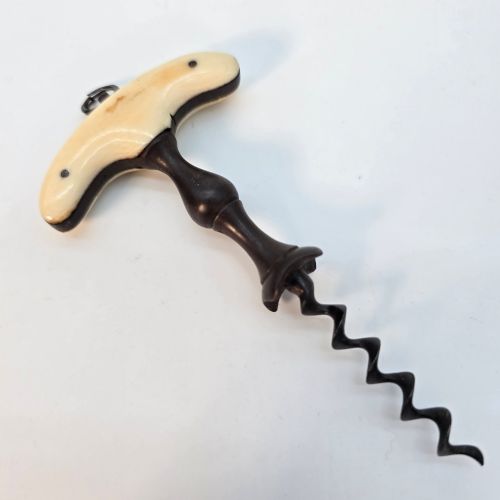
Corkscrews came out of England in the late 17th and early 18th century, once cork-stoppered bottles became the normal way to keep wine and beer. The first form was simple: a steel worm, a shank, a transverse handle. Through the 19th century patents piled up and geared forms multiplied, all doing the same job with less effort.
What you'll meet on Sellingantiques reflects that. Roughly three-quarters of the archive sits between about 1800 and 1900, and the typical listing is an English 19th-century corkscrew with a turned handle in wood, bone, antler, horn or brass. Rosewood and lignum vitae turn up in the titles, alongside plain and plated steel.
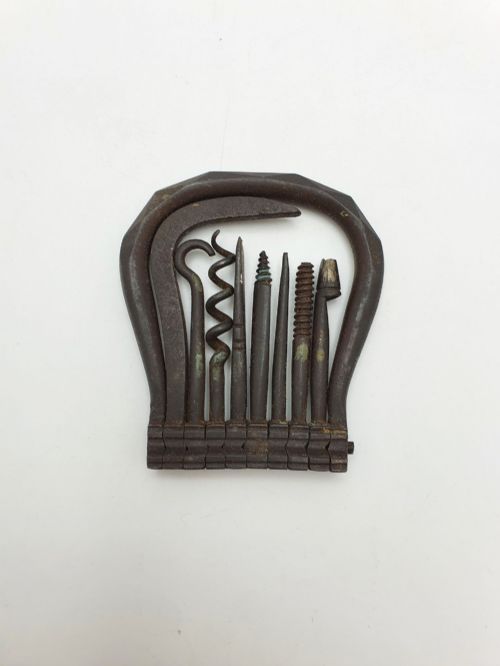
The sample splits about evenly between two groups. Direct pulls and pocket types make up roughly a third: handle, shank and worm, nothing else moving. Mechanical types make up another third, the named patterns being rack and pinion, double action and double lever. Beyond those sit walking-stick canes with a screw hidden in them, four in the archive, and a scatter of oddities: a Georgian scent-bottle corkscrew, an 1880s folding iron multi-tool, a leather football one from 1930.
Two listings under this heading aren't corkscrews at all. They're Victorian cast brass and copper door porters modelled in the shape of one, made to hold a door rather than open a bottle. Dating is often loose: half the listings carry only a broad label such as "19th Century", "Victorian" or "Georgian", and where a circa date is given it clusters on 1870 to 1900.
What Sets Them Apart
Mechanism is the main divide. Geared and patent types sit in the upper half of the sampled range, while plain rosewood, lignum and steel direct pulls sit at the bottom. A named pattern in the title carries weight too: listings that identify a double-action, double-lever or patent design consistently rank above entries that say only "corkscrew" or "cork screw".
Concealment lifts a piece further than mechanism does. Every walking-stick cane hiding a screw falls in the upper third, as does the Georgian scent-bottle combination. The appeal there is the trick, and the corkscrew is almost incidental to it. Novelty without concealment doesn't do the same work, and the leather football corkscrew of 1930 sits alone at the very bottom.
Handle material and workmanship sort the plainer end. Carved treen and horn pommels rank near the top; plain steel and French plated steel near the bottom. Recorded dimensions are a small extra: only two titles give measurements at all, a giant double lever at 16.2cm and 257g and a 97cm cane, and both sit above the middle.
Retail Price Guide 2026
Typical UK retail prices for corkscrews, calculated from the Sellingantiques database of over a million retail prices indexed since 2003. This retail price guide relies exclusively on Sellingantiques data; no external sources or auction records are used, so the figures do not describe the wider market.
About four antique corkscrews are listed on Sellingantiques each year, and 21 different dealers have handled one, so almost every listing comes from a different seller.
The Antique Corkscrews Glossary
- Worm
- The spiral steel screw itself, the part that enters the cork. Sometimes called the helix.
- Direct pull
- The plain type with no mechanism at all: handle, shank and worm, and you supply the effort.
- Double action
- A geared corkscrew that first drives the worm into the cork, then draws it out without you repositioning your hands.
- Rack and pinion
- A toothed bar and gear giving mechanical advantage on the pull; two titles in the archive use the term.
- Gadget cane
- A walking stick concealing a tool. Four in this archive hide a corkscrew, one of them under a carved rabbit handle.
- Helixophile
- A collector of corkscrews. One title addresses its buyer by the word.
Frequently Asked Questions
How often do antique corkscrews come up for sale?
Rarely. This is a thinly traded corner, with about four corkscrews listed a year on Sellingantiques.
The sellers are spread wide, though. Twenty-one different dealers have handled one at some point, so almost every listing comes from a different seller rather than a handful of specialists.
What period do most antique corkscrews date from?
The 19th century dominates. Roughly three-quarters of the archive sits between about 1800 and 1900, with the circa dates that are given clustering on 1870 to 1900.
Only 14 of 34 listings carry a clean year, and those run from 1800 to 1930. The rest use broad labels: "19th Century", "Victorian", "Georgian", or simply "1800s".
Why are walking sticks listed under corkscrews?
Because they hide one. Four canes in the archive conceal a corkscrew in the shaft or pommel, including a 97cm stick with a carved rabbit handle and a domed horn pommel example from around 1880.
All four sit in the upper part of the range. The concealment is what collectors are buying.
Are all the items in this category actual corkscrews?
Not quite. Two listings are Victorian cast brass and copper door porters modelled in the shape of a corkscrew, made to hold a door open.
One further entry is a whole corkscrew collection sold as a single lot rather than one tool.
What handle materials turn up on these?
Natural materials lead: rosewood, lignum vitae, bone, antler and horn all appear in the titles, along with turned treen.
Metal handles show up as well, in brass, steel and plated steel. A carved treen or horn-pommel handle ranks well above plain steel in the sampled range.
What does a mechanical corkscrew mean here?
It means the tool does some of the work for you through gearing or leverage, rather than relying on a straight pull.
Three named groups recur: rack and pinion, double action, and double lever. Together with the patent examples they account for roughly a third of what has passed through, and a champagne pattern for wired corks appears once.