


Antique Royal Crown Derby
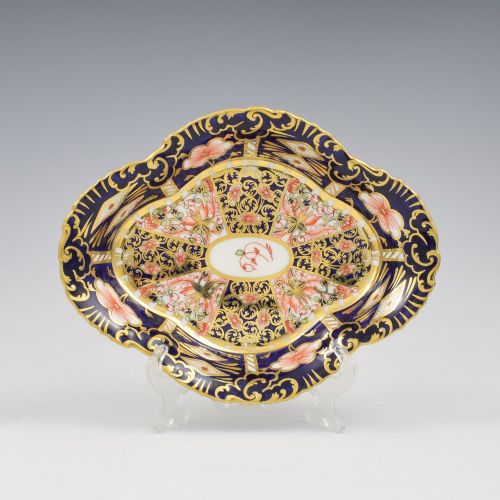
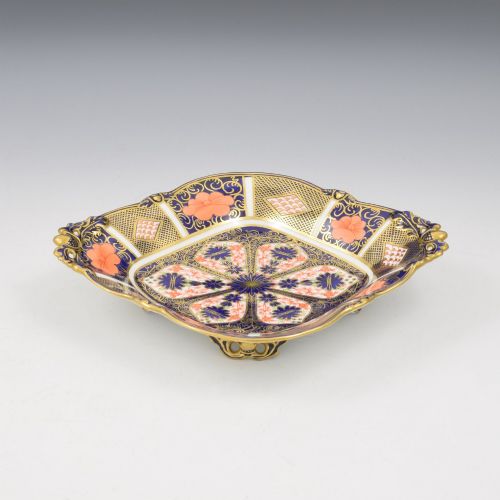
Porcelain from the Derby factories, mostly small hand-decorated table and cabinet pieces of the early twentieth century, made for the dinner table, the tea tray or the display cabinet.
Antique Royal Crown Derby
Porcelain has been made in Derby since the mid-eighteenth century, and the Royal Crown Derby name follows the royal warrant of 1890. The factory's reputation rests on two things: dense gilded Japan or Imari patterns, and hand-painted cabinet wares made for display rather than use. Both poles turn up on Sellingantiques.
The bulk of what comes through is small: dishes, plates, tea and dessert services, vases and ewers. Of 55 listings, 16 are dated to the 1910s and 10 to the 1920s, so the early twentieth century is where you are most likely to land. Dealers can quote a precise year because the factory's date cypher reads straight off the base, and 37 listings carry a clean year on that basis.
Imari decoration is named by pattern number in the titles, 1128 twice, plus 5589, 6299 and 8806. Alongside it sits a distinct novelty strand of miniatures: a watering can, a fish kettle, a saucepan, a flat iron on its stand, a solitaire set, an ink pot. A milk churn, a cow bell and a heart-shaped jewellery box belong to the same run.
A handful of earlier and adjacent Derby pieces sit at the edges of the category. A Bloor-period figure group of Jupiter and Juno given as c.1830, a Stevenson and Hancock seated fox of about 1865, a porter mug of c.1810 painted with a scene near Newark, and a Dr Syntax figure.

The Range
A painter's signature is what lifts a piece to the top. Eight listings carry one, five of them Desire Leroy, on cabinet plates, a bouillon cup, a goblet, a dish and a centrepiece, and every signed piece sits in the upper reaches. Below that, titles still separate hand painting and raised gold decoration from plain pattern-number Imari tableware.
Completeness counts for a great deal in services. The largest thing to pass through was a dinner service laid for 24, dated 1860-70; a tea service for twelve, a six-piece dressing table set and a four-piece cabaret set all sit well above single pieces of the same decoration.
At the other end are the small utility items sold on their own: a butter knife, a pepper pot, a miniature vase, a miniature ink pot. Provenance can pull a small piece upward, though. Five separate items are described as from the Judge Gary service, a butter pat and a bon bon dish among them, and a pair of goblets from it sits near the top.
Antique Royal Crown Derby Retail Price Guide 2026
Typical UK retail prices for royal crown derby, calculated from the Sellingantiques database of over a million retail prices indexed since 2003. This retail price guide relies exclusively on Sellingantiques data; no external sources or auction records are used, so the figures do not describe the wider market.
Odd forms that turn up nowhere else in the archive: a cow bell dated 1898, a milk churn and cover of 1921, and a miniature flat iron on its stand.
The Antique Royal Crown Derby Glossary
- Imari
- The factory's dense iron-red, cobalt-blue and gilt Japan-style patterns, and the single most quoted decoration in these titles.
- Pattern number
- The factory's own number for a decoration, used as identification, quoted here as 1128, 5589, 6299 or 8806.
- Date cypher
- The factory mark that lets a dealer state an exact year, which is why so many titles read dated 1914 or d. 1922.
- Cabinet plate
- A plate made for display rather than the table. Four appear in the archive, all of them signed.
- Solitaire set
- A tea service for one person, tray included. A cabaret set is the same idea for a few more, here a four-piece.
- Judge Gary service
- A named commissioned service whose pieces surface separately, from a butter pat and a bon bon dish to a pudding bowl and goblets.
Antique Royal Crown Derby: Frequently Asked Questions
How can dealers give an exact year?
The factory used a year cypher in its backstamp, and it reads straight off the base. That is unusual precision for ceramics.
It shows in the listings: 37 of 55 carry a clean year, with titles quoting 1885, 1891, 1898, 1905, 1912, 1914, 1916, 1920, 1921, 1922, 1923 and 1933.
What does a pattern number like 1128 mean?
It is the factory's own reference for a decoration rather than a shape or a date. Titles use it as shorthand for which Imari a piece carries.
Four titles quote one: 1128 twice, plus 5589, 6299 and 8806.
Are the miniatures actual tea sets?
They are novelty pieces made in reduced scale. The archive holds a watering can, a fish kettle, a saucepan, a flat iron on its stand, a solitaire set, a tea set, a vase and an ink pot.
Related one-off forms sit in the same vein: a cow bell dated 1898, a milk churn and cover of 1921, a heart-shaped jewellery box of 1905.
Eight titles use the word miniature, so it is a strand of its own rather than an occasional oddity.
Which period turns up most often?
The early twentieth century. Out of 55 listings, 16 are dated to the 1910s, 10 to the 1920s and 7 to the 1900s.
The dated field runs 1860 to 1940, with vaguer labels used for the older end: Victorian, 19th century, Edwardian, Georgian.
Does anything predate the Royal Crown Derby period?
A few pieces do. A porter mug given as c.1810, painted with a scene near Newark in Nottinghamshire, and a Bloor-period figure group of Jupiter and Juno given as c.1830 both sit earlier than the dated field's floor.
A Stevenson and Hancock seated fox of about 1865 and a Dr Syntax figure round out that small group.
How often do these come up for sale?
Around seven a year reach the market on Sellingantiques, spread across 25 dealers.
That means most dealers who have carried the name have listed one piece and no more, so the supply arrives in ones rather than collections.