



Antique Dresden
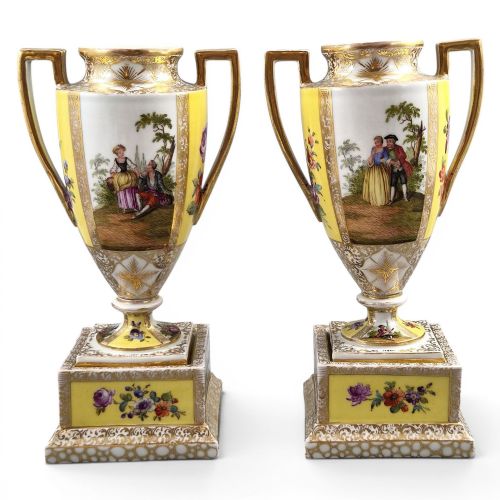
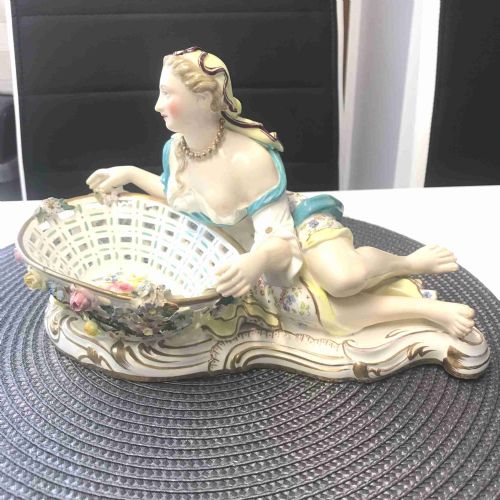
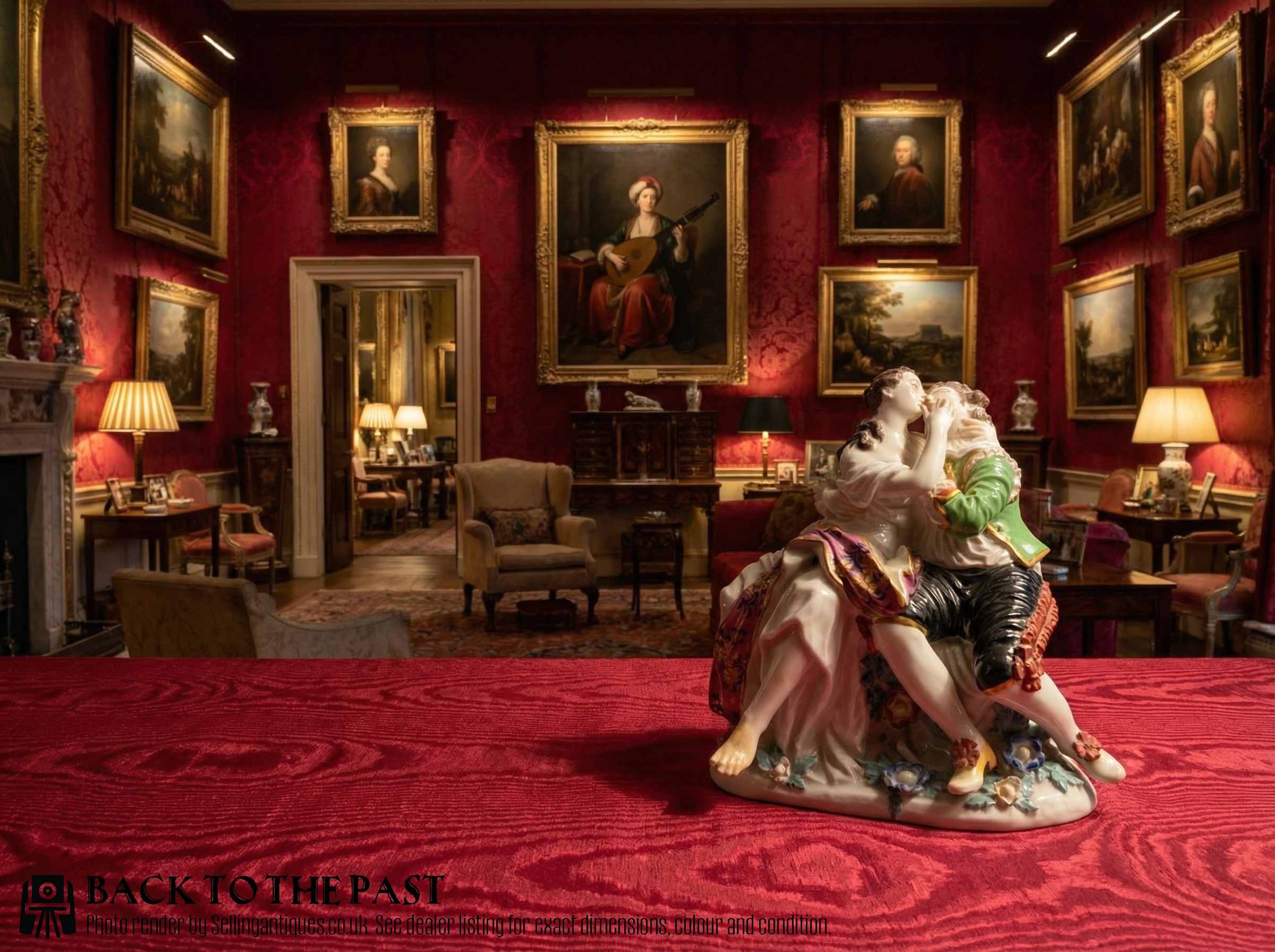
Hand-painted German porcelain in the Meissen taste, made in and around Saxony, mostly ornamental: figures, figure groups, candelabra, centrepieces and lidded urns.
Antique Dresden
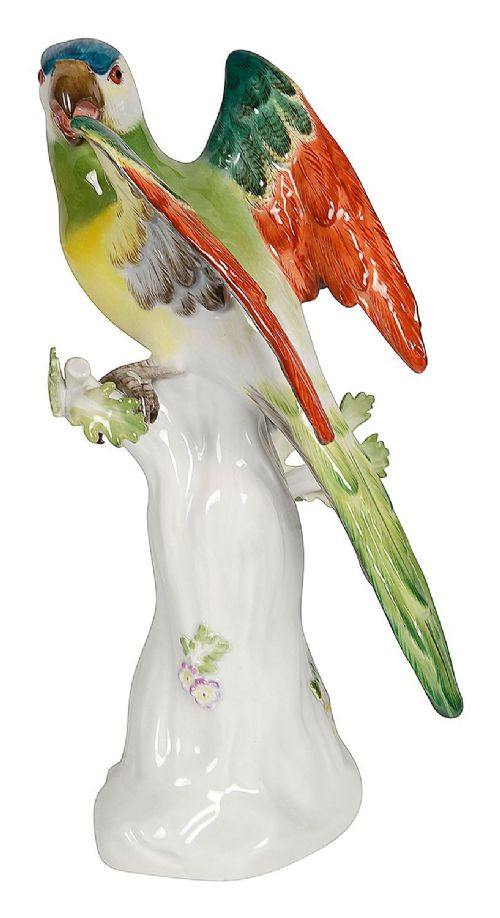
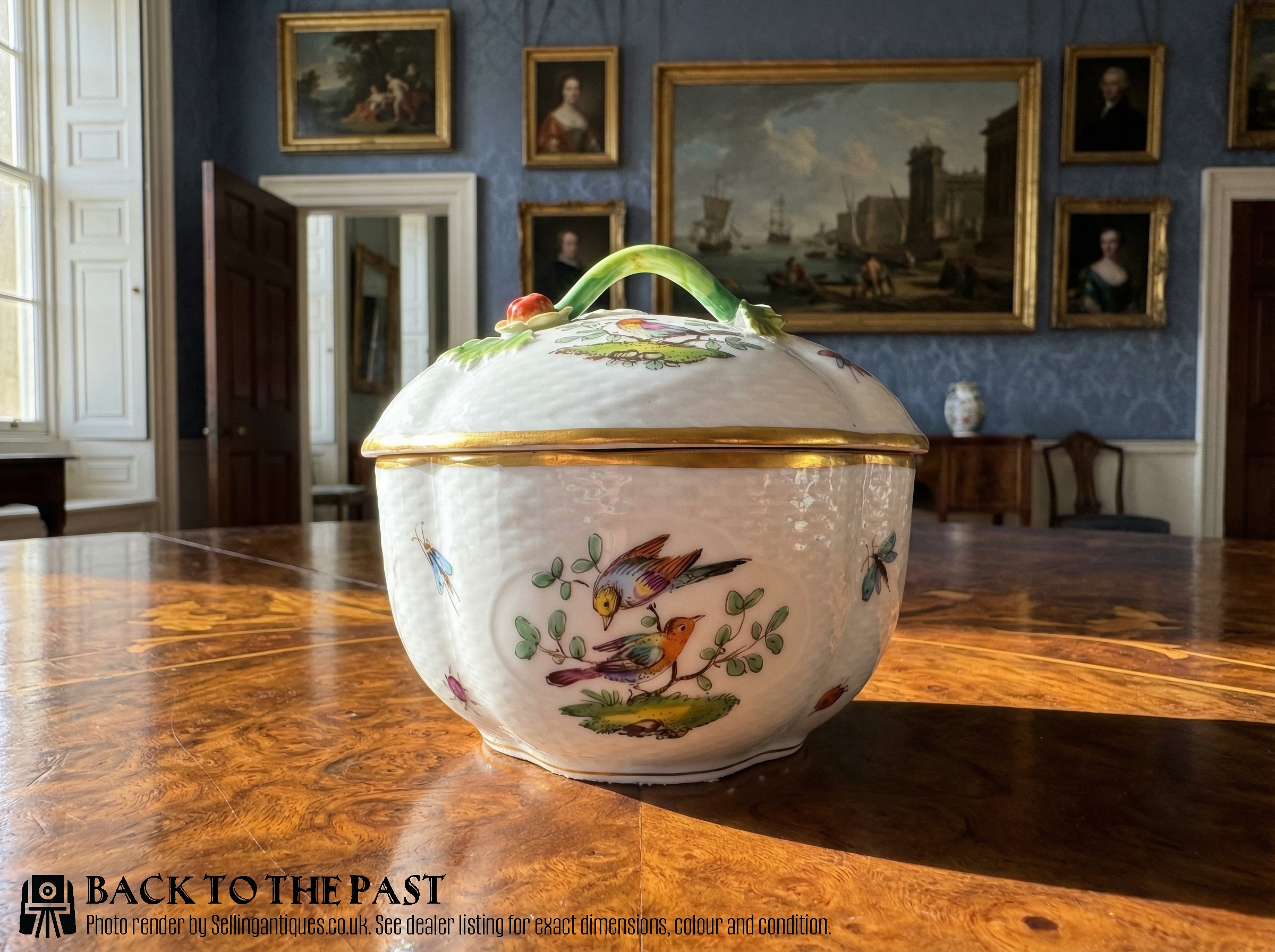
Hard-paste porcelain was first made in Europe at Meissen, just outside Dresden, and the city's name attached itself to the ornamental figures, flower-encrusted wares and painted decoration that came out of Saxony. From the mid-19th century independent studios in Dresden itself bought white blanks and painted them in the older Meissen taste, so the word describes a style as much as a place.
"Porcelain" appears in sixty-nine of a hundred and two titles on Sellingantiques, and figures, groups and figurines account for around a quarter between them. Meet one of these and you're most likely meeting a 19th-century German figure or, very often, a pair of them. "Pair" turns up in nineteen titles, covering figures, candlesticks, urns, plaques, dishes and salts.
The heading holds several groups. Around a fifth are the work of the Dresden decorating studios: Helena Wolfsohn, Carl Thieme, Karl Richard Klemm, Donath & Co, Franziska Hirsch. Another fifth carry Meissen or a Meissen-style description. Roughly a sixth are Thuringian and Saxon factories sold under the same umbrella, Sitzendorf, Volkstedt and Schierholz among them. About a quarter is hollowware: bowls, urns, cache pots, ice pails, a scent bottle, a stationery rack.
Dates run from 1750 to 1940, but only forty-five listings carry a clean year and "19th Century" is the largest single bucket at thirty-four, so read a bare 19th century as a dealer's bracket. Where dealers are specific, the weight falls in the 1880s through the 1910s. A smaller run of 18th-century English porcelain appears with Dresden as decoration rather than origin: Caughley tea bowls painted with Dresden flowers, a Derby coffee can with a Dresden handle, a Spode Dresden dish.
Where The Range Splits
Attribution does most of the work. A title naming Helena Wolfsohn, Carl Thieme, Klemm, Donath & Co or Schierholz sits above one reading only "antique pair porcelain figurines" or "continental group", and a Meissen attribution pushes hardest of all. The top dozen entries in the sampled range are almost all Meissen groups, figures and sets, including the earliest dated piece, a pair of lovers given as 1750.
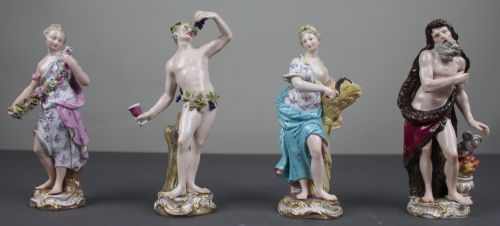
Form and number follow. Figures and figure groups dominate the upper part of the range while scent bottles, coffee cans and tea bowls sit at the bottom, and the monkey band musicians, sold as individual simian players of bagpipes, bassoon, clarinet and drum, sit lower still. Pairs beat singles, and complete sets hold the very top: two sets of the Four Seasons, four ormolu-mounted wall plaques, one lot of six pieces.
Scale and elaboration separate the rest. "Large" appears in ten titles, and the biggest measurement recorded is a 51cm Dresden-style figure. Applied flowers, lace-trimmed modelling, armorial painting, ormolu mounts and named painted patterns such as green fishnet recur among the higher-priced entries; plain painted hollowware does not.
Antique Dresden Retail Price Guide 2026
Typical UK retail prices for dresden, calculated from the Sellingantiques database of over a million retail prices indexed since 2003. This retail price guide relies exclusively on Sellingantiques data; no external sources or auction records are used, so the figures do not describe the wider market.
Dresden has been listed on Sellingantiques since 2013.
The Antique Dresden Glossary
- Dresden
- A place and a style label at once, used for Saxon and Thuringian porcelain in the Meissen taste rather than for one factory.
- Figure group
- Two or more modelled figures on a shared base. "Group" appears in eleven titles.
- Cache pot
- An ornamental outer pot for a plant, sometimes spelled cachepot. Turns up singly and in pairs.
- Dresden flowers
- A painted scattered-flower decoration, used in these listings on 18th-century English Caughley and Derby porcelain.
- Blütenbelag
- Applied flower encrustation built up on the surface of a piece, named in one Carl Thieme listing.
- Monkey band
- A set of individually modelled monkey musicians, four of which appear across separate listings.
Antique Dresden: Frequently Asked Questions
Is Dresden the same as Meissen?
No. Meissen is a factory near Dresden; Dresden is used across a wider group of Saxon and Thuringian porcelain made in the Meissen taste.
The two overlap in practice. "Meissen" appears in nineteen titles, some as firm attributions and some as "Meissen Style", and those entries occupy the top of the range.
What forms come up most often?
Figures and figure groups. Together with figurines they account for around thirty title mentions, and pairs of figures, candlesticks and urns are a habit of the category.
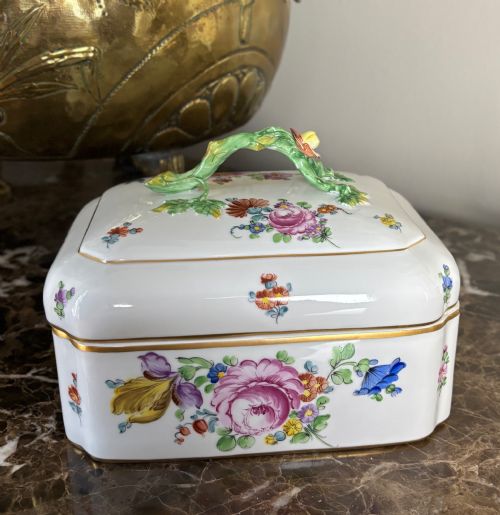
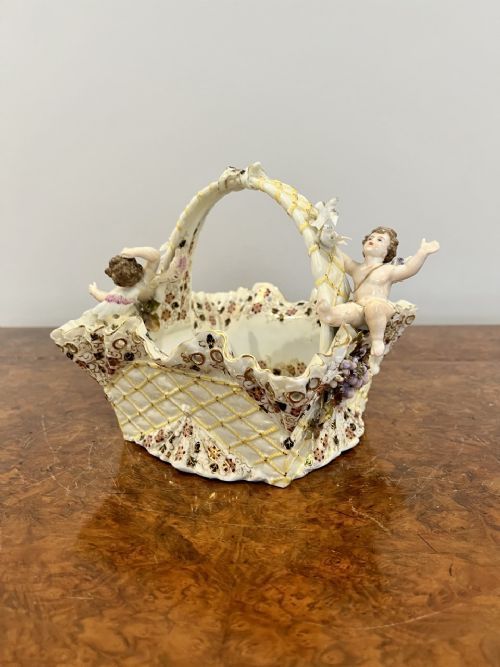
The rest is decorative and functional hollowware, roughly a quarter of listings: bowls, potpourri urns, cache pots, ice pails, a sugar box, a teapot, a dessert service.
Which studios and factories appear by name?
The Dresden decorating studios show up regularly: Helena Wolfsohn, Carl Thieme, Karl Richard Klemm, Donath & Co and Franziska Hirsch.
Thuringian and Saxon factories are sold under the same heading, among them Sitzendorf, Volkstedt, Schierholz, Ernst Bohne Söhne and Carl Schneider Volkstedt. Names appear stamped, labelled or only as attributions in the title.
How old is most antique Dresden?
Dealer-entered dates run 1750 to 1940. Where they are specific, the weight sits in the last quarter of the 19th century and the first decade of the 20th.
"19th Century" on its own is the largest bucket, thirty-four of a hundred and two listings, so it reads as a bracket rather than a date. The 18th century is thin at five listings, and the 1920s and 30s thinner again.
Why do English pieces get called Dresden?
Because the word was used for a decoration and a fitting, not an origin. A small run of 18th-century English porcelain carries it that way.
Caughley tea bowls painted with Dresden flowers, a Derby coffee can with a Dresden handle, Bloor Derby "Dresden Shepherds" and a Spode Dresden embossed dish all sit at the bottom of the range.
How often do these reach the market?
Thirty-six dealers have listed in the category and roughly fourteen pieces come up in a year. It's broadly carried, never in quantity from any one source.
Sets are the scarcest thing here. Two sets of the Four Seasons, a set of four ormolu-mounted wall plaques and one lot of six pieces of German porcelain are the whole record.