


Antique Dinner Service
A dinner service is a matched set of ceramic tableware, plates through to tureens, made to serve a meal in courses and sold as a single lot.
Antique Dinner Service
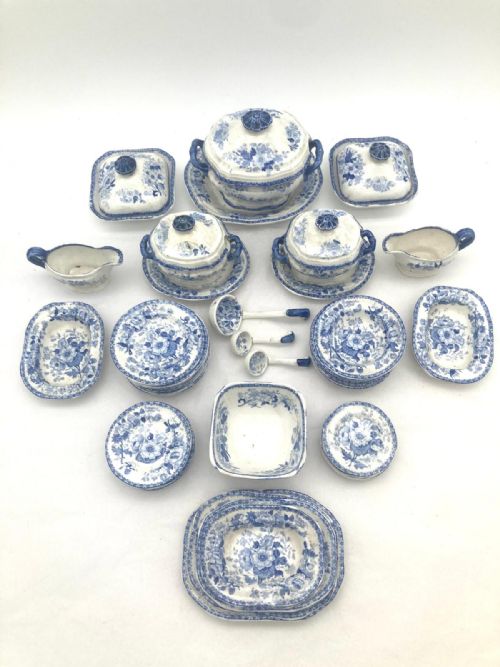
Matched sets of dishes became a standard product of the British and Continental ceramic industry from the later 18th century, as dining moved towards individual place settings and printed decoration made large uniform sets affordable. Miniature versions were made alongside them, as children's toys and as salesmen's samples.
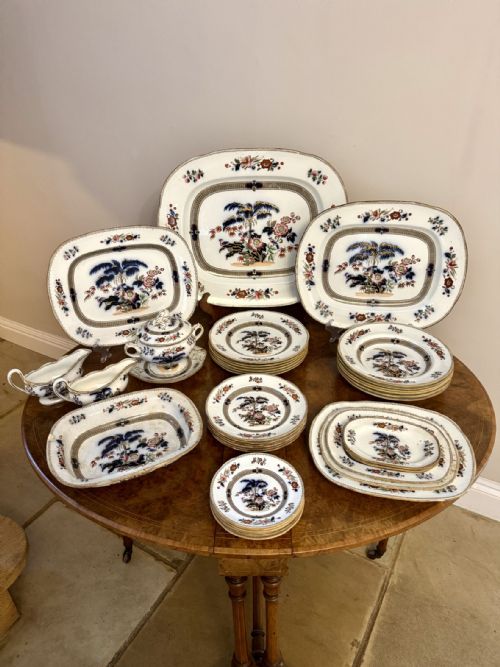
The version you're most likely to meet is a 19th-century British transfer-printed or decorated earthenware service. Victorian is the commonest period word in titles on Sellingantiques, and blue and white is the recurring look, with named printed patterns such as Humphrey's Clock and India Temple, and flow blue among them.
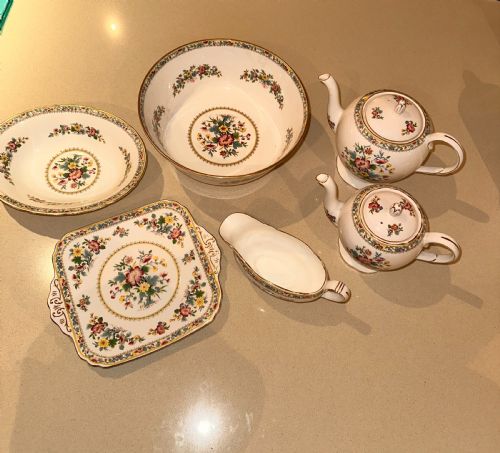
Incompleteness is normal rather than exceptional. The word "part" appears in nearly a fifth of titles, often as "part dinner service for eight". Where piece counts are quoted they run from 22 up to around 100, and one service is described as a setting for 24. A single lot is called composite, meaning matching pieces assembled rather than sold together.
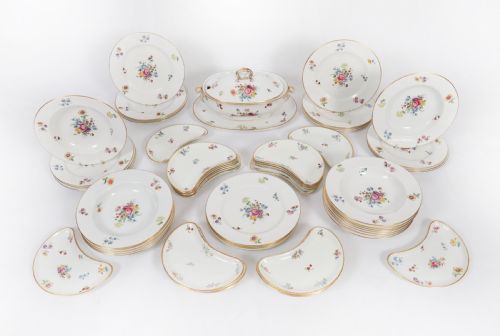
Alongside the earthenware run there are ironstone and stone-china services, including Japan Fence and Grasshopper patterns, and a smaller Continental strand: Limoges, Lunéville faience, Chantilly and a German Volkstedt set. Child's, dolls' and miniature toy services turn up throughout, one of them running to 53 pieces.
Where The Range Splits
Completeness does most of the work. Complete, high-count services sit at the top of the range, with the 60, 91 and 100-piece sets and the setting for 24 among them. The services titled "part" all fall in the lower half.
Decoration and body come next. Hand-painted and enamelled services reach above the middle, while printed earthenware sits lower, and porcelain services carry further than everyday earthenware. A recorded pattern name lifts a listing too: Water Lily, Japan Fence, Grasshopper, India Temple, Hibiscus and Humphrey's Clock all appear in higher-priced titles, where a plain "dinner service" entry sits low.
Date pulls the same way. The Regency sets, dated 1813-20, 1815-20 and around 1820, are among the highest of those sampled, while the 1920s and 1930s services cluster at the bottom. Miniature child's services don't follow the pattern, appearing at both ends.
Antique Dinner Service Retail Price Guide 2026
Typical UK retail prices for dinner service, calculated from the Sellingantiques database of over a million retail prices indexed since 2003. This retail price guide relies exclusively on Sellingantiques data; no external sources or auction records are used, so the figures do not describe the wider market.
The most expensive dinner service ever sold on Sellingantiques was a porcelain setting for 24, dated 1860-70, which sold in March 2025.
The Antique Dinner Service Glossary
- Part service
- An incomplete set, with some of the original pieces missing. It appears in nearly a fifth of titles in this category.
- Place setting
- The pieces for one diner. Services are commonly described as "for eight" or as a 12 place setting.
- Piece count
- The number of individual items in the lot, quoted in titles from 22 up to about 100.
- Transfer-printed
- Decoration applied from an engraved copper plate by way of tissue, the basis of the blue and white services.
- Flow blue
- Transfer printing blurred on purpose in the kiln, so the blue bleeds into the glaze.
- Composite service
- A set assembled from pieces of the same pattern that were not originally sold together.
Antique Dinner Service: Frequently Asked Questions
Why are so many services described as part services?
Sets got broken up over a century or more of use, and the word "part" turns up in nearly a fifth of titles on Sellingantiques. Incompleteness is the normal state of the category.
Part services are often described by covers instead of pieces, as "part dinner service for eight" or a part dinner and tea service.
How old are most dinner services on the market?
The dealer-entered dates run from 1800 to 1960, and the 19th century dominates. "19th Century" is the largest single entry, with Victorian next and Regency behind that.
Only about half the listings carry a clean year. Where decades are given they cluster in the 1880s, 1890s and again in the 1920s, with a single 1960 service at the tail.
What does a piece count actually tell you?
It tells you the size of the lot. Counts quoted in titles include 22, 40, 43, 53, 59, 60, 65, 91 and 100, so services can be compared directly against one another.
Some are described by covers instead, and a setting for 24 is the largest of those. The word "extensive" is dealer shorthand for an unusually high count.
Are child's and dolls' services collected separately?
They form their own strand. Titles include child's toy dinner services, miniature dolls' services and a child's blue and white service, one running to 53 pieces.
They were made alongside full-size sets as toys and as salesmen's samples. In price they sit at the bottom of the range as often as the top.
Which patterns are named in the titles?
Named printed and painted patterns include Humphrey's Clock, India Temple, Water Lily, Japan Fence, Grasshopper and Hibiscus.
A recorded pattern name tends to lift a listing above the plainer entries titled simply as a dinner service.
Do Continental services come up often?
They're the smaller part of the category. Limoges accounts for three entries, and there is a Lunéville faience service, a Chantilly porcelain famille rose set and a German Volkstedt one.
Everything else named is British. Around seven dinner services are listed in a year on Sellingantiques, and 27 different dealers have carried one.