



Antique Copeland
Ceramics from the Copeland works at Stoke-on-Trent, covering unglazed white parian sculpture and printed or painted tableware for the Victorian home.

Antique Copeland
Copeland is the Stoke-on-Trent pottery that carried on the Spode works from the 1830s, first as the Copeland & Garrett partnership and then under the Copeland name alone. The name reaches listings in three forms: Copeland on its own, Copeland Spode, and Copeland & Garrett, and the form used usually tracks the age of the piece.
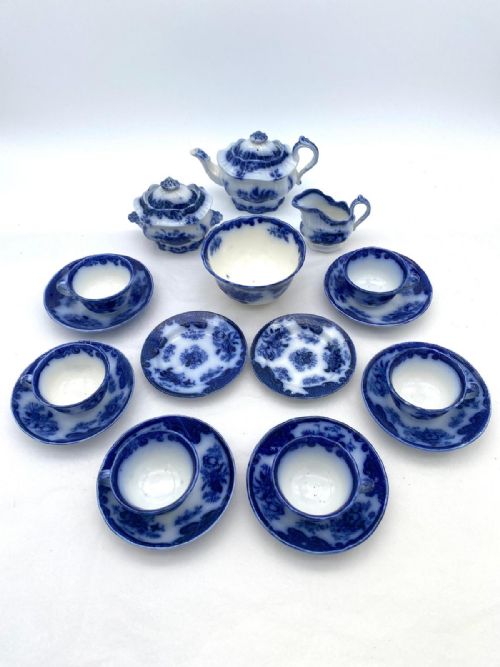
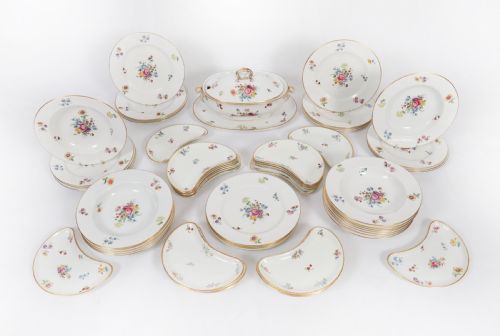
Two things dominate. One is white parian statuary, which accounts for about a quarter of the archive on Sellingantiques: busts of Byron, Clytie, Sir Robert Peel, Princess Alexandra and Queen Victoria, and titled figures such as 'Sabrina', 'Lurline', 'Rebekah' and 'Go to Sleep'. The other is tableware, blue and white or hand painted, running from single tureens and platters up to dinner services of sixty and ninety-one pieces.
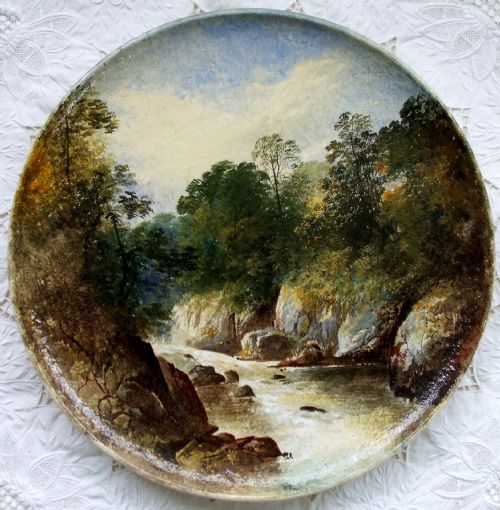
Around the edges sit the forms that make the category worth watching. Footbaths recur, in creamware, blue and white and the New Blanche pattern. Two garden seats have appeared, one barrel-form in Chinese style and one in the Tower pattern. Modelled animals turn up now and then, including a recumbent porcelain greyhound, spaniels and a hound's-head dog group, along with majolica mask-face jardinieres and four painted plaques of North Wales views signed by a decorator working at Stoke.
Dating is uneven. Only 35 of 78 listings carry a clean year, with '19th Century' and 'Victorian' doing the work for nearly half the archive. Where dates are given, the Copeland & Garrett wares sit in the 1830s and 1840s, while the multi-piece services and Spode-marked pieces cluster from about 1880 into the twentieth century.
What Sets Them Apart
With parian, the name of the modeller does most of the work. Figures credited to a named sculptor, or described as after one, sit in the upper half of the range throughout, and the highest-priced parian in the sample is a titled figure of 1862 with its modeller named. Anonymous busts and figures, of which there are many more, sit lower.
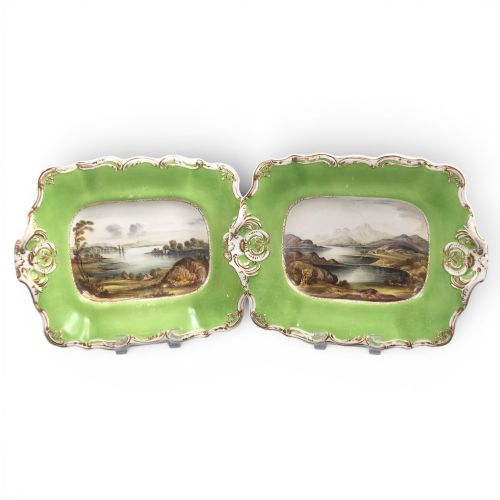
In tableware, two things lift a piece: how much of it there is, and whether it was painted rather than printed. The large dinner services top the tableware range, and a hand-painted service leads the whole sample. Single bowls, platters and nursery pieces sit at the bottom. A named pattern or series helps too, whether that is Aesops Fables, the Byron Views Series, New Blanche, Tower, Italian or Parrot Chintz, where an untitled printed dish has nothing to hold on to.
Then there is form. The garden seats, the spaniel group, the recumbent greyhound and the stirrup cup all sit well above the general run of dishes and tea wares, because nothing else in the category looks like them.
Antique Copeland Retail Price Guide 2026
Typical UK retail prices for copeland, calculated from the Sellingantiques database of over a million retail prices indexed since 2003. This retail price guide relies exclusively on Sellingantiques data; no external sources or auction records are used, so the figures do not describe the wider market.
Copeland Spode is the name that turns up from the most dealers on Sellingantiques in this category.
Copeland Spode
The Antique Copeland Glossary
- Parian
- A fine unglazed white porcelain body used for figures and busts, named in 21 of the 78 titles.
- Copeland & Garrett
- The partnership name found on the earlier wares, dated in titles between about 1830 and 1847.
- Copeland Spode
- The form of the name used on the later wares, and the one that appears most often in titles.
- Footbath
- A large deep basin, five of them in the archive, in creamware, blue and white and New Blanche.
- True trio
- A teacup, coffee cup and a single saucer sold as one set. Three Copeland trios have appeared.
- Statuary parian
- Wording used for the larger sculptural pieces, as on the 1862 figure 'Go to Sleep'.
Antique Copeland: Frequently Asked Questions
What is the difference between Copeland and Copeland Spode?
They are the same works at Stoke-on-Trent, listed under different forms of the name. Copeland & Garrett belongs to the earlier wares, dated in titles to the 1830s and 1840s.
Copeland Spode is the form on the later wares, and it attaches to the multi-piece services and tablewares dated from about 1880 onwards.
Why is so much Copeland white and unglazed?
That is parian, a fine white porcelain body used for sculpture from the middle of the nineteenth century. It makes up about a quarter of the Copeland listed on Sellingantiques.
The subjects are drawn from classical myth, literature and public life. Clytie has appeared twice, alongside Byron, Sir Robert Peel, Princess Alexandra and Queen Victoria.
Are Copeland parian figures signed by a sculptor?
Only a handful are. Named modellers attach to a figure of 1862, one of 1871, one of about 1870 and two busts.
Every one of those sits in the upper half of the range. The rest of the parian carries no modeller's name at all.
How often does Copeland come up for sale?
At roughly ten listings a year on Sellingantiques, spread across 44 different dealers. That is nearly one dealer per piece.
No single stockholder defines what turns up, so the mix shifts from year to year.
Which Copeland patterns appear by name?
Aesops Fables, the Byron Views Series, Scottish views and New Blanche run through the Copeland & Garrett wares. Tower, Italian, Parrot Chintz, Peacock and Peony and Grasshopper come up on the later pieces.
A named pattern tends to sit above an untitled printed bowl or platter in the range.
Do painted plaques turn up under Copeland?
Four have. They show North Wales views, including 'On the Llugwy' numbered 403 and 'Fairy Glen, Betws-y-Coed' numbered 520.
All four are signed by a decorator working at Stoke, and they are the only signed painted wares in the archive.