Antique Tea Sets
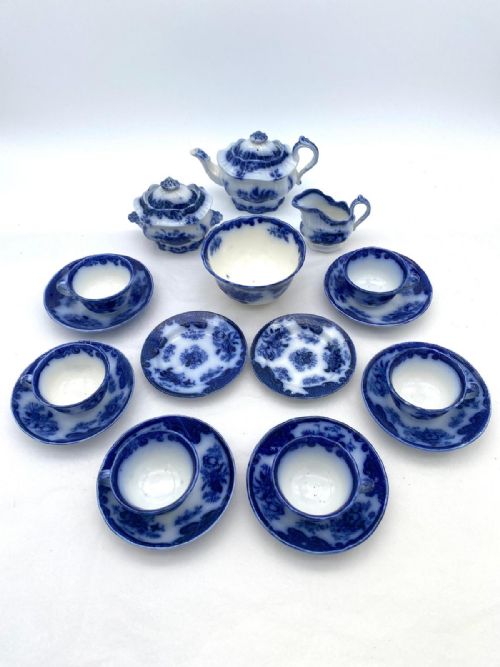
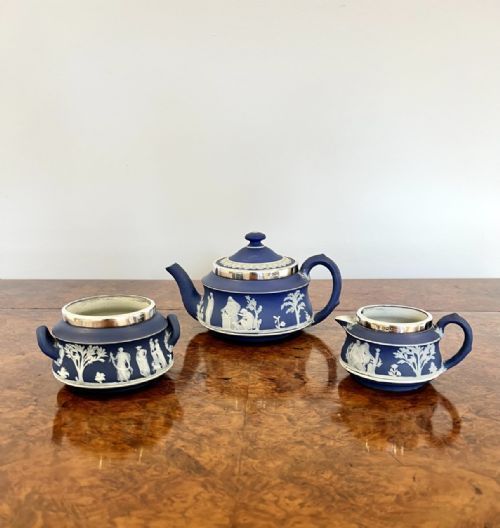
A matched group of tea wares - teapot, sugar, milk jug, cups and saucers - sold together as one service for the table.

What You're Looking At
Matched sets of teapot, sugar, cream jug, cups and saucers followed the spread of tea drinking in Europe from the later seventeenth century. By the second half of the eighteenth century, English and Continental factories were selling tea wares as coordinated services, and by the Victorian period the standard was a setting for six or twelve.
The commonest thing on Sellingantiques is an English porcelain or bone china set named by factory and pattern. Porcelain leads the titles, with bone china, creamware, pearlware, stoneware, ironstone, jasperware, earthenware, faience and majolica behind it. Piece counts get stated often enough to be a norm: twenty, thirty-two, thirty-eight, forty-two, and one hundred-piece hand-painted dinner service.
Beyond the full service, three other groupings turn up throughout. Single-setting pieces - the trio, the tea bowl and saucer, the cabinet cup, the coffee can - are around one in six. Miniature and child's sets are a persistent thread rather than a novelty, appearing at the cheapest end and, in signed Royal Worcester form, near the top. Royal Worcester painted-fruit sets, many artist-signed, are about one in ten.
Continental and Asian sets make up around one in five: Limoges, Old Paris, Bohemian, German, Hungarian and French faience, plus Japanese Satsuma, which is the most frequent non-European origin, and Chinese export porcelain. Dating runs from 1750 to 1960, though a quarter of the archive carries only "19th Century", and with Victorian, Regency and Edwardian added, broad-era labels outnumber any single decade.

Where The Range Splits
Decoration does most of the work. Hand painting pushes a set upward, and titles saying "hand painted" or "hand-decorated" recur through the stronger end, while transfer-printed and willow-pattern wares sit lower. Above hand painting sits the painter's signature: Royal Worcester sets described as artist signed, or naming the painter, occupy the highest positions in the sampled range.
Completeness is the second lever. A service for six or twelve with its teapot, sucrier and jug intact reads differently from a "part tea set" or a handful of representative pieces, and dealers state the count in the title when they have one worth stating. Body matters too, with porcelain ahead of creamware, pearlware and earthenware, and silver mounts adding at the top.
Attribution finishes it. A named factory with a recorded pattern number - and numbers rather than pattern names show up often in these titles - carries more than a descriptive name alone. At the very top of the archive sits a tête-à-tête coffee service attributed to the reign of Catherine II in St Petersburg, the only Russian entry recorded.
Retail Price Guide 2026
Typical UK retail prices for tea sets, calculated from the Sellingantiques database of over a million retail prices indexed since 2003. This retail price guide relies exclusively on Sellingantiques data; no external sources or auction records are used, so the figures do not describe the wider market.
19th Century is the period label used most on Sellingantiques for tea sets, with the 1900s next and the 1930s third.

The Antique Tea Sets Glossary
- Trio
- One cup, one saucer and one side plate, making a single place setting. A "true trio" adds a second cup for coffee.
- Part tea set
- An incomplete service. The phrase appears in titles where the original setting count is no longer whole.
- Tea bowl
- A handleless cup, the norm before roughly 1820, sold with its saucer. The handled cup took over during the early nineteenth century.
- Coffee can
- A straight-sided small cup for coffee, often supplied alongside teacups within one service. A demi tasse is the smaller cup for strong coffee, with its saucer.
- Solitaire and tête-à-tête
- A service for one person, or for two. Both terms occur in these titles, sometimes at doll scale.
- Painted fruit
- Hand-painted still-life fruit decoration, frequently signed by the painter, and often paired with a rope edge, the moulded twisted-rope rim used on some of these sets.
Frequently Asked Questions
What counts as a trio?
A cup, its saucer and a matching side plate, sold together as one place setting. Nine titles in the archive use the word.
A "true trio" goes further and adds a second cup for coffee, so one saucer serves both. Cabinet trios are the display version, usually finely painted or gilded.
How big are these sets?
They run from a single cup and saucer, or a tea bowl with its saucer, up to services of twenty, thirty-two, thirty-eight and forty-two pieces. Counts get stated in the title often enough to be normal rather than notable.
The largest thing counted in the archive is a hundred-piece hand-painted dinner service. Among tea wares proper, forty-two is the biggest stated count.
Why are so many dated just 19th Century?
A quarter of the listings carry that broad label, and Victorian, Regency and Edwardian stack on top of it. Together the soft labels outnumber any single decade.
Where firm years do appear, they cluster in the early twentieth century, with the 1900s, 1920s and 1930s all well represented. The 1960s tail is almost entirely later Royal Worcester painted-fruit work.
Are child's and miniature tea sets common?
Ten titles use "miniature", and doll's-house scale, nursery and child's toy sets appear alongside them. It's a steady thread through the category.
They sit at both ends of the range: the cheapest material in the archive and, in signed Royal Worcester form, near the top.
Which non-European sets turn up?
Japanese Satsuma is the most frequent, appearing six times, including a "Thousand Faces" and a "Thousand Flowers" set. Chinese export porcelain of the Qianlong period appears three times.
Continental entries include Limoges, Old Paris, Bohemian, German, Hungarian and French faience. One-offs surface too, among them a French cloisonné faience set in Japanese taste and a Qajar Bohemian set.
Do pattern numbers mean anything?
They show up in titles more than you might expect, with 2/739, 11617, 6948, 8190 and D5685 all recorded. A number ties a set to a factory's own records rather than a descriptive name someone applied later.
Sets carrying a named factory and a recorded pattern number sit higher in the range than those described by decoration alone.