


Antique Cloisonne
Coloured enamel held in cells of fine metal wire, fired and polished onto a metal or porcelain body, made in China and Japan for display and the export trade.
Antique Cloisonne
Thin wires are soldered to a body to form small cells, the cells are filled with coloured glass paste, and the piece is fired, then ground and polished flat. The technique has a long history in China and was taken up on a large scale in Japan from the mid-19th century, when export demand drove output in both countries.
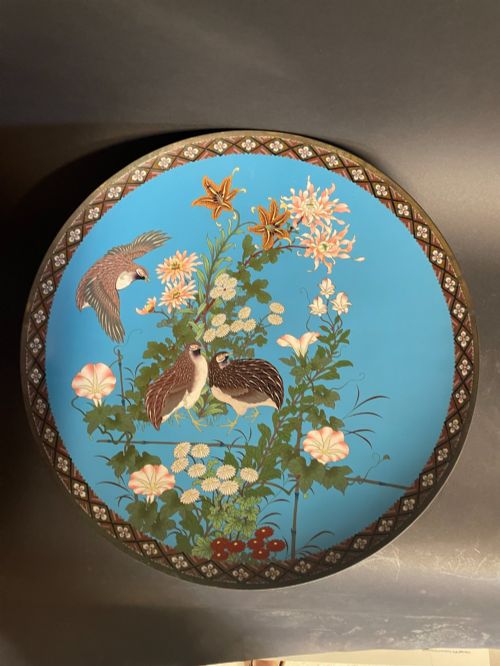
Flatware leads. Of the thirteen pieces recorded on Sellingantiques, five are dishes or chargers and one a dragon bowl, so a circular dish or charger of roughly 1880 to 1910 is what you are most likely to meet. Country of origin splits almost evenly: six titles say Japanese, six Chinese.
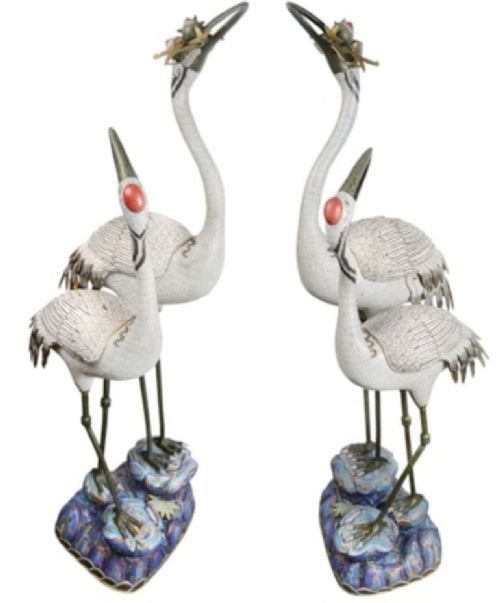
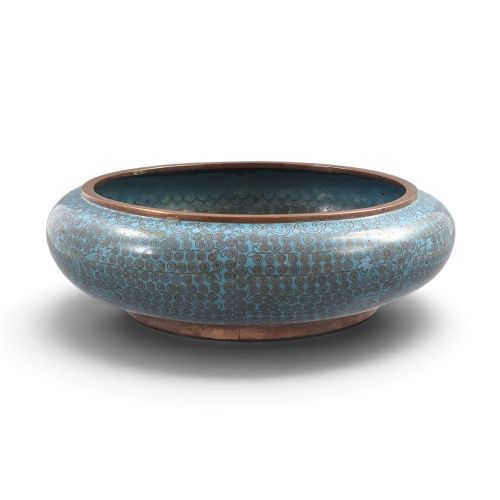
The Chinese side runs from a provincial jardiniere and a Beijing scholar's brush washer to a dragon bowl, a small mouse and a pair of Imperial-style cranes. The Japanese side covers a Meiji teapot, a large dish and a globular koro, plus three totai shippo pieces where the enamel sits over a porcelain body with a mottled tree-bark ground.
Dates cluster in the late 19th century. Seven listings carry a clean year, running 1880 to 1930, with the 1890s the busiest decade at three. A few entries are approximations rather than dates, and one piece steps outside East Asia altogether: a Victorian English comport made in the Japanese cloisonné taste.
Where The Range Sits
Size does most of the work. The words large and huge, and a charger stated at 51 cm, attach to the highest-priced flatware in the record, while the smallest thing here, a Chinese mouse that would sit in the palm, sits near the bottom. On a dish made for display, scale is the point.
Body and marking then separate the field. All three totai shippo pieces, enamel over porcelain rather than metal, fall in the upper half of the range, and the two titles stating that a piece is signed, along with the one crediting a named Japanese enameller, sit high as well.
Figures are the outliers. Only two freestanding subjects appear against eleven vessels and dishes, and the pair of near-life-size Imperial-style cranes tops the whole record by a wide margin. Sculpture in enamel is uncommon, and a matched pair more so.
Antique Cloisonne Retail Price Guide 2026
Typical UK retail prices for cloisonne, calculated from the Sellingantiques database of over a million retail prices indexed since 2003. This retail price guide relies exclusively on Sellingantiques data; no external sources or auction records are used, so the figures do not describe the wider market.
Just one cloisonné listing on Sellingantiques comes from outside East Asia: a Victorian English comport made in the Japanese taste.
The Antique Cloisonne Glossary
- Cloisonné
- Enamel decoration divided by soldered metal wires into cells, or cloisons, then fired and polished.
- Charger
- A large flat dish made for display rather than use, and the form that dominates this category.
- Totai shippo
- Japanese enamel worked over a porcelain body instead of metal; three titles here use the term.
- Tree bark
- The mottled, textured ground found on the totai chargers in this archive.
- Koro
- A Japanese incense burner, the one recorded here globular in shape.
- Brush washer
- A shallow scholar's-desk vessel for rinsing calligraphy brushes.
Antique Cloisonne: Frequently Asked Questions
Is cloisonné Chinese or Japanese?
Both, in near-equal measure. Of the thirteen pieces recorded on Sellingantiques, six titles say Japanese and six say Chinese.
The Chinese group covers a jardiniere, a brush washer, a dragon bowl, a mouse and a pair of cranes. The Japanese group covers a teapot, a dish, a koro and the totai shippo chargers.
What does totai shippo mean?
It is Japanese enamel worked over a porcelain body rather than a metal one. Three of the thirteen listings use the term, and two of those also describe a tree-bark ground.
All three fall in the upper half of the range, and two are chargers of around 1890. A third, dated 1880 and measuring 51 cm, is finished alongside cinnabar lacquer.
How old is most antique cloisonné?
Seven listings carry a clean year, and those run from 1880 to 1930. The 1890s form the largest single group at three.
Three further entries give a looser reading, around 1860, Victorian, or 19th century, which are dealer approximations rather than firm dates. Three more carry no date at all.
Why are figures priced above dishes?
Freestanding figures barely appear. Only two turn up in the record, a small mouse and a pair of Imperial-style cranes.
The cranes, near life-size, sit at the very top of the range by a wide margin. Everything else recorded is a vessel or a piece of flatware.
Does a signature change anything?
Two titles state that a piece is signed, and one credits a named Japanese enameller. All three sit high in the range.
Most listings say nothing about a mark, so a stated signature is the exception rather than the norm in this category.
Are there European pieces in this category?
One. A Victorian English comport, an Aesthetic-movement piece described as being in the Japanese cloisonné taste.
It is the only thing in the whole record made outside East Asia. Everything else is Chinese or Japanese work in enamel.