
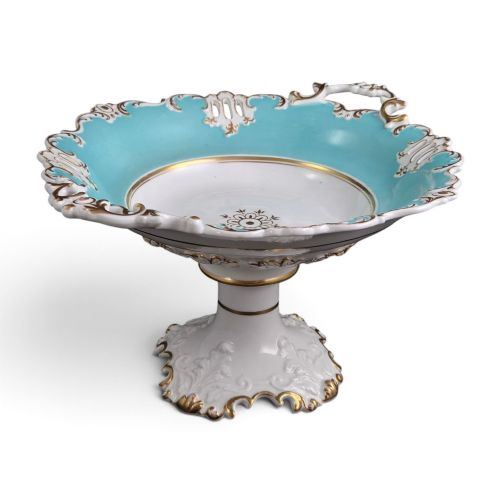
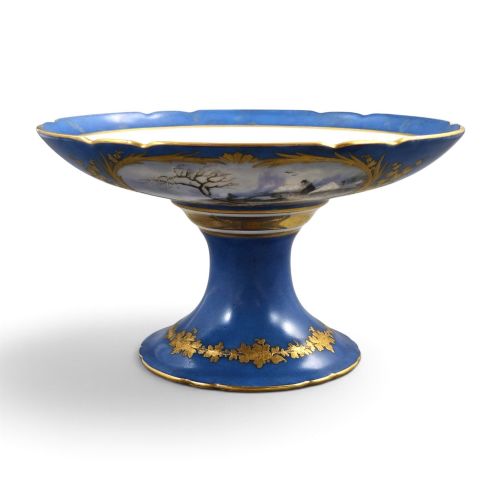
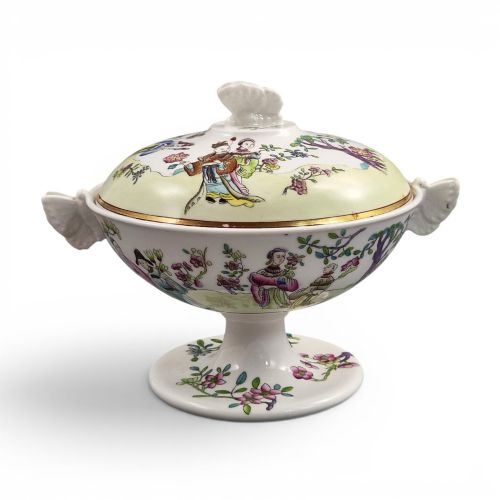


Antique Tazzas
A tazza is a shallow dish or bowl raised on a foot or stem, used to lift fruit, sweetmeats and cakes above the level of the table.
Antique Tazzas
The word is Italian for cup, and the form has been used since antiquity for serving and for display. In ceramics it settled into 18th and 19th-century dessert and dinner services, where footed dishes carried fruit and sweetmeats at varying heights across the table.
The same object gets sold under several names. "Comport" appears in a fifth of titles on Sellingantiques, and the form is also catalogued as compote, pedestal dish or cake stand. "Porcelain" is actually the commonest word in the titles, ahead of "tazza" itself, so a search on one term alone will miss a good part of what turns up.
The one you're most likely to meet is a single 19th-century ceramic footed dish. Half the archive is placed only as "19th Century" rather than a year, and where a year is given the range runs 1800 to 1920, with clusters in the 1880s and the 1920s. Nothing on record here is dated before 1800.
Beyond that, the category splits into recognisable groups: French and Continental porcelain comports, English earthenware and ironstone including transfer-printed blue and white, majolica with satyr, cherub, dolphin and Bacchanalian cupid modelling, and art pottery of around 1900 to 1920 with pewter feet. A persistent fringe sits outside all of it, taking in terracotta tazza urns, a Chinese Canton pedestal dish, a grisaille enamel tazza and a pair in carved wood.
Where The Range Splits
French porcelain holds the top. The highest-priced pieces sampled are all porcelain comports and tazzas in the French taste, and titles that name a specific factory and pattern sit above the generic ones. A plain Victorian majolica dish on a stand marks the bottom of the range.
Added metal lifts a piece. Ormolu-mounted pairs, gilt-bronze and champlevé enamel centrepieces sit well above plain ceramic dishes, and pewter feet distinguish some of the art pottery. Metal here is a mount or a foot, never the body of the piece.
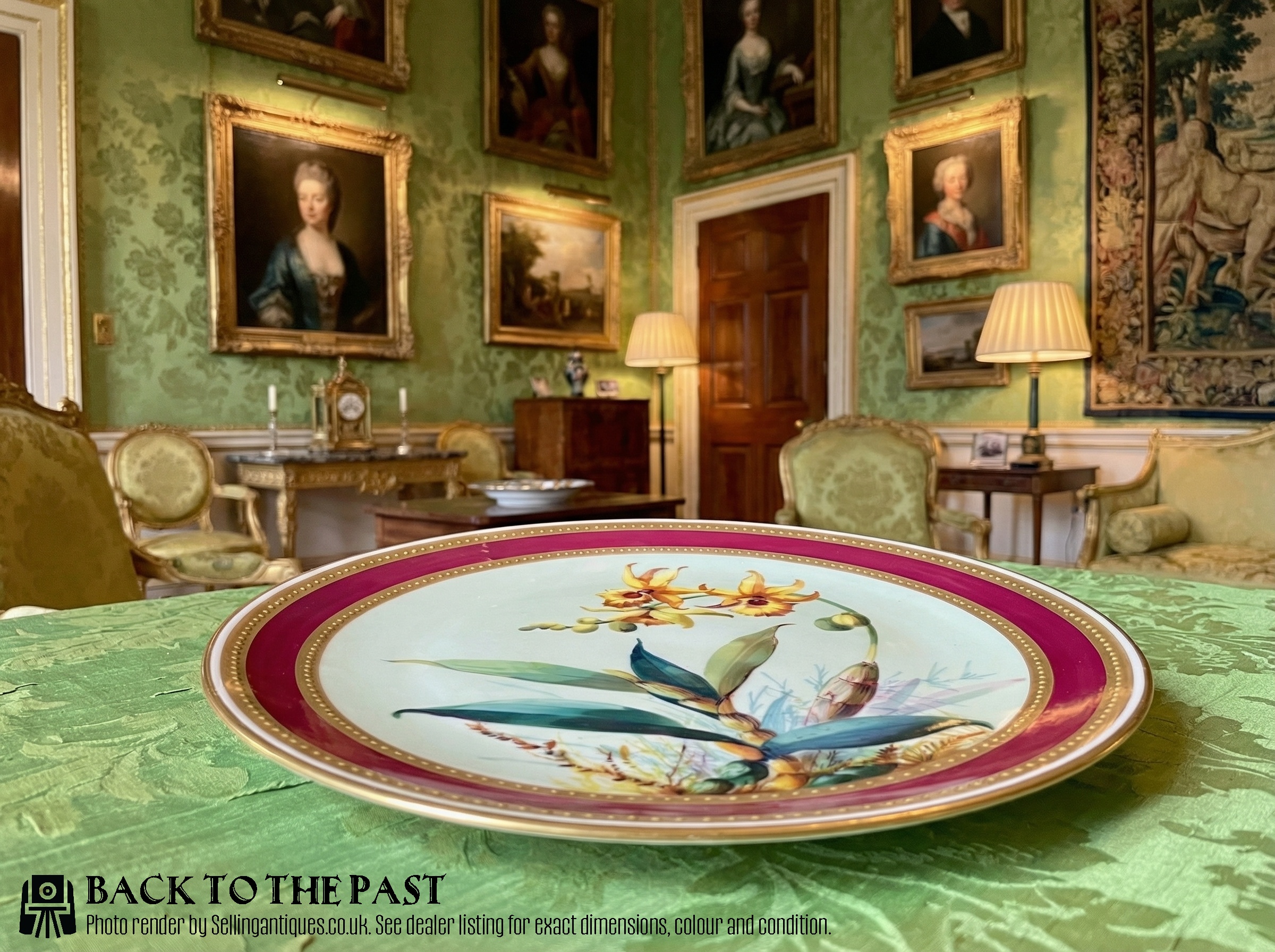
Then there's scale and count. Titles carrying "Large", pairs, and sets cluster in the upper half, as does the pair of buff terracotta urns at 44cm across. Modelling and painting matter too: figural majolica, hand-painted orchids and a portrait enamel are all described in detail where an undecorated dish gets a line.
Antique Tazzas Retail Price Guide 2026
Typical UK retail prices for tazzas, calculated from the Sellingantiques database of over a million retail prices indexed since 2003. This retail price guide relies exclusively on Sellingantiques data; no external sources or auction records are used, so the figures do not describe the wider market.
The largest tazzas to pass through Sellingantiques were a pair of buff terracotta tazza urns, 44cm across, garden scale rather than table scale.
The Antique Tazzas Glossary
- Tazza
- A shallow dish or bowl raised on a foot or stem. The name covers everything from a single dessert-service dish to a large urn-form centrepiece.
- Comport or compote
- The commoner trade word for the same footed serving dish, and it appears in eight of the titles on Sellingantiques.
- Pedestal dish
- Another title variant, describing a dish carried on a raised central foot rather than a slender stem.
- Centrepiece
- A larger and taller tazza meant for the middle of the table, often the piece that carries figural modelling or metal mounts.
- Ironstone
- A dense, durable English earthenware body, used for comports and serving dishes across the 19th century.
- Socle
- The plinth or base block a tazza urn stands on. One listing records a pair without theirs.
Antique Tazzas: Frequently Asked Questions
What's the difference between a tazza and a comport?
Nothing, in practice. Both describe a shallow dish raised on a foot, and dealers use whichever word suits the piece.
Compote, pedestal dish and cake stand cover the same form again. The naming follows trade habit rather than any difference in the object.
Are these mostly ceramic?
Yes. Porcelain leads the titles, and the remainder runs through pottery, majolica, ironstone, terracotta and stoneware.
Metal turns up as ormolu mounts, gilt-bronze, pewter feet or enamel rather than as the body. Only two pieces in the whole archive sit outside ceramics: a pair in carved wood and a grisaille enamel tazza with a painted portrait.
How old are the ones for sale?
The dated field runs from 1800 to 1920, and nothing on record is earlier than 1800.
Half the archive is placed only as "19th Century", which outnumbers every specific decade put together. Where a clean year is given, the 1880s and the 1920s are the two clusters, and "Victorian" and "Edwardian" get used as period labels rather than dates.
Do tazzas come in pairs?
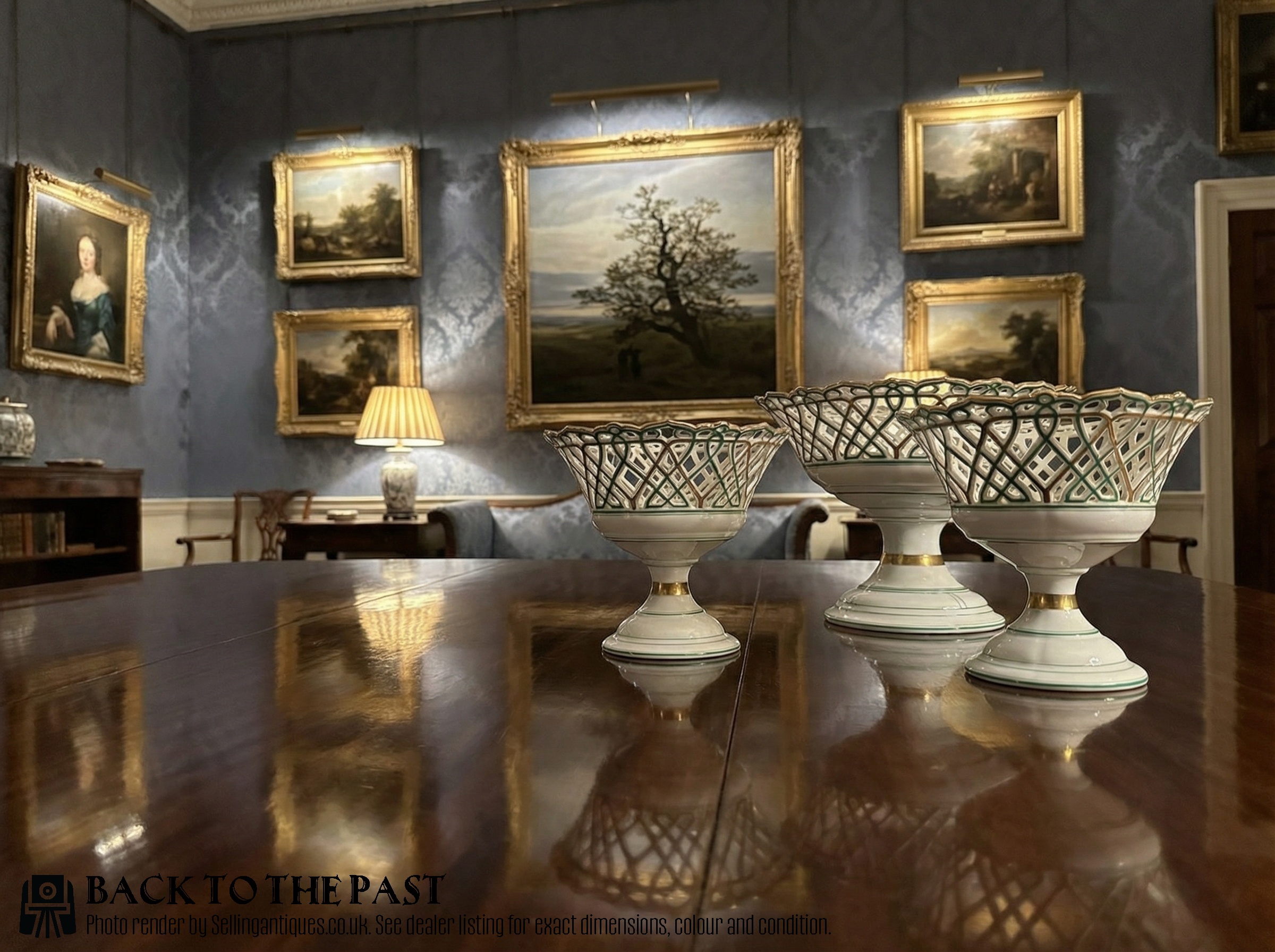
Often enough. Pairs appear at least five times across the archive, and there is a set of three lattice bowls as well.
Single pieces still outnumber pairs and sets. Pairs and larger sizes tend to sit in the upper half of the range.
Can a tazza be part of a service?
Sometimes. Two listings sell one inside something larger, a dessert service in one case and a fourteen-piece coffee service in the other.
That's the exception. The form was a standard part of 18th and 19th-century dessert services, but pieces reach the market on their own far more often than complete.
How many turn up on Sellingantiques?
Around five a year, which makes this a small category.
Twenty-eight different dealers have carried one across thirty-nine listings, close to a listing per dealer. No single dealer stocks them, so each one is a one-off arrival rather than something drawn from a standing shelf.