Textile Antiques has dated this 17th Century Tapestry Panel to the 17th Century.
Antwerp or London, circa 1670-1690
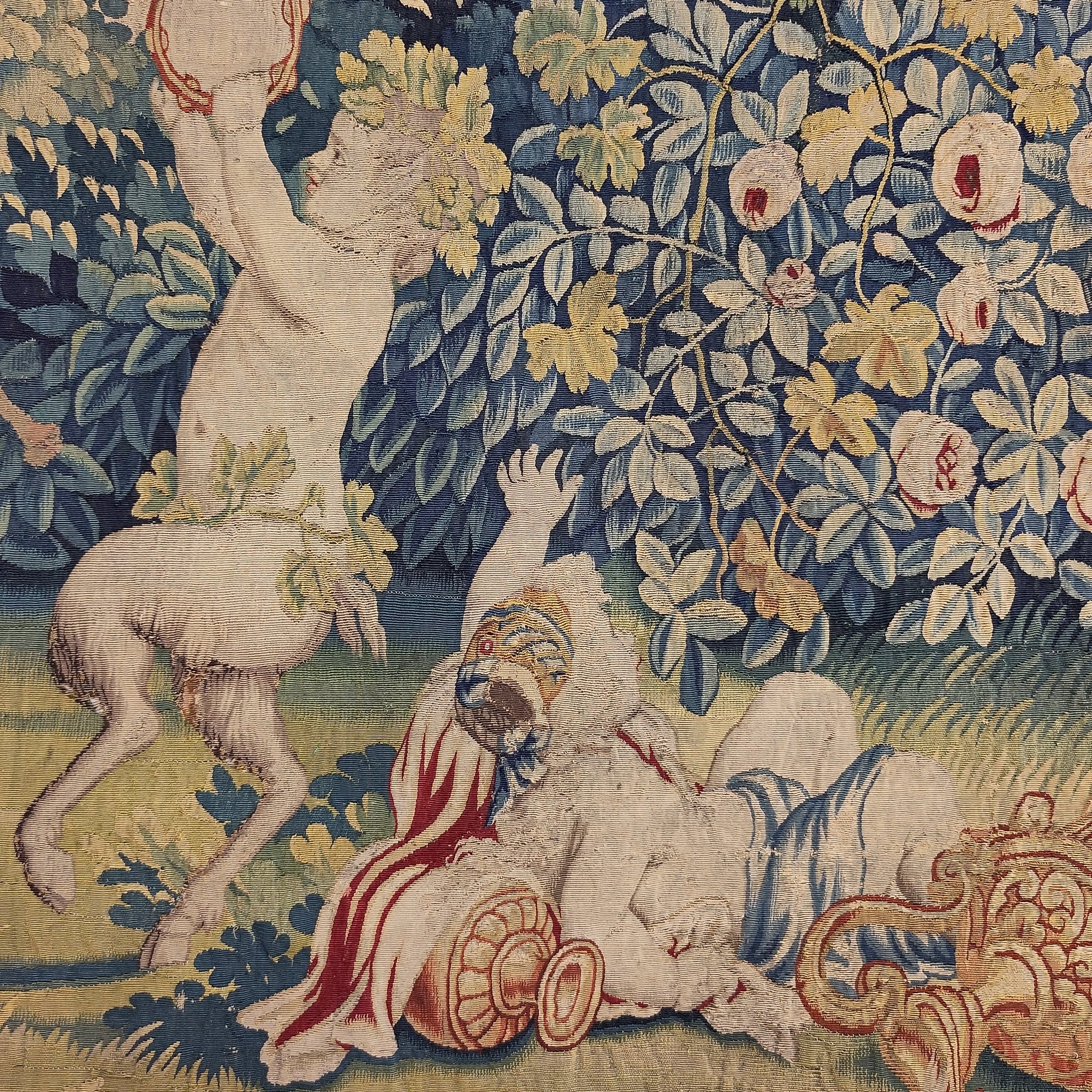
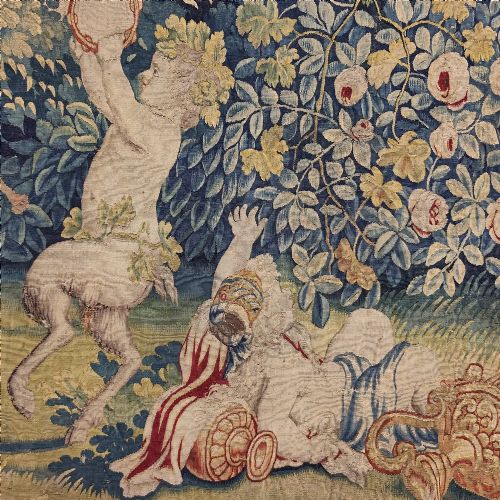
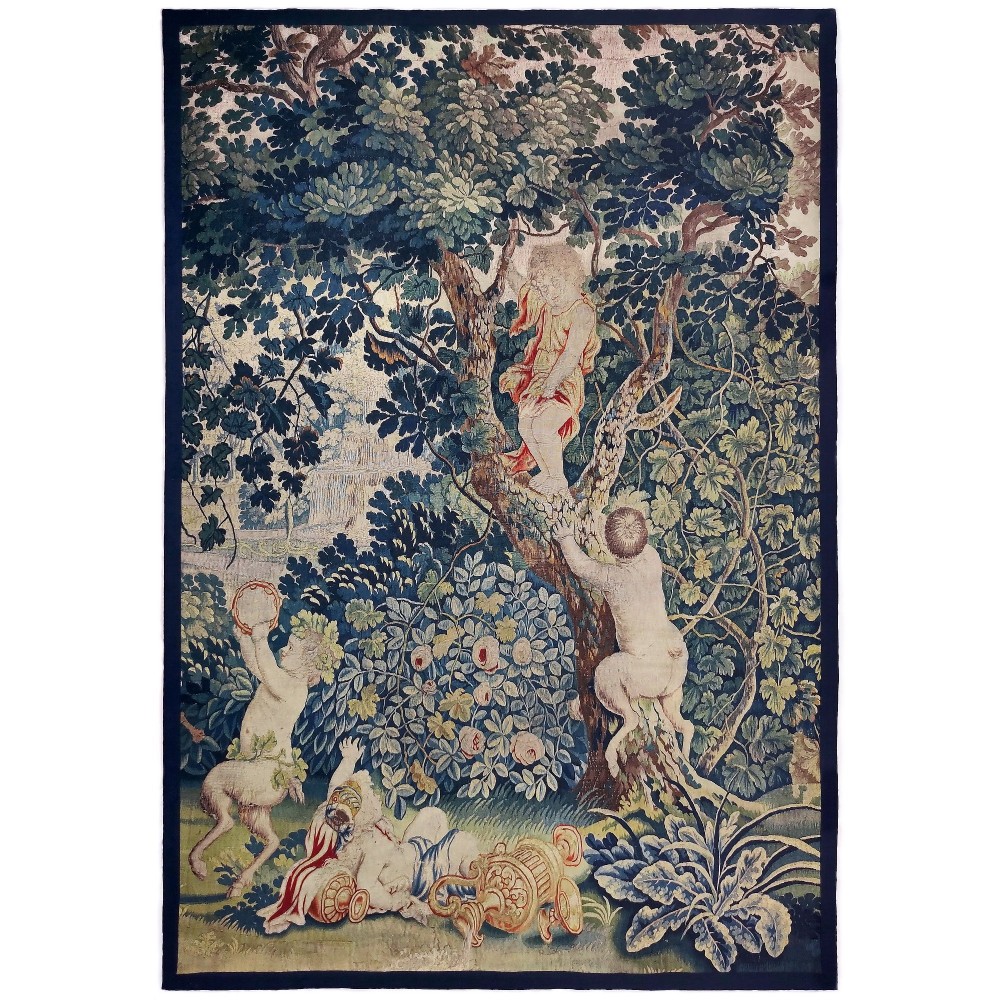
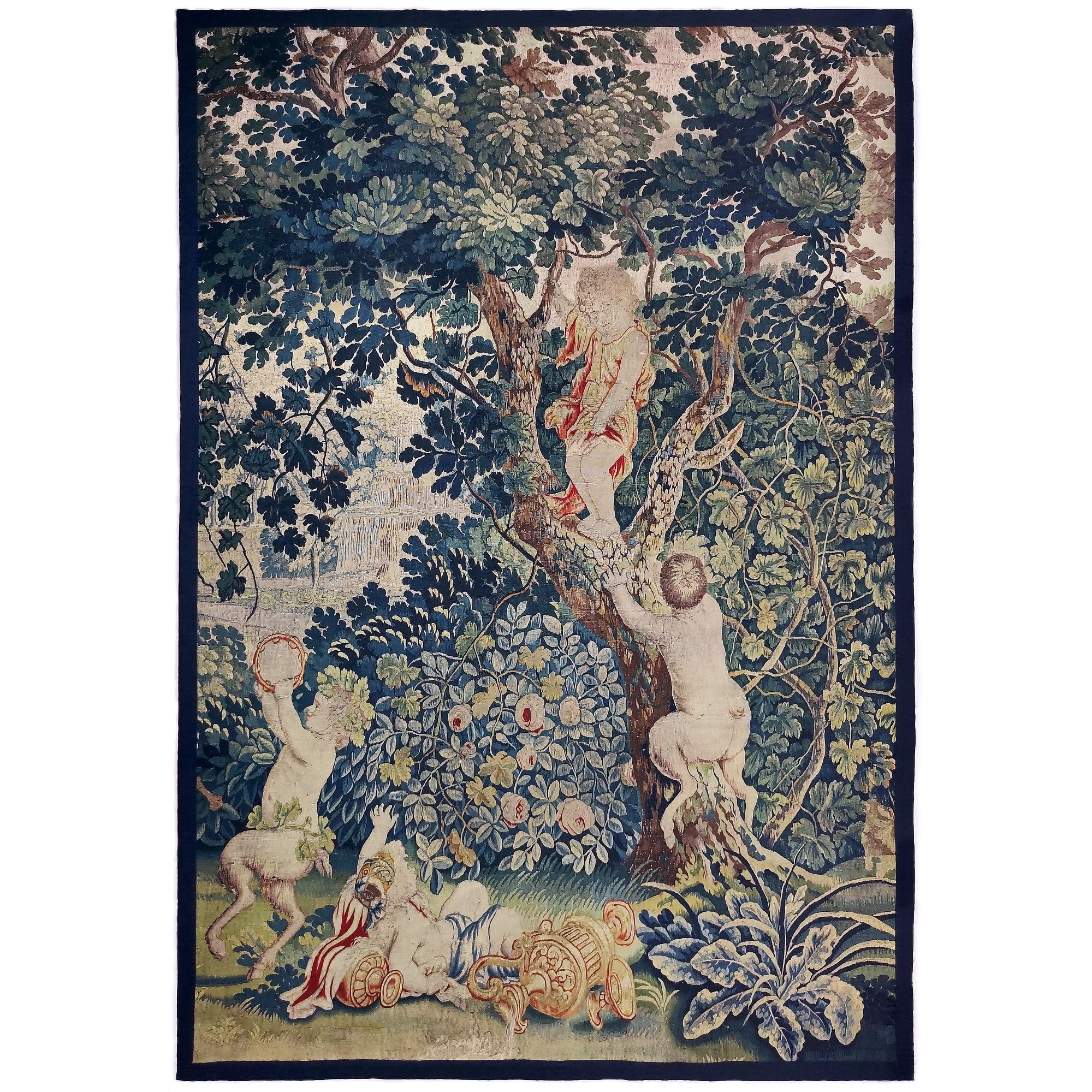
One of the children stands in the fork of an oak tree flanked by grape vines and roses, while a young satyr climbs toward him. On the ground another boy with an ornate headdress lies amid a fallen golden dish and ewers, one of which spills wine into the earth, and another satyr decked with oak leaves dances and plays a tambourine.
Although always described in the past as ‘Mortlake’, or ‘post-Mortlake’, there is now some doubt as to which of the various sets were woven in England and which in Flanders, as tapestries following some of the same designs were also woven in Antwerp in the late seventeenth century.
Two part-sets hang at Cotehele, and among these are two hangings, NT inv. no. 348253.2 and NT inv. no. 348253.6, both illustrated in ‘The Art of Tapestry’, Helen Wyld, publ. PWP Bloomsbury 2022, fig. 155, that have the elements of the present tapestry reversed and a weaver’s mark to the outer border that was used exclusively on tapestries produced at Mortlake and at some of the several workshops that were set up by ex-Mortlake weavers as that original headed to its demise. A similar version with additional scenes is illustrated in ‘English Tapestries of the Eighteenth Century - A Handbook to the Post-Mortlake Productions of English Weavers’, H.C. Marillier, publ. The Medici Society, London 1930, plate 10a, and is there described as having been woven at Soho.
A set of ‘Bacchanals’ at Boughton House are worked to the same designs as the Cotehele panels, but reversed so that they accord with the orientation of this tapestry, and have a border sometimes associated with sets woven, separately, by Thomas and Francis Poyntz, both English tapestry weavers. Another of this design was previously in the hands of the New York dealers French & Co, there described as Mortlake, but the undoubted existence of Flemish tapestries woven to the same composition renders certain attribution difficult.
Textile Antiques has dated this 17th Century Tapestry Panel to the 17th Century.
Fine european textiles and tapestries of the period spanning the 15th century to the early 20th century.
You can view the stock and full dealer information on the Textile Antiques Profile Page
A 17th Century Tapestry Panel