60,914  PAGES BROWSED TODAY PAGES TODAY • 221 ANTIQUES UPLOADED TODAYNEW ARRIVALS
GIFTS
221 ITEMS ADDED TODAY
Sort Order
Items Per Page
Browse Categories
Sort order
Relevant Links
Items per page
ID #SA1190167
SOLD
Email Phone
Save
18th Century Caricature - ‘An Enquiry Concerning the Clock Tax’ (1797) - By Charles Ansell
Sold by The English Interior
sold SA1190167
Sorry, but this item has been sold.
The English Interior

The English Interior

Sellingantiques Verified Since Jul 2023
Browse dealers 74 items
  • About Us
    Specialist dealer in 17th century to the 20th century fine art, furniture and decorative antiques for your home.
Id #SA1190167
PDF SHARE
SAVE

18th Century Caricature - ‘An Enquiry Concerning the Clock Tax’ (1797) - By Charles Ansell

18th century
Sold 23 January 2026 · The English Interior
This “18th Century Caricature - ‘An Enquiry Concerning the Clock Tax’ (1797) - By Charles Ansell” found a buyer.

It was listed by The English Interior. Sold pieces stay on Sellingantiques as a record of what has passed through, and the next one is rarely far away.

Description

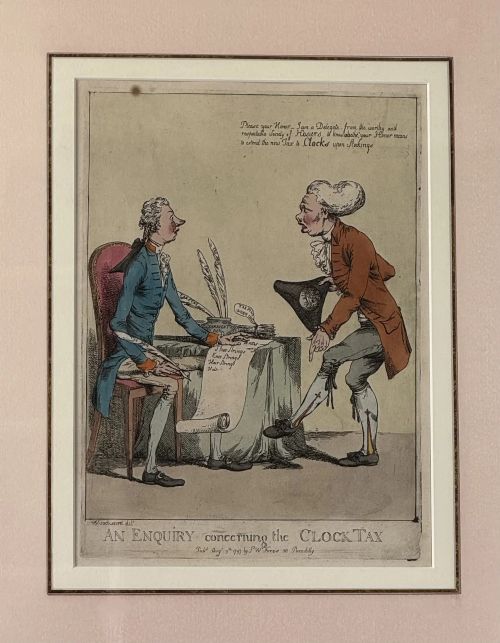
‘AN ENQUIRY CONCERNING THE CLOCK TAX’ (1797) - BY CHARLES ANSELL AFTER GEORGE MOUTARD WOODWARD PUBLISHED BY S.W.FORES (1761-1838).

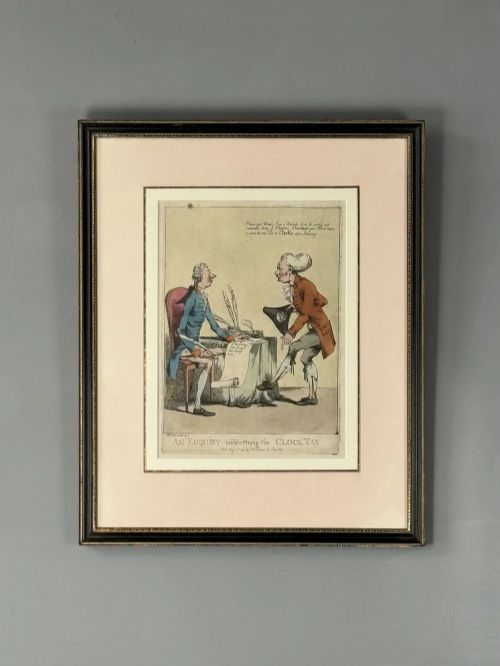
A fine caricature etching with original hand colouring which satirises British Prime Minister William Pitt the Younger. Pitt imposed a tax on clocks and watches to raise revenue for Britain's war efforts against Revolutionary France. The tax was five shillings on every clock (even those in private homes), two shillings and sixpence on silver watches, and ten shillings on gold watches. The tax proved immensely unpopular, nearly ruined manufacturers, and was repealed after only nine months.
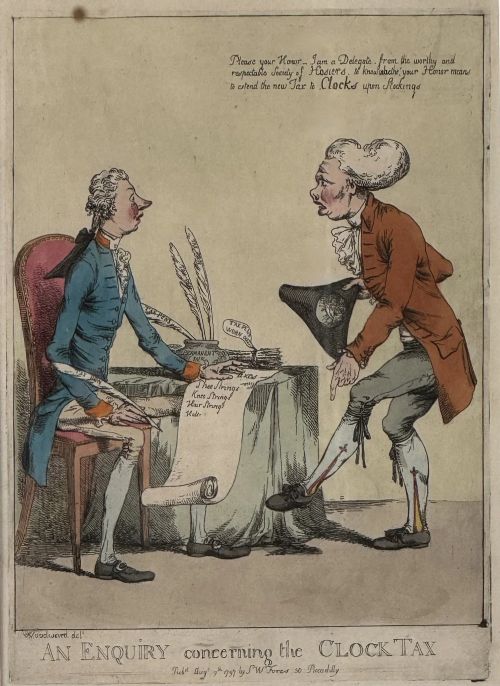
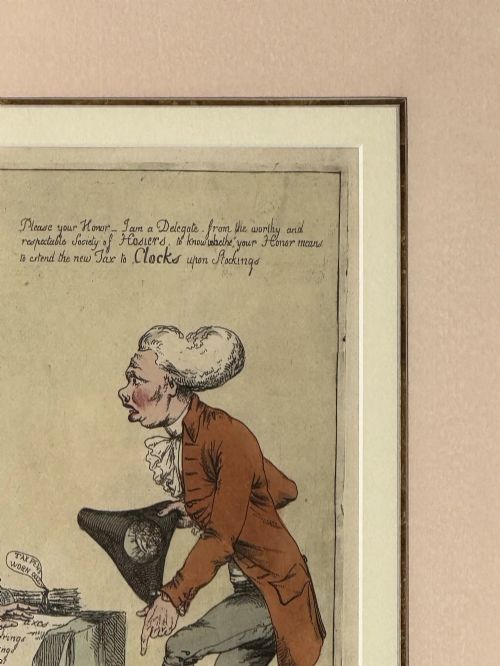
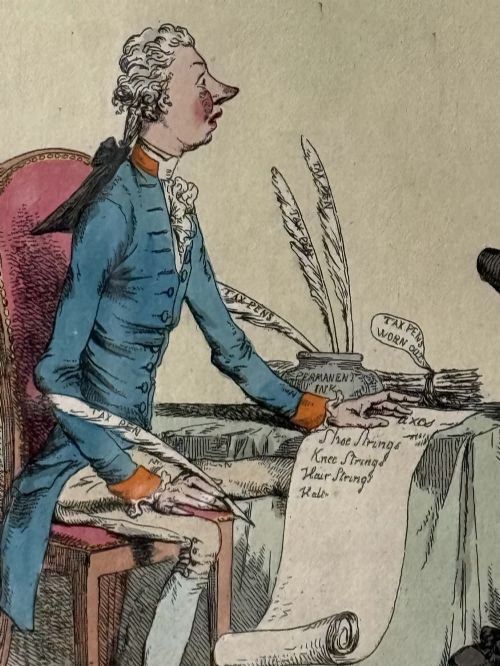
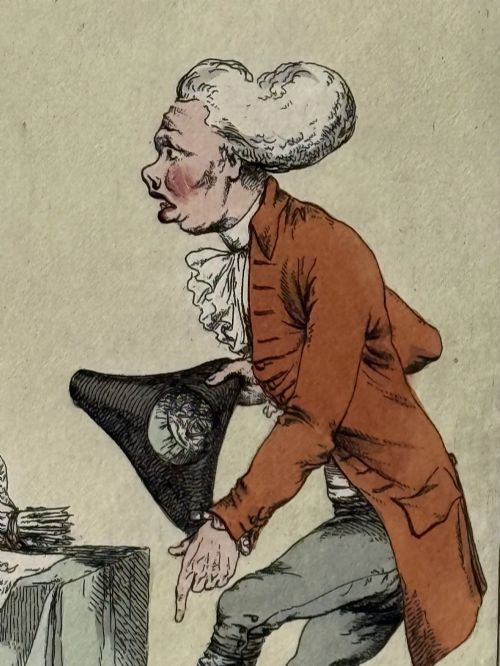
Ansell uses a visual pun on the word “clock" in his print where we see an anxious delegate from the "Society of Hosiers" asks the Prime Minister, William Pitt, if the new tax will extend to the "clocks upon stockings". "Clock" in this context refers to an ornamental pattern, often embroidered on the ankle of a stocking. Pitt is depicted with a list of other trivial taxable items, such as "shoe strings, knee strings, hair strings, etc.". Stocking “Clocks" were a common name for the decorative, embroidered panels found on 18th-century stockings, usually running up the side of the ankle and calf. The joke highlights the perceived absurdity and overreach of the new tax.
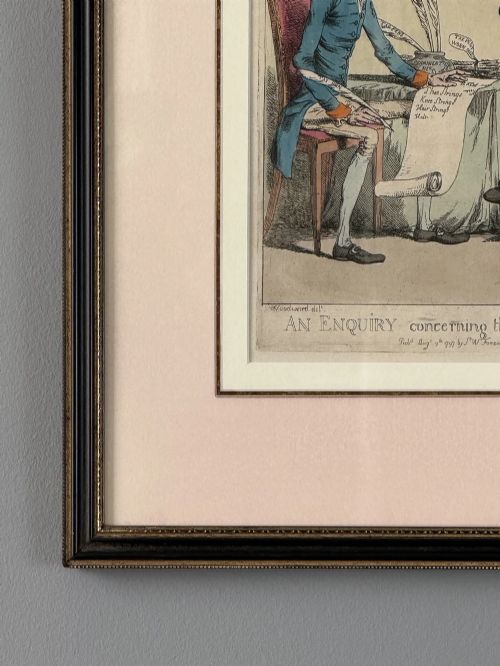
Similar versions of 'An Enquiry Concerning the Clock Tax' are held in various collections, including the British Museum and the Yale Center for British Art (see more on the Lewis Walpole Library collection.

Date: c.1797

Sheet: 31 × 22 cm (12 1/4 × 8 11/16 in.)

Framed: 43 x 53 cm (17 x 21 in.)

Price: £520

Date of Manufacture

The English Interior has dated this Georgian Satirical Caricature Print to the 18th Century.

Physical Dimensions
Height
53cm (20.87")
Width
43cm (16.93")
Depth
2cm (0.79")
Reference Numbers
Sellingantiques Reference
SA1190167
Description
‘AN ENQUIRY CONCERNING THE CLOCK TAX’ (1797) - BY CHARLES ANSELL AFTER GEORGE MOUTARD WOODWARD PUBLISHED BY S.W.FORES (1761-1838).
“
A fine caricature etching with original hand colouring which satirises British Prime Minister William Pitt the Younger.
The English Interior

Pitt imposed a tax on clocks and watches to raise revenue for Britain's war efforts against Revolutionary France. The tax was five shillings on every clock (even those in private homes), two shillings and sixpence on silver watches, and ten shillings on gold watches. The tax proved immensely unpopular, nearly ruined manufacturers, and was repealed after only nine months.

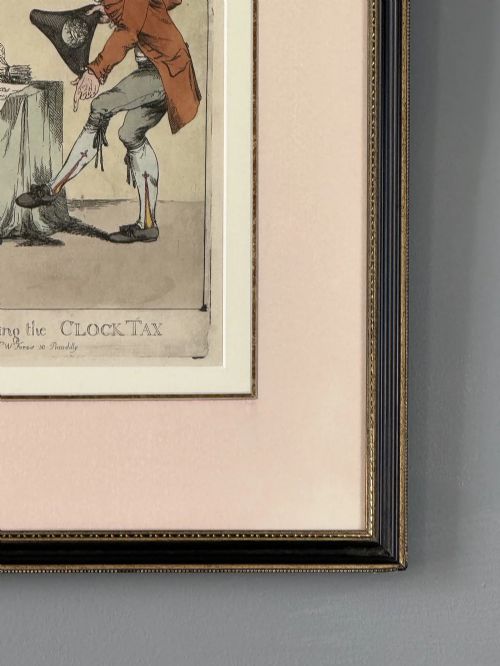
fig 1. A framed 18th-century satirical caricature print depicting two men discussing the clock tax, set within a neutral mount and dark wooden frame.
fig 1. 18th Century Caricature - ‘An Enquiry Concerning the Clock Tax’ (1797) - By Charles Ansell

Ansell uses a visual pun on the word “clock" in his print where we see an anxious delegate from the "Society of Hosiers" asks the Prime Minister, William Pitt, if the new tax will extend to the "clocks upon stockings". "Clock" in this context refers to an ornamental pattern, often embroidered on the ankle of a stocking. Pitt is depicted with a list of other trivial taxable items, such as "shoe strings, knee strings, hair strings, etc.". Stocking “Clocks" were a common name for the decorative, embroidered panels found on 18th-century stockings, usually running up the side of the ankle and calf. The joke highlights the perceived absurdity and overreach of the new tax.

fig 2. A framed 18th-century satirical caricature print depicting two men discussing the clock tax, set within a neutral mount and dark wooden frame.
fig 2. 18th Century Caricature - ‘An Enquiry Concerning the Clock Tax’ (1797) - By Charles Ansell

Similar versions of 'An Enquiry Concerning the Clock Tax' are held in various collections, including the British Museum and the Yale Center for British Art (see more on the Lewis Walpole Library collection.

Date: c.1797

Sheet: 31 × 22 cm (12 1/4 × 8 11/16 in.)

Framed: 43 x 53 cm (17 x 21 in.)

Price: £520

Date of Manufacture

The English Interior has dated this Georgian Satirical Caricature Print to the 18th Century.

Height
53cm (20.87")
Width
43cm (16.93")
Depth
2cm (0.79")
Reference Numbers
Sellingantiques Ref
SA1190167
The English Interior
Sellingantiques verified Since Jul 2023

Specialist dealer in 17th century to the 20th century fine art, furniture and decorative antiques for your home.

Dealer Profile

You can view the stock and full dealer information on the The English Interior Profile Page

PDF SHARE
SAVE
A framed 18th-century satirical caricature print depicting two men discussing the clock tax, set within a neutral mount and dark wooden frame. SOLD6+ MONTHS AGO
1 / 9
Archive I A framed 18th-century satirical caricature print depicting two men discussing the clock tax, set within a neutral mount and dark wooden frame. SOLD6+ MONTHS AGO

18th Century Caricature - ‘An Enquiry Concerning the Clock Tax’ (1797) - By Charles Ansell
Archive II A framed 18th-century satirical caricature print depicting two men discussing the clock tax, set within a neutral mount and dark wooden frame. View II
Archive III A framed 18th-century satirical caricature print depicting two men discussing the clock tax, set within a neutral mount and dark wooden frame. View III
Archive IV A framed 18th-century satirical caricature print depicting two men discussing the clock tax, set within a neutral mount and dark wooden frame. View IV
Archive V A framed 18th-century satirical caricature print depicting two men discussing the clock tax, set within a neutral mount and dark wooden frame. View V
Archive VI A framed 18th-century satirical caricature print depicting two men discussing the clock tax, set within a neutral mount and dark wooden frame. View VI
Archive VII A framed 18th-century satirical caricature print depicting two men discussing the clock tax, set within a neutral mount and dark wooden frame. View VII
Archive VIII A framed 18th-century satirical caricature print depicting two men discussing the clock tax, set within a neutral mount and dark wooden frame. View VIII
Archive IX A framed 18th-century satirical caricature print depicting two men discussing the clock tax, set within a neutral mount and dark wooden frame. View IX
Enlarged Archival View
Telephone 07860 363 882
Location
The Duke of Somersets House
Kirkgate
Tadcaster
North Yorkshire
LS24 9AD
United Kingdom

By appointment only.
Verified Since Jul 2023
Items For Sale 74
Items Sold 66
The English Interior
Verified Since Jul 2023
View Dealer Info
Location: The Duke of Somersets House, Kirkgate, Tadcaster, North Yorkshire, LS24 9AD , United Kingdom, , By appointment only.
Verified
Jul 2023
For Sale
74
Sold
66
A framed 18th-century satirical caricature print depicting two men discussing the clock tax, set within a neutral mount and dark wooden frame.
18TH CENTURY CARICATURE - ‘AN ENQUIRY CONCERNING THE CLOCK TAX’ (1797) - BY CHARLES ANSELL
Ref: SA1190167
A framed 18th-century satirical caricature print depicting two men discussing the clock tax, set within a neutral mount and dark wooden frame.
Detail View 1
Detail View 2
Detail View 3
Detail View 4
Detail View 5
Detail View 6
Detail View 7
Detail View 8
Archival Detail
Every single antique dealer on our platform is individually approved by our internal team. We verify their professional trade history, ethical standards, and photographic quality to ensure a secure, high-standard buying environment. Upon joining, every dealer agrees to a strict 9-point code of conduct. While issues can occasionally arise, our dealers typically resolve them swiftly and directly with the buyer. In fact, since our founding in 2002, Sellingantiques has only had to step in to help resolve an issue on roughly five occasions—a true testament to the quality of our dealers and their dedication to your happiness.
Our dealers are highly experienced in packing and shipping fragile, high-value antiques. Because you are in direct contact with the dealer, you will be able to easily go through all available shipping and insurance options together to ensure your item arrives safely.
Antiques are the ultimate green purchase. By choosing historical pieces over newly manufactured goods, you completely eliminate the carbon footprint of modern mass production while preserving exceptional, timeless craftsmanship.
Written by Sellingantiques from the dealer’s photographs and listing
  • ObjectFramed Art
  • Period18th century
  • StyleGeorgian
  • MaterialPaper, ink, watercolour, wood, glass
  • ColourSepia
  • MotifsHand-coloured etching, Calligraphic text captions, Period costume illustration
  • SizeH 53 cm (21 in) x W 43 cm (17 in) x D 2 cm (1 in)

Georgian satirical caricatures are 18th-century graphic artworks that mocked political figures, social trends, and contemporary events through exaggerated visual humor and biting wit.

These historical works were typically copperplate etchings or engravings on laid or wove paper, often finished with hand-applied watercolours to enhance the humorous details.

Authenticity is assessed through paper analysis, plate mark impressions, contemporary publishing details, watermark examination, and the characteristic printing ink and hand-colouring methods of the period.

These framed works add intellectual depth and historical character to traditional studies, libraries, or gallery walls when paired with conservation framing and neutral mats.

To protect fragile paper from degradation, prints must be displayed away from direct sunlight using UV-filtering glass, acid-free mats, and stable humidity-controlled environments.
items
Add keywords to the filter
Price
£100
£250000
Era
Period
Style
Material
Origin
Stock Location
Recently Added
Online Payments
Categories