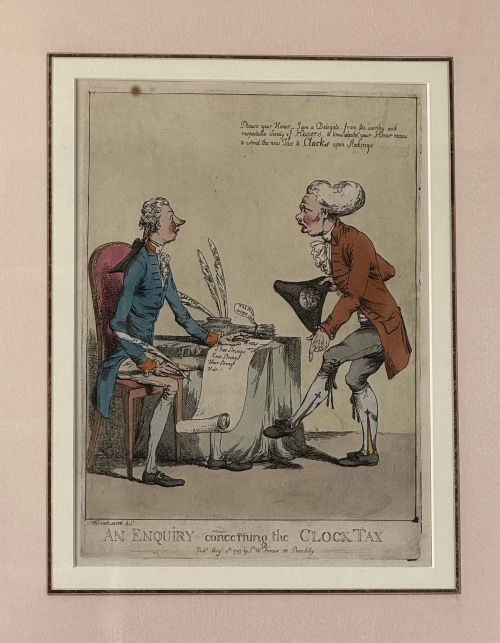
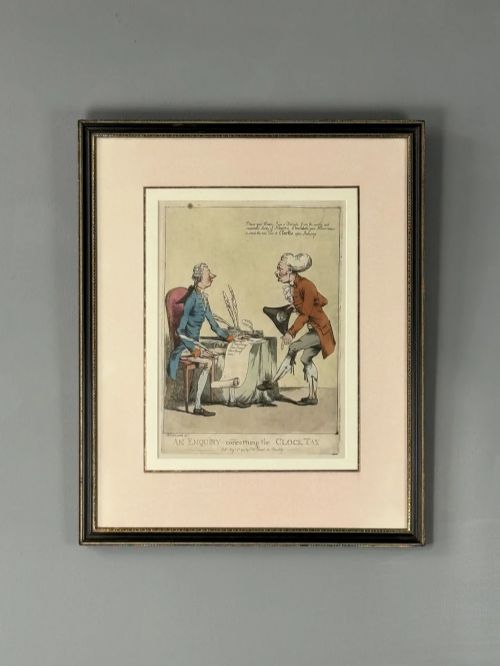
It was listed by The English Interior. Sold pieces stay on Sellingantiques as a record of what has passed through, and the next one is rarely far away.
The English Interior has dated this Georgian Satirical Caricature Print to the 18th Century.
Pitt imposed a tax on clocks and watches to raise revenue for Britain's war efforts against Revolutionary France. The tax was five shillings on every clock (even those in private homes), two shillings and sixpence on silver watches, and ten shillings on gold watches. The tax proved immensely unpopular, nearly ruined manufacturers, and was repealed after only nine months.
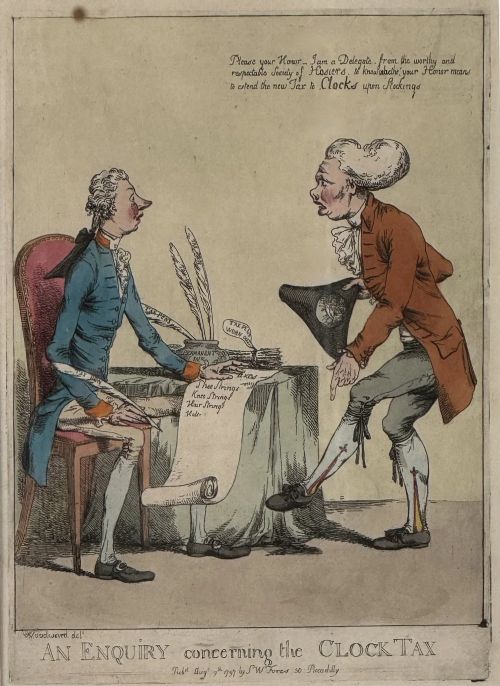
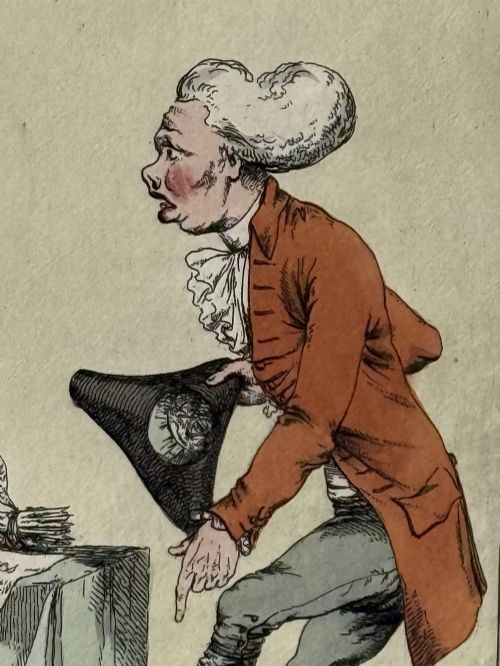
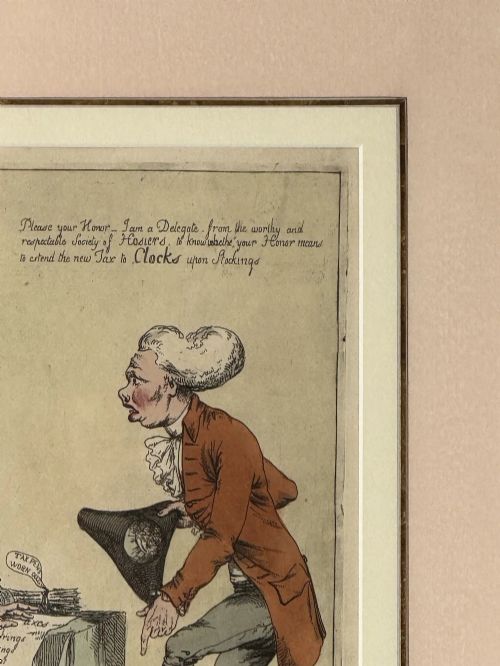
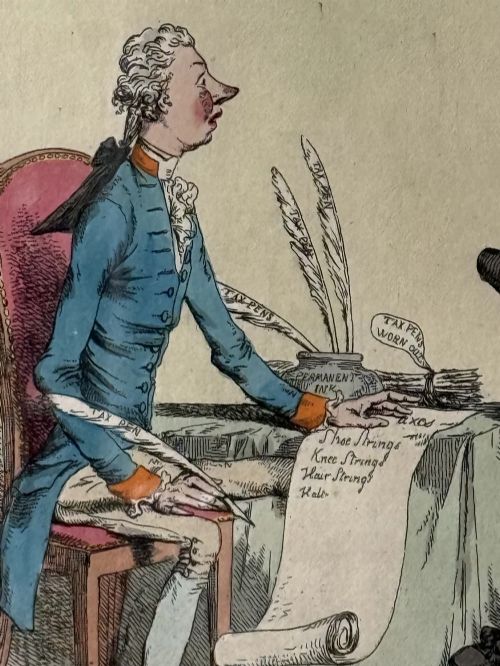
Ansell uses a visual pun on the word “clock" in his print where we see an anxious delegate from the "Society of Hosiers" asks the Prime Minister, William Pitt, if the new tax will extend to the "clocks upon stockings". "Clock" in this context refers to an ornamental pattern, often embroidered on the ankle of a stocking. Pitt is depicted with a list of other trivial taxable items, such as "shoe strings, knee strings, hair strings, etc.". Stocking “Clocks" were a common name for the decorative, embroidered panels found on 18th-century stockings, usually running up the side of the ankle and calf. The joke highlights the perceived absurdity and overreach of the new tax.
Similar versions of 'An Enquiry Concerning the Clock Tax' are held in various collections, including the British Museum and the Yale Center for British Art (see more on the Lewis Walpole Library collection.
Date: c.1797
Sheet: 31 × 22 cm (12 1/4 × 8 11/16 in.)
Framed: 43 x 53 cm (17 x 21 in.)
Price: £520
The English Interior has dated this Georgian Satirical Caricature Print to the 18th Century.
Specialist dealer in 17th century to the 20th century fine art, furniture and decorative antiques for your home.
You can view the stock and full dealer information on the The English Interior Profile Page

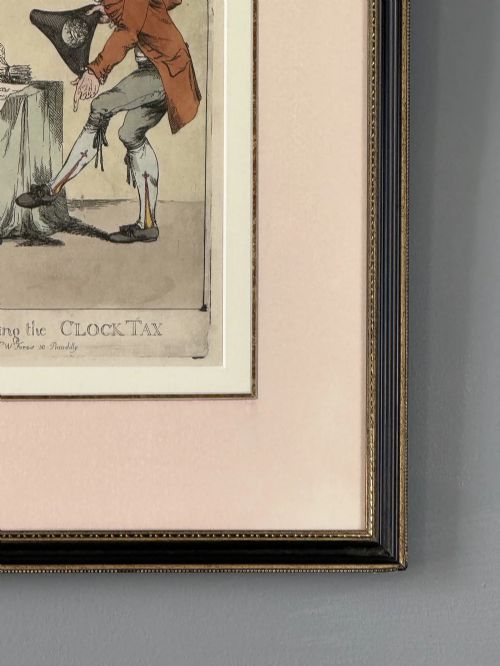
18th Century Caricature - ‘An Enquiry Concerning the Clock Tax’ (1797) - By Charles Ansell