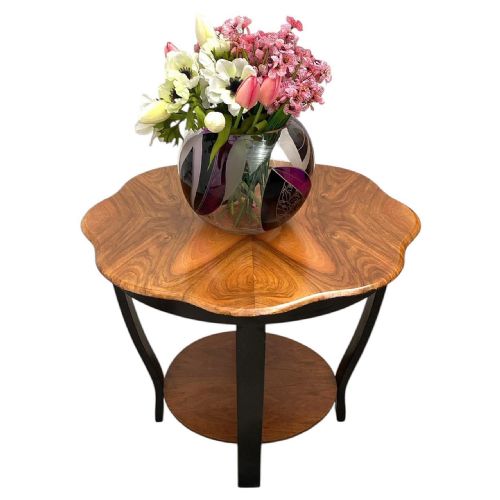
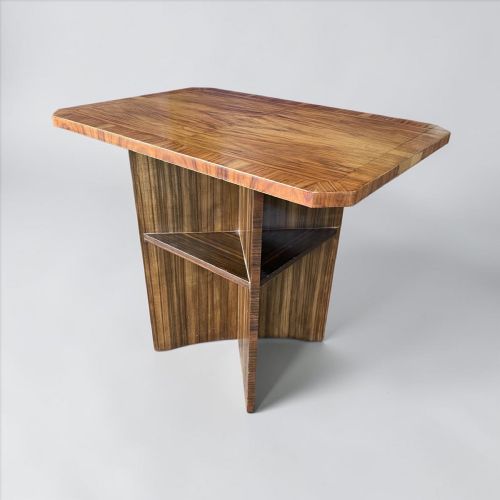
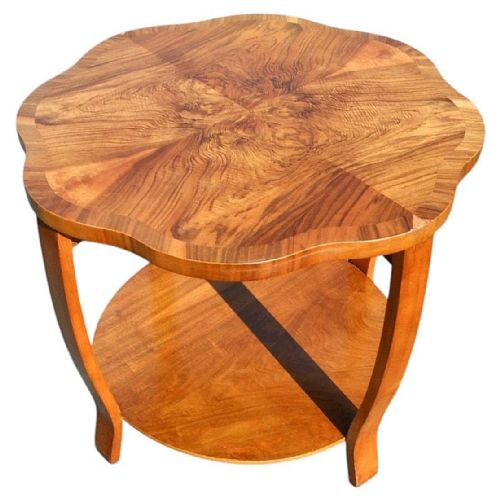
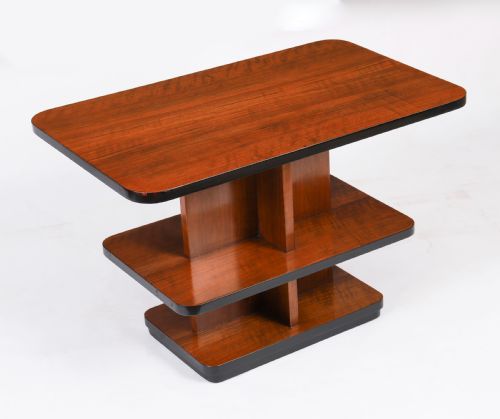
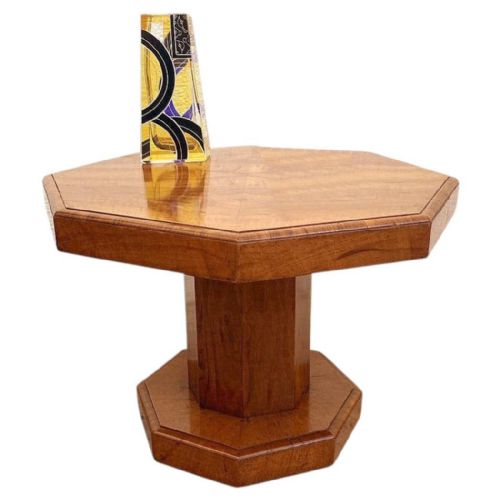
Regent Antiques has dated this Art Deco Coffee Table to the 1920s.

There is no mistaking the unique quality and elaborate design, which is certain to make it a talking point in your home and a fine embellishment to your reception room.
Condition:
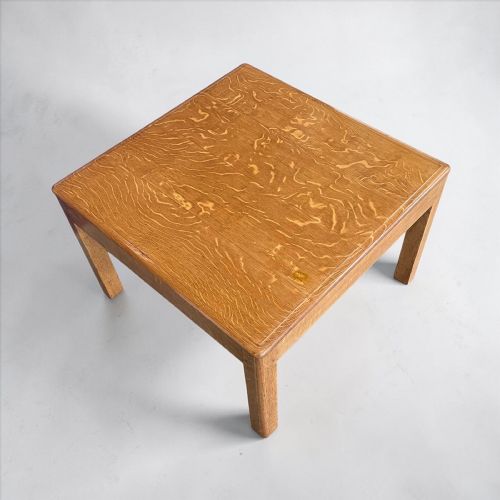
In excellent condition having only been beautifully cleaned and waxed in our workshops, please see photos for confirmation.

Dimensions in cm:
Height 50 cm x Width 51 cm x Depth 61 cm
Dimensions in inches:
Height 1 foot, 8 inches x Width 1 foot, 8 inches x Depth 2 foot
Walnut & Burr Walnut
Walnut is a hard, dense, tight- grained wood that polishes to a very smooth finish. It is a popular and attractive wood whose colour ranges from near white in the sapwood to a dark hew in the heartwood. When dried in a kiln, walnut wood tends to develop a dull brown colour, but when air-dried can become a rich purplish-brown. Because of its colour, hardness and grain, it is a prized furniture and carving wood. Walnut veneer was highly priced and the cost would reflect the ‘fanciness’ of the veneer – the more decorative, then the more expensive and desirable.

Burr walnut refers to the swirling figure present in nearly all walnut when cut and polished, and especially in the wood taken from the base of the tree where it joins the roots. However the true burr is a rare growth on the tree where hundreds of tiny branches have started to grow. Burr walnut produces some of the most complex and beautiful figuring you can find.

Walnut "burrs" were often used to make fabulous furniture. Veneer sliced from walnut burl is one of the most valuable and highly prized by cabinet makers and prestige car manufacturers and is also a favourite material for shotgun stocks.

Inlay was commonly used in the production of decorative burr walnut furniture, where pieces of coloured veneers are inlaid into the surface of the walnut, adding delicate or intricate patterns and designs. Inlays normally use various exotic veneers, but other materials such as mother-of-pearl, brass or bone were also be used.

Art Deco or Deco,
is an influential visual arts design style which first appeared in France during the 1920s, flourished internationally during the 30s and 40s.
It is an eclectic style that combines traditional craft motifs with Machine Ageimagery and materials. The style is often characterized by rich colours, bold geometric shapes, and lavish ornamentation.

Deco emerged from the Interwar period when rapid industrialization was transforming culture. One of its major attributes is an embrace of technology. This distinguishes Deco from the organic motifs favored by its predecessor Art Nouveau.

Historian Bevis Hillier defined Art Deco as "an assertively modern style...[that] ran to symmetry rather than asymmetry, and to the rectilinear rather than the curvilinear; it responded to the demands of the machine and of new material...[and] the requirements of mass production".
During its heyday Art Deco represented luxury, glamour, exuberance, and faith in social and technological progress.
Our reference: A4797
Regent Antiques has dated this Art Deco Coffee Table to the 1920s.
We specialise in english and continental furniture, silver, porcelain and decorative items.
You can view the stock and full dealer information on the Regent Antiques Profile Page
Regent Antiques is a registered member of LAPADA CINOA

Antique Art Deco Burr Walnut Coffee Table Circa 1920