


Antique Mahogany Tables
Mahogany tables were the working furniture of the British dining room, drawing room and hall from the early 18th century onward, made in every size from a tripod wine table to a six-pillar dining table seating twenty-eight.
What They Are
Mahogany came into Britain in quantity from the Caribbean and Central America from the early 1700s, and it became the standard table timber: strong enough for slender legs, wide enough in the plank for a one-piece top. Almost every domestic table form was made in it, and the category on Sellingantiques runs the full spread, from small occasional tables up to multi-pillar dining tables.
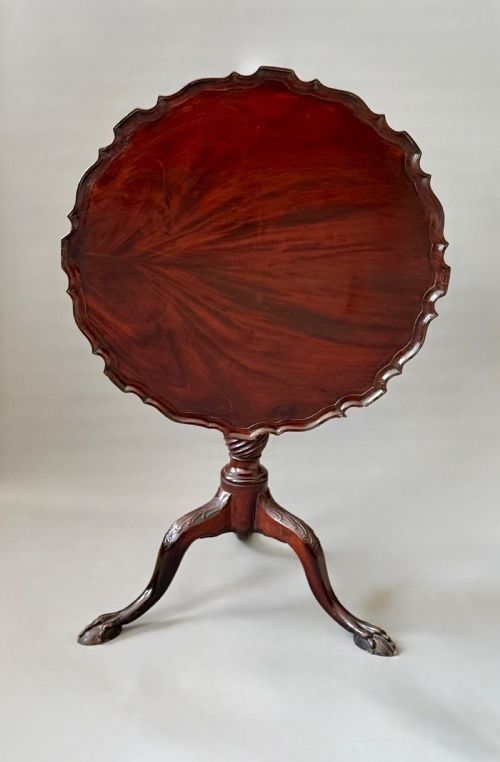
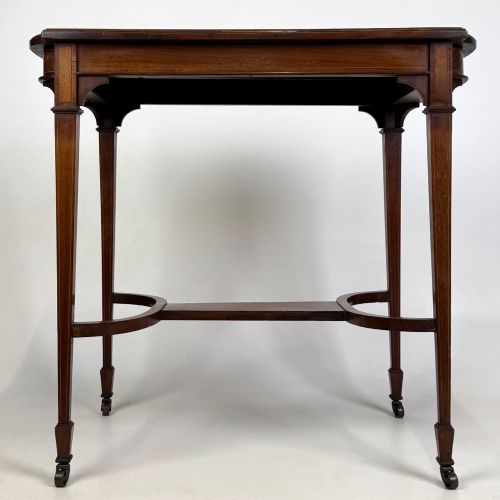
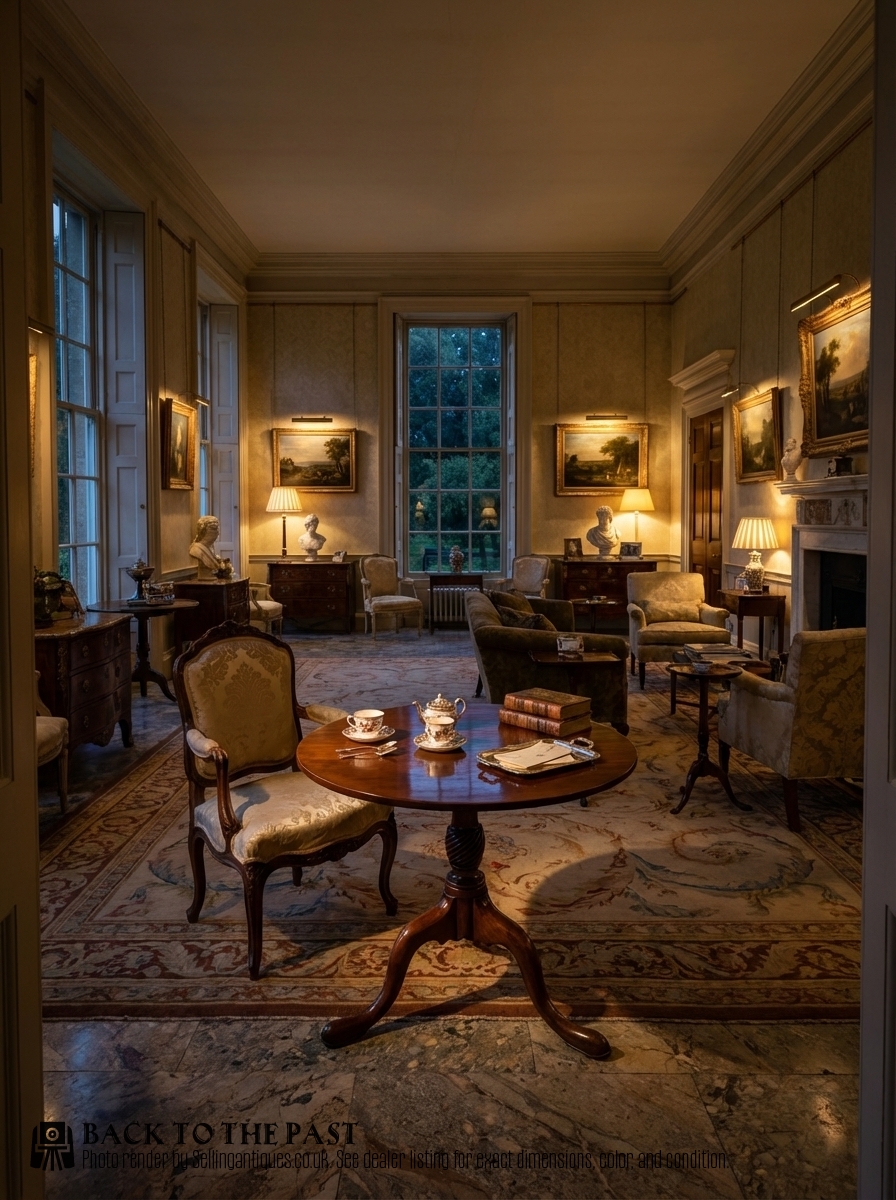
Four working types dominate the titles: side tables, dining tables, writing tables and console tables. The thing you're most likely to meet is a small-to-medium occasional or side table, often on a tripod base with a top that tips vertical so it stands against a wall. Titles for these routinely run several words together, side and hall and lamp and wine in the same line, because one table did all four jobs.
Second commonest is a dining table that extends, either on leaves wound out of a frame or on additional pillars. Around these sit the specialised forms: card, tea, Pembroke, sofa, work, drum, bijouterie and nests of three or four. Consoles and demi-lunes turn up in pairs more often than anything else does.
Dates in this market are loose by habit. Nearly half of all titles name a monarch or reign rather than a maker, and the dated field spans 1700 to 1950. Nineteenth Century is the largest single bucket, ahead of Georgian, Regency and Victorian, and round-number tags like 1800s are shorthand. Edwardian and 1920s entries mark a substantial revival population, where titles carry style, revival or in the manner of.
What Sets Them Apart
Size decides the dining tables. Seat counts and lengths are stated in the titles more often than anything else at the top of the range, and the pieces that sit highest are twelve, fourteen, sixteen and twenty-four seaters, running from eight feet up to sixteen. Small drop-leaf and Pembroke dining tables sit at the other end.
Timber is the next lever. Figure named in the title, flame, plum pudding, fiddleback, Cuban, clusters in the upper half of the range, and inlay counts too: boxwood and satinwood stringing and crossbanding appear in over a thousand titles. Pairs and sets pull the same way, whether that's two demi-lune consoles, two D-shaped card tables, or a quartetto of four.
Date and attribution do the rest. Eighteenth-century and Regency pieces sit above the later revivals, and the 1920s and 1930s entries, all of them conscious copies of earlier styles, sit lower. A named maker or retailer lifts a table clear of the anonymous run, and Gillows-associated pieces sit well above the middle of the category.
Retail Price Guide 2026
Typical UK retail prices for mahogany tables, calculated from the Sellingantiques database of over a million retail prices indexed since 2003. This retail price guide relies exclusively on Sellingantiques data; no external sources or auction records are used, so the figures do not describe the wider market.
The earliest firmly dated mahogany table on Sellingantiques is an Irish corner tea table given as 1735; the latest dated entries fall in the 1930s.
Gillows, and Waring & Gillow·Maple & Co·Edwards & Roberts·William Trotter·W. Priest·Druce & Co·Holland and Sons·James Mein·James Shoolbred
The Antique Mahogany Tables Glossary
- Tilt-top
- A top hinged to tip vertical so the table stands flat against a wall. Also called snap-top or tip-top, and it appears in over 550 titles.
- Tripod
- Three splayed legs rising to a central pillar, the standard support for small round tables. Nearly 900 titles use the word.
- Extending
- A dining table whose frame opens on a screw or slide to take extra leaves, sometimes called wind-out. Over a thousand titles say extending.
- Demi-lune
- Half-moon in plan, used for console, card and side tables, and one of the shapes that most often turns up as a pair.
- Pembroke
- A small table with two hinged drop flaps and usually a drawer in the frieze.
- Birdcage
- A small boxed assembly between the pillar and the top, letting the top both tilt and rotate.
Frequently Asked Questions
How many mahogany tables are listed each year?
Around 1,639 mahogany tables are listed on Sellingantiques in a year, and 382 different dealers have handled one. That makes it one of the broadest-based furniture categories on the marketplace.
The spread runs from small tripod wine and lamp tables through to extending dining tables seating twelve or more.
What does pillar or pedestal mean on a dining table?
It counts the turned columns holding the top up. Listings read twin pillar, three pillar, six pillar, and the number generally rises with the length of the table.
The largest thing in the archive is a six-pillar George III table advertised as seating twenty-eight.
Why are so many described only by monarch or period?
Because that's how this market labels stock. Nearly half of all titles name a reign, with Victorian, Regency, Georgian and George all appearing over 1,900 times, while maker names are scarce.
The tagging is loose in both directions. A table can be tagged Georgian while the title says Regency, or tagged Regency while the title says George IV.
Which maker turns up most often?
Gillows. It appears in around 250 titles and has come from 33 separate dealers, so it behaves like a category of its own rather than one dealer's stock.
Every other firm here is in single figures for mentions. Names appear stamped, on a retailer's label, or simply as attributed to.
Are pairs of mahogany tables common?
Common enough to be a sub-market. Over 640 titles say pair, most often demi-lune consoles, D-shaped card tables or wine tables.
Paired examples cluster towards the top of the range, as do nests and quartettos of four.
What unusual forms appear in this category?
Once in a while something turns up that's barely a table. A metamorphic music stand, a bed or chair table, a lazy susan, an orangery planting table, an architect's table.
A Chinese export occasional table and a specimen marble top attributed to a Devon family have both passed through as well.