


Antique Bouillotte Tables
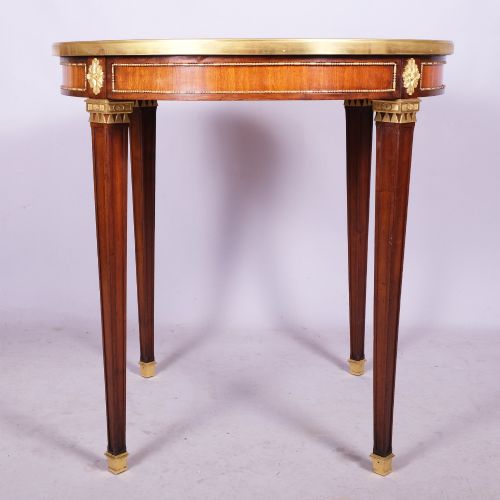
A small round table, marble-topped and ringed with a pierced brass gallery, made for the French card game bouillotte and later used for lamps and everything else.
What Is A Bouillotte Table?
The name comes from bouillotte, a French card game popular from the later 18th century. The table was built for it: a small circular top, usually marble, with a raised metal gallery round the rim to stop counters and candlesticks sliding off, all on slender tapering legs.
The form on Sellingantiques is French first and foremost. The word appears in 19 of 33 titles, more often than any material or timber, and marble is named in 9. Mahogany is the timber that turns up most in the samples, ahead of ebonised. A table of that description sits squarely in the middle of the range.
Dates are later than the card game suggests. The dealer dated field runs from 1870 to 1920, with clusters in the 1910s and 1900s and nine listings under the broad label "19th Century". Only two are given as 18th century, so an Ancien Régime example is the rarest thing in the category by period.
It also answers to other names. Side table, occasional table, coffee table, lamp table, centre table and guéridon all appear in these titles, so the same object arrives under a label that never mentions bouillotte at all.
Where The Range Splits
Decoration on the surface does most of the separating. Plain bouillotte and ebonised entries sit lowest in the samples, with marquetry, parquetry, brass-inlaid and kingwood titles above them. Metal follows the same line: a brass gallery and brass collars are the mid-range norm, while ormolu and gilt bronze appear once each, both at the top.
A name lifts a table clear of the rest. The two highest-priced samples are the only ones carrying one, a signed guéridon bouillotte table and a pair described as after a named ébéniste. No other listing among 33 names anybody, so attribution is the exception rather than a category feature.
Size reads plainly in the titles. "Small" sits near the bottom of the sampled range, while "Large" and "Very large" sit in the upper half. Dealers' own quality words, from "Nice quality" to "Outstanding quality", turn up only from the middle of the range upward.
Retail Price Guide 2026
Typical UK retail prices for bouillotte tables, calculated from the Sellingantiques database of over a million retail prices indexed since 2003. This retail price guide relies exclusively on Sellingantiques data; no external sources or auction records are used, so the figures do not describe the wider market.
The top sale of the last year on Sellingantiques was a round French bouillotte table with a marble top, in October 2025.
The Antique Bouillotte Tables Glossary
- Gallery
- The pierced or railed metal rim round the top edge, described in one title as a "Brass Gallery". It is the feature that marks the form.
- Marble top
- A stone slab top, named in 9 of 33 titles, the most frequently specified material in the category.
- Occasional table
- Label for a small movable table, used in place of bouillotte in four sample titles.
- Guéridon
- French term for a small round pedestal or occasional table. One title uses it alongside "bouillotte".
- Parquetry
- Geometric veneer work rather than pictorial, as against marquetry, which builds a picture from contrasting woods. Both appear in these titles.
- Ormolu
- Gilded cast bronze mounts. "Ormolu" and "Gilt Bronze" each appear once, both at the upper end of the range.
Frequently Asked Questions
Why are they called bouillotte tables?
Bouillotte was a French card game popular from the later 18th century, and the table was made for it. The marble top took the wear and the raised metal gallery kept counters and candlesticks from sliding off.
The form was then revived through the 19th and early 20th centuries as a general occasional or lamp table.
Are these tables usually French?
French is the single most stated fact about the form on Sellingantiques. The word appears in 19 of 33 titles, more often than the material of the top.
That makes national origin the thing dealers lead with, ahead of timber, marble or period.
How old are most examples on the market?
The dealer dated field runs from 1870 to 1920, with 19 listings carrying a clean year. The clusters fall in the 1910s and 1900s, with a few in the 1920s, the 1890s and earlier.
Nine more listings sit under the broad label "19th Century", which reads as a placeholder rather than a date. Only two are given as 18th century.
Do they all have marble tops?
No. Marble is named in 9 of 33 titles, which makes it the most frequently specified material, but it is a minority of the listings.
Other titles name mahogany, ebonised finishes, kingwood, marquetry and parquetry tops instead.
What other names do they sell under?
Several others appear in these titles: side table, occasional table, coffee table, lamp table, centre table and guéridon.
Occasional table is the commonest of them, used in four sample titles. A search on "bouillotte" alone will miss stock.
How many come up for sale each year?
Around four a year on Sellingantiques, from a pool of 15 dealers.
So most dealers who handle the form have listed one rather than a run of them.