
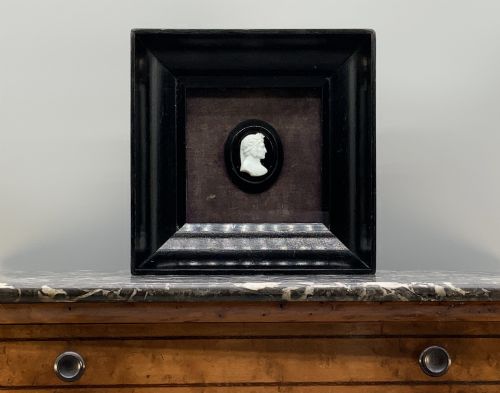
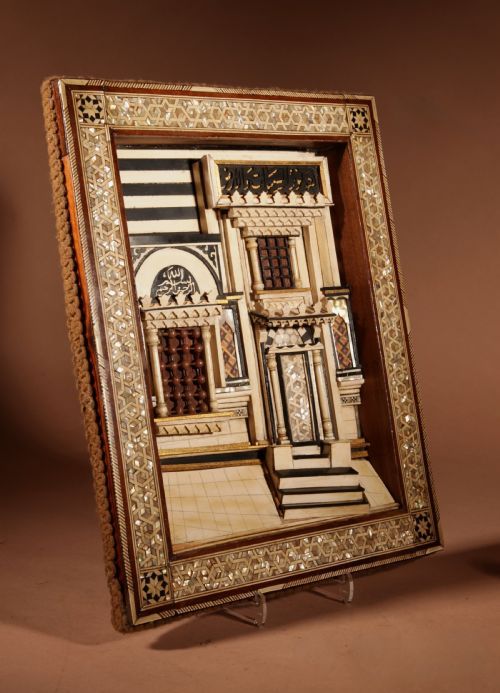


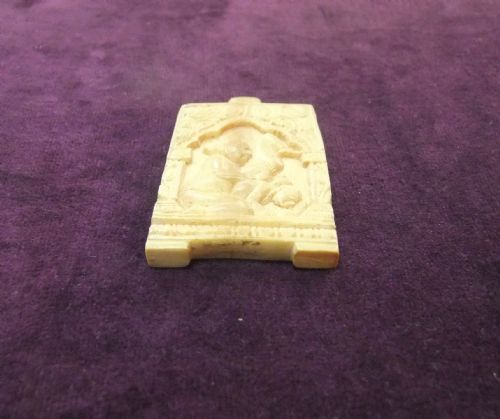


Antique Ivory
Small carved and turned objects in elephant, walrus and marine ivory, made as toggles, display figures, games pieces and desk tools, and dominated by Japanese carving of the Meiji period.
Antique Ivory
Japanese carving is the centre of gravity. Nearly half of all titles on Sellingantiques say Japanese, and okimono and netsuke sit dead level with one another at sixty-nine and sixty-eight titles. The piece you are most likely to meet is a small figural carving: a fisherman, a bijin, an animal, a lucky god, a toad, a shishi or a mask.
Netsuke began as toggles, worn to hang a pouch or inro from the sash. Okimono are free-standing carvings for display, and came in after the mid-19th century. Related sash forms turn up in ones and twos: manju and kagamibuta netsuke, ojime beads, inro cases and tonkotsu tobacco containers.
The second body of work is European, English and colonial utility. Chess sets appear in twenty titles, alongside draughts, backgammon counters, cribbage boards, bezique markers and boxed billiard balls. Then the desk and dressing objects: magnifying glasses, letter openers, page turners, card cases, walking stick handles, opera glasses and an etui. Chinese and Anglo-Indian carving forms a further band, with puzzle balls, card cases and miniature paintings on ivory.
Dating runs from 1700 to 1940, and the commonest entry is not a year but the broad label "19th Century", used on eighty-one listings. The 1890s is the commonest decade. Japanese pieces are dated by period as much as by year, Meiji on forty-nine titles and Edo on thirty-three. Sizes are given in centimetres, from a 4.5cm magnifying glass up to okimono of 21cm and 28.5cm, with tusk vases on stands and two-fold table screens the largest forms recorded.
Where Value Sits
A signature moves a piece. Signed appears in only a small minority of titles, yet every entry at the top of the range names a carver, a school or an artist. Below that, the bulk of the category is unsigned and described generically, and the evidence supports no firmer attribution than the title carries.
Form matters more than material. The cheapest entries recorded are magnifying glasses, cheese knives, paperknives and needle cases, plain turned or mounted work. The highest are Japanese figural carvings without exception. Between the two sit the games sets, where a named pattern lifts a set well above an unnamed export or travelling one.
Then scale and construction. Large appears in nineteen titles, and the taller okimono, tusk vases and table screens sit high. So does complexity: multi-figure groups, articulated jizai work such as a dragon, a lobster and a pair of crabs, and shibayama inlay of shell, coral and stone, which attaches itself to almost every Japanese form here.
Japanese work makes up close to half the ivory titles on Sellingantiques, with okimono and netsuke dead level at sixty-nine and sixty-eight.
The Antique Ivory Glossary
- Okimono
- A Japanese free-standing display carving, usually figural. The commonest form in the category, on sixty-nine titles.
- Netsuke
- A small toggle carved to hang a pouch or inro from the sash. Sixty-eight titles, level with okimono.
- Inro
- A tiered case worn at the sash, suspended by a netsuke. The ojime is the sliding bead on the cord between the two.
- Shibayama
- Inlay of shell, coral and stone into ivory or lacquer. Twelve titles, spread across okimono, netsuke, card cases, an inro, a tusk vase and a tanto.
- Bijin
- A carving of a beautiful woman, named in nine titles. Manju and kagamibuta are netsuke shapes: the first flat and bun-like, the second a bowl with an inset metal disc lid.
- Marine ivory
- Walrus tusk and similar, seen in scrimshaw crib boards, sailors' netting fids and a walrus netsuke. Vegetable ivory is a hard palm nut turned in place of tusk, recorded here in a needle case.
Antique Ivory: Frequently Asked Questions
What is the difference between okimono and netsuke?
A netsuke is a toggle. It was carved to hang a pouch, inro or tonkotsu from the sash, so it is small and has cord holes.
An okimono stands on its own and was made to be looked at, arriving after the mid-19th century. Sizes given in titles reach 21cm and 28.5cm for okimono, while netsuke stay small.
How often does ivory come up for sale?
Rarely. Seventy-two dealers have listed in this category on Sellingantiques, and only around nine pieces reach the market in a year.
That means most dealers who handle it do so once and not again, so the run of listings is thin and varied rather than a steady stream of one thing.
Are most pieces signed?
No. Signed appears in only a small minority of the titles.
The signatures that do appear cluster at the top: the leading entries name an individual carver, a school or an artist. The rest of the category is described generically, and the evidence does not carry attributions beyond what the listing states.
Which periods do listings cover?
Dealer-entered dates run from 1700 to 1940, with 180 of 332 listings carrying a clean year rather than a century label.
The single commonest entry is the broad "19th Century", on eighty-one listings, followed by the 1890s and the 1900s. Japanese pieces are often given as Meiji or Edo instead of a date.
The 18th century is present but thin, and the tail runs into the 1920s and 1930s.
Does the category only hold solid ivory?
No. A scatter of pieces use ivory as a component: handles, inlay and mounts on objects made mainly of something else, and Japanese work combining ivory with lacquer, rootwood, mixed metal, silver and enamel.
The heading also gathers a few things that are not ivory at all, including masks and carvings from the Ivory Coast and ivory-coloured Bakelite telephones.
What games pieces turn up?
Chess dominates, named in twenty titles, in patterns as well as plain export and travelling sets, including Chinese export and Anglo-Indian work.
Beyond chess there are draughts, backgammon counters, cribbage boards, bezique markers and boxed billiard and snooker balls. Sets described by a named pattern sit above the unnamed ones.