


A 2026 Guide by Sellingantiques

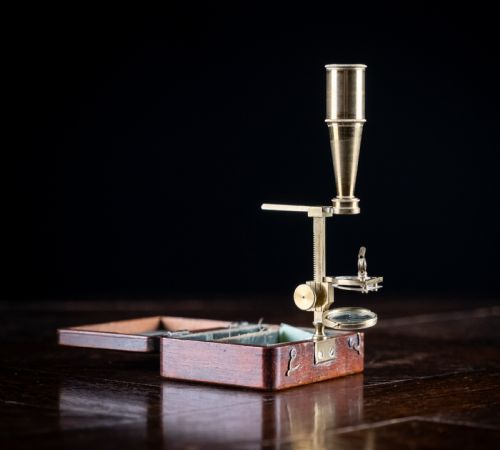
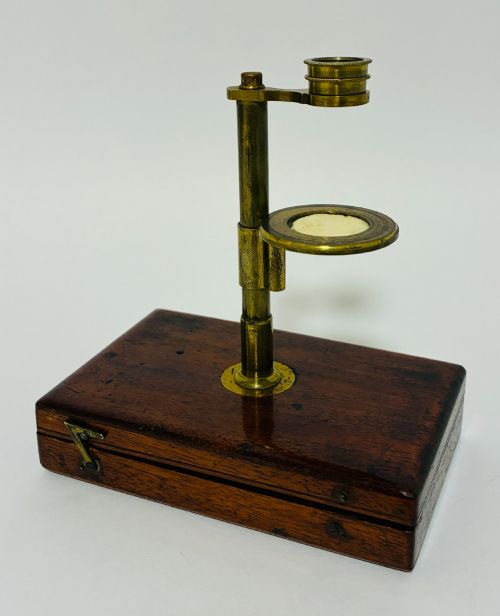
Antique Pocket Field Microscope, 1920
Priced at £75 from In A Nutshell Antiques and Interiors
Early antique microscopes were playthings for wealthy gentlemen. They sat in drawing rooms rather than laboratories.
Look for the shift in the nineteenth century. Instrument making became a serious commercial trade to supply medical students.
Most surviving Victorian examples date from after the Great Exhibition. Production scaled up rapidly to meet demand from natural history enthusiasts.
Compound lenses changed everything. Adding multiple lenses corrected colour distortion and allowed higher magnification without blurring the image.
Powell and Lealand operated in London from the 1840s to the early twentieth century. Their large antique microscopes are complex and highly engineered.
Carl Zeiss began producing optical instruments in Jena during the mid-nineteenth century. German lenses from this period have a solid reputation for clarity.
Note signatures on the tube. R. & J. Beck made thousands of instruments in London, ranging from simple student models to advanced binocular stands.
The 2026 retail price guide for Antique Microscopes is drawn from a proprietary archive of over 1.1 million retail prices indexed by Sellingantiques since 2003. This guide relies exclusively on their own internal data; no external sources or auction records are used.
Analysing nearly 25 years of UK antique market history alongside current retail values, the data indicates that typical UK retail prices for Antique Microscopes range between £200 and £1,600. Entry-level prices generally fall under £200 and premium examples upwards of £1,600.
A heavy foot keeps the instrument stable. This might be a solid brass disc or a Y-shaped tripod design.
Turn the coarse focus knobs. They operate a rack and pinion gear to move the main optical tube.
Mirrors sit below the stage to direct light. You often find a flat mirror on one side and a concave one on the back.
Early tubes were rolled by hand. Makers hammered flat sheet brass around a steel mandrel and soldered the seam.
Later components were turned on lathes. This allowed thicker brass to be cut with precise screw threads for interchangeable lenses.
Inspect the knurled adjustment knobs. Craftsmen cut these textured edges using specialised milling tools to give users a better grip.
"Many instruments were sold with tiny bone sliders. These contained prepared specimens like flea legs and plant stems ready for immediate viewing."
"Some bases fold flat. Travelling naturalists needed field models that could collapse neatly into pocket-sized mahogany boxes."
"A bullseye stand often sits beside the main instrument. This heavy glass lens concentrates lamplight onto solid objects for top illumination."
Based on almost 25 years of Sellingantiques UK antique market data, Antique Microscopes appeared 174 times (out of 1,100,000 antiques) which gives it a rarity score of 97/100.
This score measures scarcity within the Sellingantiques archive only and is not a survey of the entire antiques market, so these statistics may not be indicative of the general availability of Antique Microscopes elsewhere.
Leave the original lacquer alone. Using harsh metal polishes will strip away the historic golden finish and expose the raw brass underneath. This raw metal will then tarnish rapidly.
Dust the surface lightly with a soft brush. If you need to remove old grease from the mechanical gears, a cotton swab with a little mild solvent works well. Wipe dry immediately.
Those are prepared specimen slides. Victorian enthusiasts mounted insect parts, botanical sections, and diatoms onto glass slips and sealed them under thin cover slips. The paper wrappers protect the edges and provide space for handwritten descriptions.
These slides often tell a social history of their own. Many were prepared by professional mounters who sold them by the dozen to amateur naturalists.
Mirrors are frequently lost or broken over time. They were mounted on fragile pins and took the brunt of accidental knocks.
Finding an exact period replacement is difficult. Many collectors simply leave the substage mount empty rather than fitting a modern cosmetic replacement.
Cloudiness usually means the balsam cement between the glass lens elements has degraded. Nineteenth-century makers used Canada balsam to stick compound lenses together. Over time, this natural resin dries out, crystallises, or separates.
Another common cause is simple fungus growing on the glass. Spores thrive in dark, damp mahogany cases. A professional optical restorer can sometimes clean the elements and re-cement them, though the process requires specialised skills.
Never try to unscrew the tiny objective lenses yourself. They are set in very specific alignments and the brass threads are easily crossed.
Please note: This Antique Microscopes guide and its associated pricing data are provided for general informational purposes only. It does not constitute formal financial, investment, or appraisal advice and should not be relied upon as the sole basis for any commercial activity, purchasing, or sales decisions. Sellingantiques.co.uk accepts no liability for any actions taken in reliance on this information. Always consult with a qualified professional or independent appraiser.
