


A 2026 Guide by Sellingantiques
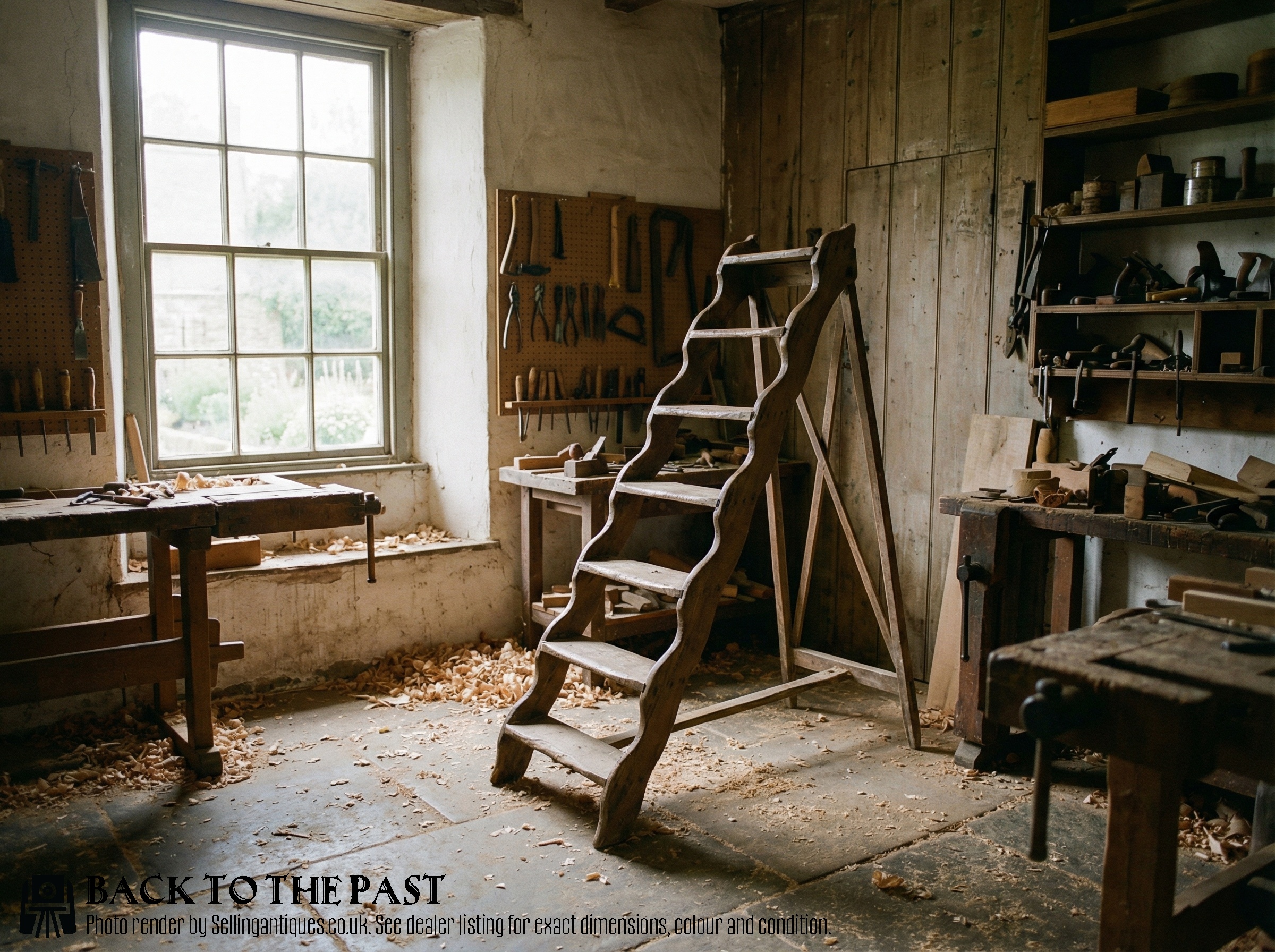
19th Century Pine Step Ladder, 19th Century
Priced at £700 from Elmgarden
Look at the heavy iron hinges on early estate steps. Blacksmiths forged these locally before industrial catalogues took over.
Mostly Victorian shop fittings or country house survivals. Earlier outdoor examples didn't survive the damp.
Library steps evolved alongside tall Georgian bookcases. Gentlemen required a dignified way to reach upper volumes.
Folding mechanisms became common later on. Space was tight in urban terrace houses and commercial stockrooms.
Documented makers are rare for agricultural examples. Local village carpenters built them to suit nearby fruit trees.
H.C. Slingsby began making commercial ladders during the 1890s. Heavy factory stamps mark the timber sides of their shop steps.
Gillows of Lancaster supplied mahogany library steps to the gentry. Complex folding mechanisms disguised the ladder as a stool.
The 2026 retail price guide for Antique Ladders is drawn from a proprietary archive of over 1.1 million retail prices indexed by Sellingantiques since 2003. This guide relies exclusively on their own internal data; no external sources or auction records are used.
Analysing nearly 25 years of UK antique market history alongside current retail values, the data indicates that typical UK retail prices for Antique Ladders range between £300 and £2,200. Entry-level prices generally fall under £300 and premium examples upwards of £2,200.
Notice the wear pattern on the wooden rungs. Genuine pieces usually show a clear hollow where boots landed.
Tall top handrails on some folding steps. This vertical pole gave balance to staff carrying boxes.
Original canvas or rope restraints sometimes survive on A-frame designs. These stop the back legs sliding on hard floors.
Early joints rely on tight mortise and tenon friction. Makers drove a wooden peg through the side to lock the rung.
Steel screws replaced wooden pegs by the late nineteenth century. Mass production required faster assembly methods for shop equipment.
Turn the piece over. Hand-planed tool marks survive underneath while the top surfaces wore smooth over the decades.
"Certain orchard ladders taper to a sharp point at the top. Fruit pickers wedged the apex securely into narrow branch forks."
"Metamorphic library steps hide in plain sight. They flip over on brass hinges to become an ordinary reading chair."
"Old shop ladders often glide on cast iron wheels. The brass track they ran along remains fixed to original shelving."
Based on almost 25 years of Sellingantiques UK antique market data, Antique Ladders appeared 902 times (out of 1,100,000 antiques) which gives it a rarity score of 83/100.
This score measures scarcity within the Sellingantiques archive only and is not a survey of the entire antiques market, so these statistics may not be indicative of the general availability of Antique Ladders elsewhere.
Most antique library ladders range from three to eight feet tall. Shorter folding steps served domestic studies, while the taller rolling models belonged in grand country house libraries.
Measure the vertical distance from your floor to the top shelf. You need a ladder tall enough to reach the highest books without standing on the final tread.
Many people repurpose old wooden steps as display shelving. The broad treads hold plant pots and books very well, provided the timber remains solid.
Check the joints where the treads meet the side stiles. If the wood is punky or the metal tie-rods wobble, it isn't safe for taking any real weight.
It is a piece of dual-purpose furniture. A typical metamorphic chair looks like a standard dining chair until you unlatch a catch.
The unfolded piece forms a short set of steps. This space-saving mechanism suited tight rooms.
You are describing traditional agricultural ladders. The flared base gives stability on uneven mud or grass, preventing the structure from tipping sideways while a worker stood near the top.
They saw heavy use in orchards for pruning and fruit picking. Farm labourers also used them for thatching roofs or loading hay lofts before mechanised lifting gear arrived.
Please note: This Antique Ladders guide and its associated pricing data are provided for general informational purposes only. It does not constitute formal financial, investment, or appraisal advice and should not be relied upon as the sole basis for any commercial activity, purchasing, or sales decisions. Sellingantiques.co.uk accepts no liability for any actions taken in reliance on this information. Always consult with a qualified professional or independent appraiser.
