


A 2026 Guide by Sellingantiques
Think about Victorian hallways. These stands emerged as domestic essentials when top hats and bonnets became daily wear for the middle classes.
Early examples often doubled as wig stands during the eighteenth century before headwear fashions shifted.
By the Edwardian era, many homes had an antique hat stand near the front door.
Commercial milliners relied on countertop versions to display their latest stock to passing window shoppers.
Thonet dominated the bentwood market during the late nineteenth century, making curving forms in Austrian factories.
English firms like James Shoolbred & Co supplied substantial oak and mahogany hall stands for middle-class Victorian homes.
Check the cast iron bases. Foundries like Coalbrookdale sometimes cast their maker marks and registration diamonds directly into the metal.
The 2026 retail price guide for Antique Hat Stands is drawn from a proprietary archive of over 1.1 million retail prices indexed by Sellingantiques since 2003. This guide relies exclusively on their own internal data; no external sources or auction records are used.
Analysing nearly 25 years of UK antique market history alongside current retail values, the data indicates that typical UK retail prices for Antique Hat Stands range between £300 and £1,400. Entry-level prices generally fall under £300 and premium examples upwards of £1,400.
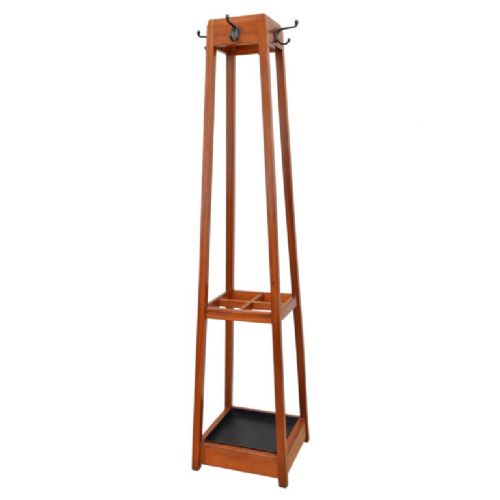
Most tall hall varieties incorporate a central column with radiating branches or pegs at the top.
Notice the rounded finials. They prevent sharp wooden edges from piercing felt or silk.
Tabletop stands frequently have adjustable telescopic stems to hold different brim widths.
Steam bending revolutionised production. Factories heated strips of ash or beech until pliable, forming loops and curves that traditional carving struggled to match.
Earlier wooden bases rely on heavy mortise and tenon joints to secure the thick central column.
Turners shaped smaller tabletop pieces on foot-treadle lathes, leaving visible tool marks underneath the base.
"Countertop millinery versions from the Edwardian period often hid tiny compartments in the base to hold price tickets or pins."
"Some taller wooden models break down into three or four threaded sections for easy transport by train."
"The spacing of pegs on larger hall stands was calculated to keep wide brims from knocking into each other."
Based on almost 25 years of Sellingantiques UK antique market data, Antique Hat Stands appeared 1027 times (out of 1,100,000 antiques) which gives it a rarity score of 81/100.
This score measures scarcity within the Sellingantiques archive only and is not a survey of the entire antiques market, so these statistics may not be indicative of the general availability of Antique Hat Stands elsewhere.
Wipe the metal with a soft dry cloth to remove loose dust. You want to preserve the dull, aged patina that builds up over a century.
Avoid liquid metal polishes. They leave a white powdery residue in the crevices and strip away the historical surface finish.
Turn the stand upside down and check the main joint. A loose nut on a threaded iron rod often causes the column to wobble. Tightening this gently with a spanner will usually pull the piece back upright.
If the base relies on wooden joints, the animal glue might have dried out and cracked. A furniture restorer can clean out the old adhesive and clamp it fresh without harming the external finish.
Most makers used beech or ash for these structures.
These species have long, straight grain structures that respond well to steam. This makes them pliable enough to bend into tight curves without snapping.
Not necessarily. Milliners pinned hats directly to those velvet domes thousands of times to secure them in the shop window. The damage is standard working wear rather than neglect.
Many buyers leave the original frayed silk or velvet alone. It tells the story of the object working on a shop counter.
Please note: This Antique Hat Stands guide and its associated pricing data are provided for general informational purposes only. It does not constitute formal financial, investment, or appraisal advice and should not be relied upon as the sole basis for any commercial activity, purchasing, or sales decisions. Sellingantiques.co.uk accepts no liability for any actions taken in reliance on this information. Always consult with a qualified professional or independent appraiser.
