
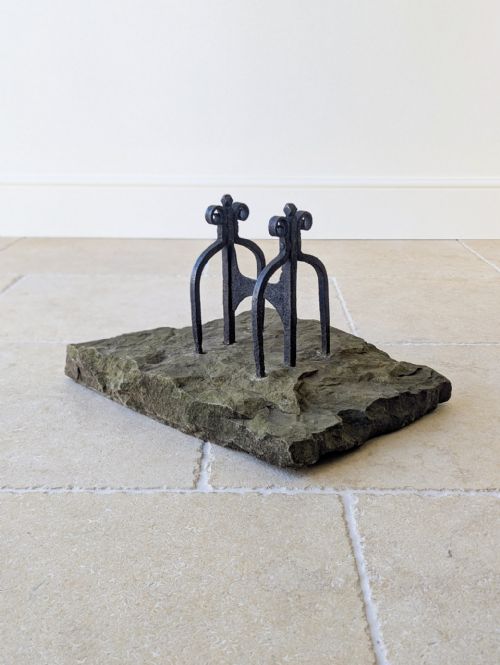


A 2026 Guide by Sellingantiques

Pair of 19th-century Country House Large Cast Iron Boot Scrapers, 1800
Priced at £395 from Rupert Landen Antiques
Unpaved streets and deep mud. That was the reality driving the need for antique boot scrapers during the eighteenth and nineteenth centuries.
Look at townhouses built after 1750. They often have scrapers built right into the stone steps or flanking the main door.
The arrival of paved roads and motorised transport eventually reduced the daily struggle with mud, making these metal guards less essential.
Factories expanded their catalogues massively during the Victorian period, creating hundreds of distinct scraper patterns for the growing middle classes.
Coalbrookdale in Shropshire dominated the trade in decorative cast iron from the mid-nineteenth century, producing highly detailed scraper patterns.
Archibald Kenrick & Sons of West Bromwich turned out thousands of domestic cast iron goods, often marking their scrapers underneath the tray.
Notice that many provincial pieces carry no maker's mark at all. Local blacksmiths supplied standard wrought iron shapes to their immediate area.
The 2026 retail price guide for Antique Boot Scrapers is drawn from a proprietary archive of over 1.1 million retail prices indexed by Sellingantiques since 2003. This guide relies exclusively on their own internal data; no external sources or auction records are used.
Analysing nearly 25 years of UK antique market history alongside current retail values, the data indicates that typical UK retail prices for Antique Boot Scrapers range between £200 and £600. Entry-level prices generally fall under £200 and premium examples upwards of £600.
A central horizontal blade is the defining element of any antique boot scraper.
Check the base tray on freestanding models. These pan sections catch the falling dirt and keep it off the porch floor.
Uprights often take architectural or natural forms, with lyre shapes, scrolls, and animal motifs appearing frequently on cast examples.
Early smiths hammered wrought iron on an anvil, creating tough but visually sparse frames assembled with rivets or collar joints.
Tap a cast iron piece gently. You will feel how sand casting allowed foundries to create heavy, solid forms in a single pour.
Assembly using threaded nuts. Later Victorian foundries sometimes cast the uprights and pan separately, bolting them together at the base.
"Some models incorporate flanking brushes alongside the metal blade to clean the sides of the shoe at the same time."
"Elaborate griffin and dog designs often served a dual purpose as both a scraper and a firm doorstop for heavy front doors."
"Built-in wall niches. Many Georgian architects designed dedicated recesses right into the brickwork specifically to house these iron scrapers neatly out of the way."
Based on almost 25 years of Sellingantiques UK antique market data, Antique Boot Scrapers appeared 187 times (out of 1,100,000 antiques) which gives it a rarity score of 96/100.
This score measures scarcity within the Sellingantiques archive only and is not a survey of the entire antiques market, so these statistics may not be indicative of the general availability of Antique Boot Scrapers elsewhere.
Free-standing models just sit on a flat surface. Their own weight keeps them stable while you scrape.
Wall-mounted or step-mounted types need setting. Masons drill holes into the stone, drop the iron lugs in, and pour molten lead to fix them fast.
You can. Most cast iron leaving the nineteenth-century foundries had a dark protective coat applied.
Use a wire brush to remove loose rust first. A rust-inhibiting metal primer followed by a tough exterior gloss helps prevent further deterioration outside.
Yes, those holes are typical for a fixed scraper. The original iron lugs sat inside them to anchor the frame.
Over time, frost or rust expansion can split the stone, or the iron simply snaps off from a heavy impact.
You can sometimes find replacement uprights with lugs that match the distance between your existing holes.
They sit outside. The tray catches the heavy mud falling from the blade, stopping it from spreading across the exterior porch tiles.
Bringing them indoors defeats their main purpose. People used them to remove the worst of the dirt before even touching the front door handle.
Please note: This Antique Boot Scrapers guide and its associated pricing data are provided for general informational purposes only. It does not constitute formal financial, investment, or appraisal advice and should not be relied upon as the sole basis for any commercial activity, purchasing, or sales decisions. Sellingantiques.co.uk accepts no liability for any actions taken in reliance on this information. Always consult with a qualified professional or independent appraiser.
