3,822  PAGES BROWSED TODAY PAGES TODAY 0 ANTIQUES UPLOADED TODAYNEW ARRIVALS
LATEST STOCK
Sort Order
Items Per Page
Browse Categories
Sort order
Items per page
ID #SA887577
SOLD
Email
Save
Late Eighteenth Century Hydrostatic Bubbles by Charles Aiano London
Jason Clarke Antiques
sold SA887577
Sorry, but this item has been sold.
Jason Clarke Antiques

Jason Clarke Antiques

Sellingantiques Verified Since Jul 2015
View Dealers Stock Page
Id #SA887577
PDF SHARE
SAVE

Late Eighteenth Century Hydrostatic Bubbles by Charles Aiano London

19th century
Description

For sale a rare set of late Eighteenth Century hydrostatic bubbles by Charles Aiano, London.

The early forefather of the more widely known Sikes hydrometer which was invented in 1802, these interesting instruments are also known as philosophical bubbles, specific gravity beads, aerometrical beads or hydrostatic beads. Described on the paper label affixed to the underside of the lid as ‘Hydrostatic Balls for Spirits’ they were invented in 1757 by Dr Alexander Wilson (1714-1786) a Scot who rose to become the first Professor of Practical Astronomy at Glasgow University and was a founder member of the Royal Society of Edinburgh.
A contemporary biographical account of Wilson’s life relates that in 1757:

“He invented the hydrostatical glass-bubbles, for determining the strength of spirituous liquors of all kinds, which long experience, especially among the distillers and merchant in the West Indies, has now shown to be more accurate and more commodious than the instruments formerly used. From the minutes of a Philosophical and Literary Society, composed of the Professors and some of their friends, whose meetings were held weekly in the college, it appears that these hydrostatical bubbles made the subject of a discourse delivered by Wilson in 1757. At this time he also showed how a single glass bubble may serve for estimating very small differences of specific gravity of fluids of the same kind, such as water taken from different springs, or the like. This he did by varying the temperature of such fluids, till the same bubble, when immersed, became stationary at every trial, and then expressing the differences of their specific gravity, by degrees of the thermometer, the value of which can be computed and stated in the usual manner”.

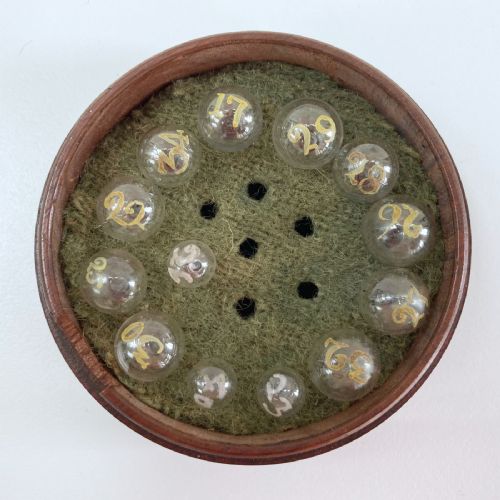
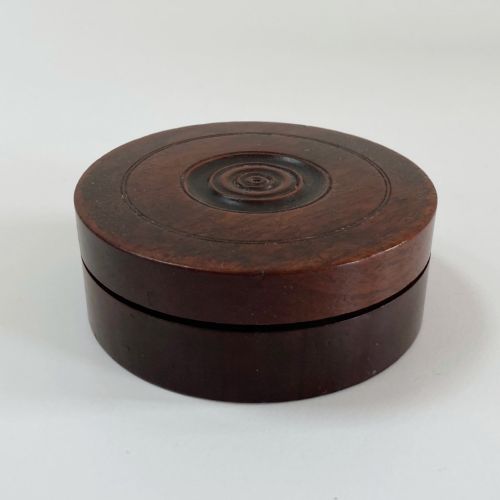
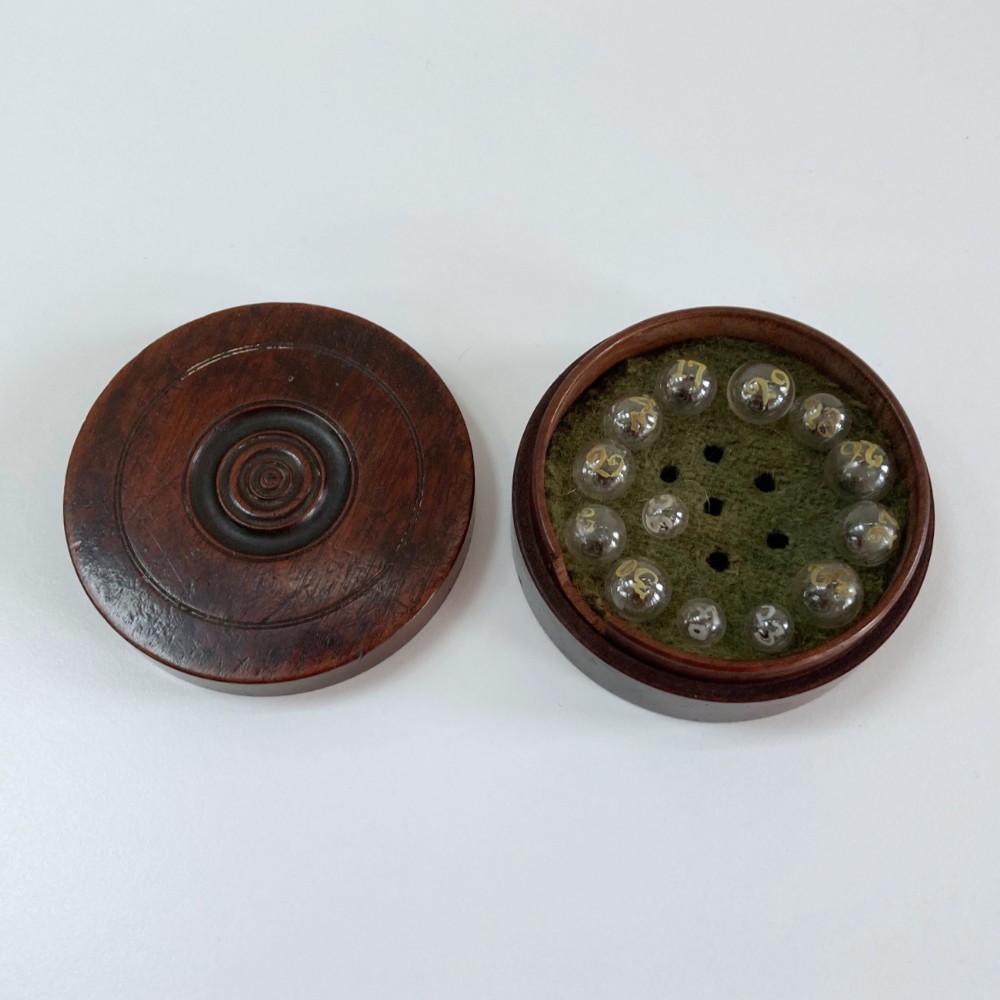
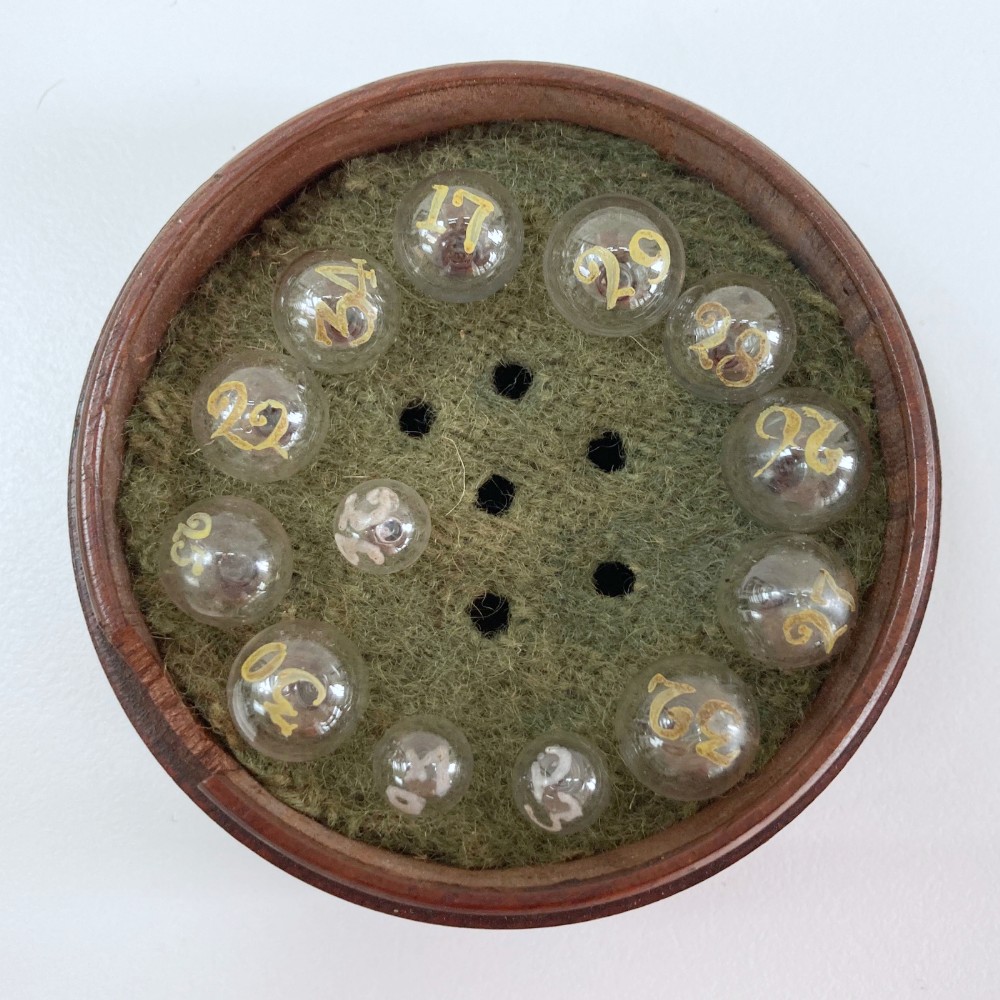
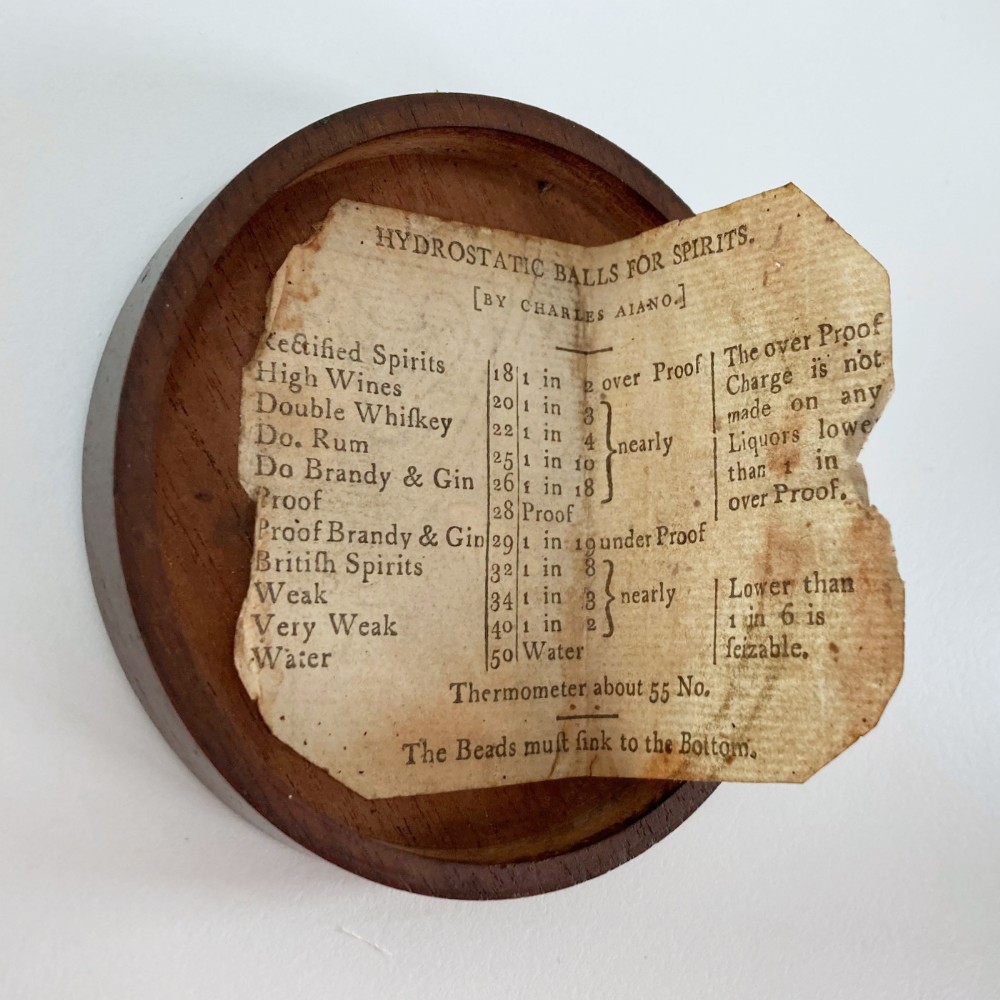
This particular set of hydrostatic bubbles is comprised of a turned mahogany case with a diameter of three and a half inches. The removal of the lid reveals a set of 13 glass bubbles and 19 holes (six bubbles are missing or were never present) with a paper label denoting the various proof levels for the types of spirits being measured. The glass bubbles themselves consist of a bulb end with differing sizes of glass stalk and a corresponding number engraved to the top. The paper label states,
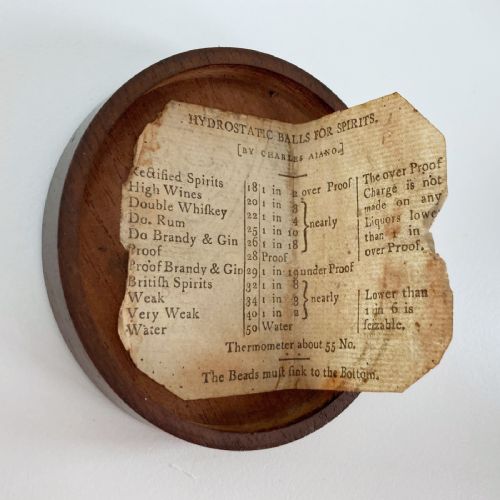
“Hydrostatic Ball for Spirits by Charles Aiano” and lists various spirits including wines, whiskey, rum, brandy & gin with notes on which bubbles are required for the measurement and the thermometer temperature required for the liquids to be measured.
The maker, Charles Aiano is a name more often associated with barometers and he is one of the most recognisable names amongst those early Italian makers whose families emigrated to the UK at the end of the Eighteenth Century. Although Aiano was born in Canterbury in 1784, his family hailed from the Northern regions of Italy around Lake Como. His early apprenticeship into the instrument making industry is not well understood but it is certain that he trained and then traded in London for the majority of his career. Numerous barometers bear his London signature and he made various unusual examples including multi-tube variations and angle barometers amongst the standard wheel and stick designs of the period.

For reasons unknown, Charles is registered back in Canterbury by 1826 and records show that he continued to trade and live there until his death in 1859.

A rare set, and unusual as they are normally accompanied with Scottish makers labels rather than London ones. Please note, there is a small area of wood missing from the rim of the bottom of the case, a common fault with these which has been considered within the price.

Circa 1795

Physical Dimensions
Height
3.5cm (1.38")
Width
9cm (3.54")
Depth
9cm (3.54")
Declaration

Jason Clarke Antiques has dated this piece to the 1800s.

Reference Numbers
Sellingantiques Reference
SA887577
Description
For sale a rare set of late Eighteenth Century hydrostatic bubbles by Charles Aiano, London.

The early forefather of the more widely known Sikes hydrometer which was invented in 1802, these interesting instruments are also known as philosophical bubbles, specific gravity beads, aerometrical beads or hydrostatic beads. Described on the paper label affixed to the underside of the lid as ‘Hydrostatic Balls for Spirits’ they were invented in 1757 by Dr Alexander Wilson (1714-1786) a Scot who rose to become the first Professor of Practical Astronomy at Glasgow University and was a founder member of the Royal Society of Edinburgh.

fig 1. Late Eighteenth Century Hydrostatic Bubbles by Charles Aiano London

A contemporary biographical account of Wilson’s life relates that in 1757:

“He invented the hydrostatical glass-bubbles, for determining the strength of spirituous liquors of all kinds, which long experience, especially among the distillers and merchant in the West Indies, has now shown to be more accurate and more commodious than the instruments formerly used. From the minutes of a Philosophical and Literary Society, composed of the Professors and some of their friends, whose meetings were held weekly in the college, it appears that these hydrostatical bubbles made the subject of a discourse delivered by Wilson in 1757. At this time he also showed how a single glass bubble may serve for estimating very small differences of specific gravity of fluids of the same kind, such as water taken from different springs, or the like. This he did by varying the temperature of such fluids, till the same bubble, when immersed, became stationary at every trial, and then expressing the differences of their specific gravity, by degrees of the thermometer, the value of which can be computed and stated in the usual manner”.

This particular set of hydrostatic bubbles is comprised of a turned mahogany case with a diameter of three and a half inches.
Jason Clarke Antiques

The removal of the lid reveals a set of 13 glass bubbles and 19 holes (six bubbles are missing or were never present) with a paper label denoting the various proof levels for the types of spirits being measured. The glass bubbles themselves consist of a bulb end with differing sizes of glass stalk and a corresponding number engraved to the top. The paper label states,

fig 2. Late Eighteenth Century Hydrostatic Bubbles by Charles Aiano London

“Hydrostatic Ball for Spirits by Charles Aiano” and lists various spirits including wines, whiskey, rum, brandy & gin with notes on which bubbles are required for the measurement and the thermometer temperature required for the liquids to be measured.

fig 3. Late Eighteenth Century Hydrostatic Bubbles by Charles Aiano London

The maker, Charles Aiano is a name more often associated with barometers and he is one of the most recognisable names amongst those early Italian makers whose families emigrated to the UK at the end of the Eighteenth Century. Although Aiano was born in Canterbury in 1784, his family hailed from the Northern regions of Italy around Lake Como. His early apprenticeship into the instrument making industry is not well understood but it is certain that he trained and then traded in London for the majority of his career. Numerous barometers bear his London signature and he made various unusual examples including multi-tube variations and angle barometers amongst the standard wheel and stick designs of the period.

For reasons unknown, Charles is registered back in Canterbury by 1826 and records show that he continued to trade and live there until his death in 1859.

A rare set, and unusual as they are normally accompanied with Scottish makers labels rather than London ones. Please note, there is a small area of wood missing from the rim of the bottom of the case, a common fault with these which has been considered within the price.

Circa 1795

Height
3.5cm (1.38")
Width
9cm (3.54")
Depth
9cm (3.54")
Date of Manufacture

Jason Clarke Antiques has dated this piece to the 1800s.

Reference Numbers
Sellingantiques Ref
SA887577
Jason Clarke Antiques
Sellingantiques verified Since Jul 2015
Dealer Profile

You can view the stock and full dealer information on the Jason Clarke Antiques Profile Page
PDF SHARE
SAVE
Late Eighteenth Century Hydrostatic Bubbles by Charles Aiano London
1 / 4
Archive I Late Eighteenth Century Hydrostatic Bubbles by Charles Aiano London
Late Eighteenth Century Hydrostatic Bubbles by Charles Aiano London

Archive II Late Eighteenth Century Hydrostatic Bubbles by Charles Aiano London View II
Archive III Late Eighteenth Century Hydrostatic Bubbles by Charles Aiano London View III
Archive IV Late Eighteenth Century Hydrostatic Bubbles by Charles Aiano London View IV
Enlarged Archival View
Telephone 07815 046645
Location
Newbury
Berkshire
United Kingdom
Verified Since Jul 2015
Items For Sale 80
Items Sold 607
Jason Clarke Antiques
Verified Since Jul 2015
View Dealer Info
Location: Newbury, Berkshire, United Kingdom
Verified
Jul 2015
For Sale
80
Sold
607
Late Eighteenth Century Hydrostatic Bubbles by Charles Aiano London
Ref: SA887577
Late Eighteenth Century Hydrostatic Bubbles by Charles Aiano London
Detail View 1
Detail View 2
Detail View 3
Archival Detail
Every single antique dealer on our platform is individually approved by our internal team. We verify their professional trade history, ethical standards, and photographic quality to ensure a secure, high-standard buying environment. Upon joining, every dealer agrees to a strict 9-point code of conduct. While issues can occasionally arise, our dealers typically resolve them swiftly and directly with the buyer. In fact, since our founding in 2002, Sellingantiques has only had to step in to help resolve an issue on roughly five occasions—a true testament to the quality of our dealers and their dedication to your happiness.
Our dealers are highly experienced in packing and shipping fragile, high-value antiques. Because you are in direct contact with the dealer, you will be able to easily go through all available shipping and insurance options together to ensure your item arrives safely.
Antiques are the ultimate green purchase. By choosing historical pieces over newly manufactured goods, you completely eliminate the carbon footprint of modern mass production while preserving exceptional, timeless craftsmanship.
items
Add keywords to the filter
Price
£100
£250000
Era
Movements
Material
Origin
Stock Location
Freshness
Online Payments
Categories