57,384  PAGES BROWSED TODAY PAGES TODAY 59 ANTIQUES UPLOADED TODAYNEW ARRIVALS
59 ITEMS ADDED TODAY
Sort Order
Items Per Page
Browse Categories
Sort order
Relevant Links
Items per page
ID #SA802279
FOR SALE
£250
Email Buy
Save
Pair of Victorian Staffordshire Flat Back Spill Holders
Gertrude Antiques
for sale €293     $318
£250

Gertrude Antiques

Sellingantiques Verified Since Dec 2016
View Dealers Stock Page
Id #SA802279
PDF SHARE
SAVE

Pair of Victorian Staffordshire Flat Back Spill Holders

19th century
Description

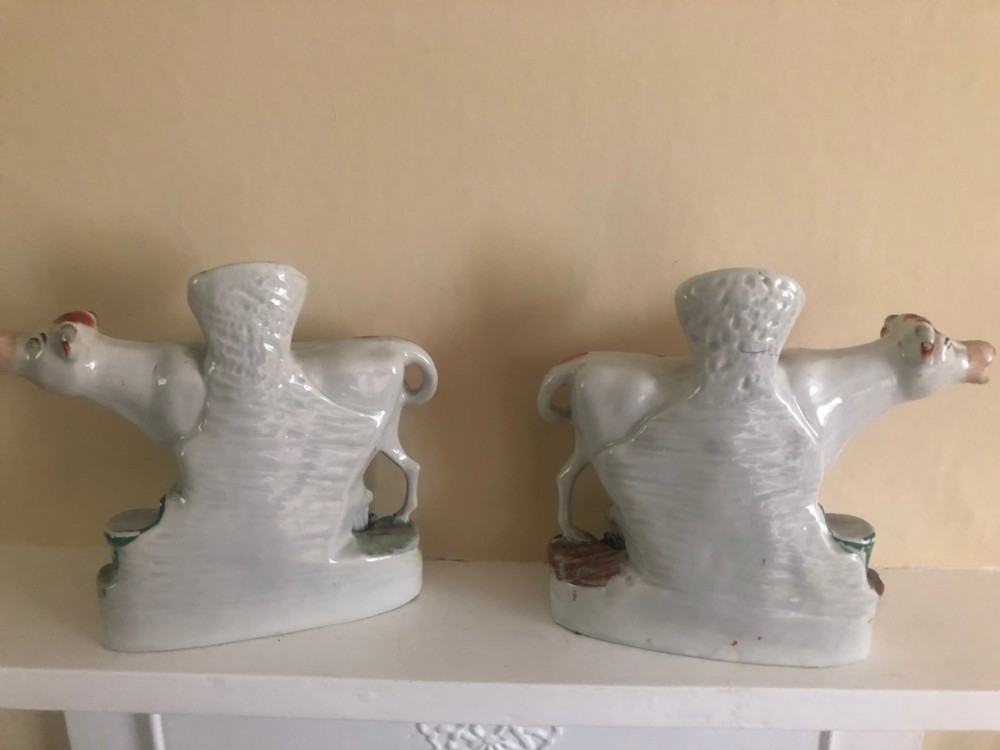
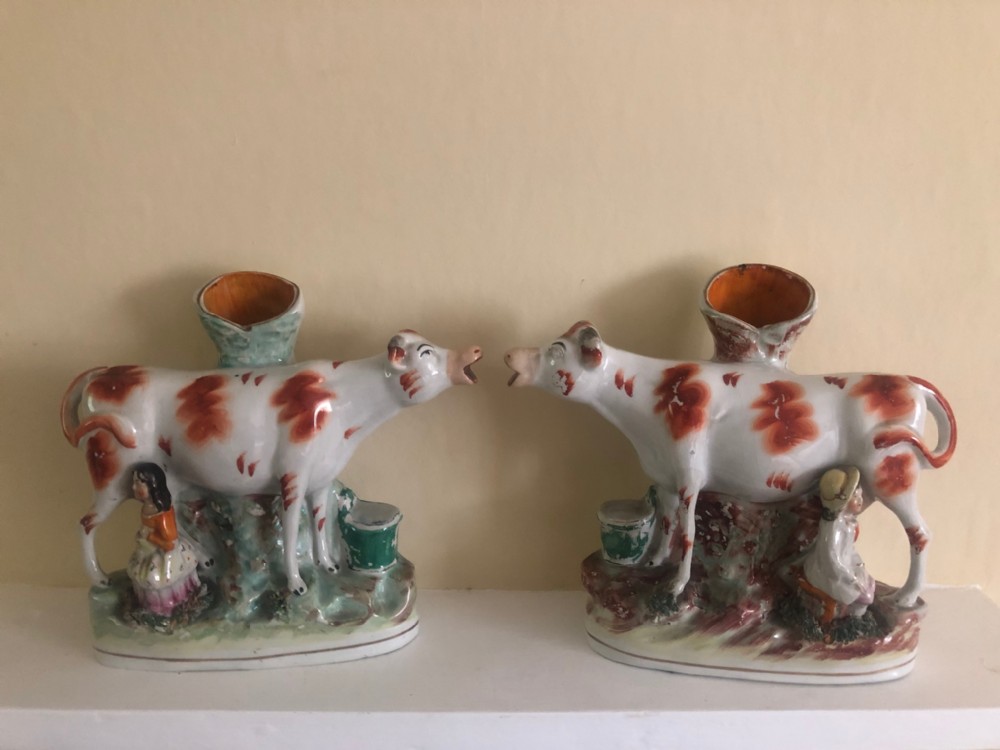
A charming pair of Victorian Staffordshire spill holders featuring russet and white cows being milked by a boy and a girl respectively. Set on a base painted naturalistically with tussocks of grass. Gilding to the rim of the spill vase and the base, also to boy's sleeves. Spill vase in the shape of a tree trunk.

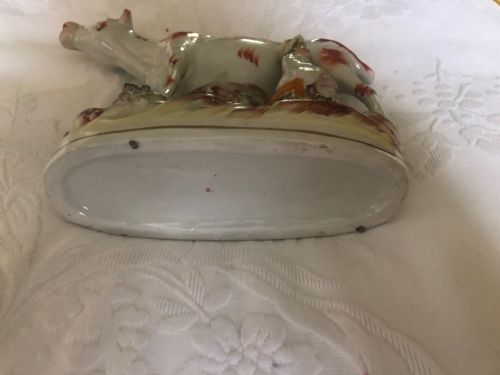
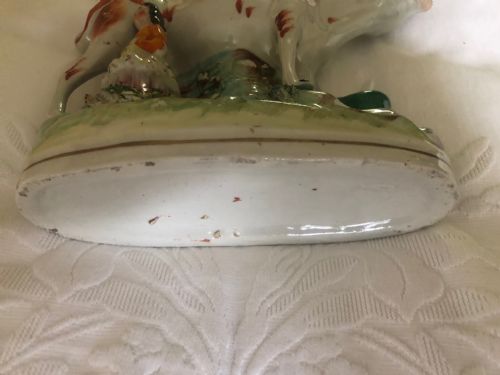
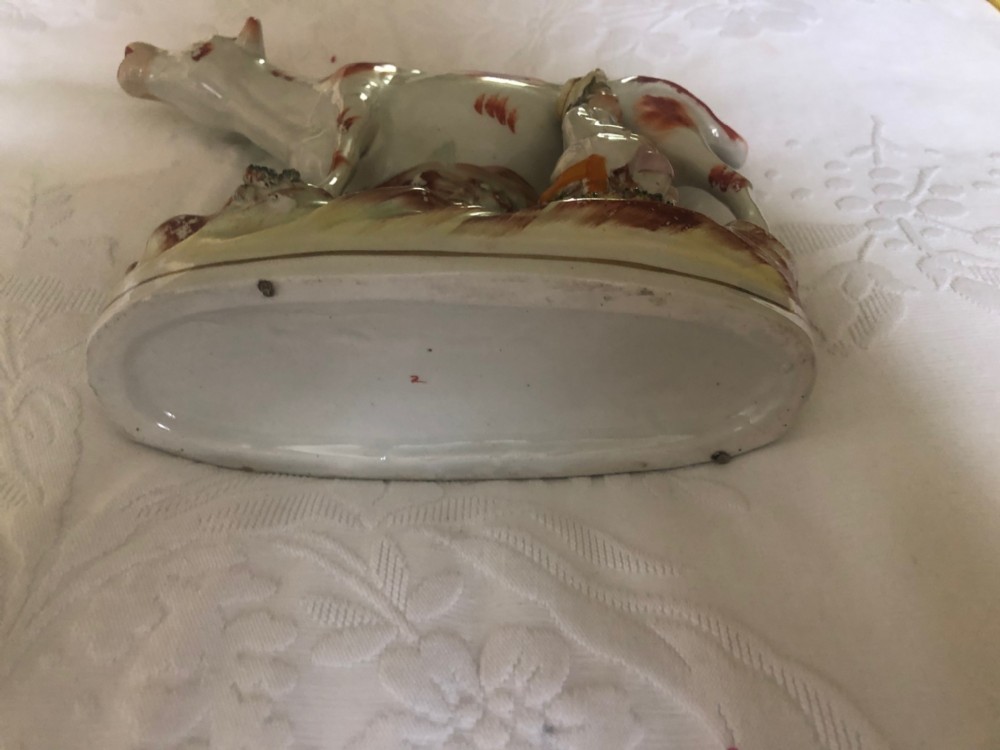
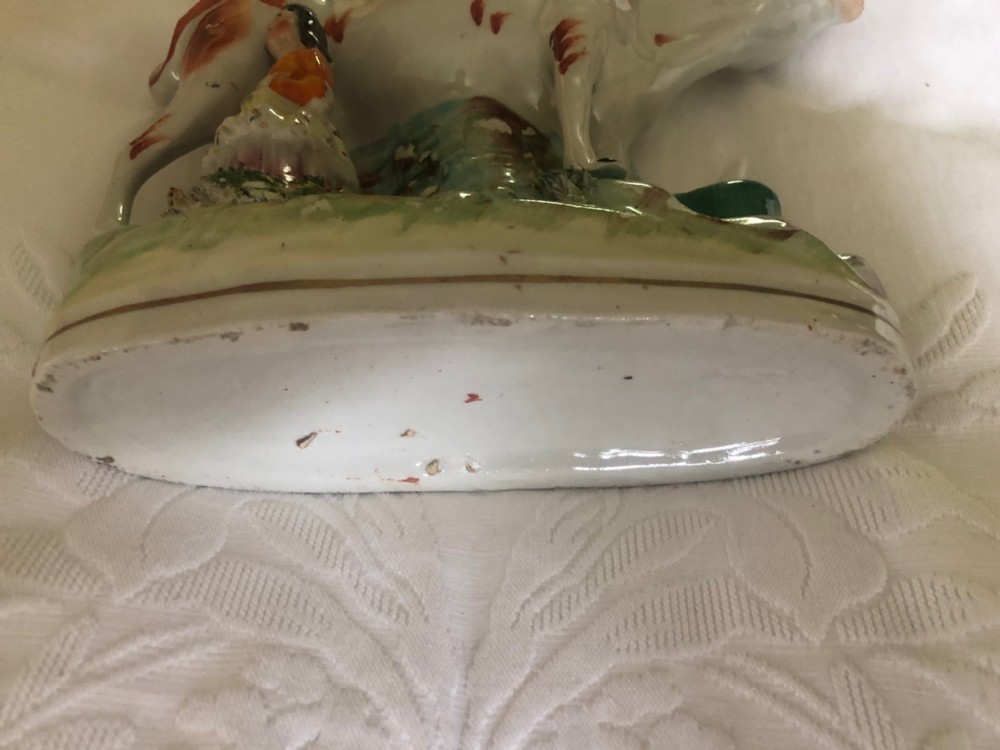
Condition: Gilding still good on bases and rim of spill vase. Cow with boy showing some wear to paint - specifically the russett patches on the cow - commensurate with age. Small chip to top of spill holder at the back. Some crazing typical of age. Cow with girl milkmaid shows much less wear to the paint, and some crazing typical of age.
Book reference: Victorian Staffordshire Figures 1815-1875 (Book 2) by A & N Harding page 160, fig: 2.

A combination of the right clays, inventive potters such as Josiah Wedgwood and available labour made the Staffordshire district the centre of the china industry. Many small forgotten factories as well as the giants such as Spode, Wedgwood, Adams, clustered in the towns of Burslem, Cobridge, Fenton, Longton, Stoke and Tunstall, now incorporated in the present day town of Stoke-on-Trent.
England’s Industrial Revolution coincided almost exactly with the start of Queen Victoria's reign in 1837, creating wealth from industry. The new middle classes were eager to emulate their betters by decorating their homes with objects similar to costly Meissen and Chelsea figures, and Staffordshire potters obliged by turning out painted and glazed pottery greyhounds, houses, sheep, dogs, cattle and more exotic animals such as zebras and elephants. Figures of gods and goddesses, examples drawn from literature, famous political and military men and above all, representations of royalty, all found homes in England and America.
All of the items that we advertise for sale have been as accurately described as possible and are in excellent condition, unless otherwise stated. Please note that we are also able to arrange a full shipping service for our customers. We offer a 14 day returns policy. In the unlikely event that you are not completely satisfied with your purchase we will issue a full refund of the purchase price less the return transport costs with an approved courier once an item is received by us in the same condition as it was originally dispatched. We look forward to being of service.

Physical Dimensions
Height
22cm (8.66")
Width
24cm (9.45")
Declaration

Gertrude Antiques has dated these Staffordshire Cow Spill Vases to the 1880s.

Reference Numbers
Sellingantiques Reference
SA802279
Dealers Internal Reference
10268
Description
A charming pair of Victorian Staffordshire spill holders featuring russet and white cows being milked by a boy and a girl respectively. Set on a base painted naturalistically with tussocks of grass. Gilding to the rim of the spill vase and the base, also to boy's sleeves. Spill vase in the shape of a tree trunk.

Condition: Gilding still good on bases and rim of spill vase.

Cow with boy showing some wear to paint - specifically the russett patches on the cow - commensurate with age.
Gertrude Antiques

Small chip to top of spill holder at the back. Some crazing typical of age. Cow with girl milkmaid shows much less wear to the paint, and some crazing typical of age.

fig 1. A pair of Victorian ceramic flat-back spill holders depicting rust-brown and white cows standing beside tree-trunk shaped vases with small figures at their feet.
fig 1. Pair of Victorian Staffordshire Flat Back Spill Holders

Book reference: Victorian Staffordshire Figures 1815-1875 (Book 2) by A & N Harding page 160, fig: 2.

A combination of the right clays, inventive potters such as Josiah Wedgwood and available labour made the Staffordshire district the centre of the china industry. Many small forgotten factories as well as the giants such as Spode, Wedgwood, Adams, clustered in the towns of Burslem, Cobridge, Fenton, Longton, Stoke and Tunstall, now incorporated in the present day town of Stoke-on-Trent.

fig 2. A pair of Victorian ceramic flat-back spill holders depicting rust-brown and white cows standing beside tree-trunk shaped vases with small figures at their feet.
fig 2. Pair of Victorian Staffordshire Flat Back Spill Holders

England’s Industrial Revolution coincided almost exactly with the start of Queen Victoria's reign in 1837, creating wealth from industry. The new middle classes were eager to emulate their betters by decorating their homes with objects similar to costly Meissen and Chelsea figures, and Staffordshire potters obliged by turning out painted and glazed pottery greyhounds, houses, sheep, dogs, cattle and more exotic animals such as zebras and elephants. Figures of gods and goddesses, examples drawn from literature, famous political and military men and above all, representations of royalty, all found homes in England and America.

fig 3. A pair of Victorian ceramic flat-back spill holders depicting rust-brown and white cows standing beside tree-trunk shaped vases with small figures at their feet.
fig 3. Pair of Victorian Staffordshire Flat Back Spill Holders

All of the items that we advertise for sale have been as accurately described as possible and are in excellent condition, unless otherwise stated. Please note that we are also able to arrange a full shipping service for our customers. We offer a 14 day returns policy. In the unlikely event that you are not completely satisfied with your purchase we will issue a full refund of the purchase price less the return transport costs with an approved courier once an item is received by us in the same condition as it was originally dispatched. We look forward to being of service.

Height
22cm (8.66")
Width
24cm (9.45")
Date of Manufacture

Gertrude Antiques has dated these Staffordshire Cow Spill Vases to the 1880s.

Reference Numbers
Sellingantiques Ref
SA802279
Dealers Internal Ref
10268
Gertrude Antiques
Sellingantiques verified Since Dec 2016
Dealer Profile

You can view the stock and full dealer information on the Gertrude Antiques Profile Page
PDF SHARE
SAVE
A pair of Victorian ceramic flat-back spill holders depicting rust-brown and white cows standing beside tree-trunk shaped vases with small figures at their feet.
1 / 4
Archive I A pair of Victorian ceramic flat-back spill holders depicting rust-brown and white cows standing beside tree-trunk shaped vases with small figures at their feet.

Pair of Victorian Staffordshire Flat Back Spill Holders
Archive II A pair of Victorian ceramic flat-back spill holders depicting rust-brown and white cows standing beside tree-trunk shaped vases with small figures at their feet. View II
Archive III A pair of Victorian ceramic flat-back spill holders depicting rust-brown and white cows standing beside tree-trunk shaped vases with small figures at their feet. View III
Archive IV A pair of Victorian ceramic flat-back spill holders depicting rust-brown and white cows standing beside tree-trunk shaped vases with small figures at their feet. View IV
Enlarged Archival View
Telephone 07786 022 538
Location
East Sussex
United Kingdom
Verified Since Dec 2016
Items For Sale 74
Items Sold 126
Gertrude Antiques
Verified Since Dec 2016
View Dealer Info
Location: East Sussex, United Kingdom
Verified
Dec 2016
For Sale
74
Sold
126
A pair of Victorian ceramic flat-back spill holders depicting rust-brown and white cows standing beside tree-trunk shaped vases with small figures at their feet.
Pair of Victorian Staffordshire Flat Back Spill Holders
Ref: SA802279
A pair of Victorian ceramic flat-back spill holders depicting rust-brown and white cows standing beside tree-trunk shaped vases with small figures at their feet.
Detail View 1
Detail View 2
Detail View 3
Archival Detail
Every single antique dealer on our platform is individually approved by our internal team. We verify their professional trade history, ethical standards, and photographic quality to ensure a secure, high-standard buying environment. Upon joining, every dealer agrees to a strict 9-point code of conduct. While issues can occasionally arise, our dealers typically resolve them swiftly and directly with the buyer. In fact, since our founding in 2002, Sellingantiques has only had to step in to help resolve an issue on roughly five occasions—a true testament to the quality of our dealers and their dedication to your happiness.
Our dealers are highly experienced in packing and shipping fragile, high-value antiques. Because you are in direct contact with the dealer, you will be able to easily go through all available shipping and insurance options together to ensure your item arrives safely.
Antiques are the ultimate green purchase. By choosing historical pieces over newly manufactured goods, you completely eliminate the carbon footprint of modern mass production while preserving exceptional, timeless craftsmanship.

Spill holders were popular nineteenth-century household vessels designed to hold thin wooden splints or rolled paper spills used to transfer fire from a hearth to candles or pipes. Staffordshire potteries produced these items in large quantities, featuring flat rear surfaces so they could sit flush against a fireplace mantelpiece.

These ornaments were produced using earthenware clay press-moulded into hollow forms. After an initial bisque firing, workers applied lead glazes and hand-painted enamel details, often finishing pieces with overglaze polychrome colours and gilding.

Authentic period examples typically display an unglazed or roughly finished flat back with a small firing hole to prevent exploding in the kiln. They generally exhibit fine glaze crazing, soft wear to the overglaze paint, and a lightweight construction compared to modern reproductions.

These decorative ceramics are commonly arranged in symmetrical pairs along a fireplace mantelpiece, within a traditional dresser display, or alongside books on open shelving to introduce historical folk art charm into modern spaces.

Dust ceramics regularly with a soft, dry microfibre cloth. Avoid immersing cold-painted or overglaze-decorated earthenware in water, and never use abrasive chemical cleaners, as these can strip original paintwork and gilding.
items
Add keywords to the filter
Price
£100
£250000
Era
Movements
Material
Origin
Stock Location
Freshness
Online Payments
Categories