10,613  PAGES BROWSED TODAY PAGES TODAY 51 ANTIQUES UPLOADED TODAYNEW ARRIVALS
51 ITEMS ADDED TODAY
Sort Order
Items Per Page
Browse Categories
Sort order
Items per page
ID #SA754957
SOLD
Email
Save
Cased George III Pantograph by Dudley Adams of Fleet Street London
Jason Clarke Antiques
sold SA754957
Sorry, but this item has been sold.
Jason Clarke Antiques

Jason Clarke Antiques

Sellingantiques Verified Since Jul 2015
View Dealers Stock Page
Id #SA754957
PDF SHARE
SAVE

Cased George III Pantograph by Dudley Adams of Fleet Street London

19th century
Description

For sale, a George III mahogany cased pantograph by Dudley Adams of Fleet Street, London.

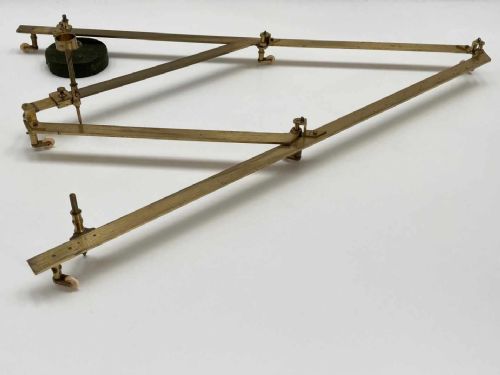
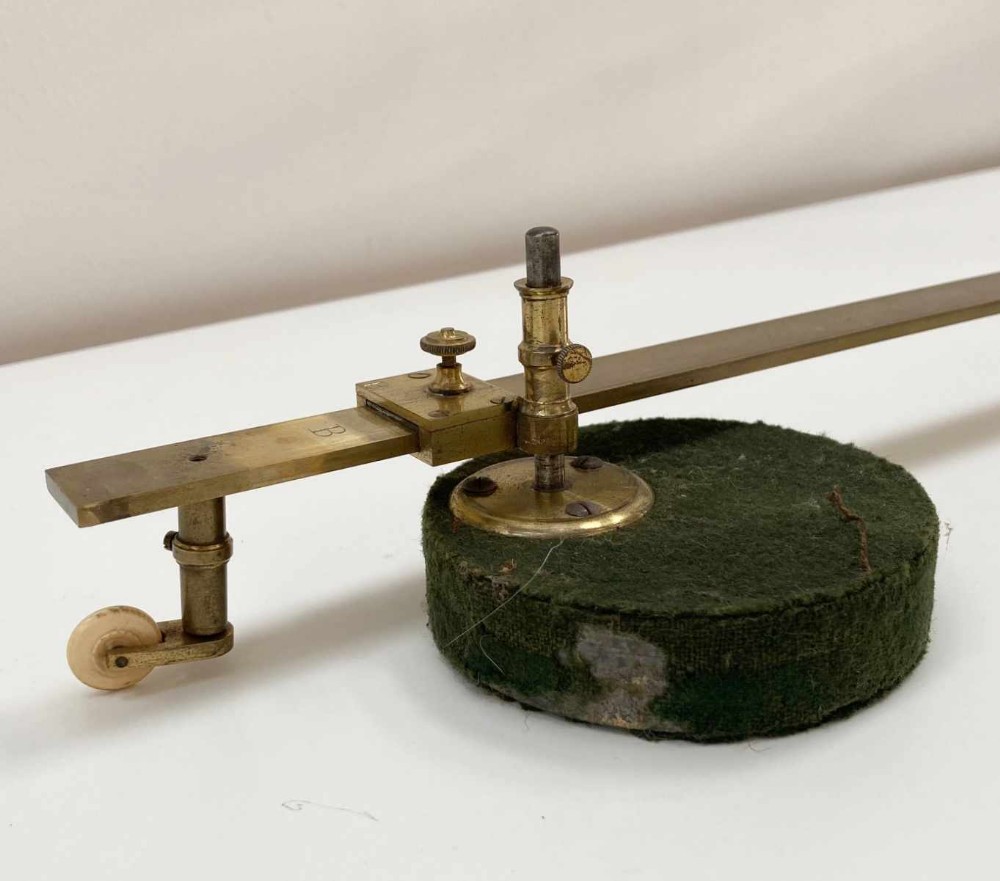
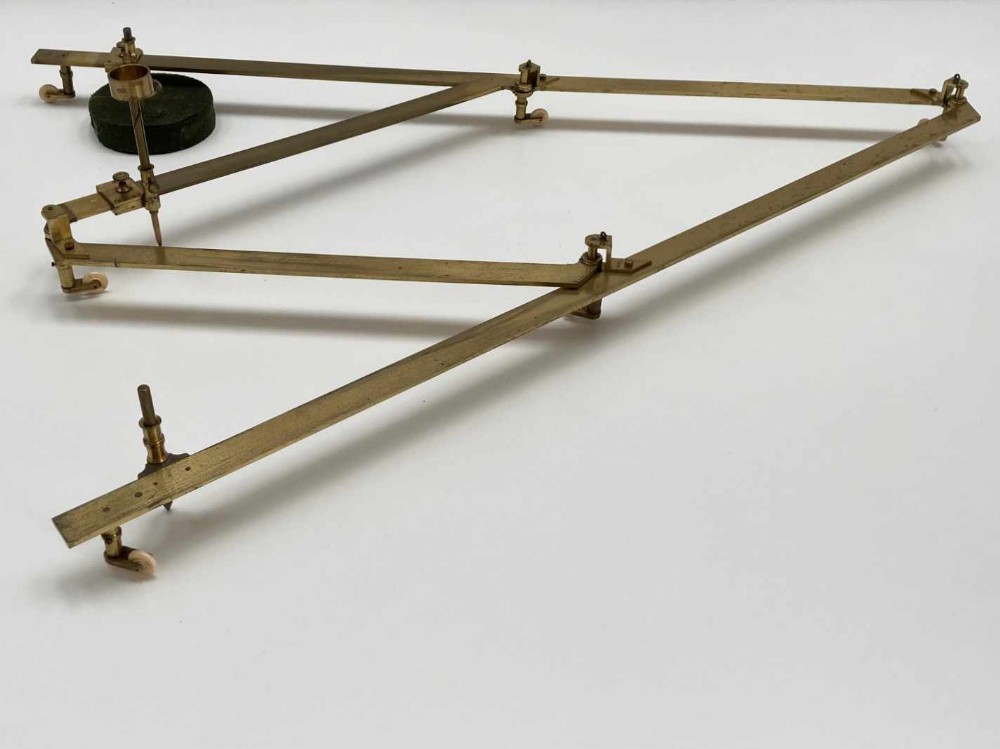
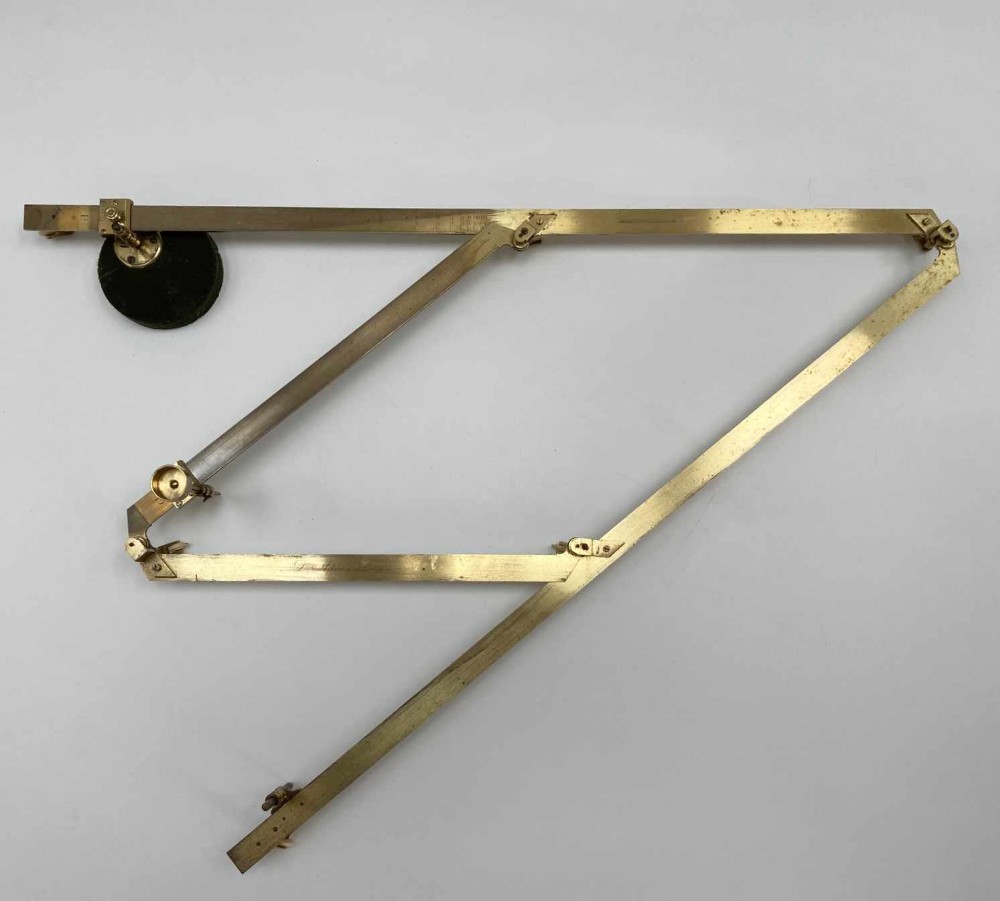
Comprised of four original lacquered brass bars connected together to form a central parallelogram. The extended limbs either end have a fixed lead weight at one end to create a fixed point for the instrument with the other containing a pencil holder. The central axis between has a secondary pen holder from which an original drawing can be traced. The movement of the central pen on the mechanism causes the pencil at the far end to trace an exact image but in enlarged form.
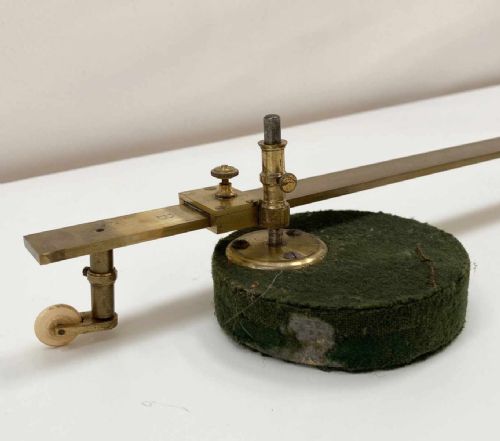
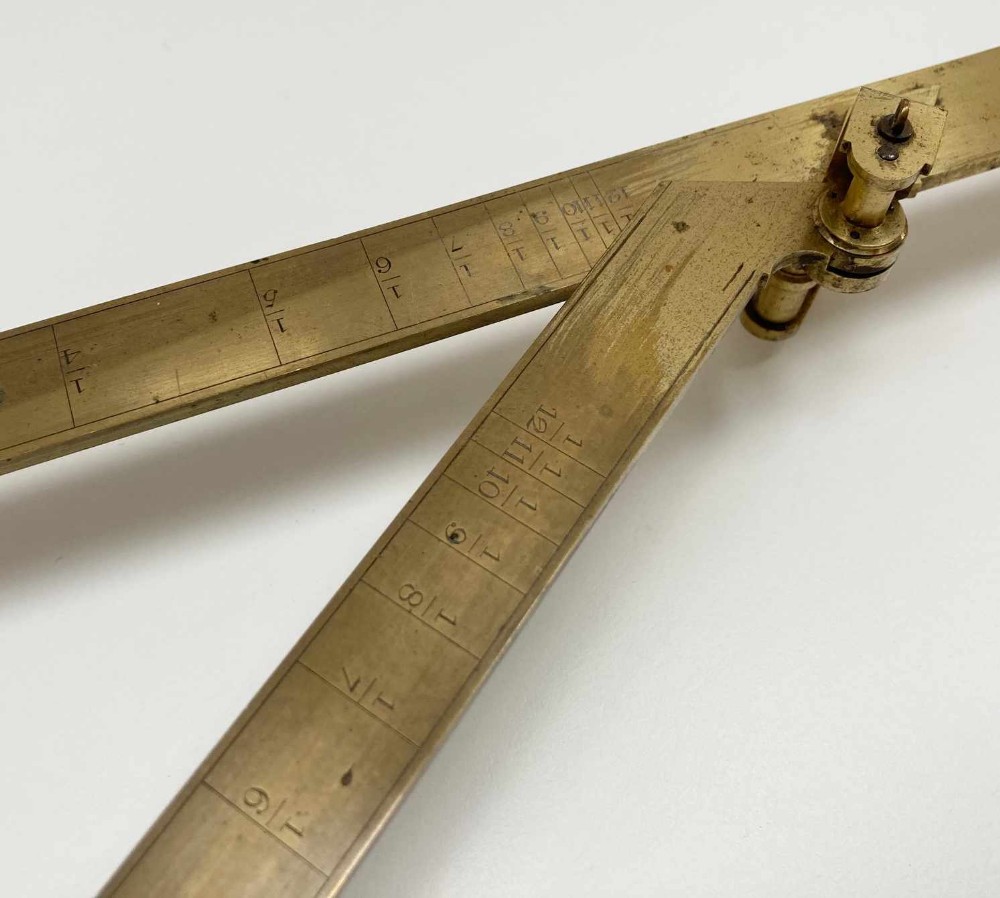
Both the lead weighted fixed point and the central pencil hold can be side adjusted along the bar length in order to inform the scale of the enlarged copy being produced.

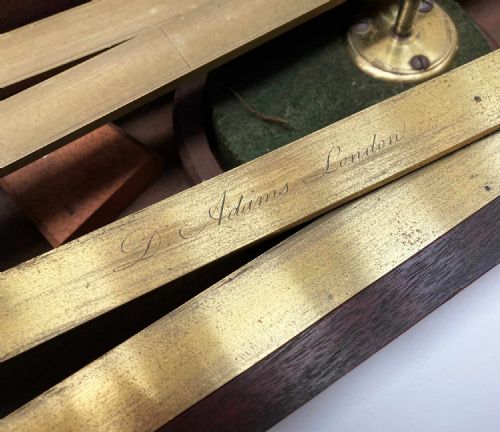
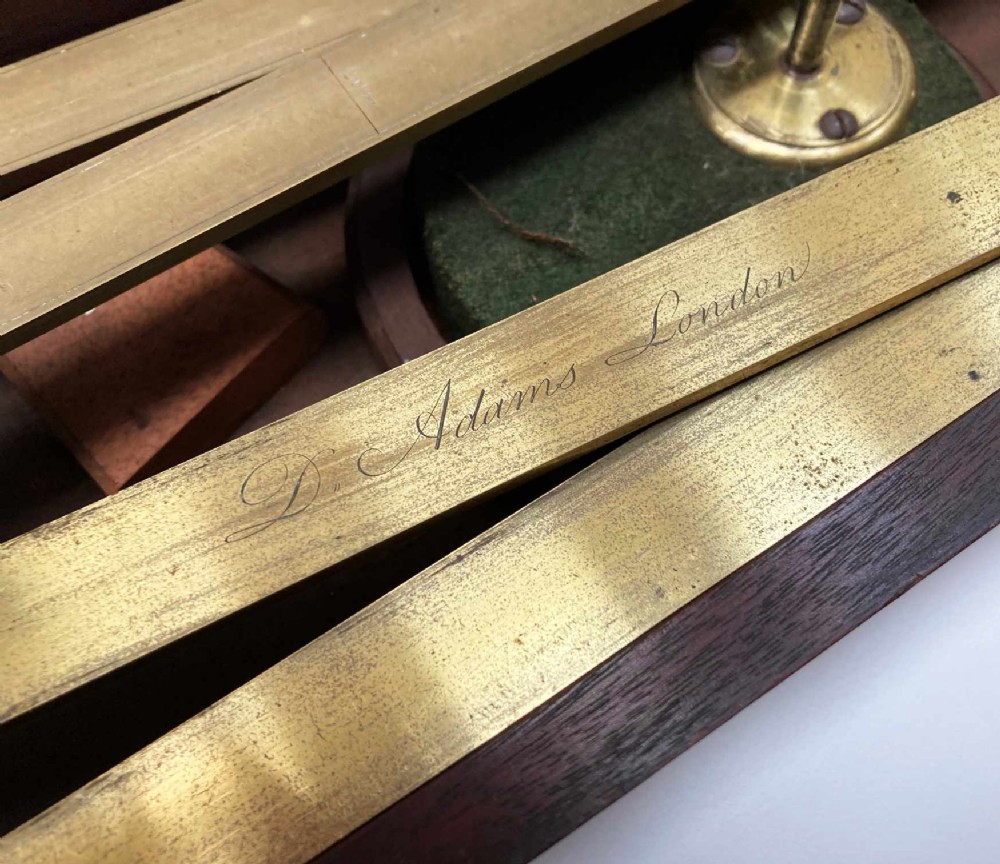
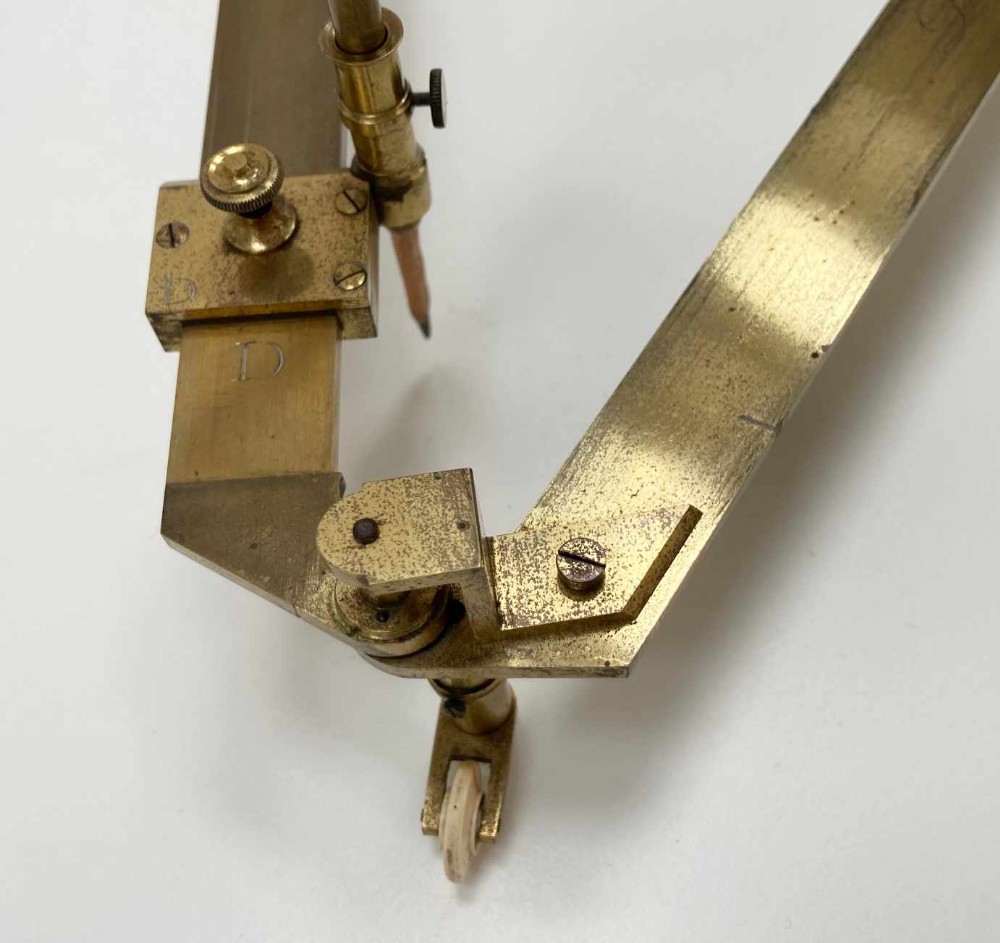
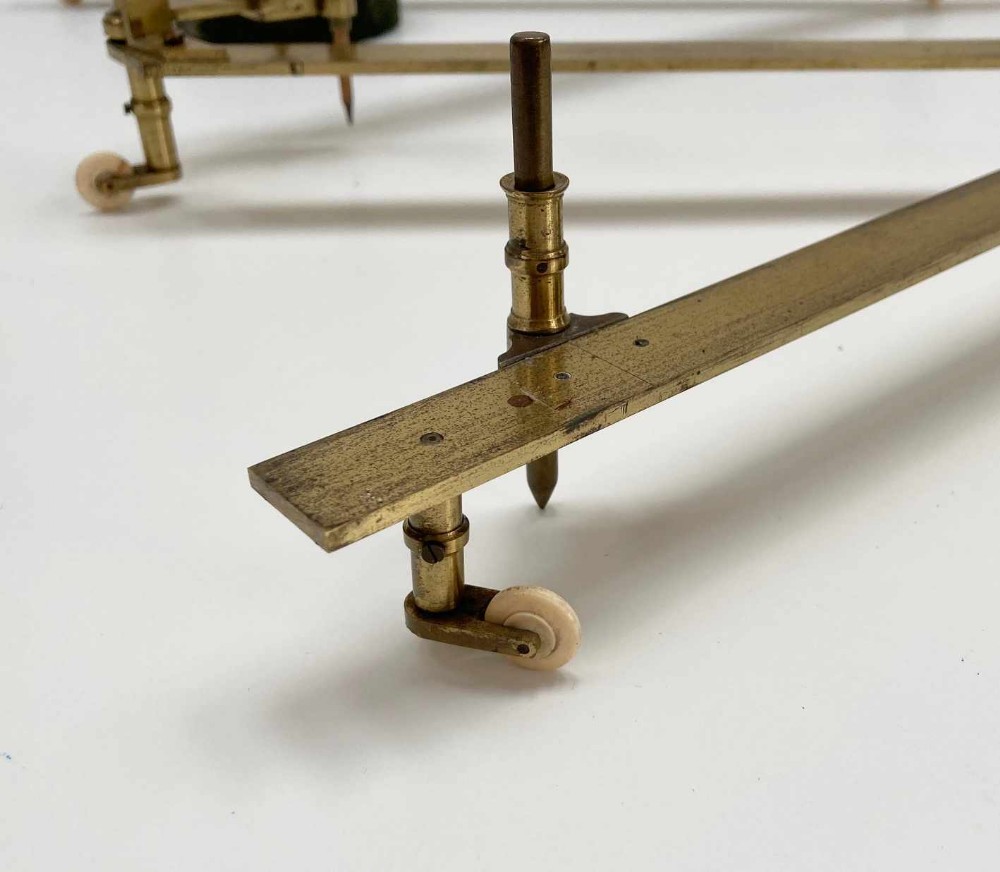
This example is in excellent condition with superb quality brass workmanship and much of its original lacquer remaining. It comes complete with its original bone castor feet and baize covered lead weight. It is engraved along one limb simply to, “Dudley Adams, London” and has further scale measurements for accurate setting and adjustment of the instrument.
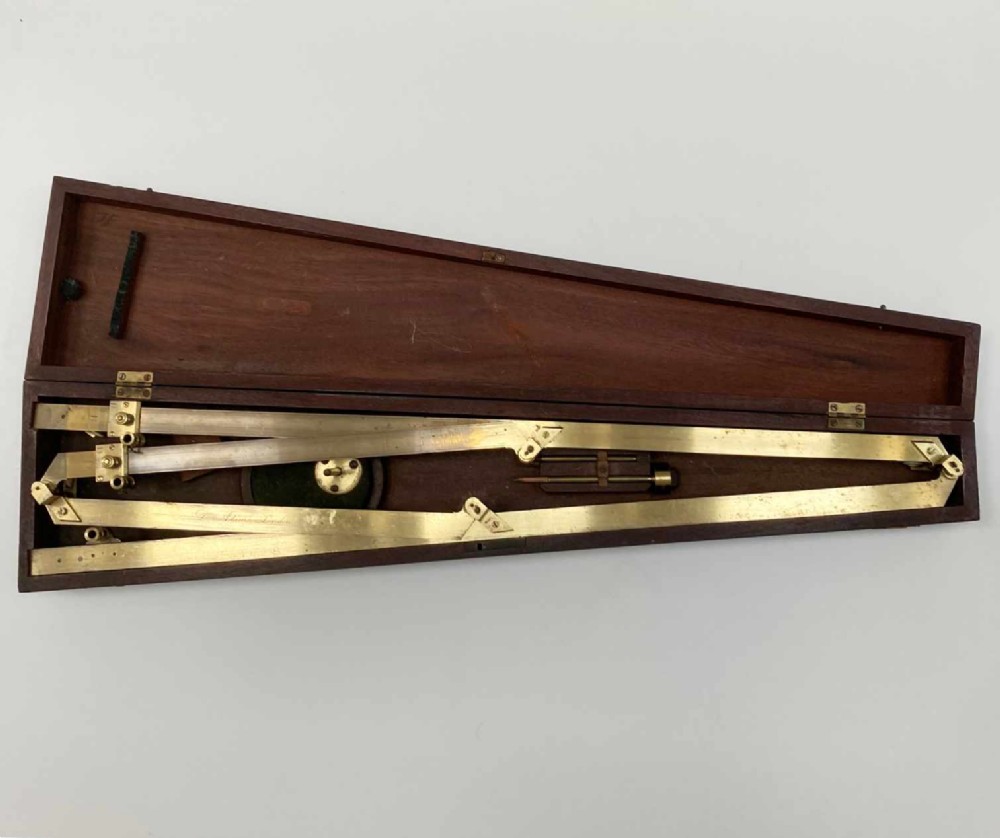
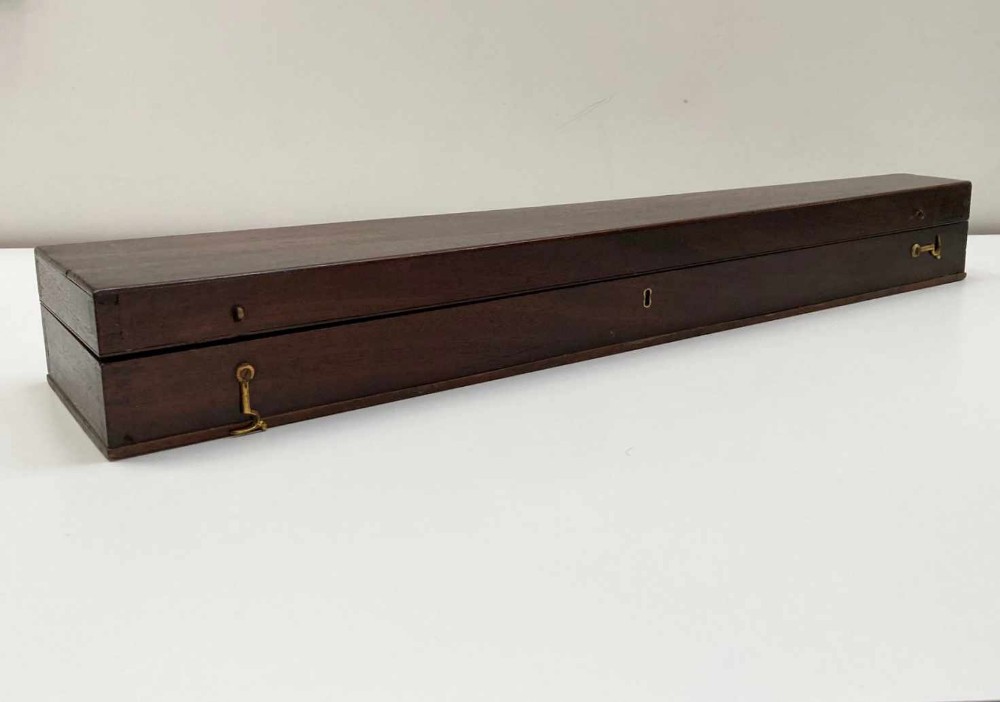
The mahogany hinged and fitted case also remains in super condition, a lovely example from one of London’s most eminent scientific instrument making families.

The founder of this dynasty was George Adams Senior, born in Fleet Street London in 1709 to Morris and Mary Adams. His Father was a freeman of London and belonged to the Loriner’s Company and although he was a liveryman, was actually a cook by trade. At the age of fifteen (1724), George was apprenticed to a James Parker, a mathematical instrument maker of the Grocer’s Company for a premium of £20. His initial two years were not without difficulty as his father Morris died the following year leaving George, his mother Mary and two further children without support and the following year also saw the death of his master. By good fortune, George was turned over to a new master Thomas Heath who had by then been trading on The Strand for just six years but ran a successful and enterprising establishment and his adverts from the period attest to the wide range of instruments that the young Adams would have been tasked to manufacture. On completion of his seven year tenure, he chose to continue his work for Heath, only being granted his freedom of the Grocer’s Company in 1733 by which point his mother had also passed away. It is likely then that the proceeds of his parent’s estate was the catalyst for George Adams to begin trading in his own right.
The establishment of his business at the sign of Tycho Brahe’s Head on Fleet Street was close to his home in Shoe Lane but he joined a community of already established scientific instrument makers in that area and could guarantee a certain amount of passing trade from the positioning. He also kept up his ties with Thomas Heath which is evidenced from dual advertisements that were taken out by the pair in the mid-1730’s. His prominence as an instrument maker really took off in the 1740’s where he began to undertake work for both The Board of Ordnance and The East India Company. It was also the decade in which the microscope began to ascend in its popularity and Adams, seeing an opportunity, undertook to write the first of his two famous publications. This initial publication, “Micrographia Illustrata” was introduced in 1746 at the same time as his New Universal Microscope and must have been timed to support his instrument’s release to the market but the book was in its majority a compilation of many previously known publications but served to provide his audience with instruction and a full account of the possible uses to which this instrument could be applied.

Tragedy struck Adams again in the same year with his wife Ann’s death, leaving him with two young daughters and records of his duties as churchwarden would suggest that he threw him

Physical Dimensions
Height
8cm (3.15")
Width
12cm (4.72")
Depth
53cm (20.87")
Declaration

Jason Clarke Antiques has dated this piece to the 1800s.

Reference Numbers
Sellingantiques Reference
SA754957
Description
For sale, a George III mahogany cased pantograph by Dudley Adams of Fleet Street, London.

Comprised of four original lacquered brass bars connected together to form a central parallelogram.

The extended limbs either end have a fixed lead weight at one end to create a fixed point for the instrument with the other containing a pencil holder.
Jason Clarke Antiques

The central axis between has a secondary pen holder from which an original drawing can be traced. The movement of the central pen on the mechanism causes the pencil at the far end to trace an exact image but in enlarged form.

fig 1. Cased George III Pantograph by Dudley Adams of Fleet Street London

Both the lead weighted fixed point and the central pencil hold can be side adjusted along the bar length in order to inform the scale of the enlarged copy being produced.

This example is in excellent condition with superb quality brass workmanship and much of its original lacquer remaining. It comes complete with its original bone castor feet and baize covered lead weight. It is engraved along one limb simply to, “Dudley Adams, London” and has further scale measurements for accurate setting and adjustment of the instrument.

fig 2. Cased George III Pantograph by Dudley Adams of Fleet Street London

The mahogany hinged and fitted case also remains in super condition, a lovely example from one of London’s most eminent scientific instrument making families.

The founder of this dynasty was George Adams Senior, born in Fleet Street London in 1709 to Morris and Mary Adams. His Father was a freeman of London and belonged to the Loriner’s Company and although he was a liveryman, was actually a cook by trade. At the age of fifteen (1724), George was apprenticed to a James Parker, a mathematical instrument maker of the Grocer’s Company for a premium of £20. His initial two years were not without difficulty as his father Morris died the following year leaving George, his mother Mary and two further children without support and the following year also saw the death of his master. By good fortune, George was turned over to a new master Thomas Heath who had by then been trading on The Strand for just six years but ran a successful and enterprising establishment and his adverts from the period attest to the wide range of instruments that the young Adams would have been tasked to manufacture. On completion of his seven year tenure, he chose to continue his work for Heath, only being granted his freedom of the Grocer’s Company in 1733 by which point his mother had also passed away. It is likely then that the proceeds of his parent’s estate was the catalyst for George Adams to begin trading in his own right.

fig 3. Cased George III Pantograph by Dudley Adams of Fleet Street London

The establishment of his business at the sign of Tycho Brahe’s Head on Fleet Street was close to his home in Shoe Lane but he joined a community of already established scientific instrument makers in that area and could guarantee a certain amount of passing trade from the positioning. He also kept up his ties with Thomas Heath which is evidenced from dual advertisements that were taken out by the pair in the mid-1730’s. His prominence as an instrument maker really took off in the 1740’s where he began to undertake work for both The Board of Ordnance and The East India Company. It was also the decade in which the microscope began to ascend in its popularity and Adams, seeing an opportunity, undertook to write the first of his two famous publications. This initial publication, “Micrographia Illustrata” was introduced in 1746 at the same time as his New Universal Microscope and must have been timed to support his instrument’s release to the market but the book was in its majority a compilation of many previously known publications but served to provide his audience with instruction and a full account of the possible uses to which this instrument could be applied.

Tragedy struck Adams again in the same year with his wife Ann’s death, leaving him with two young daughters and records of his duties as churchwarden would suggest that he threw him

Height
8cm (3.15")
Width
12cm (4.72")
Depth
53cm (20.87")
Date of Manufacture

Jason Clarke Antiques has dated this piece to the 1800s.

Reference Numbers
Sellingantiques Ref
SA754957
Jason Clarke Antiques
Sellingantiques verified Since Jul 2015
Dealer Profile

You can view the stock and full dealer information on the Jason Clarke Antiques Profile Page
PDF SHARE
SAVE
Cased George III Pantograph by Dudley Adams of Fleet Street London
1 / 9
Archive I Cased George III Pantograph by Dudley Adams of Fleet Street London
Cased George III Pantograph by Dudley Adams of Fleet Street London
Archive II Cased George III Pantograph by Dudley Adams of Fleet Street London View II
Archive III Cased George III Pantograph by Dudley Adams of Fleet Street London View III
Archive IV Cased George III Pantograph by Dudley Adams of Fleet Street London View IV
Archive V Cased George III Pantograph by Dudley Adams of Fleet Street London View V
Archive VI Cased George III Pantograph by Dudley Adams of Fleet Street London View VI
Archive VII Cased George III Pantograph by Dudley Adams of Fleet Street London View VII
Archive VIII Cased George III Pantograph by Dudley Adams of Fleet Street London View VIII
Archive IX Cased George III Pantograph by Dudley Adams of Fleet Street London View IX
Enlarged Archival View
Telephone 07815 046645
Location
Newbury
Berkshire
United Kingdom
Verified Since Jul 2015
Items For Sale 80
Items Sold 607
Jason Clarke Antiques
Verified Since Jul 2015
View Dealer Info
Location: Newbury, Berkshire, United Kingdom
Verified
Jul 2015
For Sale
80
Sold
607
Cased George III Pantograph by Dudley Adams of Fleet Street London
Ref: SA754957
Cased George III Pantograph by Dudley Adams of Fleet Street London
Detail View 1
Detail View 2
Detail View 3
Detail View 4
Detail View 5
Detail View 6
Detail View 7
Detail View 8
Archival Detail
Every single antique dealer on our platform is individually approved by our internal team. We verify their professional trade history, ethical standards, and photographic quality to ensure a secure, high-standard buying environment. Upon joining, every dealer agrees to a strict 9-point code of conduct. While issues can occasionally arise, our dealers typically resolve them swiftly and directly with the buyer. In fact, since our founding in 2002, Sellingantiques has only had to step in to help resolve an issue on roughly five occasions—a true testament to the quality of our dealers and their dedication to your happiness.
Our dealers are highly experienced in packing and shipping fragile, high-value antiques. Because you are in direct contact with the dealer, you will be able to easily go through all available shipping and insurance options together to ensure your item arrives safely.
Antiques are the ultimate green purchase. By choosing historical pieces over newly manufactured goods, you completely eliminate the carbon footprint of modern mass production while preserving exceptional, timeless craftsmanship.
items
Add keywords to the filter
Price
£100
£250000
Era
Movements
Material
Origin
Stock Location
Freshness
Online Payments
Categories