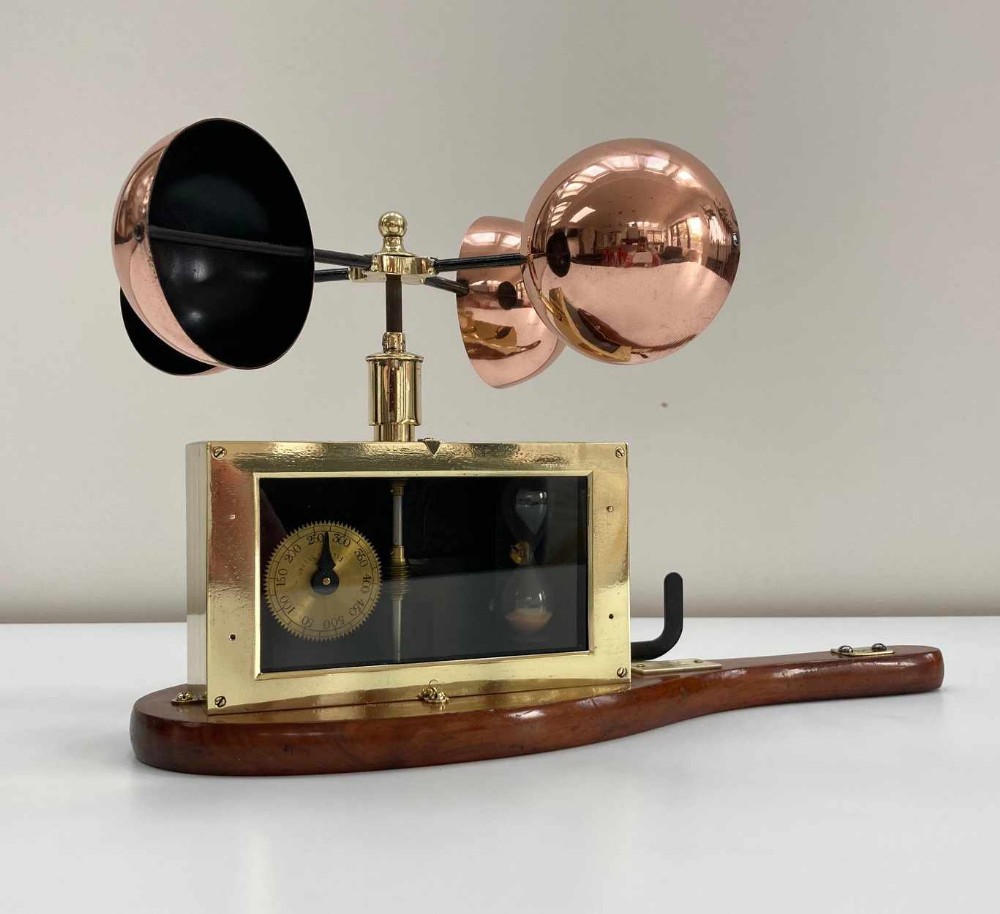
Jason Clarke Antiques has dated this piece to the 1890s.
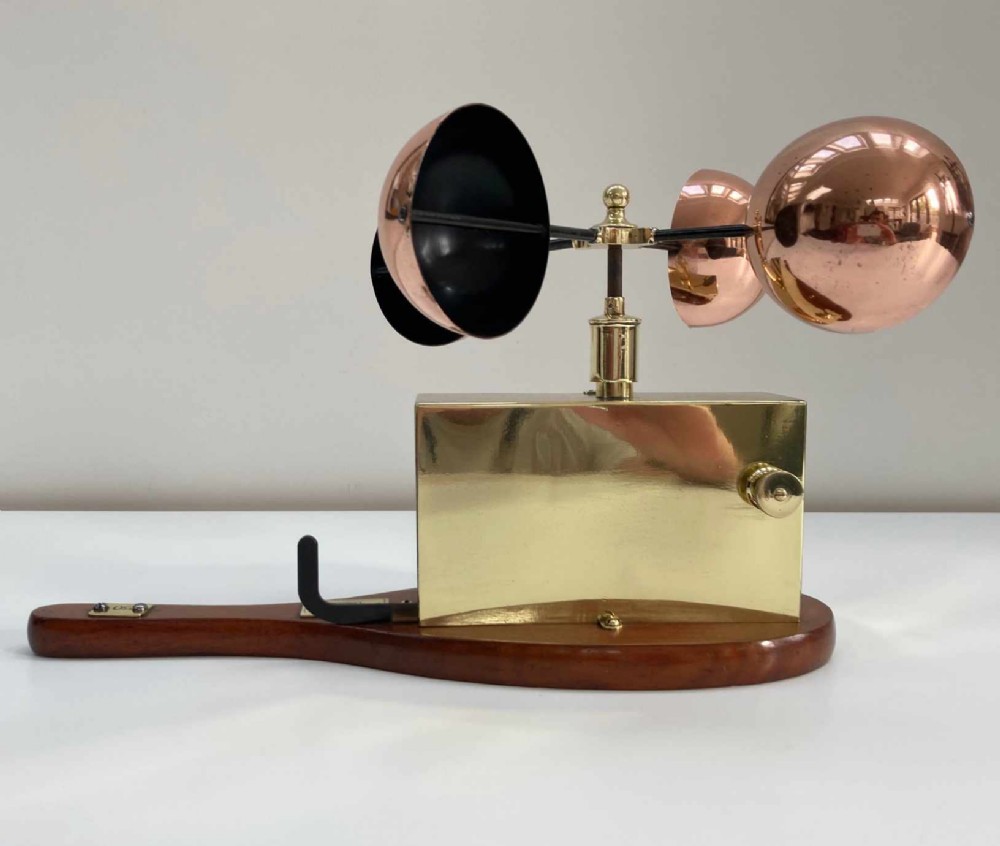
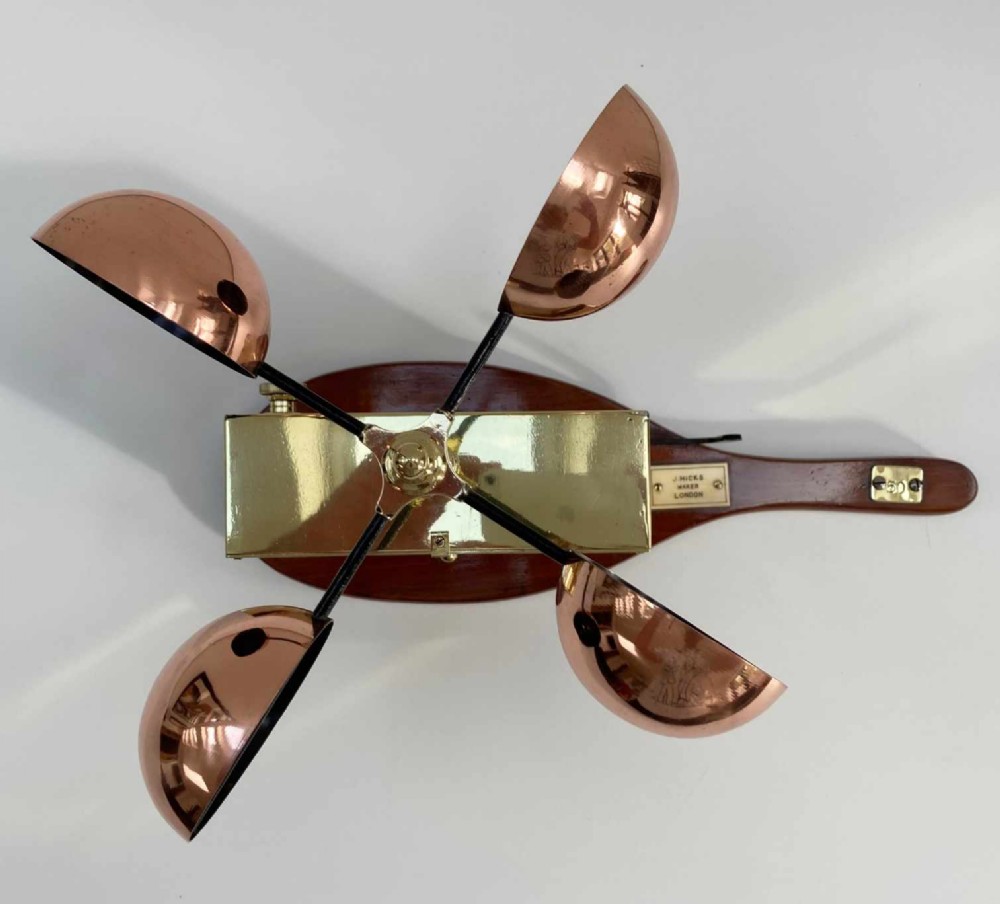
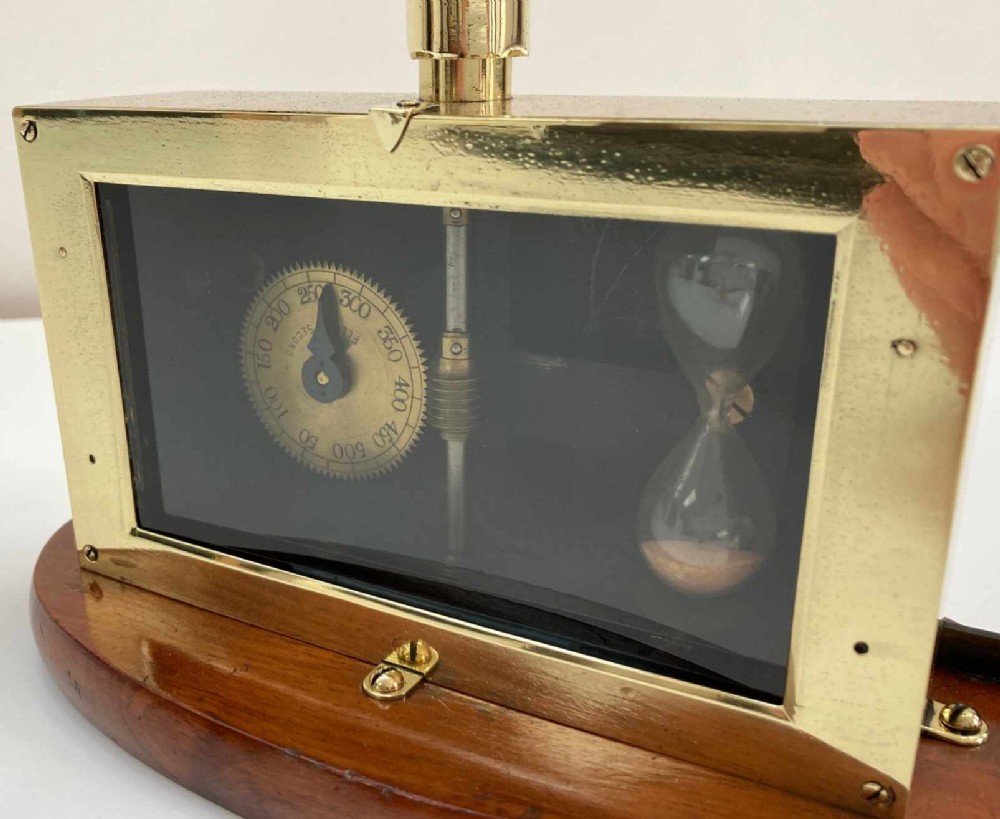
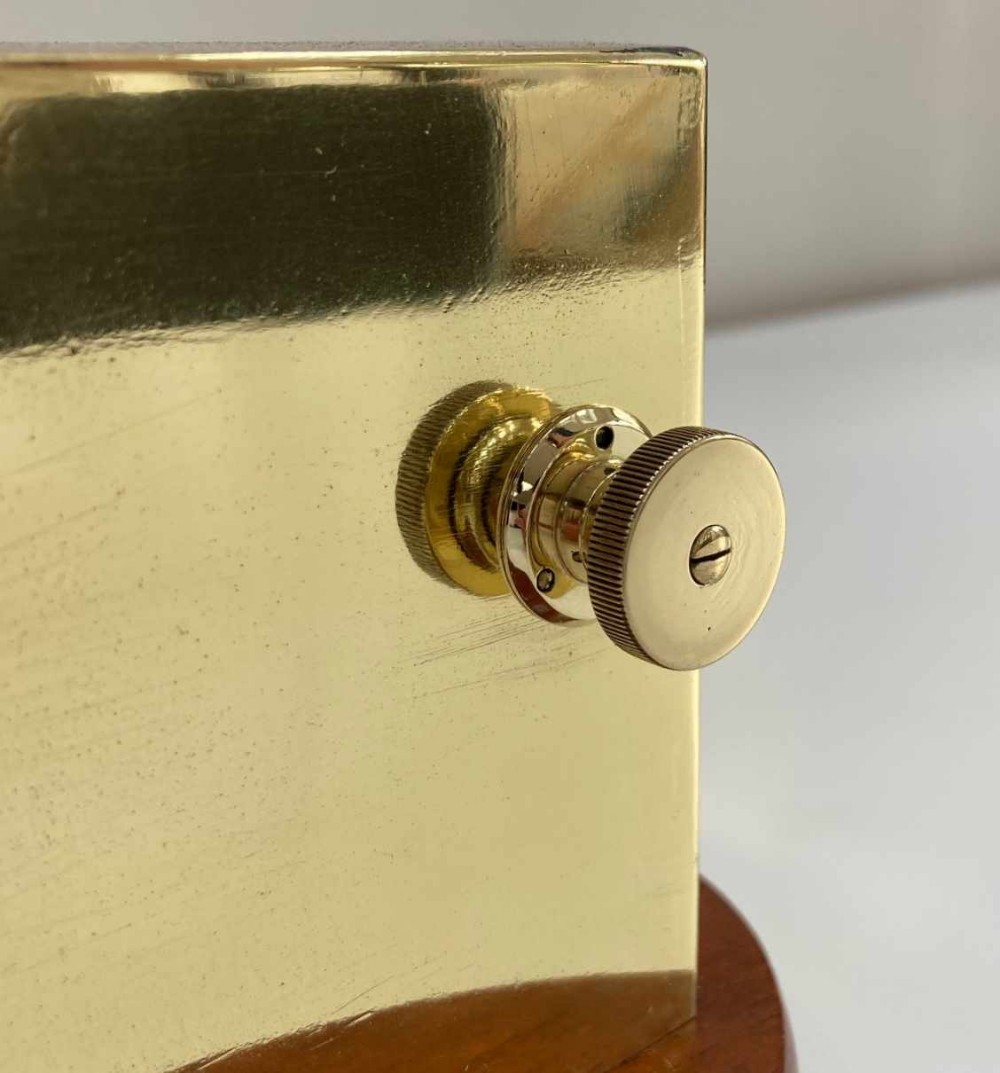
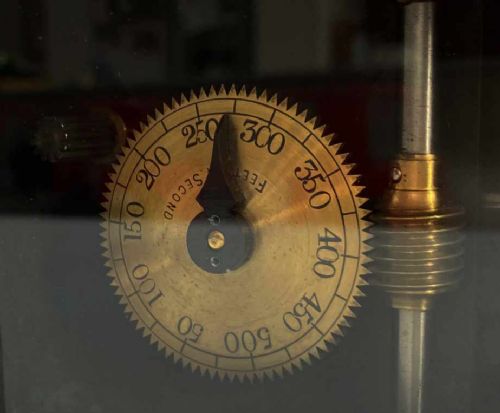
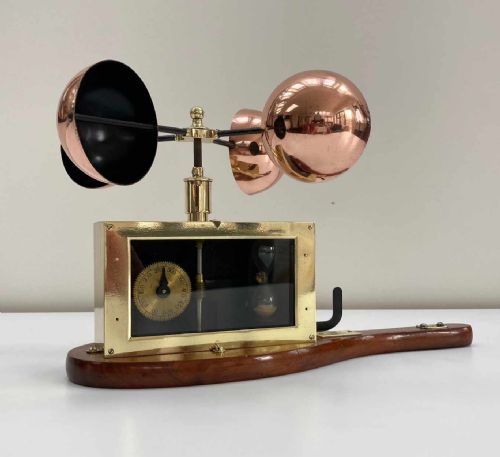
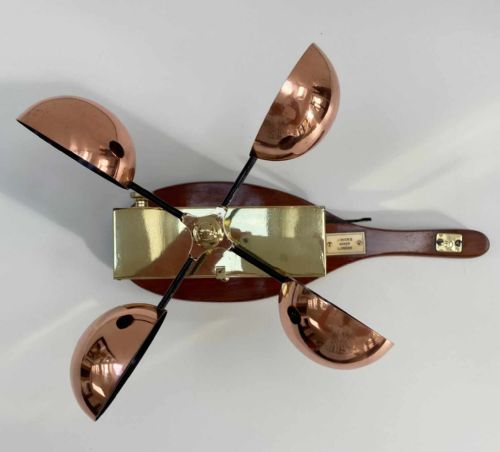
An external finger trigger to the side of the case when pushed, causes the sand glass to turn and simultaneously engages the dial with a central spindle connected to the four cups attached above the case. When operated in windy conditions, the cups would spin and register the amount of wind recorded during the time it took for the sand glass to complete its cycle. At this point the trigger is pulled to disengage the mechanism to allow for precise reading. When disengaged, a knurled screw can be used to reset the dial to zero.
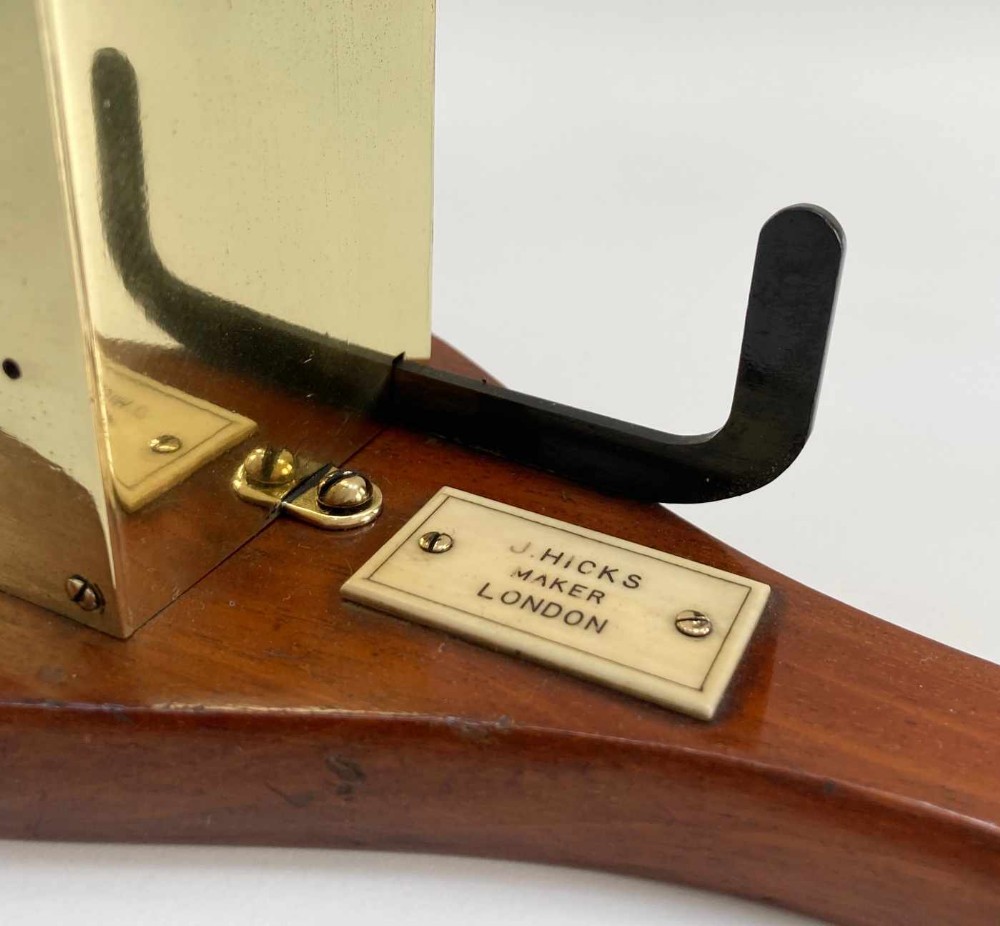
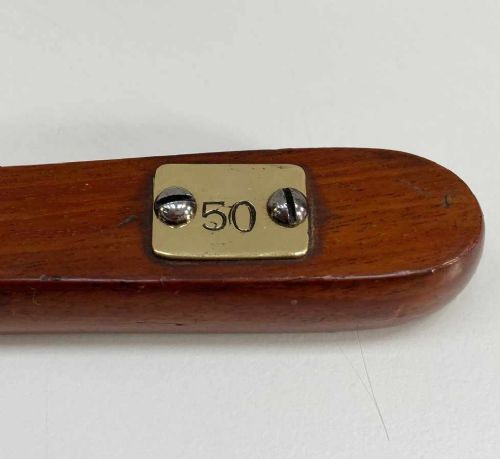
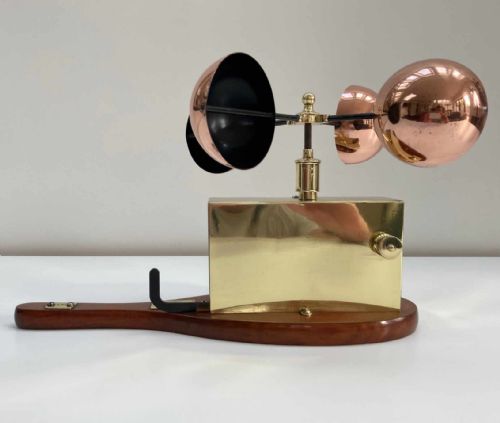
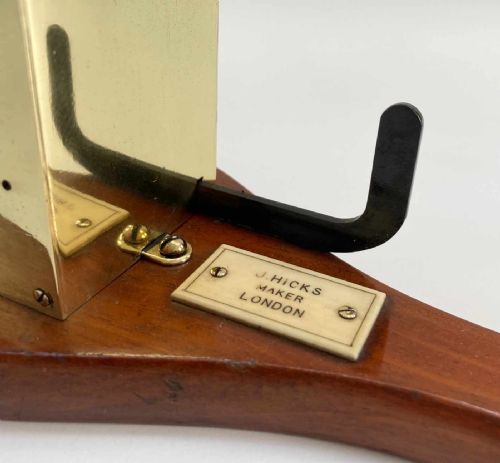
The instrument bears an ivorine plaque to the handle for “J. Hicks Maker, London” and a second brass plaque with the number 50 engraved upon it. We may assume that this was an inventory number for The Met Office or some other similar organisation.
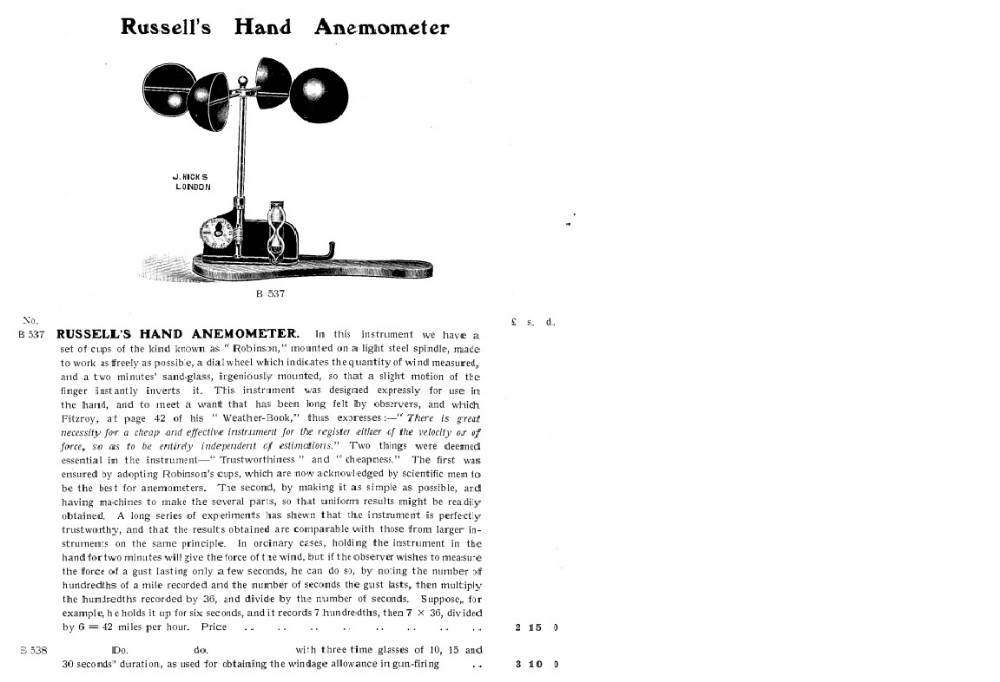
The anemometer is described within Hick’s 1911 Catalogue as follows:
RUSSELL’S HAND ANEMOMETER. In this instrument we have a set of cups of the kind known as “Robinson” mounted on a light steel spindle, made to work as freely as possible, a dial wheel which indicates the quantity of wind measured, and a two minutes’ sand glass, ingeniously mounted, so that a slight motion fo the finger instantly inverts it. This instrument was designed expressly for use in the hand, and to meet a want that has been long felt by observers, and which Fitzroy (Admiral Fitzroy), at page 42 of his “Weather Book” thus expresses:- “There is great necessity for a cheap and effective instrument for the register either of the velocity or of force, so as to be entirely independent of estimations.” Two things were deemed essential in the instrument – “Trustworthiness” and “cheapness”. The first was ensured by adopting Robinson’s cups, which are now achnowledged by scientific men to be the best for anemometers. The second, by making it as simple as possible, and having machines to make several parts, so that uniform results might be readily obtained. A long series of experiments has shewn that the instrument is perfectly trustworthy, and that the results obtained are comparable with those from larger instruments on the same principle. In ordinary cases, holding the instrument in the hand for two minutes will give the force of the wind, but if the observer wishes to measure the force of a gust lasting only a few seconds, he can do so, by noting the number of hundredths of a mile recorded nd the number of seconds the gust lasts, then multiply the hundredths recorded by 36, and divide by the number of seconds. Suppose for example, he holds it up for six seconds, and it records 7 hundredths, then 7 x 36, divided by 6 = 42 miles per hour.”
The price at this time was £2 and 15 shillings
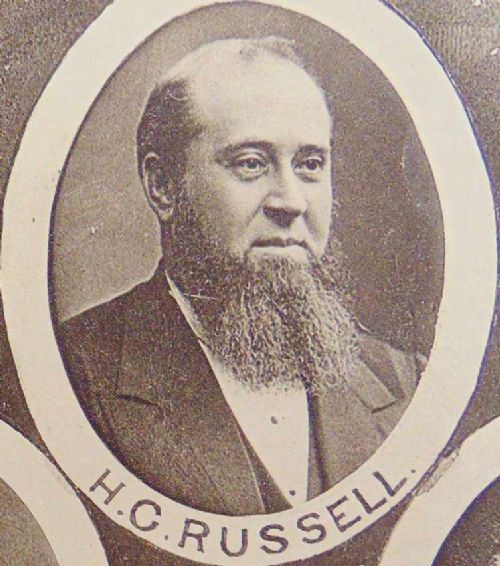
This instrument was originally designed by the Australian astronomer and meteorologist, Henry Chamberlain Russell (1836 – 1907). Russell joined the staff of The Sydney Observatory in the 1860’s and became acting director from 1862 to 1864 until George Smalley was formally appointed. It was, (according to The Sydney Bulletin of 1880) during this period that Russell invented his hand anemometer.
Upon Smalley’s death in 1870, he was formally appointed and continued to hold that position until 1905. He was responsible for greatly expanding the number of observing weather station throughout Australia, most of which were manned by volunteers. His need for cheap and reliable instruments was therefore necessary and Hicks’s advert continued to espouse this sentiment beyond Russell’s death. He was both President of The Royal Society of New South Wales and a Fellow of the Royal Society London and was awarded the CMG in 1890. Russell continued to dedicate his time to The Sydney O
Jason Clarke Antiques has dated this piece to the 1890s.
You can view the stock and full dealer information on the Jason Clarke Antiques Profile Page
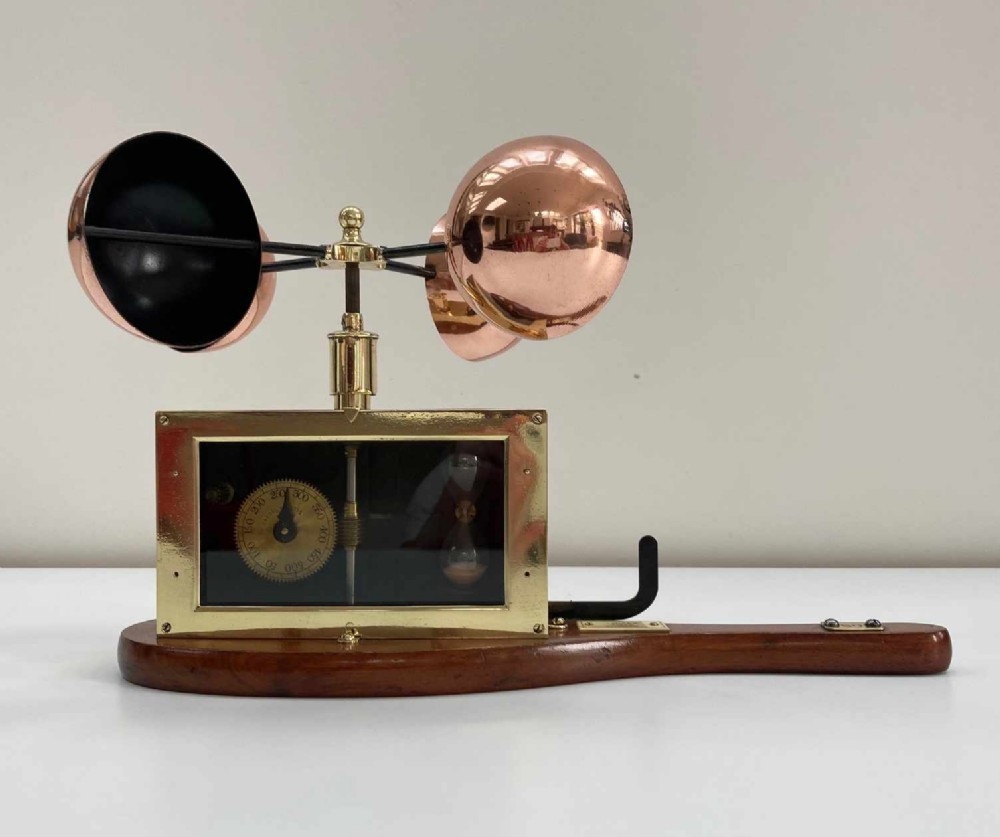
Russells Hand Anemometer by J Hicks of London