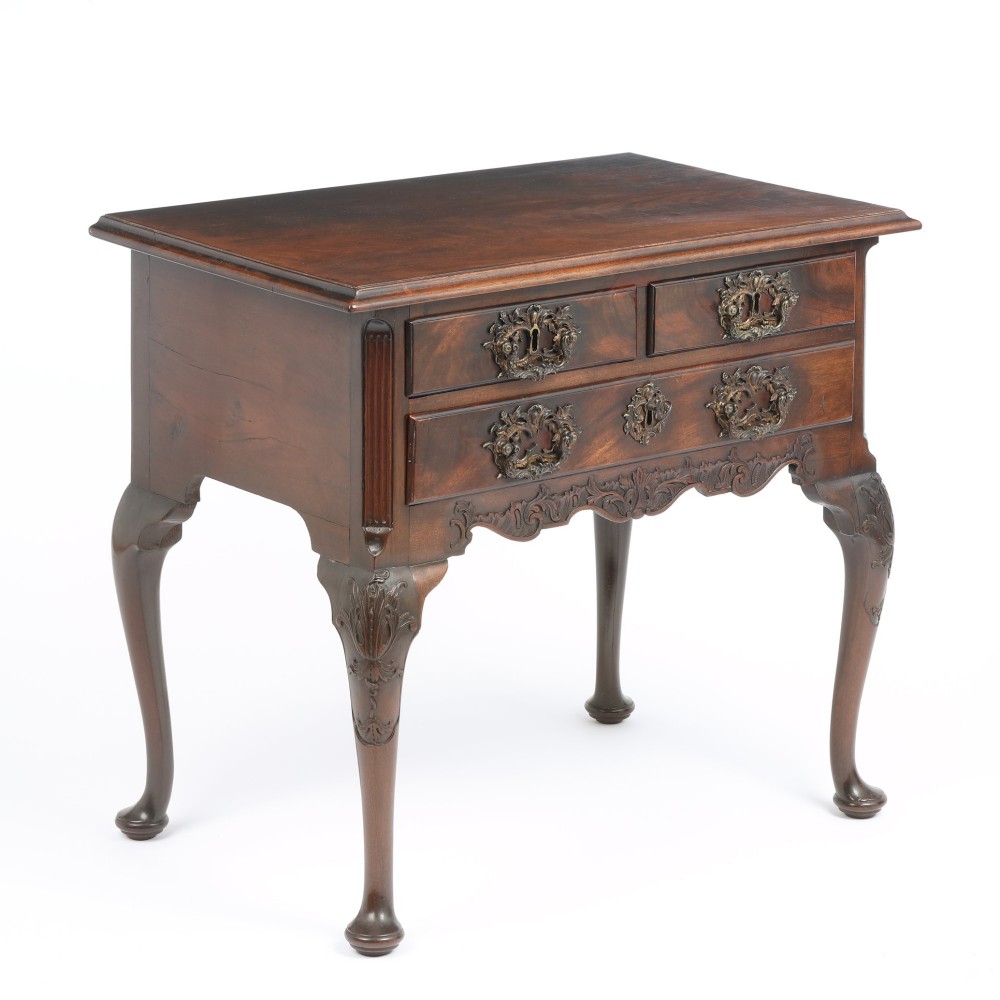
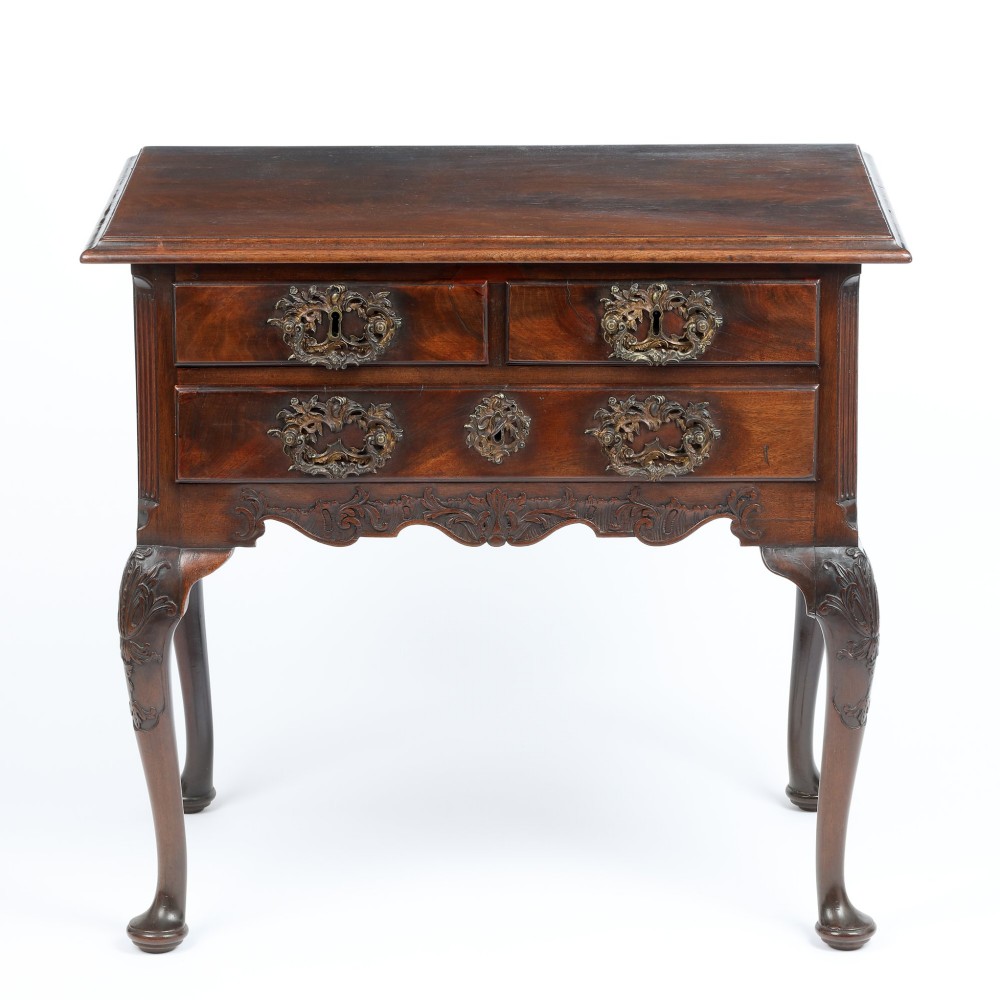
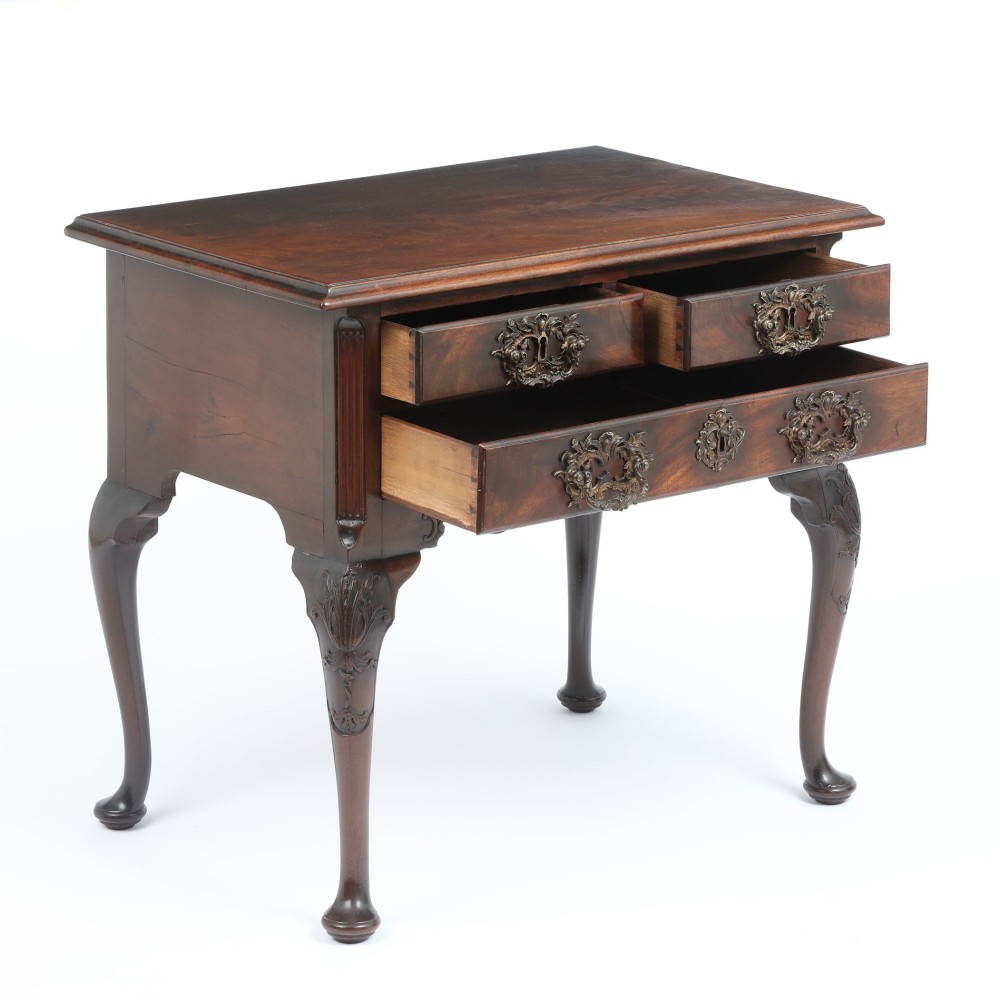
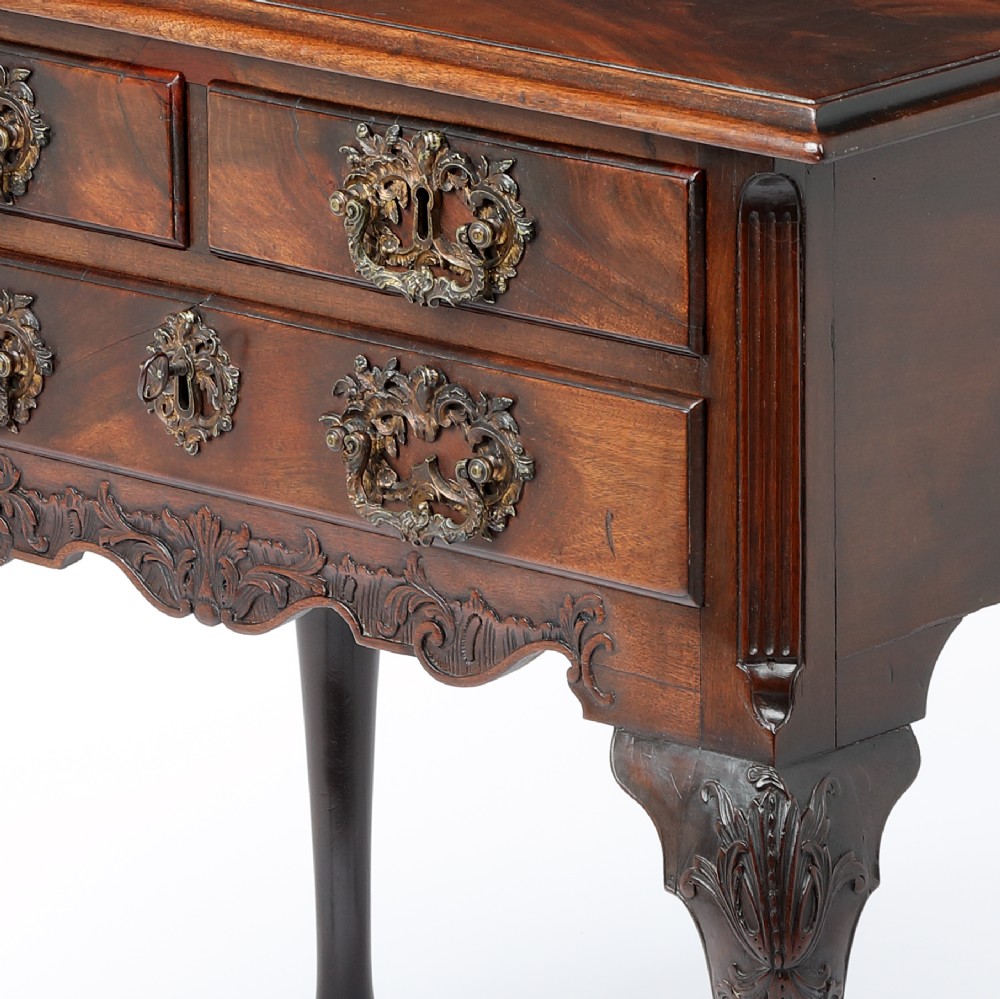
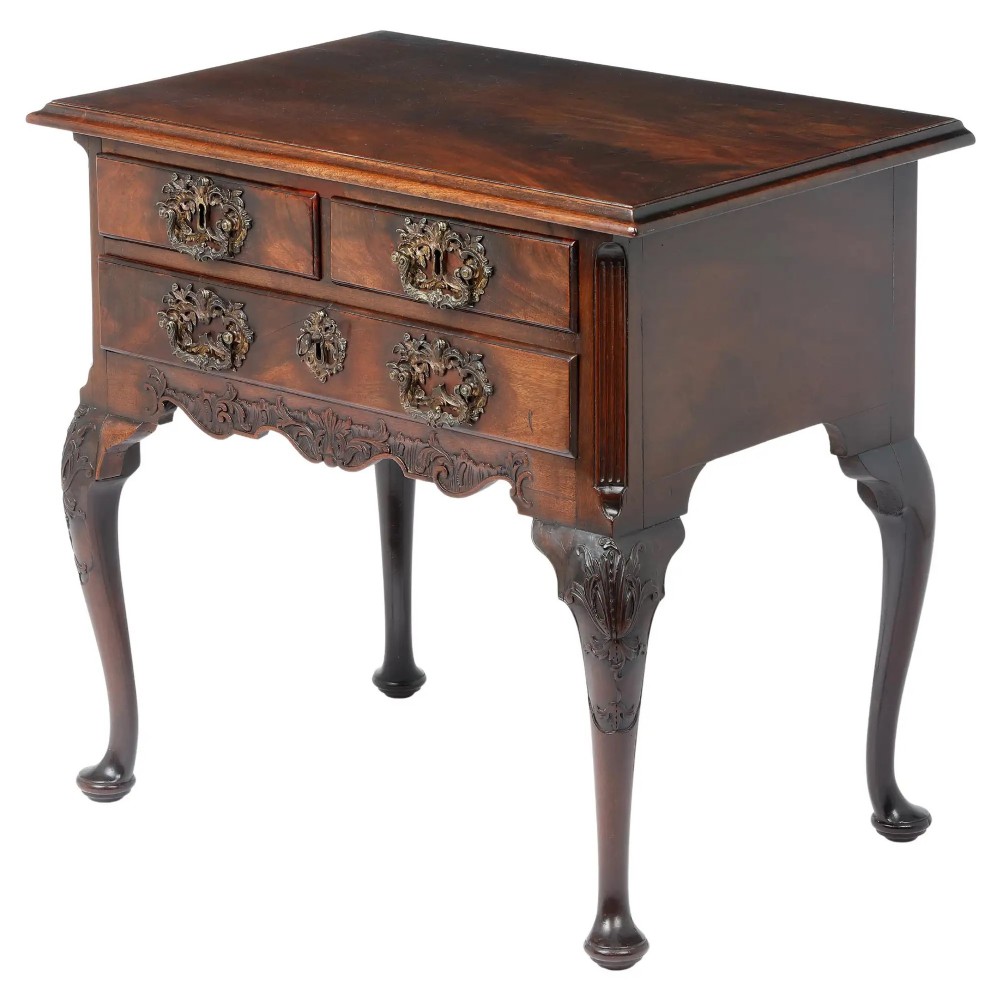
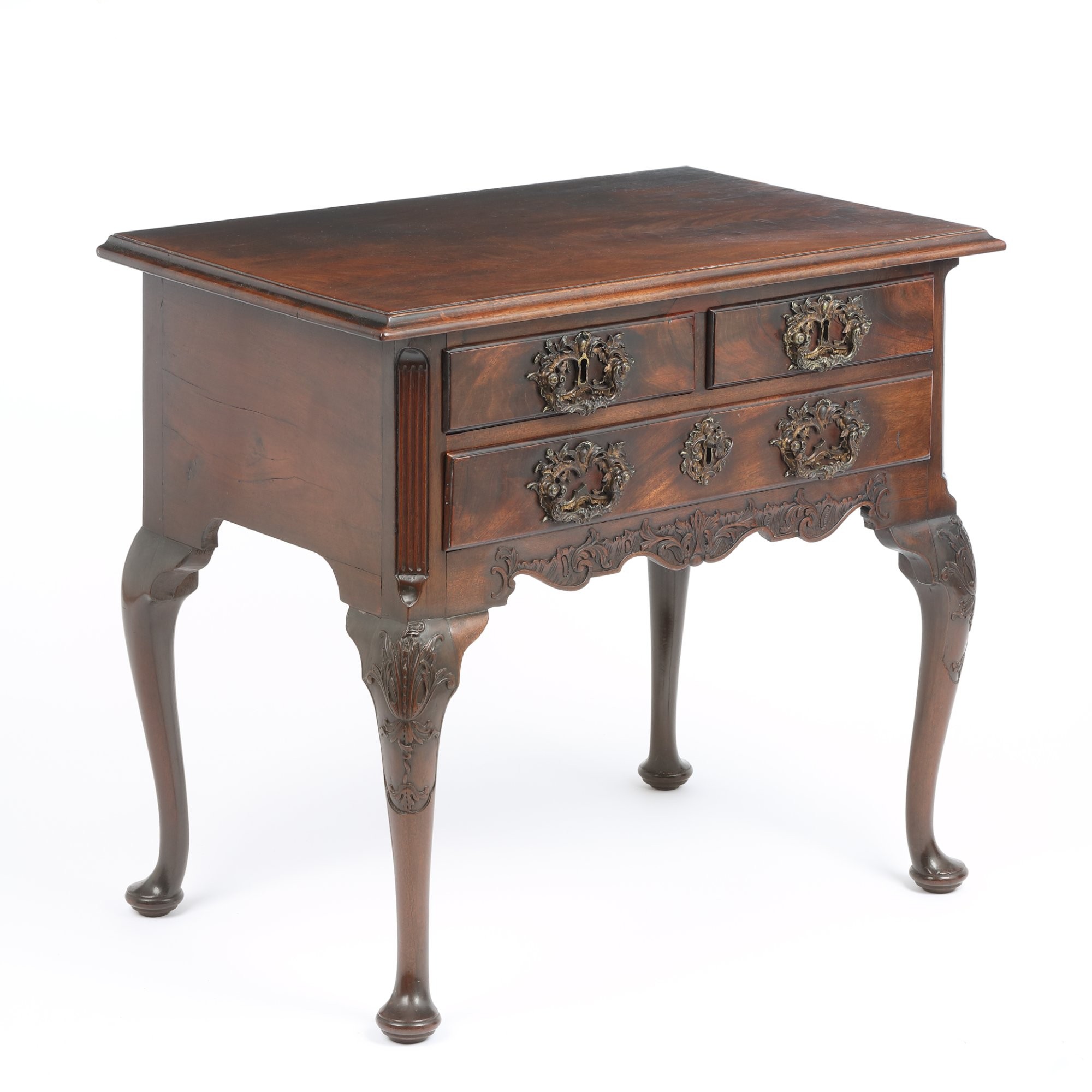
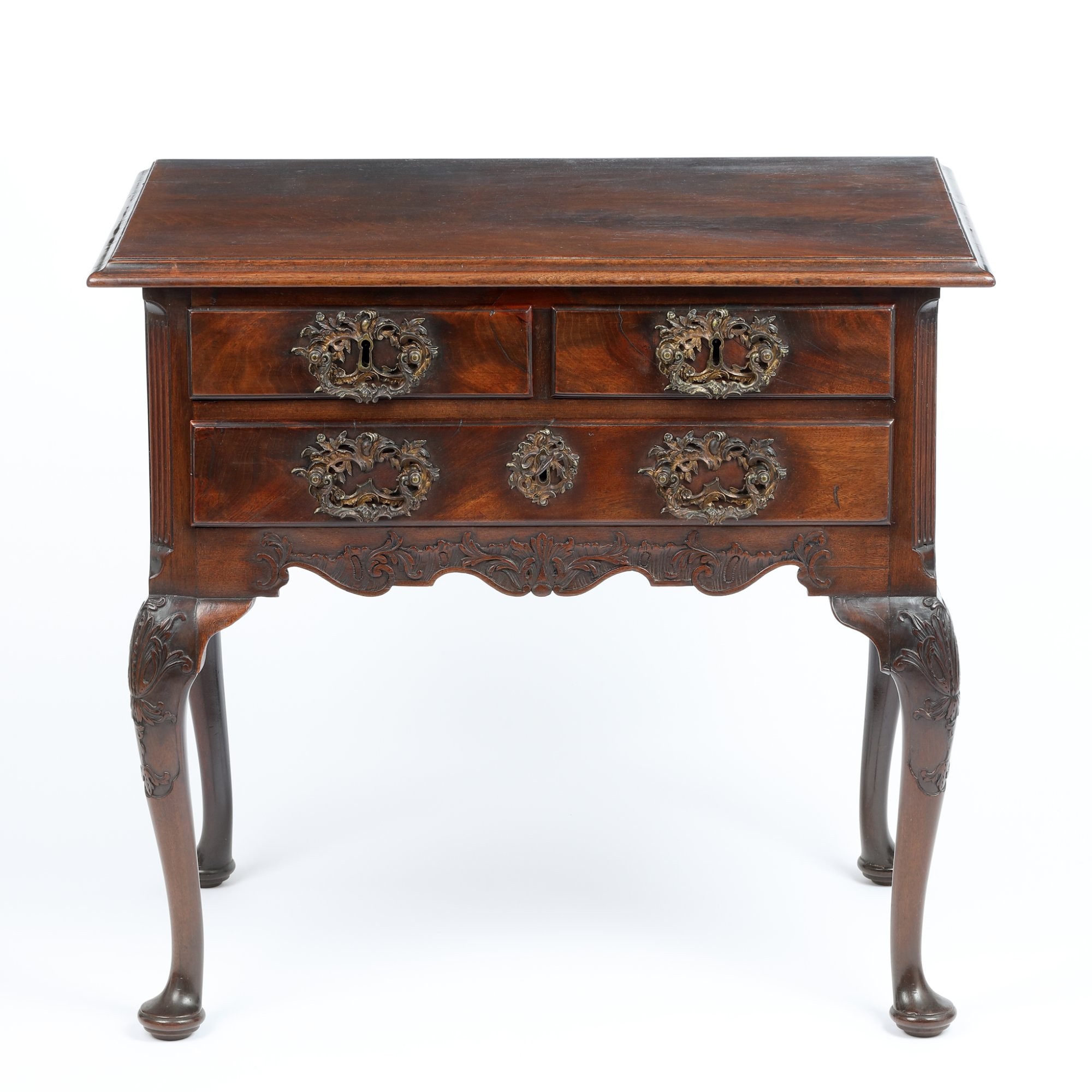
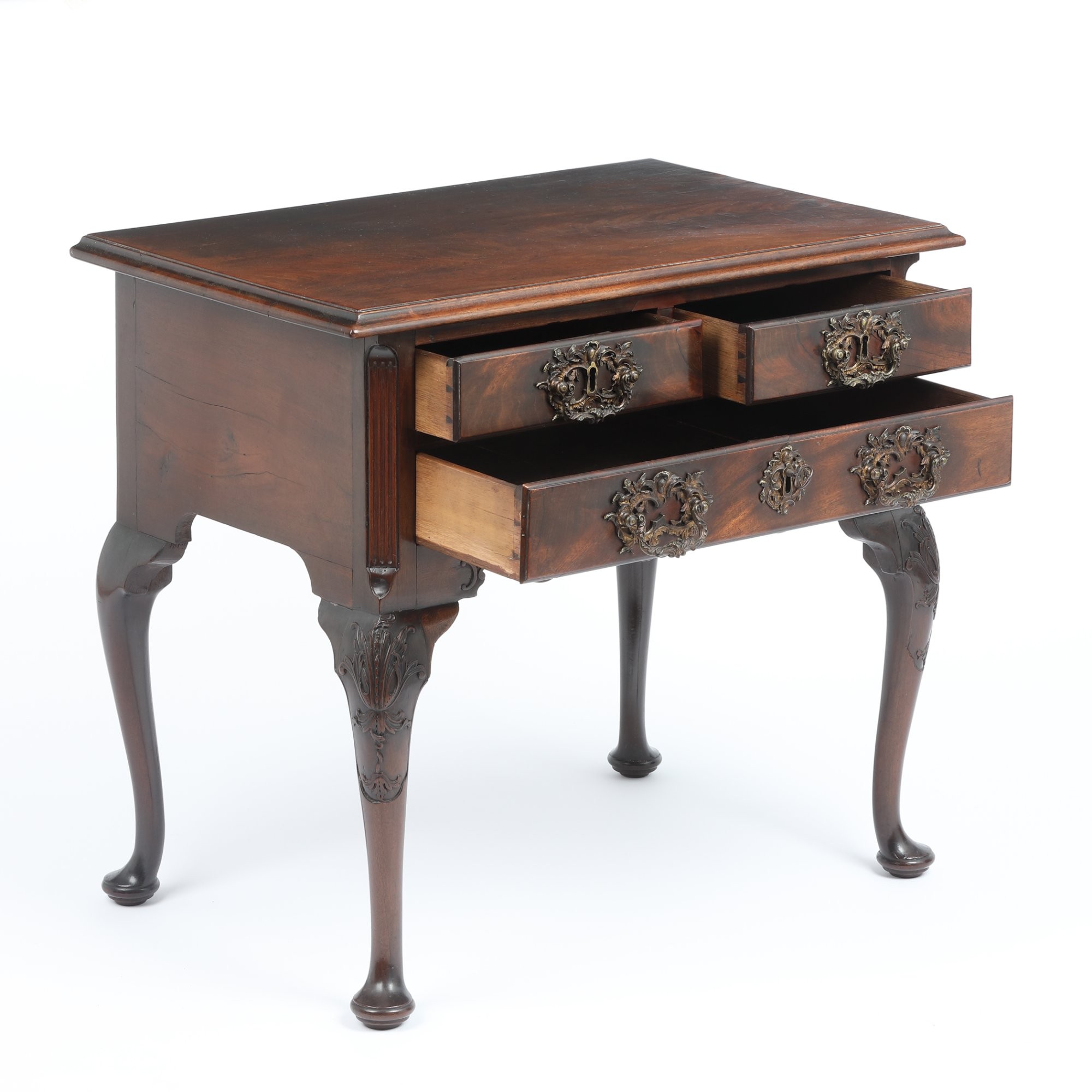
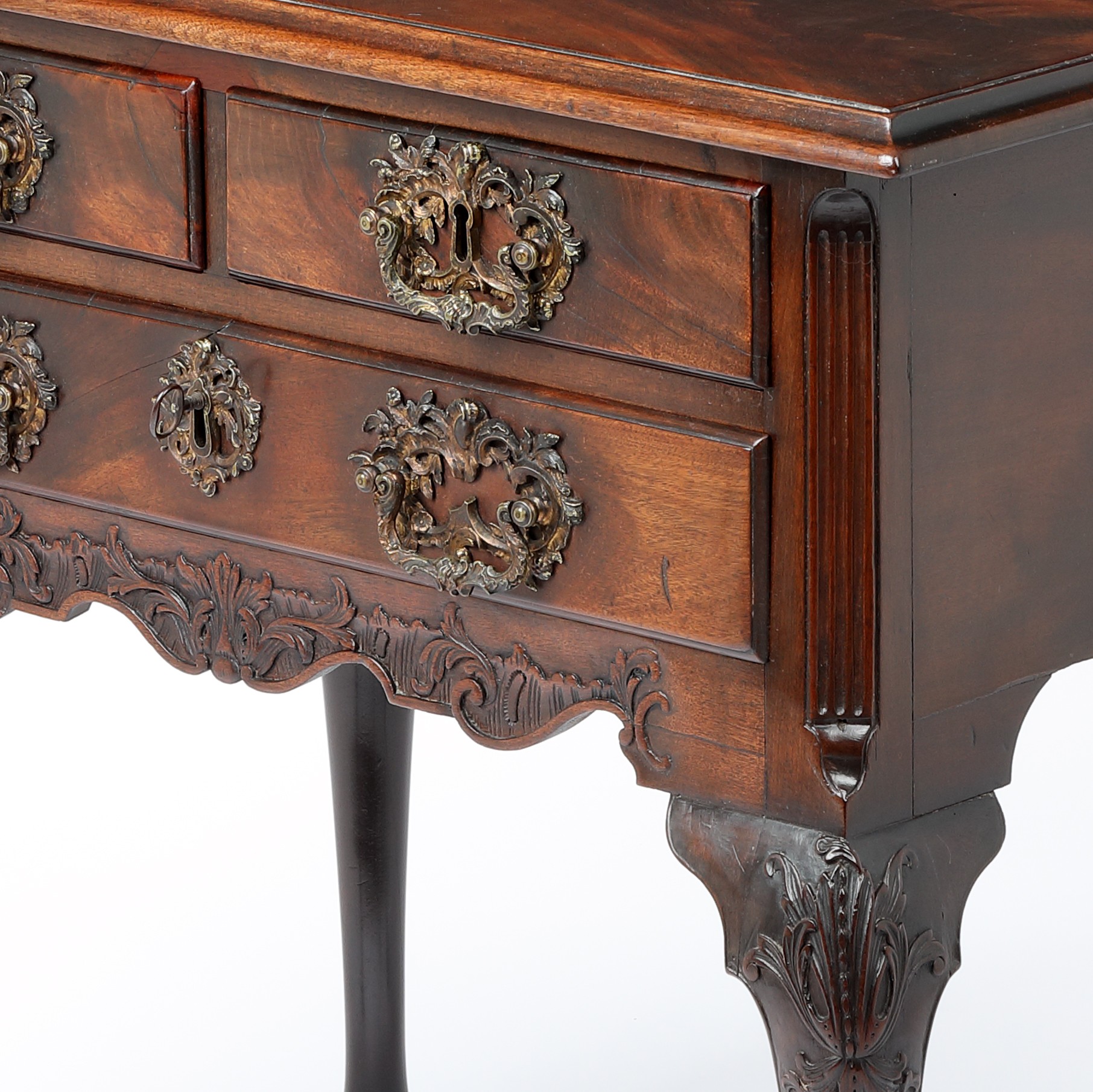
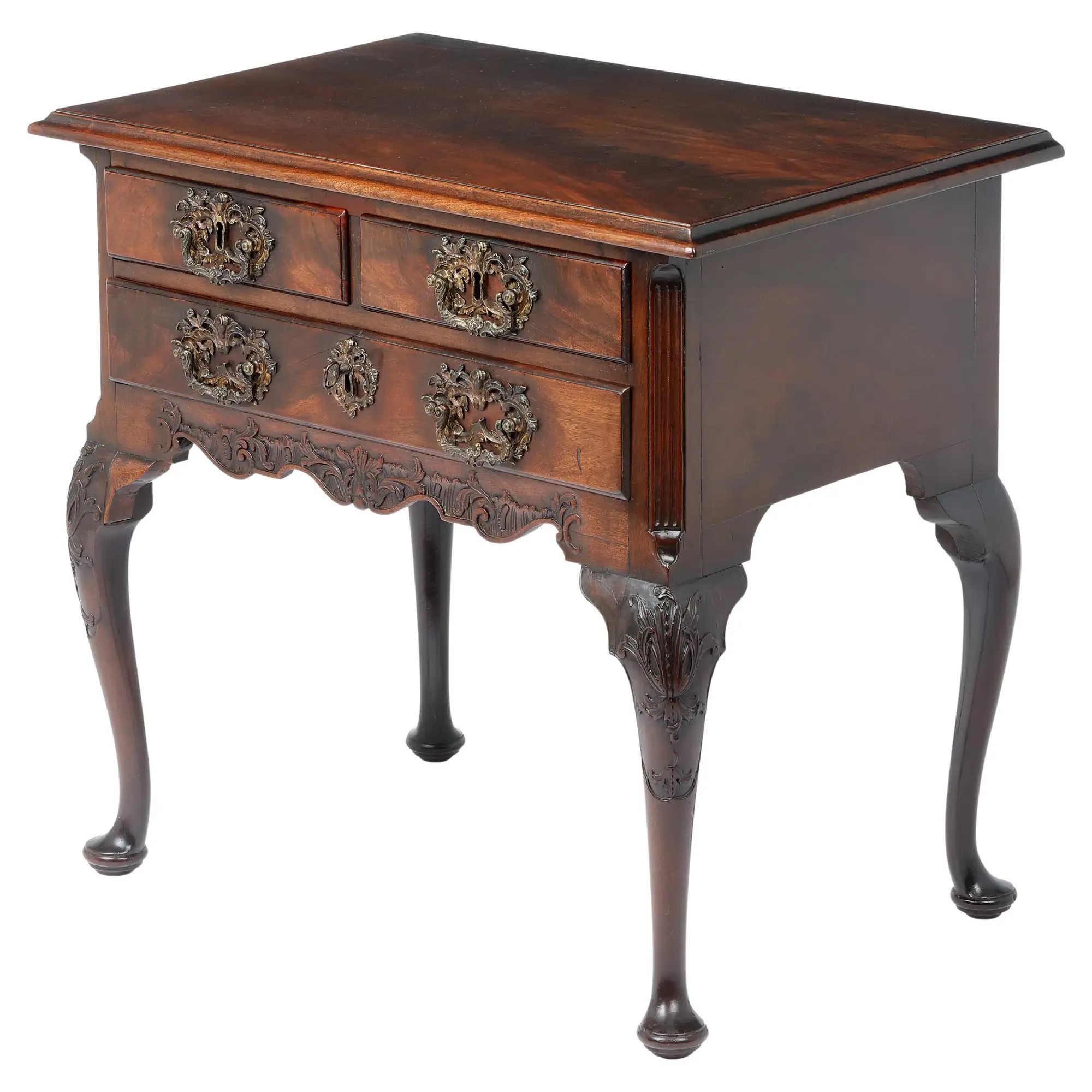
An exceptional George II period mahogany side table of small proportions and exquisite form attributed to Wright and Elwick. The superbly figured overhanging top above two short and two long drawers, all with the most remarkable fire-gilded handles and a shaped frieze decorated with scrolled leafy ornament and raised on cabriole legs carved to the knees and beyond with trailing acanthus and terminating in circular pad feet.
In outstanding 'untouched' and original condition, including handles, escutcheons, locks and even a key.
The Wright and Elwick Attribution
The piece can be firmly attributed to Wright and Elwick of Wakefield for a number of reasons. The combination of fine proportions, excellent quality of timber and robust design places the piece very much within the range of pieces known to have originated from their workshops but there are some features in particular that make an attribution more convincing. The firm's work often incorporates a relatively traditional basic design that is then enhanced with carving of excellent quality and an unusual degree of exuberance. The present piece demonstrates this perfectly. The combination of a George I lowboy silhouette but enhanced with rocaille and scrollwork carving on the lower apron is entirely in keeping with the firm's core aesthetic style, as examined in detail by Christie's in their essay The Wentworth Cabinet-Maker, pp.110-112 in the Wentworth catalogue, 8th of July 1998, written by Edward Lennox-Boyd. In this essay, the auctioneers note that the firm were amongst the original subscribers to Thomas Chippendale's Director of 1754 and the firm worked alongside Chippendale at Nostell Priory. It is at Wentworth Woodhouse, however, that the firm's largest documented commission was to take form, the surviving bills and payments allowing a large number of pieces to be given to the firm with great confidence. One of the most important pieces of Wright and Elwick furniture to be sold in the 1998 sale was a ladies' writing cabinet and this piece shares the same extravagant rococo handles as found on the present piece. These same handles, and matching escutcheons, also feature on a fine breakfront commode from Wentworth Woodhouse that was sold from the house in 1948 at Christie's and is illustrated below.
With their restrained cabriole legs with only a gentle “kick” to them and their pad feet, the chairs are remarkably reminiscent of the design of the legs of the present table. The knees on the chairs have some fine carving in medium relief, again a feature echoed on the present piece. It is also worth noting the similarities in treatment of the knees between the present piece and a set of twelve side chairs made by Wright and Elwick for Nostell Priory.
The carved designs are not identical but the “handwriting” of the maker is very similar indeed.
The present table makes use of fine fluting to the front angles, a feature that is often associated in this mid 18th century period with north country design and, taken in conjunction with the other features discussed previously, makes Wright and Elwick all the more likely to have been the makers.
Established in Wakefield, Yorkshire, in 1745, the firm was run by the two principals Richard Wright and Edward Elwick until 1771 when the firm became Elwick, Edward & Son until 1787, finally trading as Elwick, John & Robinson, John from 1788 until its closure in 1816.
In my opinion the present table is a fine example which can be attributed to the firm with a high degree of confidence.
Christopher Coles Research.