
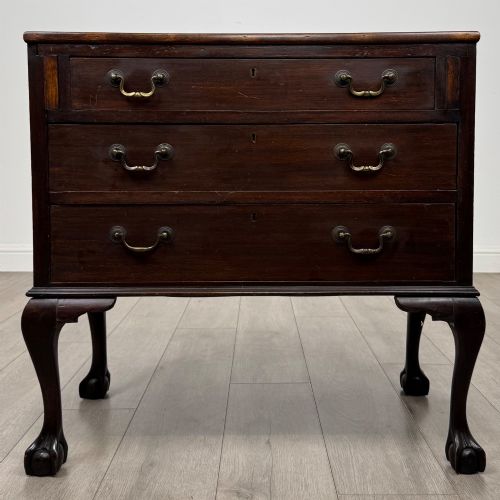
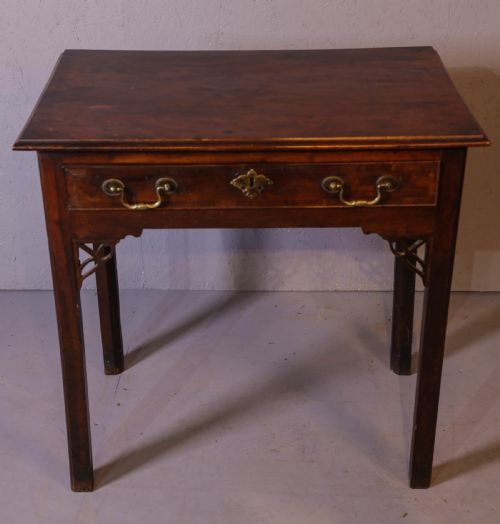


Chippendale Style Lowboy
These chippendale style lowboy pieces are classic mahogany side tables built for Georgian rooms.
What They Are
A chippendale style lowboy is a Georgian side table designed with multiple drawers and standing on slender legs. These small tables served practical storage needs in bedrooms and parlours during the eighteenth century.
The examples gathered here span the Georgian era and the year 1800, capturing the domestic furniture of the period. Forms range from straight lines to serpentine tops fitted with three drawers.
Mahogany forms the primary timber across these pieces, paired with brass hardware. Buyers encounter country house interpretations alongside refined urban versions of the low boy.
How They Were Made
Cabinet makers constructed these lowboys using solid mahogany timbers, selecting dense wood for structural stability and surface polish. Joinery relied on traditional methods to house drawers and frame the tables securely.
Brass handles and escutcheons were fitted to the drawer fronts, providing functional grip and metallic contrast against the dark timber. Serpentine front edges required careful timber selection and skilled shaping by hand.
Retail Price Guide 2026
Typical UK retail prices for chippendale style lowboy, calculated from the Sellingantiques database of over a million retail prices indexed since 2003. This retail price guide relies exclusively on Sellingantiques data; no external sources or auction records are used, so the figures do not describe the wider market.
Every listed lowboy employs solid mahogany combined with brass fittings, representing the Georgian period and the year 1800.
What Varies in Quality
Quality rests in the precision of the timber shaping and the subtlety of the proportions. A serpentine top with finely contoured curves distinguishes the higher tier of cabinet work from simpler rectangular carcases.
The selection of mahogany grain and the integrity of the original brass hardware dictate the visual authority of each table. Country house pieces show robust utility, whereas formal examples display greater refinement in every joint.
The Chippendale Style Lowboy Glossary
- Lowboy
- A small dressing table or side table featuring drawers, popular in the eighteenth century. These low tables were often placed in bedchambers for personal grooming.
- Serpentine top
- A table surface that curves outward at the centre and inward at the sides, or vice versa. This undulating contour demands advanced woodworking skill.
- Mahogany
- A durable, reddish-brown tropical hardwood imported for high-end furniture. Its stable nature allowed cabinet makers to carve intricate details without splitting.
- Georgian
- The period spanning the reigns of the four British monarchs named George, covering the eighteenth century. Furniture from this era is celebrated for classical proportions.
Frequently Asked Questions
Where were lowboys used in the home?
These tables sat primarily in bedrooms and dressing rooms to hold personal items and cosmetics.
Over time, owners also placed them in hallways and reception rooms as convenient side surfaces.
How do I date a Georgian lowboy?
Examine the timber species, drawer construction methods, and hardware styles to estimate the period.
Serpentine fronts and specific brass fixings help narrow the date toward the late eighteenth century.
Are these tables sturdy enough for daily use?
Solid mahogany construction and traditional joinery make these eighteenth-century tables remarkably durable.
They function well today as lamp tables or writing surfaces in domestic interiors.
What is the difference between a lowboy and a side table?
Lowboys specifically feature a low frame with one or more rows of drawers built into the structure.
General side tables from the same era often lack drawer storage entirely.