


A 2026 Guide by Sellingantiques
French cabinetmakers developed the form in the late eighteenth century. They needed a lightweight solution to hold small objects in crowded reception rooms.
Victorian society embraced antique etagere tables with enthusiasm. The rising middle class had new ornaments to show off and required open shelving to display them properly.
Look at late nineteenth-century versions for a shift in style. The Aesthetic movement brought in Japanese influences and lighter forms.
They shifted from the centre of the room to the walls. Early examples were finished all round, while later ones often have an unfinished back edge.
Gillows of Lancaster and London made mahogany etageres throughout the nineteenth century. Their pattern books show several tiered designs with turned supports.
Émile Gallé produced elaborate versions in France during the late nineteenth century. His workshops incorporated detailed floral marquetry across the varying tier levels.
Louis Majorelle is another documented maker. He applied flowing, organic lines to the uprights of Art Nouveau etageres in the early twentieth century.
The 2026 retail price guide for Antique Etagere Tables is drawn from a proprietary archive of over 1.1 million retail prices indexed by Sellingantiques since 2003. This guide relies exclusively on their own internal data; no external sources or auction records are used.
Analysing nearly 25 years of UK antique market history alongside current retail values, the data indicates that typical UK retail prices for Antique Etagere Tables range between £500 and £2,300. Entry-level prices generally fall under £500 and premium examples upwards of £2,300.
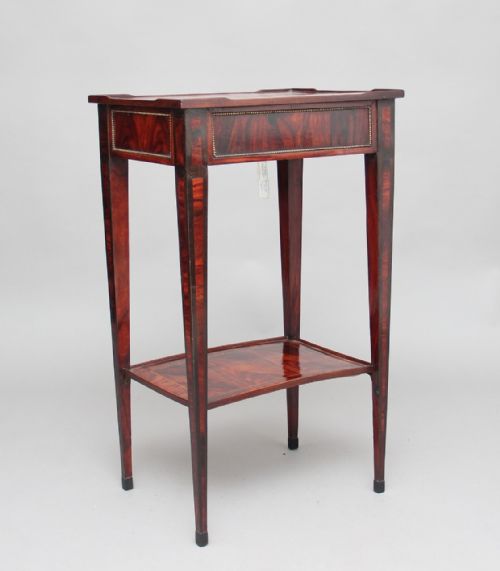
Open tiers define an antique etagere table. Most have three or four graduating shelves that decrease in depth towards the top.
Turned upright supports separate the levels. These are often carved or spiralled, providing structural stability without blocking the light.
A base drawer is sometimes incorporated. It sits beneath the lowest shelf and provides concealed storage below the open display areas.
Early upright supports were turned on a manual lathe. A craftsman used hand tools to shape the rotating timber into symmetrical baluster forms.
Notice how the shelves join the posts. The best makers used concealed dowel joints to maintain flush outer surfaces.
Marquetry required cutting contrasting veneers into complex patterns. Craftsmen glued these thin layers onto a stable carcase to prevent them from warping.
"Some designs incorporate a music stand. The top tier is hinged and adjusts to a reading angle to hold sheet music by the piano."
"They often doubled as serving tables in dining rooms. The varied heights allowed staff to stage dessert plates and silverware efficiently before a meal."
"Certain Victorian versions fold flat. The shelves drop down on hinges to allow the piece to be stored away when not required."
Based on almost 25 years of Sellingantiques UK antique market data, Antique Etagere Tables appeared 420 times (out of 1,100,000 antiques) which gives it a rarity score of 92/100.
This score measures scarcity within the Sellingantiques archive only and is not a survey of the entire antiques market, so these statistics may not be indicative of the general availability of Antique Etagere Tables elsewhere.
It depends heavily on the design and timber. Thick mahogany shelves with sturdy, short uprights will usually take the weight of heavy volumes without issue.
Delicate rosewood or bamboo examples with tall, slender supports are a different matter. They were built for lightweight porcelain and will start to sway if overloaded.
Most etagere tables stand on four delicate feet, often fitted with brass casters. If your floorboards have significant dips, a rigid four-legged structure will wobble.
You can sometimes fix this by resting one caster on a subtle felt pad. If the joints are tight, the structure itself is solid, but a sloping floor will always cause issues for displaying tall china objects.
The base drawer provided a closed storage area below the open display tiers. It kept practical items out of sight in a formal reception room.
People kept sheet music, letters, or spare playing cards inside. It allowed the upper shelves to remain clear for ornaments.
Mirrored backs turn up frequently on late nineteenth-century etageres, particularly those from French workshops. The mirror glass helped bounce light around a dim room and showed off the back of a porcelain figure.
Earlier Georgian pieces rarely feature mirror backs. They relied on open sides to let the natural light flow right through the shelves.
When a mirror is present, look at the glass itself. Antique mirror plates often show a subtle grey blooming or minor spots of silvering loss near the edges.
Please note: This Antique Etagere Tables guide and its associated pricing data are provided for general informational purposes only. It does not constitute formal financial, investment, or appraisal advice and should not be relied upon as the sole basis for any commercial activity, purchasing, or sales decisions. Sellingantiques.co.uk accepts no liability for any actions taken in reliance on this information. Always consult with a qualified professional or independent appraiser.
