

A 2026 Guide by Sellingantiques

Majolica 19thc Bread Plate C1870, 1870
Priced at £105 from Mike Melody Antiques
Early households often relied on wooden trenchers before ceramic options became widely available.
Wealthy families ordered large armorial services from China during the eighteenth century. They shipped these designs across the world to show off their status.
Look at the transition from pewter to earthenware. Cheaper production methods meant ordinary households could afford matching dinner services by the Victorian period.
Standardising sizes happened gradually. Dessert, soup, and dinner sizes eventually became fixed elements in formal dining setups.
Wedgwood dominated the English market in the late eighteenth century. Their creamware services found buyers across Europe.
Meissen produced the first true hard-paste porcelain in Europe. Their crossed-swords mark appears on many early continental dinner services.
Spode perfected underglaze blue transfer printing. This allowed mass production of detailed patterns on everyday antique plates.
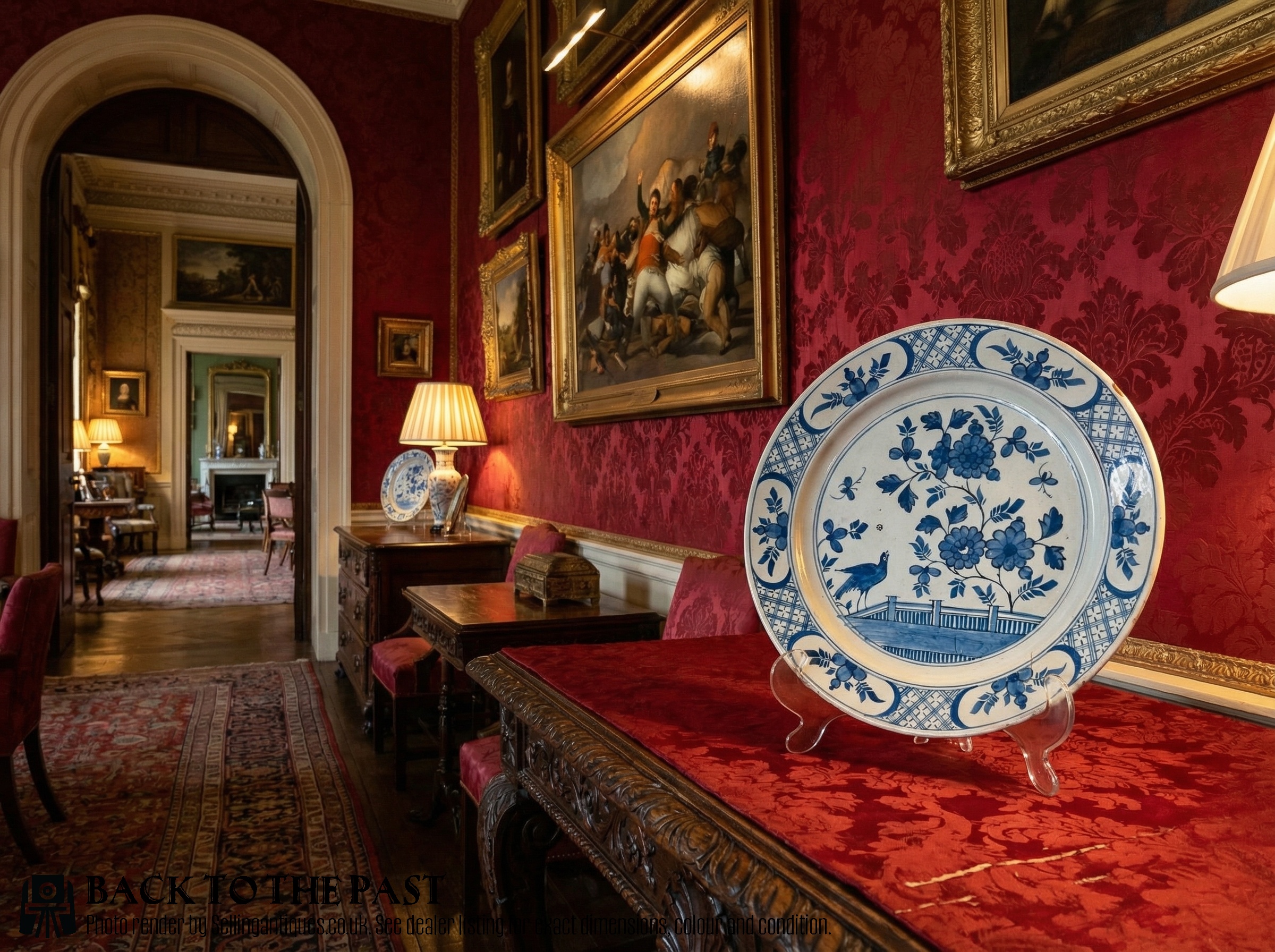
18th Century English Delft Charger, 18th Century
Priced at £185 from Antique and Unique
The 2026 retail price guide for Antique Plates is drawn from a proprietary archive of over 1.1 million retail prices indexed by Sellingantiques since 2003. This guide relies exclusively on their own internal data; no external sources or auction records are used.
Analysing nearly 25 years of UK antique market history alongside current retail values, the data indicates that typical UK retail prices for Antique Plates range between £200 and £1,100. Entry-level prices generally fall under £200 and premium examples upwards of £1,100.
Foot rims give the base stability. They protect the flat underside from scratching the table surface.
Notice the border decoration. Transfer-printed patterns often feature repeating floral or geometric borders that frame the central scene.
Indented rims help contain liquids. Some eighteenth-century antique plates feature shaped or scalloped edges rather than simple circular profiles.

Austrian Majolica Pottery Depicting Birds and Sunflowers, C1890, 1890
Priced at £495 from Robert Belcher Antiques
Throwing on a wheel was standard for early wares. Potters later used plaster moulds to ensure uniform shapes across a whole service.
Hand painting required immense skill and steady hands. Decorators applied enamel colours over the glaze before a low-temperature firing.
Transfer printing revolutionised the trade. Engraved copper plates allowed workers to press identical complex designs onto hundreds of pieces a day.
"Many early services survived because owners only displayed them on dressers. They used cheaper wooden wares for actual dining."
"Gilders often signed their work with tiny numerical marks. You can sometimes identify the specific decorator who applied the gold leaf to an antique plate."
"Plate hangers kept these pieces safe on walls for decades. This domestic habit preserved thousands of fragile ceramic pieces from accidental breakage."
Based on almost 25 years of Sellingantiques UK antique market data, Antique Plates appeared 23491 times (out of 1,100,000 antiques) which gives it a rarity score of 1/100.
This score measures scarcity within the Sellingantiques archive only and is not a survey of the entire antiques market, so these statistics may not be indicative of the general availability of Antique Plates elsewhere.
Do not put antique plates in a dishwasher. The harsh detergents degrade the glaze and strip away overglaze enamels.
High heat causes sudden expansion. This stress cracks an older clay body. Hand wash them in warm water instead.
That brown staining is caused by moisture and oils seeping into the porous clay body. It happens when the protective glaze develops fine cracks over time.
Soaking them in a weak solution of hydrogen peroxide sometimes lifts the stains. It takes time and patience. Make sure you rinse the pieces thoroughly in clean water afterwards to stop the chemical action.
That is a British registry mark. The Patent Office issued these to show a maker had registered a specific design.
The letters indicate the exact date of registration.
Ceramics were expensive commodities before the industrial revolution. Replacing a single broken piece from a large matching dinner service was often impossible or costly.
Travelling riveters repaired these pieces using a hand drill and brass wire. They drilled partway into the ceramic body to insert the metal staples. The tension held the shards together.
These historic repairs are now part of the object's story. Many collectors prefer to leave them exactly as they are.
Please note: This Antique Plates guide and its associated pricing data are provided for general informational purposes only. It does not constitute formal financial, investment, or appraisal advice and should not be relied upon as the sole basis for any commercial activity, purchasing, or sales decisions. Sellingantiques.co.uk accepts no liability for any actions taken in reliance on this information. Always consult with a qualified professional or independent appraiser.
