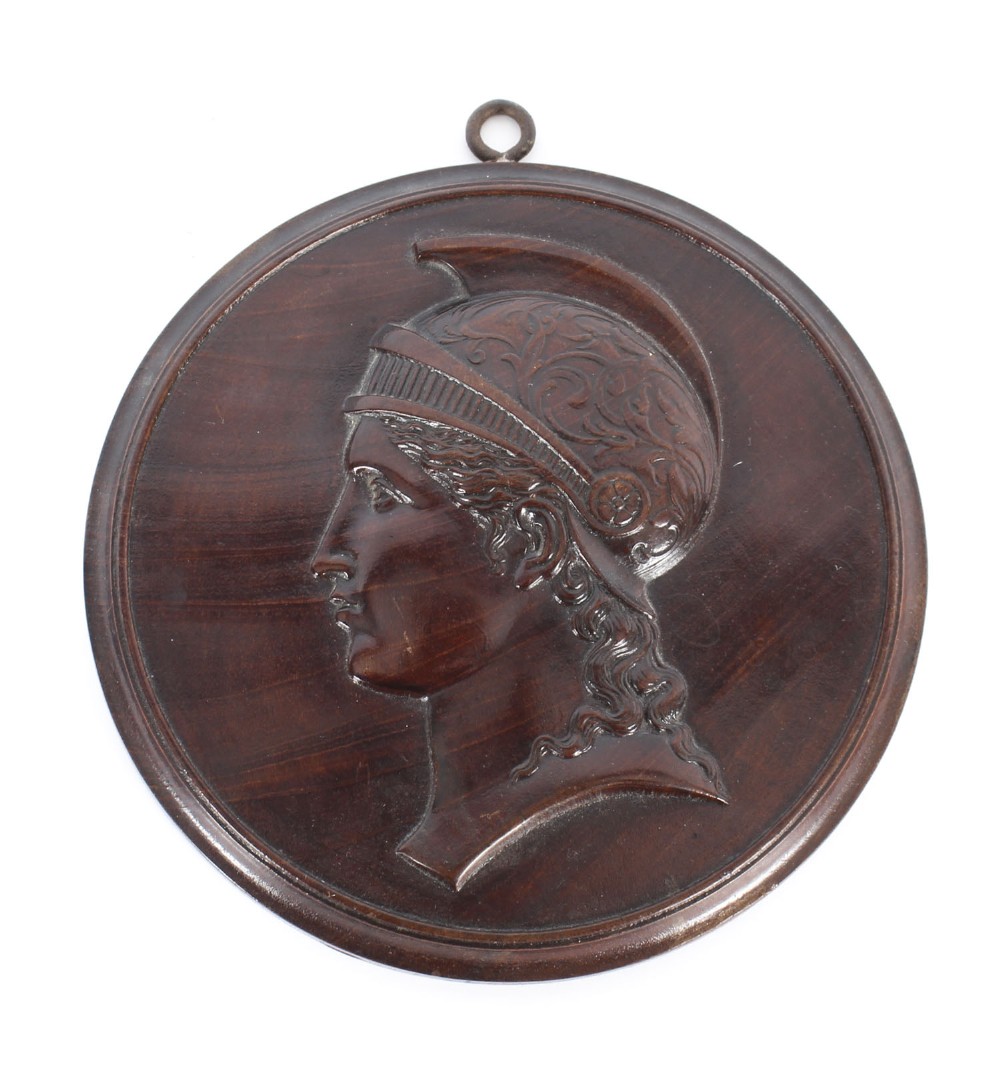
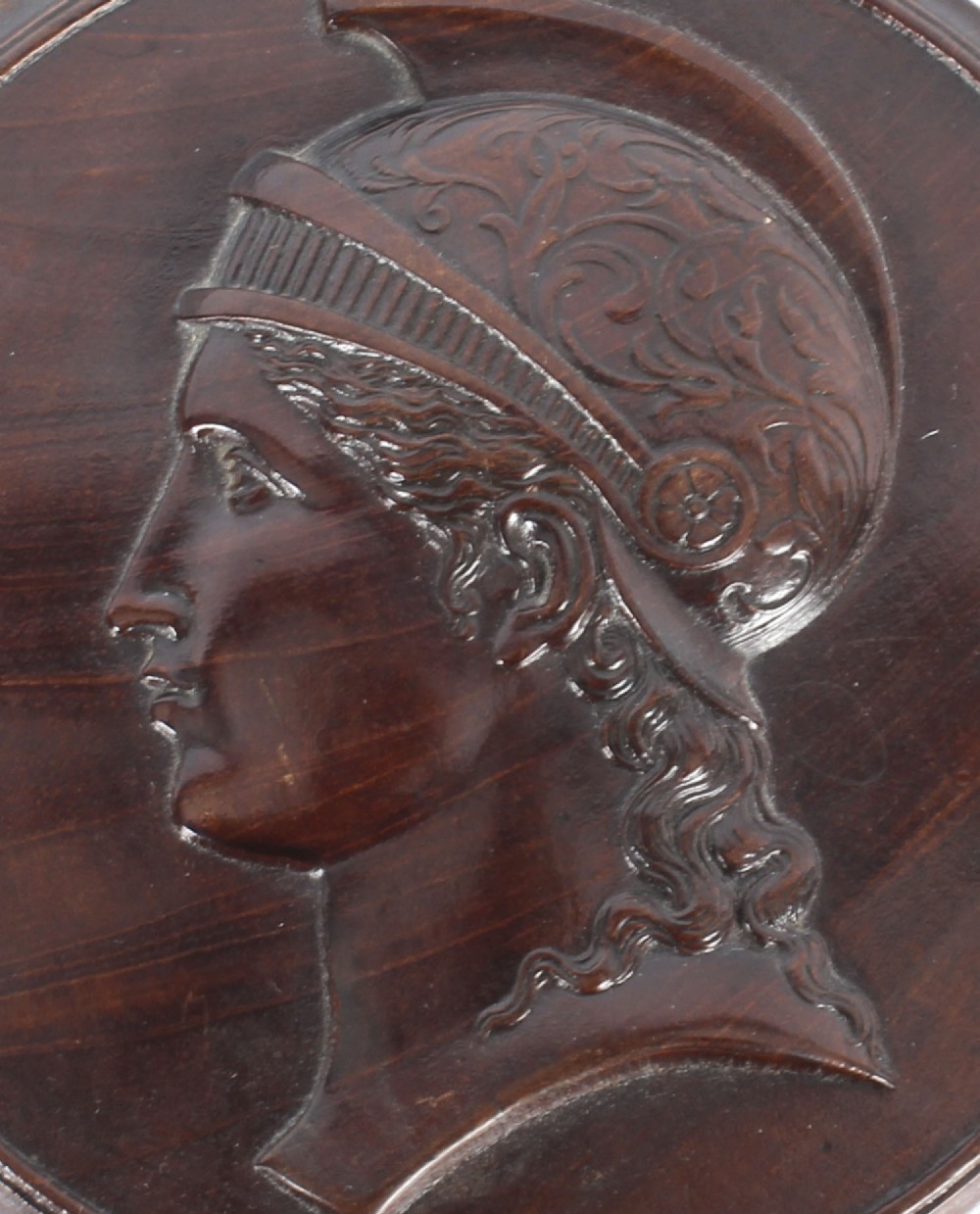
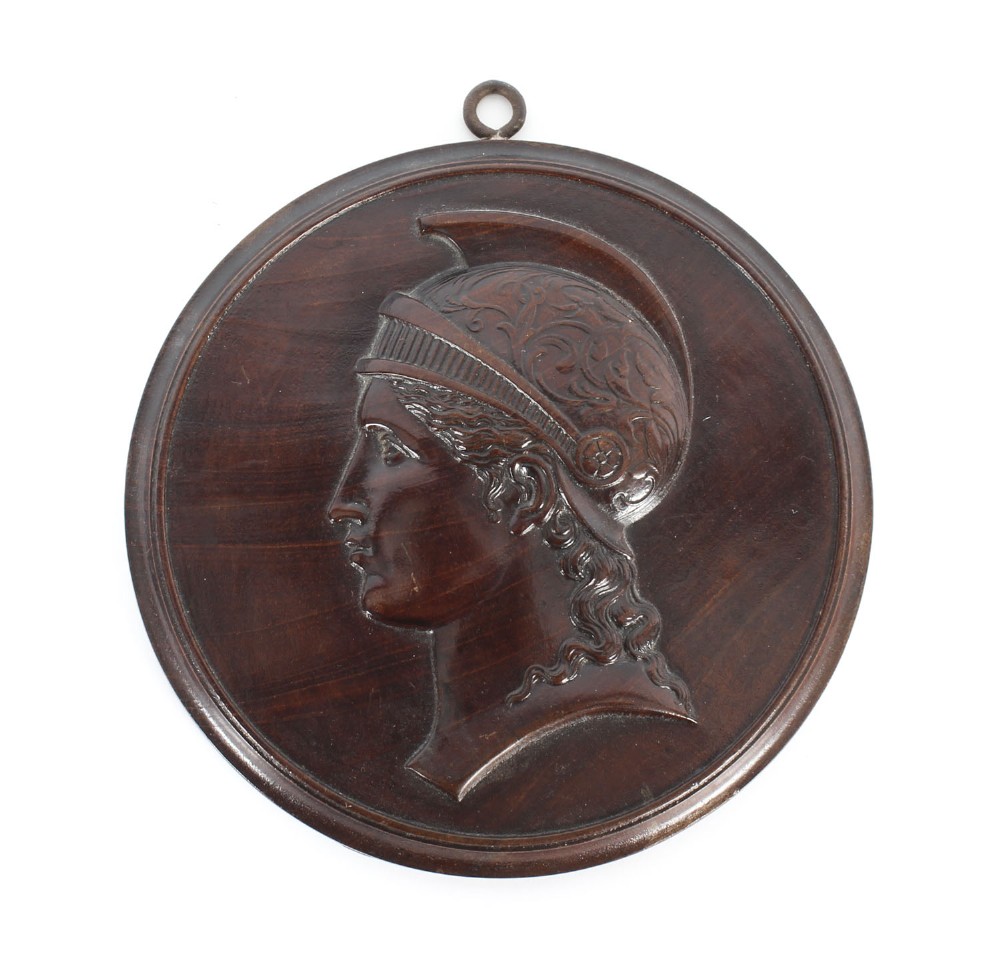
This beautiful Italian Grand Tour mahogany roundel plaque profile bust depicting Minerva dating from the mid 19th Century.
The plaque superbly depicts the profile of Minerva, the Roman goddess of wisdom and strategic warfare, in high relief.
The attention to detail throughout is second to none.
Condition:
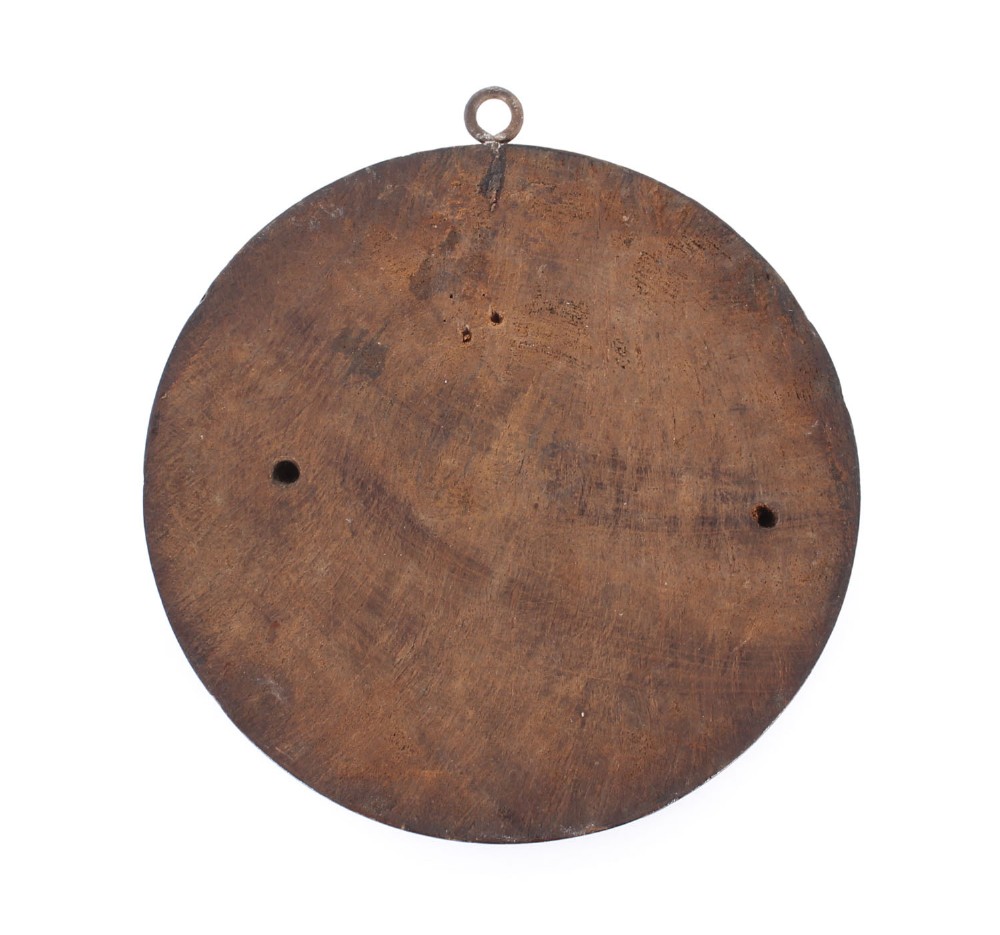
In excellent condition, please see photos for confirmation.
Dimensions in cm:
Height 16 x Width 14 x Depth 2
Dimensions in inches:
Height 6.3 x Width 5.5 x Depth 0.8
Minerva
is the Roman goddess of wisdom and strategic warfare, and the sponsor of arts, trade, and strategy. Minerva is not a patron of violence such as Mars, but of defensive war only. From the second century BC onward, the Romans equated her with the Greek goddess Athena. Minerva is one of the three Roman deities in the Capitoline Triad, along with Jupiter and Juno.
She was the virgin goddess of music, poetry, medicine, wisdom, commerce, weaving, and the crafts. She is often depicted with her sacred creature, an owl usually named as the "owl of Minerva", which symbolised her association with wisdom and knowledge as well as, less frequently, the snake and the olive tree. Minerva is commonly depicted as tall with an athletic and muscular build, as well as wearing armour and carrying a spear. Marcus Terentius Varro considered her to be ideas and the plan for the universe personified.
The Grand Tour was the traditional trip of Europe undertaken by mainly upper-class European young men of means. The custom flourished from about 1660 until the advent of large-scale rail transit in the 1840s, and was associated with a standard itinerary.
It served as an educational rite of passage. Though primarily associated with the British nobility and wealthy landed gentry, similar trips were made by wealthy young men of Protestant Northern European nations on the Continent, and from the second half of the 18th century some South American, U.S., and other overseas youth joined in. The tradition was extended to include more of the middle class after rail and steamship travel made the journey less of a burden.
The primary value of the Grand Tour, it was believed, lay in the exposure both to the cultural legacy of classical antiquity and the Renaissance, and to the aristocratic and fashionably polite society of the European continent. In addition, it provided the only opportunity to view specific works of art, and possibly the only chance to hear certain music. A grand tour could last from several months to several years. It was commonly undertaken in the company of a knowledgeable guide or tutor.
The Grand Tour not only provided a liberal education but allowed those who could afford it the opportunity to buy things otherwise unavailable at home, and it thus increased participants' prestige and standing. Grand Tourists would return with crates of art, books, pictures, sculpture, and items of culture, which would be displayed in libraries, cabinets, gardens, and drawing rooms, as well as the galleries built purposely for their display; The Grand Tour became a symbol of wealth and freedom.
Our reference: A1270a