21,158  PAGES BROWSED TODAY PAGES TODAY • 116 ANTIQUES UPLOADED TODAYNEW ARRIVALS
GIFTS
116 ITEMS ADDED TODAY
Sort Order
Items Per Page
Browse Categories
Sort order
Items per page
ID #SA1239701
FOR SALE
£1,250
Email Phone
Save
Remarkable Fragment of 15th C. Burial Cloth Exhumed During Trenching in 1821 with Provenance
For sale by Folk and Fable Antiques
for sale €1,463     $1,588
£1,250
Folk and Fable Antiques

Folk and Fable Antiques

Sellingantiques Verified Since Oct 2026
Browse dealers 36 items
  • About Us
    Unique pieces for collectors and curious minds
Id #SA1239701
PDF SHARE
SAVE

Remarkable Fragment of 15th C. Burial Cloth Exhumed During Trenching in 1821 with Provenance

19th century
Description

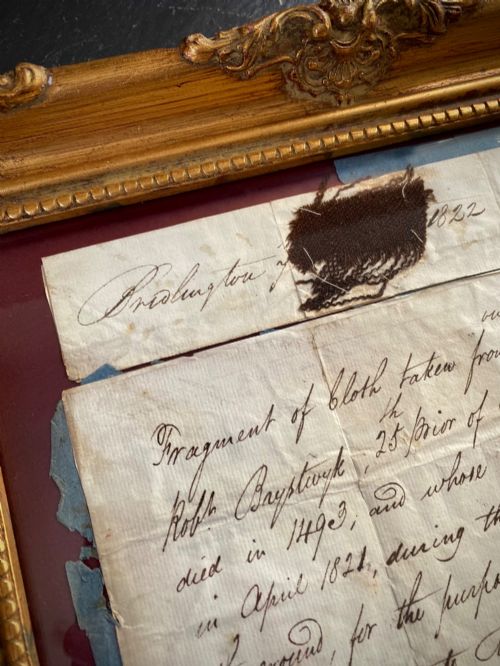
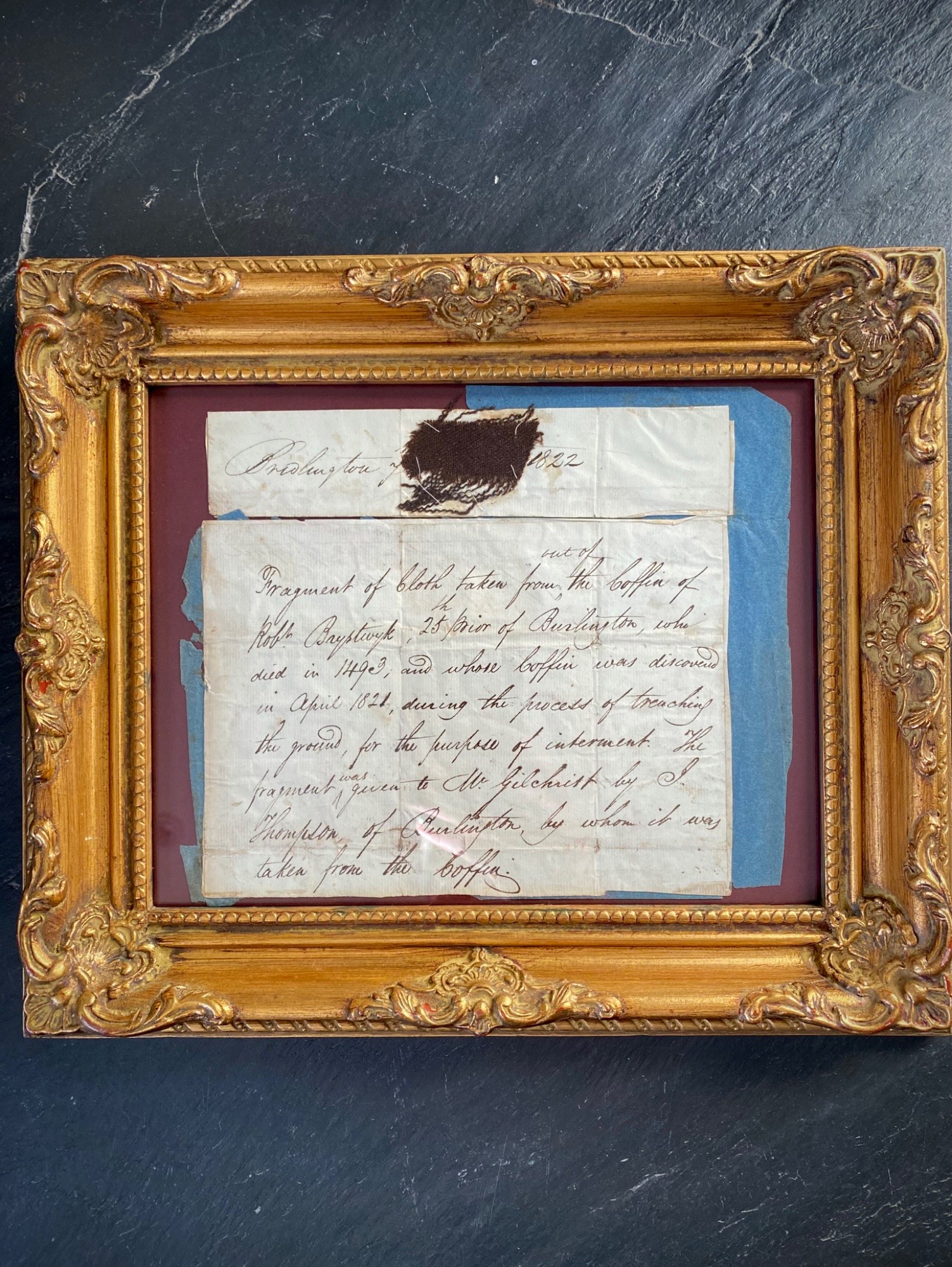
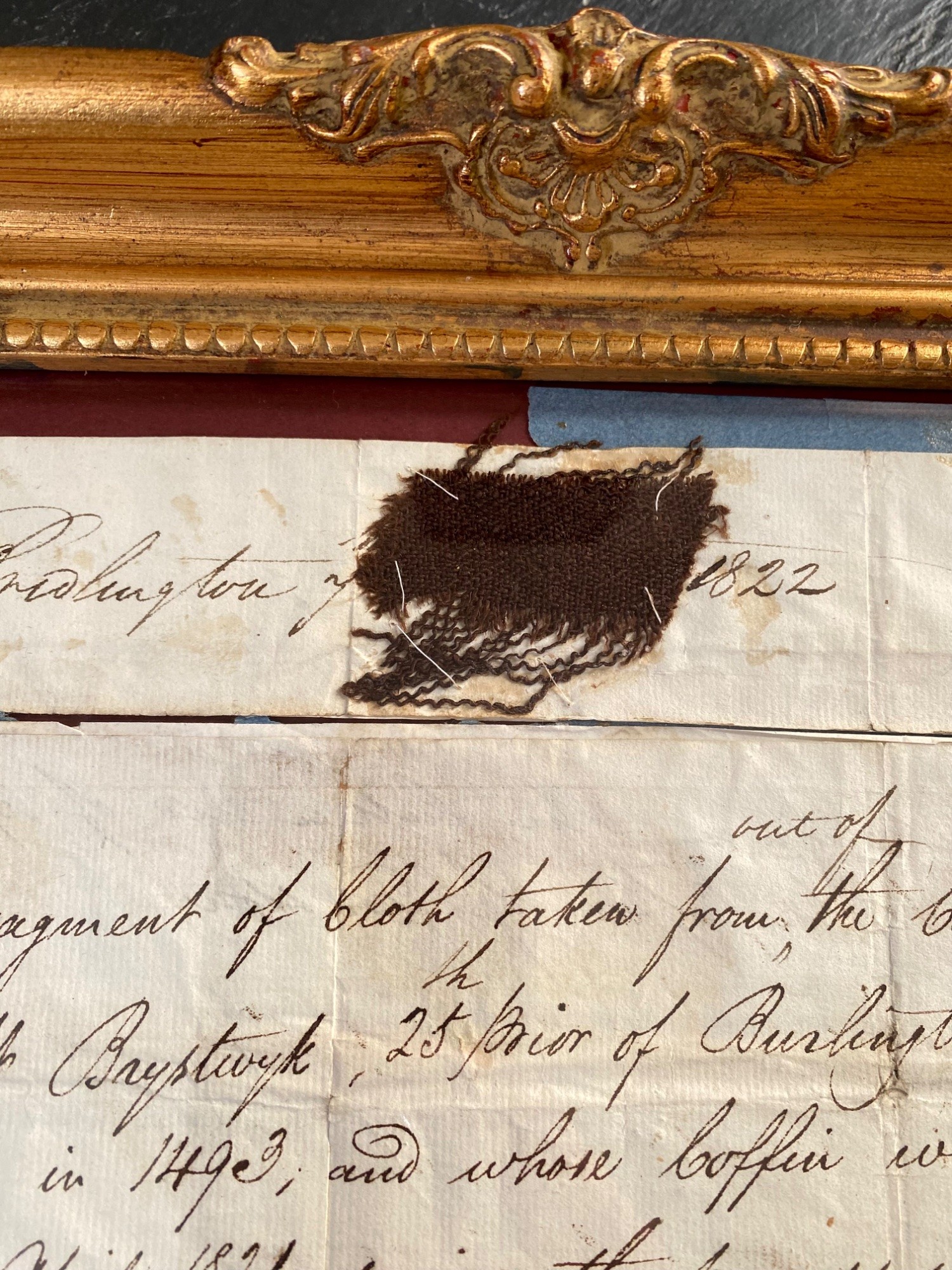
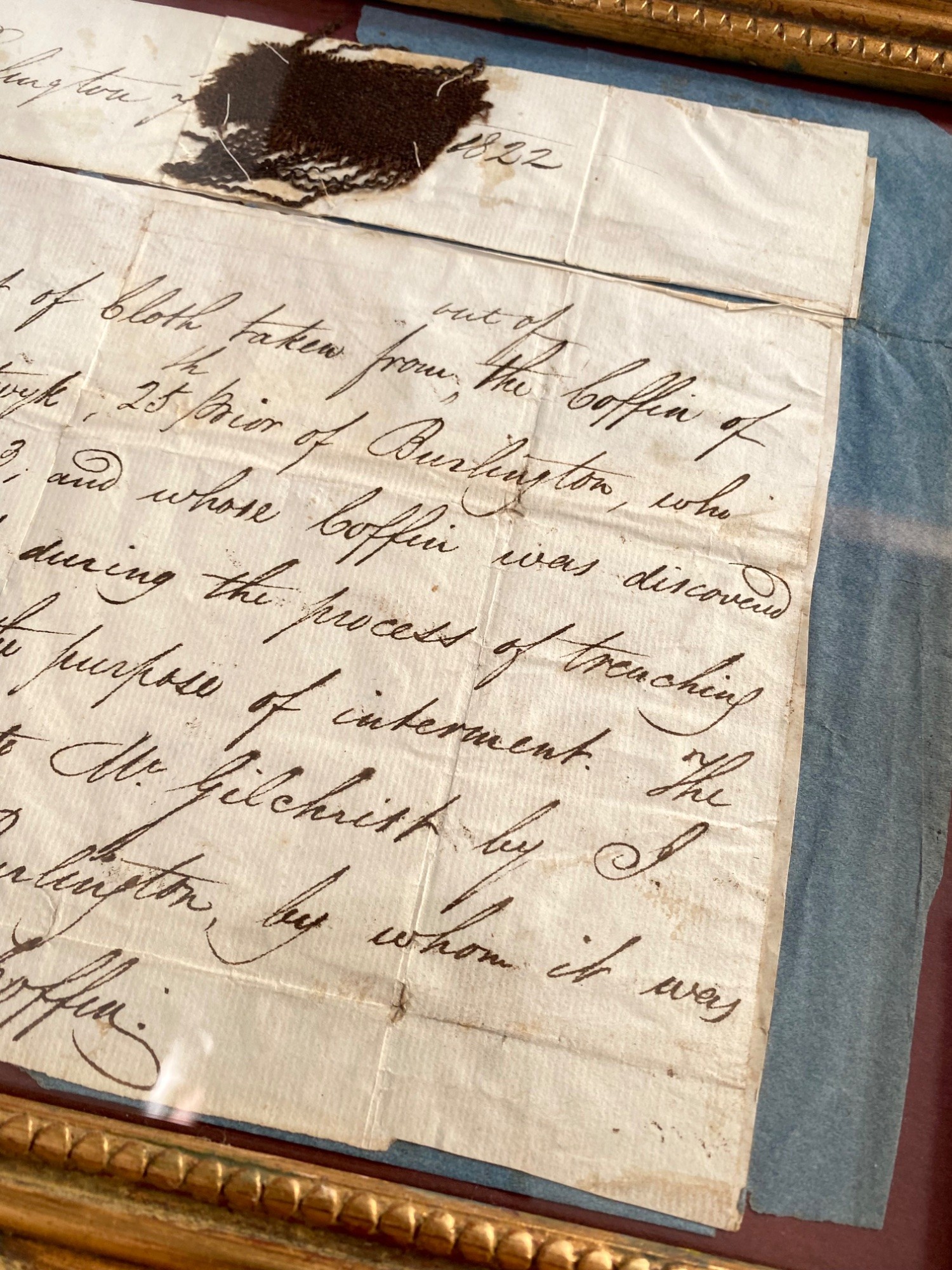
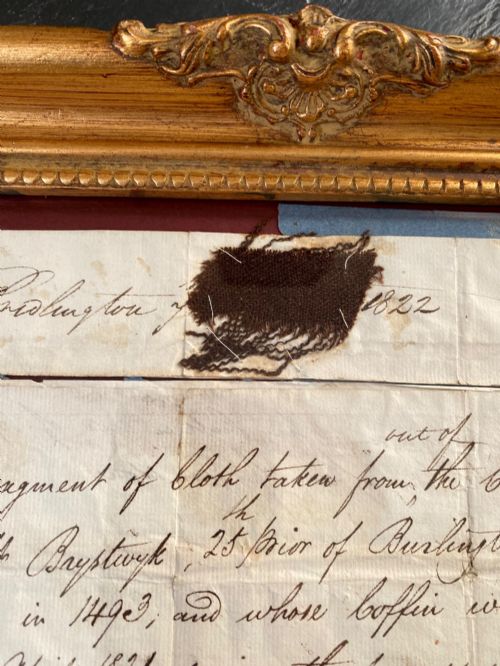
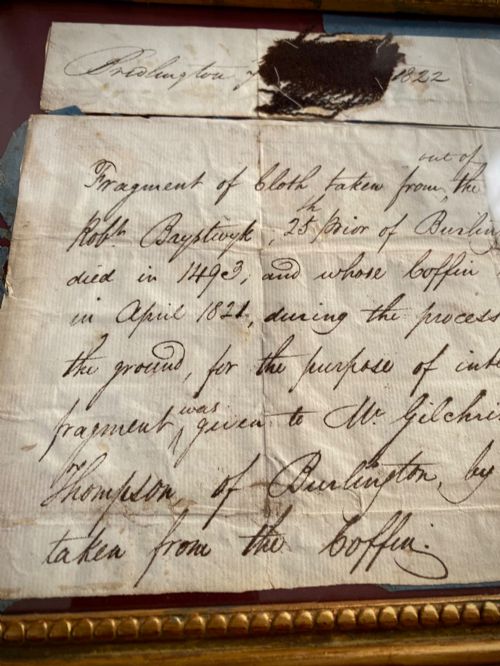
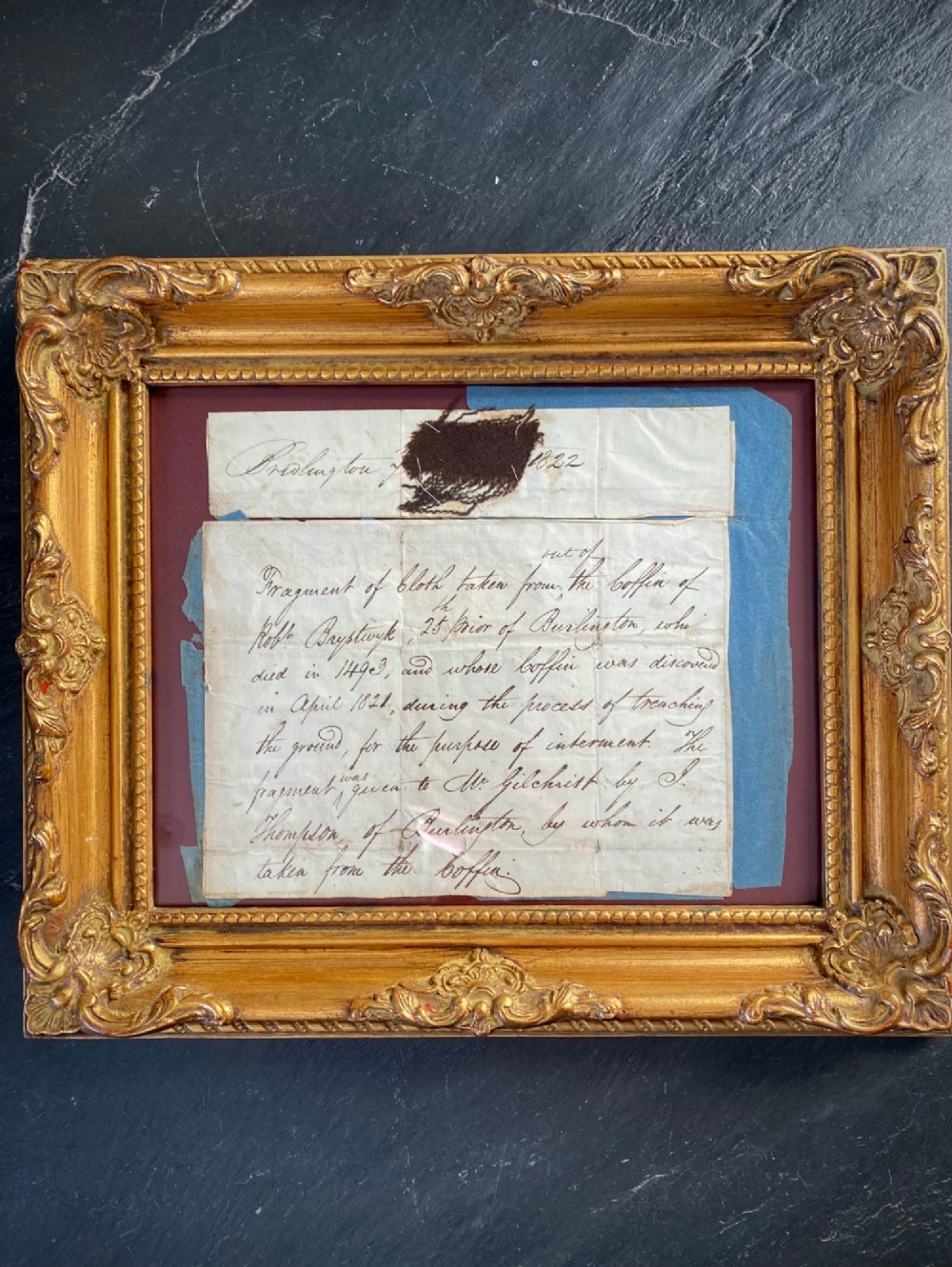
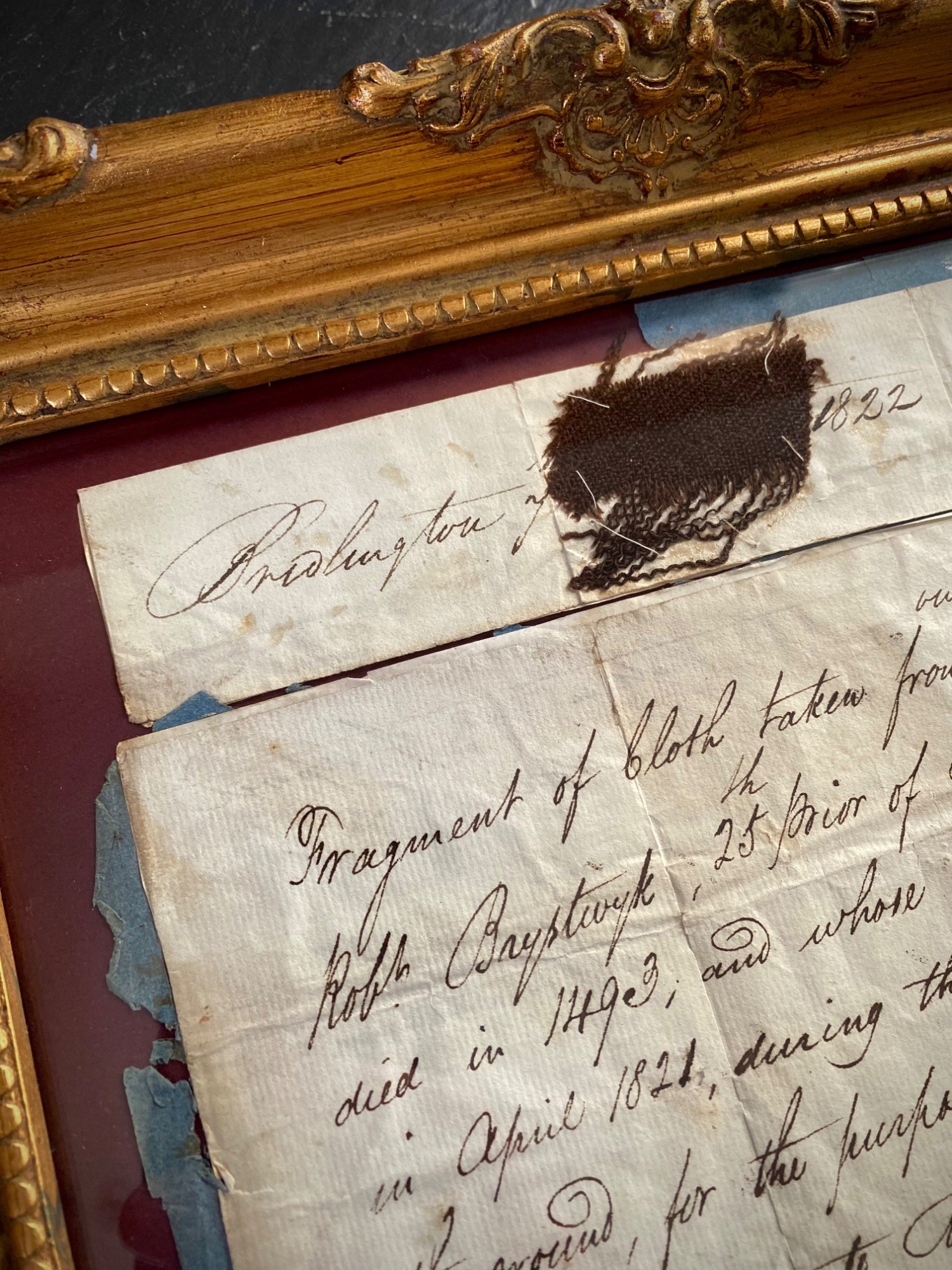
A Remarkable Framed Fragment Of 15th Century Burial Cloth Attached To A Handwritten Letter Of Provenance Which States It Was Exhumed During Trenching in 1821.

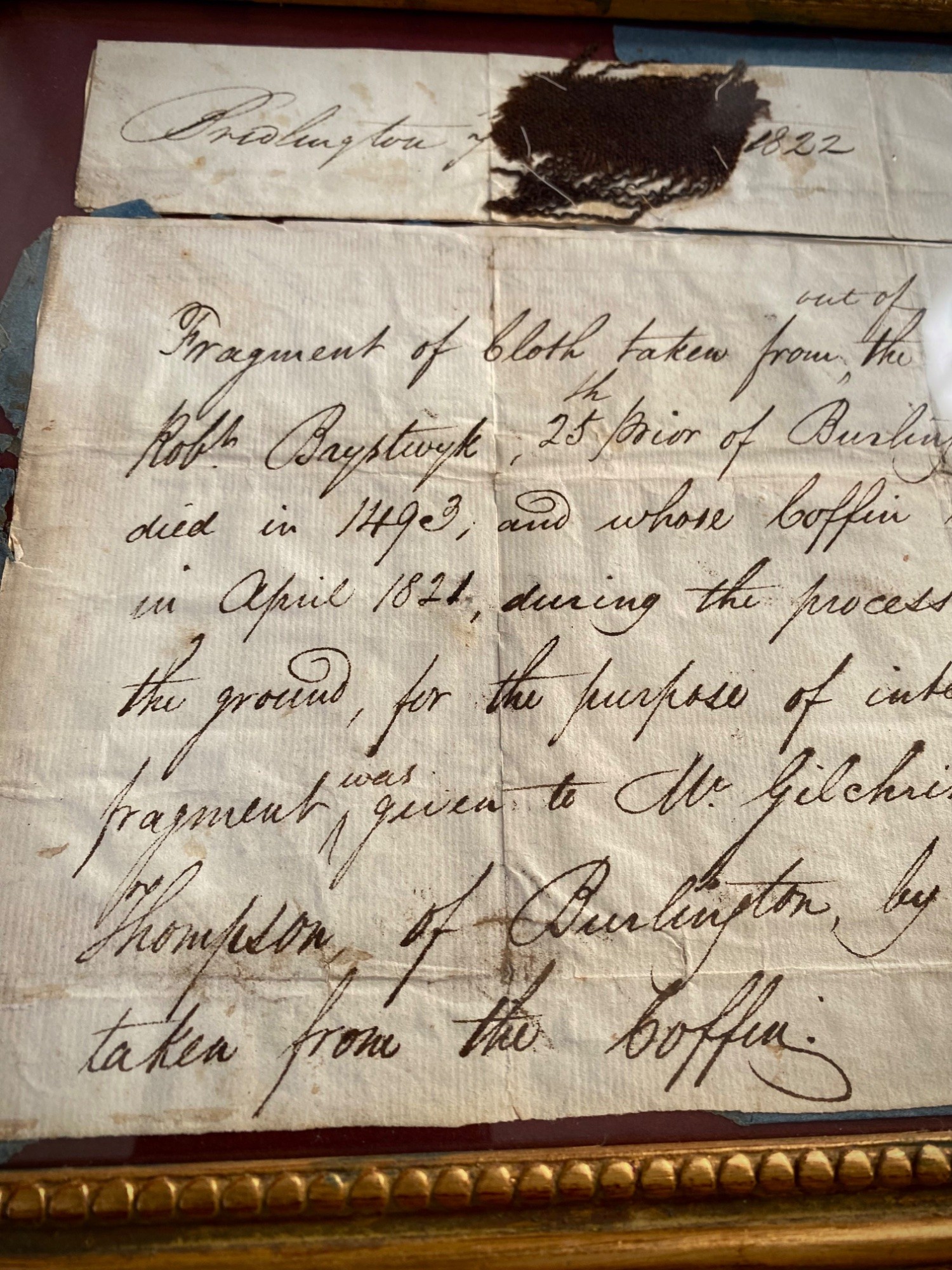
The letter reads:

”Bridlington 1822

Fragment of cloth taken from the coffin of Robert Brystwyk, 25th prior of Bridlington, who died in 1493, and whose coffin was discovered in April 1821, during the process of trenching the ground, for the purpose of interment. The fragment was given to Mr Gilchrist by J. Thompson, of Bridlington by whom it was taken from the coffin.”

Incredibly, during my research, I discovered local history records that revealed fascinating context that perfectly matches the timeline and events described in this letter of 1822. It read as follows:

"Another stone, now preserved in the vestry, bears the following inscription in old church text : - Hic jacet dns Robt. brystwyk quo da prior huj loci q obiit - 0 0 ano do m cccc nonagesimo iii cui aic ppiciet. de. Amen, which may be thus translated : - Here lies Robert Brystwyk formerly prior of this place, who died in the year of our Lord 1493; on whose soul may God have mercy. Amen. This stone was discovered in 1821, a little south of the church, where the transept had stood. Some workmen were employed digging up the foundations, and brought to light a stone coffin, covered by the above chalk-stone slab. The coffin contained the remains of the prior; the hair of the beard and the serge in which the body had been wrapped were still undecayed."
You can find this information HERE

Bridlington Priory itself has a fascinating history. The Priory's website describes it as:

"one of the great monastic houses of England during the Medieval period. Its wealth and possessions made it a key monastery in the North, one of the largest and richest of the Augustinian order. The church in those times was more than twice as large as what now remains, rivaling in size other great Yorkshire churches including Beverley Minster and Selby Abbey. The Priory today is a glorious survival of that pre-Reformation splendour, its transepts and its stately central tower over which soared a stone crown similar to those above the cathedrals of Newcastle and Edinburgh St Giles."
You can find this information HERE

This piece has been framed within a vintage ornate frame.

A rare survivor!

Condition is decent, commensurate with age. There is a tear across the top of the letter and it has been attached to blue backing paper to secure it.

Measures 33.5cm x 28cm x 3.5cm

Weighs 750 grams

Physical Dimensions
Height
28cm (11.02")
Width
33.5cm (13.19")
Depth
3.5cm (1.38")
Declaration

Folk and Fable Antiques has dated this Framed Medieval Textile Relic to the 19th Century.

Reference Numbers
Sellingantiques Reference
SA1239701
Description
A Remarkable Framed Fragment Of 15th Century Burial Cloth Attached To A Handwritten Letter Of Provenance Which States It Was Exhumed During Trenching in 1821.

The letter reads:

”Bridlington 1822

Fragment of cloth taken from the coffin of Robert Brystwyk, 25th prior of Bridlington, who died in 1493, and whose coffin was discovered in April 1821, during the process of trenching the ground, for the purpose of interment. The fragment was given to Mr Gilchrist by J. Thompson, of Bridlington by whom it was taken from the coffin.”

“
Incredibly, during my research, I discovered local history records that revealed fascinating context that perfectly matches the timeline and events described in this letter of 1822.
Folk and Fable Antiques

It read as follows:

fig 1. A dark 15th-century textile fragment and handwritten 19th-century note mounted inside an ornate carved giltwood frame.
fig 1. Remarkable Fragment of 15th C. Burial Cloth Exhumed During Trenching in 1821 with Provenance

"Another stone, now preserved in the vestry, bears the following inscription in old church text : - Hic jacet dns Robt. brystwyk quo da prior huj loci q obiit - 0 0 ano do m cccc nonagesimo iii cui aic ppiciet. de. Amen, which may be thus translated : - Here lies Robert Brystwyk formerly prior of this place, who died in the year of our Lord 1493; on whose soul may God have mercy. Amen. This stone was discovered in 1821, a little south of the church, where the transept had stood. Some workmen were employed digging up the foundations, and brought to light a stone coffin, covered by the above chalk-stone slab. The coffin contained the remains of the prior; the hair of the beard and the serge in which the body had been wrapped were still undecayed."

fig 2. A dark 15th-century textile fragment and handwritten 19th-century note mounted inside an ornate carved giltwood frame.
fig 2. Remarkable Fragment of 15th C. Burial Cloth Exhumed During Trenching in 1821 with Provenance

You can find this information HERE

Bridlington Priory itself has a fascinating history. The Priory's website describes it as:

"one of the great monastic houses of England during the Medieval period. Its wealth and possessions made it a key monastery in the North, one of the largest and richest of the Augustinian order. The church in those times was more than twice as large as what now remains, rivaling in size other great Yorkshire churches including Beverley Minster and Selby Abbey. The Priory today is a glorious survival of that pre-Reformation splendour, its transepts and its stately central tower over which soared a stone crown similar to those above the cathedrals of Newcastle and Edinburgh St Giles."

fig 3. A dark 15th-century textile fragment and handwritten 19th-century note mounted inside an ornate carved giltwood frame.
fig 3. Remarkable Fragment of 15th C. Burial Cloth Exhumed During Trenching in 1821 with Provenance

You can find this information HERE

This piece has been framed within a vintage ornate frame.

A rare survivor!

Condition is decent, commensurate with age. There is a tear across the top of the letter and it has been attached to blue backing paper to secure it.

Measures 33.5cm x 28cm x 3.5cm

Weighs 750 grams

Height
28cm (11.02")
Width
33.5cm (13.19")
Depth
3.5cm (1.38")
Date of Manufacture

Folk and Fable Antiques has dated this Framed Medieval Textile Relic to the 19th Century.

Reference Numbers
Sellingantiques Ref
SA1239701
Folk and Fable Antiques
Sellingantiques verified Since Oct 2026

Unique pieces for collectors and curious minds

Dealer Profile

You can view the stock and full dealer information on the Folk and Fable Antiques Profile Page
PDF SHARE
SAVE
A dark 15th-century textile fragment and handwritten 19th-century note mounted inside an ornate carved giltwood frame.
1 / 5
Archive I A dark 15th-century textile fragment and handwritten 19th-century note mounted inside an ornate carved giltwood frame.

Remarkable Fragment of 15th C. Burial Cloth Exhumed During Trenching in 1821 with Provenance
Archive II A dark 15th-century textile fragment and handwritten 19th-century note mounted inside an ornate carved giltwood frame. View II
Archive III A dark 15th-century textile fragment and handwritten 19th-century note mounted inside an ornate carved giltwood frame. View III
Archive IV A dark 15th-century textile fragment and handwritten 19th-century note mounted inside an ornate carved giltwood frame. View IV
Archive V A dark 15th-century textile fragment and handwritten 19th-century note mounted inside an ornate carved giltwood frame. View V
Enlarged Archival View
Telephone 07788216610
Location
United Kingdom
Verified Since Oct 2026
Items For Sale 36
Folk and Fable Antiques
Verified Since Oct 2026
View Dealer Info
Location: United Kingdom
Verified
Oct 2026
For Sale
36
A dark 15th-century textile fragment and handwritten 19th-century note mounted inside an ornate carved giltwood frame.
Remarkable Fragment Of 15th C. Burial Cloth Exhumed During Trenching in 1821 With Provenance
Ref: SA1239701
A dark 15th-century textile fragment and handwritten 19th-century note mounted inside an ornate carved giltwood frame.
Detail View 1
Detail View 2
Detail View 3
Detail View 4
Archival Detail
Every single antique dealer on our platform is individually approved by our internal team. We verify their professional trade history, ethical standards, and photographic quality to ensure a secure, high-standard buying environment. Upon joining, every dealer agrees to a strict 9-point code of conduct. While issues can occasionally arise, our dealers typically resolve them swiftly and directly with the buyer. In fact, since our founding in 2002, Sellingantiques has only had to step in to help resolve an issue on roughly five occasions—a true testament to the quality of our dealers and their dedication to your happiness.
Our dealers are highly experienced in packing and shipping fragile, high-value antiques. Because you are in direct contact with the dealer, you will be able to easily go through all available shipping and insurance options together to ensure your item arrives safely.
Antiques are the ultimate green purchase. By choosing historical pieces over newly manufactured goods, you completely eliminate the carbon footprint of modern mass production while preserving exceptional, timeless craftsmanship.
Written by Sellingantiques from the dealer’s photographs and listing
  • ObjectFramed Art
  • Period19th century
  • StyleGothic
  • MaterialGiltwood, Paper, Textile, Glass
  • ColourGold
  • MotifsHandwritten script, Acanthus moulding, Gilded finish, Textile swatch
  • SizeH 28 cm (11 in) x W 33.5 cm (13 in) x D 3.5 cm (1 in)

A medieval textile fragment relic is a preserved piece of fabric dating from the Middle Ages, often retrieved from archaeological digs, burial sites, or ecclesiastical vestments. These fragments are frequently mounted alongside written documentation detailing their origin and history.

Fifteenth-century burial textiles were typically woven from wool, linen, or silk threads depending on the individuals status. Nineteenth-century display mountings commonly utilised rag paper, iron gall ink, glass, and carved timber frames coated in gold leaf or composition gilding.

Authentication involves evaluating the weave structure, fibre degradation, and chemical composition of the fabric. Accompanying handwritten paper notes, ink composition, and historical records of nineteenth-century exhumations further confirm authenticity.

Framed relics and manuscript notes serve as visual focal points when styled on gallery walls, within bookshelf displays, or mounted above side tables. Pairing gilded historic frames with dark wood paneling or neutral contemporary walls highlights their historical character.

Framed paper and textile artefacts must be displayed away from direct sunlight and humid environments to prevent fading and mould growth. Conservation-grade UV-filtering glass and acid-free mounting boards are recommended to protect fragile organic fibers.
items
Add keywords to the filter
Price
£100
£250000
Era
Period
Style
Material
Origin
Stock Location
Recently Added
Online Payments
Categories