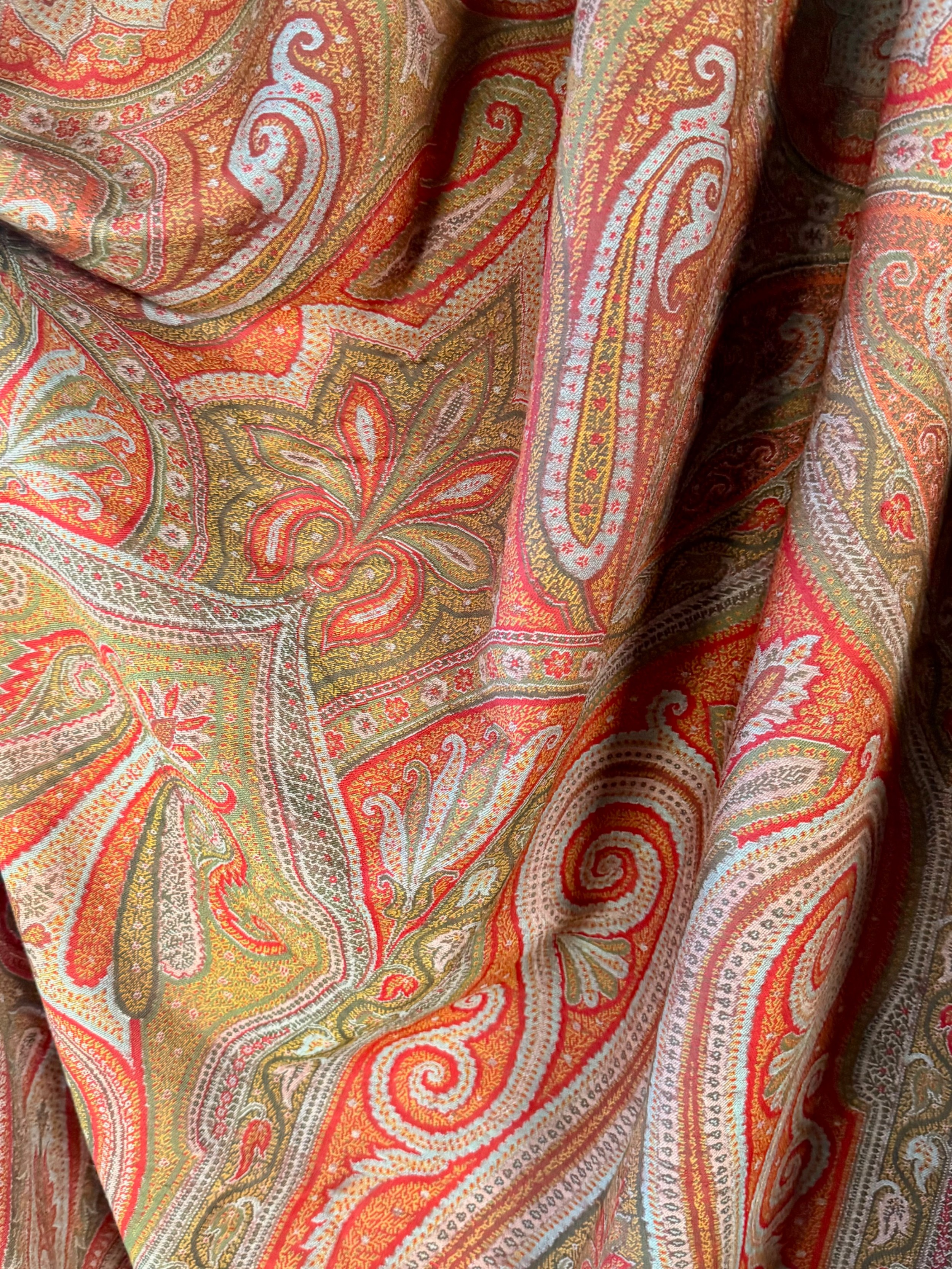
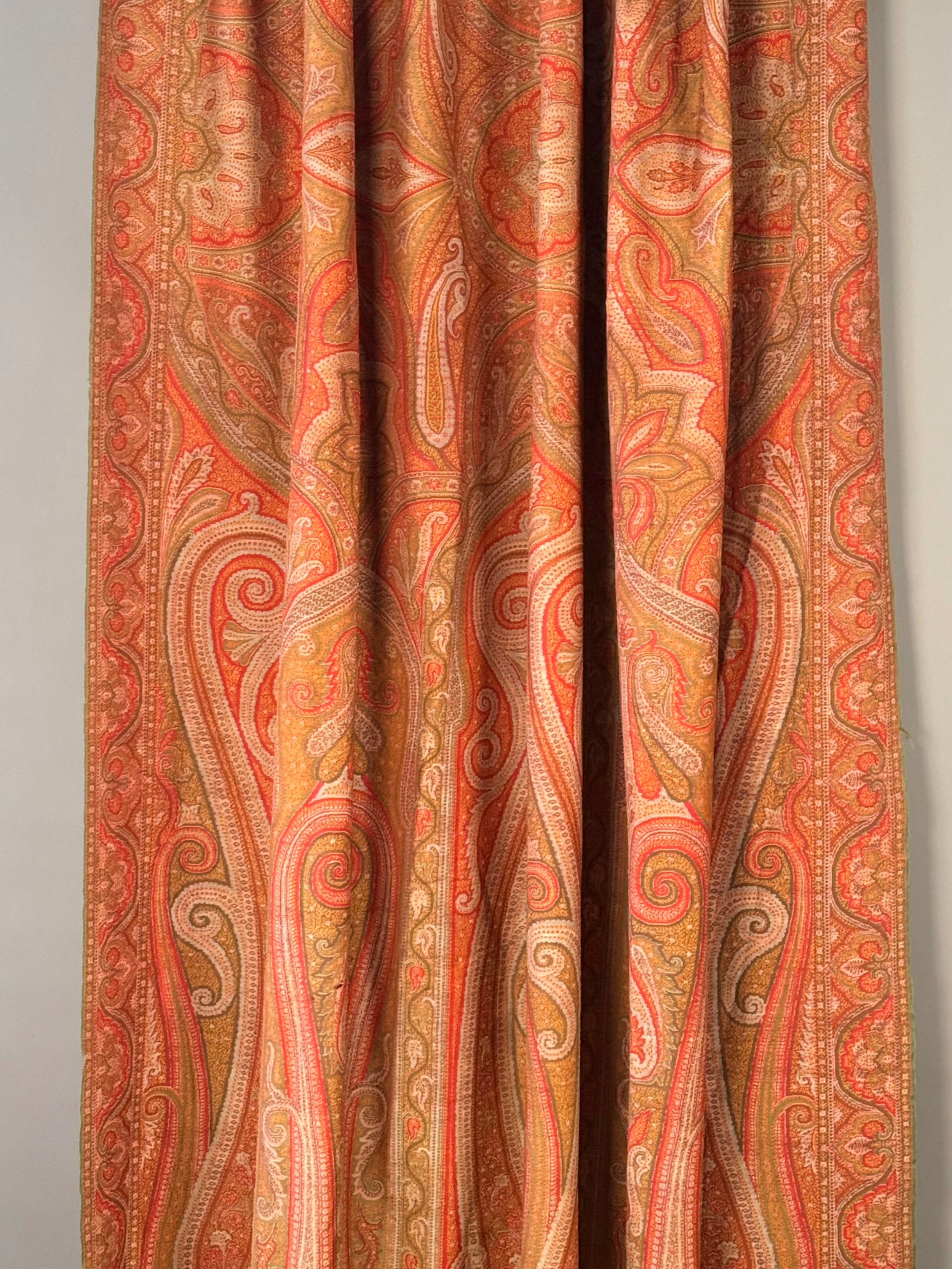
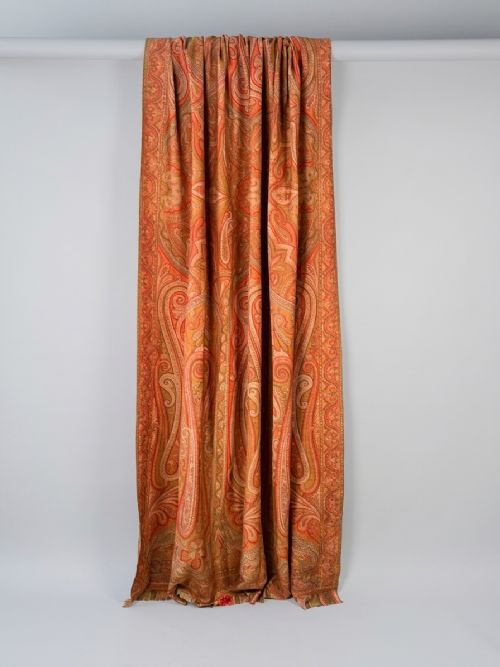
The English Interior has dated this Victorian Paisley Wool Shawl to the 19th Century.
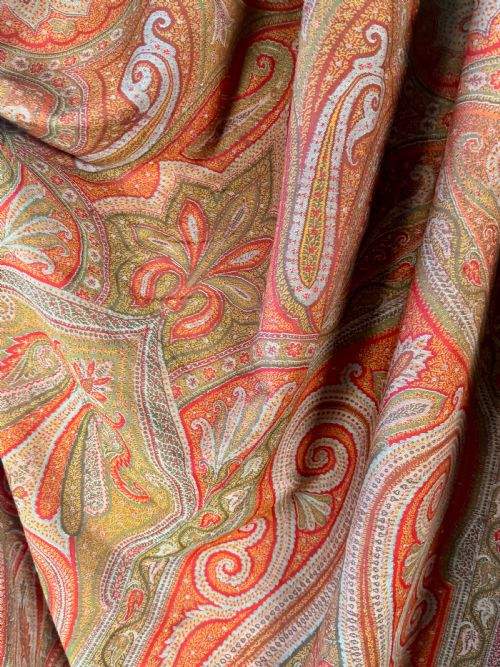
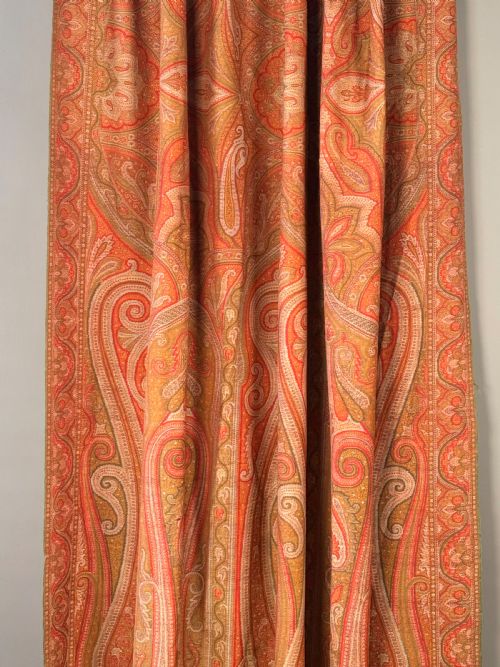
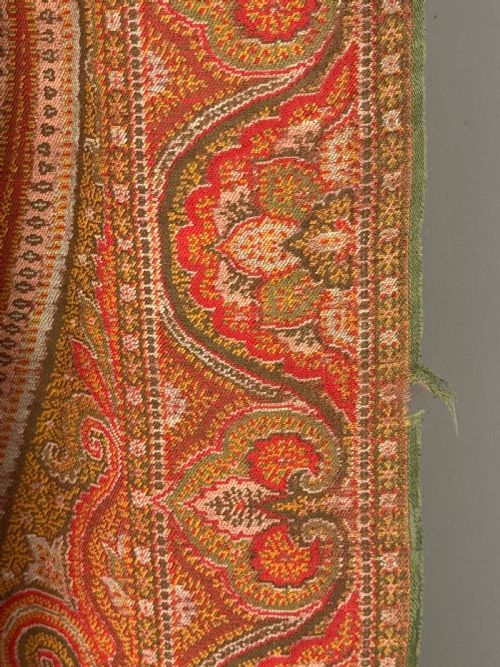
Wonderful scrolling paisley design in oranges russets and greens
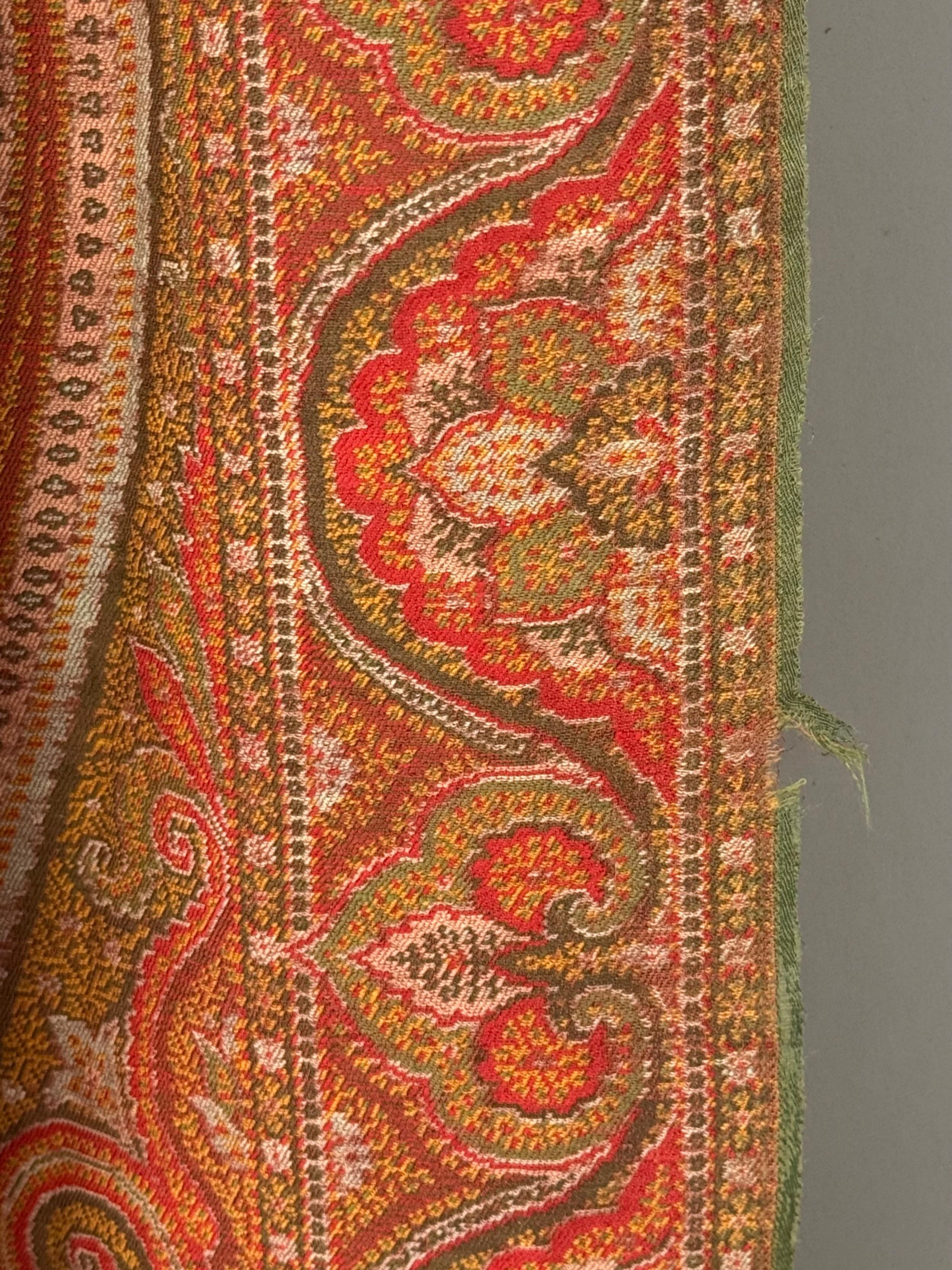
The shawl is In good age related condition, so I do think that not may also be possible to conserve it as the real of damage are all small.
There are approximately 6 to 8 areas of damage, and these are mostly to centre where has been folded
The Paisley Shawls have been for long regarded as masterpieces of design and weaving, worthy to rank with the best tapestries, and greater than the finest brocades. It is to be regretted, therefore, that there is so much misapprehension and even ignorance among their admirers, and that the art and craft of their manufacture is almost forgotten. The generation that made them is dead and gone, those that knew them a little are almost gone, and only a modicum of knowledge of the technique of both design and weaving has survived. Even in 1903, Matthew Blair in " The Paisley Shawl" deplored the loss of all information regarding the bead-lam lappet, the deil or douge, and other strangely named objects. We cannot hope to compensate for this loss. We can only offer a brief sketch of the evolution and history of the Paisley Shawl for the benefit of those whose knowledge is even more imperfect than ours.
The production of " Paisley " shawls in Paisley lasted only seventy years, but the industry had its origin very much further back than the weaving of the first shawl about 1800. The shawls of Kashmir which were copied by the Paisley weavers were known to the Roman Caesars. Their designs are prehistoric.
Kashmir made shawls which were famous all over Asia from very early times ; but, though many went to the Russian nobles, few reached Western Europe till the latter part of the eighteenth century. Napoleon's officers are said to have been the means of introducing them from Egypt to France. A famous beauty, Mme Emile Gaudin, made them fashionable, and a regular trade in them sprang up with the Levant. The British Fleet was active in the Mediterranean about that time, which may explain the arrival of Kashmir shawls in this country.
A Kashmir shawl might take three people more than a year to make, so fine and so laborious were the methods of embroidery and hand weaving used. They were consequently very valuable, and such shawls became the property of princes and nobles, and were commonly given as royal gifts. The specimens which reached Europe fell into similar hands. A French trade journal Le Cachemirien, of designs copied from Indian examples cites the owners of the shawls - the King of the Belgians, the Due de Berri, and others. It was the nobility of Britain who acquired them too. In spite of their high price, the demand for Kashmir shawls became so great that it could hardly be satisfied. Then, inevitably, a cheaper variety was desired. Efforts to copy the Indian examples were made. These soon succeeded, and eventually the Indian trade was almost entirely superseded. This happened first in France, where Paris and Lyons became the centres of manufacture, next in Norwich and Edinburgh, and only lastly in Paisley, where about 1800 a Mr Paterson made the first attempt to copy an Indian shawl.
Paisley was important as a weaving town from Stewart times, and had profited from the teaching of Flemish weavers to become one of the leading producers of cloth in Scotland. In the eighteenth century its silks and gauzes eclipsed Spitalfields for a time ; it also had a name for fine lawn and for damask. Its weavers had therefore a command of the technique necessary before the copying of Indian designs could be attempted. But even the technique of damask weaving, which used a harness " draw-loom " to produce patterns, was inadequate for the task
The English Interior has dated this Victorian Paisley Wool Shawl to the 19th Century.
Specialist dealer in 17th century to the 20th century fine art, furniture and decorative antiques for your home.
You can view the stock and full dealer information on the The English Interior Profile Page
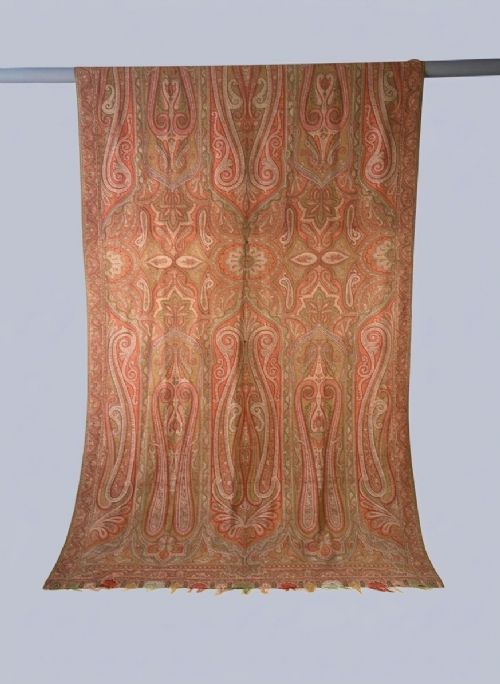
Fine and Large 19th Century Scottish Paisley Wool Shawl