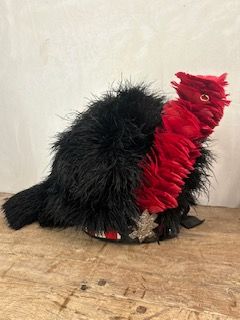
William Morris Antiques has dated this piece to the 1910s.
These are reminiscent of the bearskins that used to be worn, but which are no longer used in military service. Due to the increasing scarcity of bears, as well as the required hunting, the feather bonnets were a much more economical choice, even in the early 1800s. These are now mostly worn by pipers and drummers in various bands throughout the world.
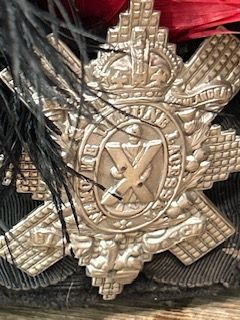
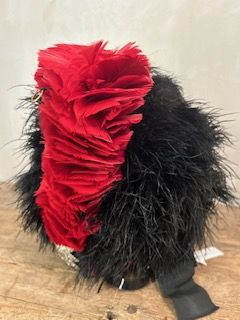
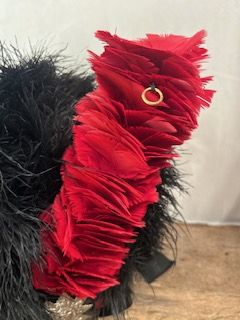
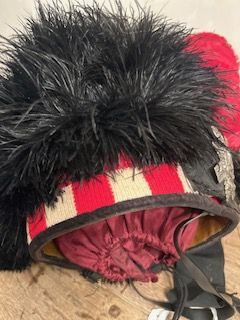
This bonnet has the usual white, red and navy blue checkerboard around the bottom, with a black "tail" on the back, which has four separate sections. The left side of the helmet has a small fabric rosette, where the Regimental Badge of the The Black Watch (Royal Highland Regiment) is displayed, and features a "King's Crown", indicating issue before 1952. It also has the distinctive red feather "hackle" plume, used only by the Black Watch.
The cap badge is distinctive, with the 8 pointed Star of the Order of the Thistle, bearing a banner reading THE ROYAL HIGHLANDERS at the top, and another reading BLACK WATCH at the bottom. Within this is a thistle wreath surrounding an oval with the Royal Motto of Scotland: NEMO ME IMPUNE LACESSIT (No one provokes me with impunity). This was the Latin motto of the Royal Stuart dynasty of Scotland from at least the reign of James VI when it appeared on the reverse side of merk coins minted in 1578 and 1580. The Very center of the badge is an image of St. Andrew with the Cross of Scotland, and at the very bottom is a Sphinx atop a tablet, added to the regimental emblems of all units that saw service in the Egyptian Campaign of 1801.
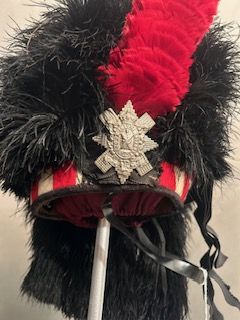
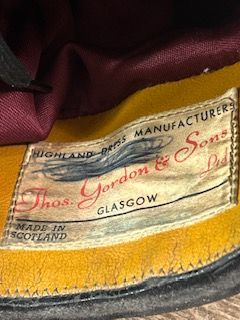
It retains its original leather headband, retains original makers label for Thomas Gordon & sons Glasgow and totally covered in Black Feathers. There are four tails to the bonnet, which indicate an enlisted man: five tails are reserved for officers.
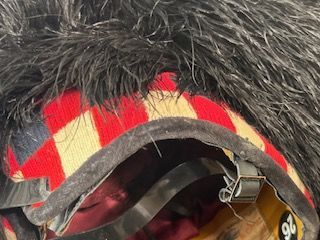
The bonnet is in very good condition, especially considering the age and condition. While modern feather bonnets make good use of more "modern" materials, this one has a wool checkerboard, which while somewhat scuffed and "fuzzy", has not suffered moth damage. There is age toning and staining on the white, as expected, but overall it presents very nicely.
William Morris Antiques has dated this piece to the 1910s.
Jess william morris established himself in the antiques business in 1999 after being awarded an rics accredited fine art valuation degree
You can view the stock and full dealer information on the William Morris Antiques Profile Page
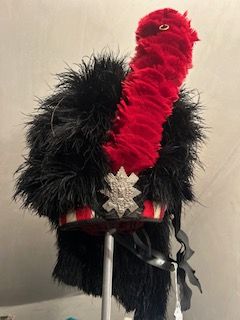
Antique Black Watch Feather Bonnet by Thomas Gordon Glasgow