30,070  PAGES BROWSED TODAY PAGES TODAY 88 ANTIQUES UPLOADED TODAYNEW ARRIVALS
88 ITEMS ADDED TODAY
Sort Order
Items Per Page
Browse Categories
Sort order
Items per page
ID #SA1104194
FOR SALE
£2,950
Email
Save
Antique Regency Ormolu Cherub Tazza with Malachite & Blue John 19th Century
Regent Antiques
for sale €3,452     $3,747
£2,950
Regent Antiques

Regent Antiques

Sellingantiques Verified Since Sep 2016
View Dealers Stock Page
  • About Us
    We specialise in english and continental furniture, silver, porcelain and decorative items.
  • Trade Associations
    Regent Antiques is a registered member of LAPADA  CINOA
Id #SA1104194
PDF SHARE
SAVE

Antique Regency Ormolu Cherub Tazza with Malachite & Blue John 19th Century

19th century
For Sale by Regent Antiques
Description

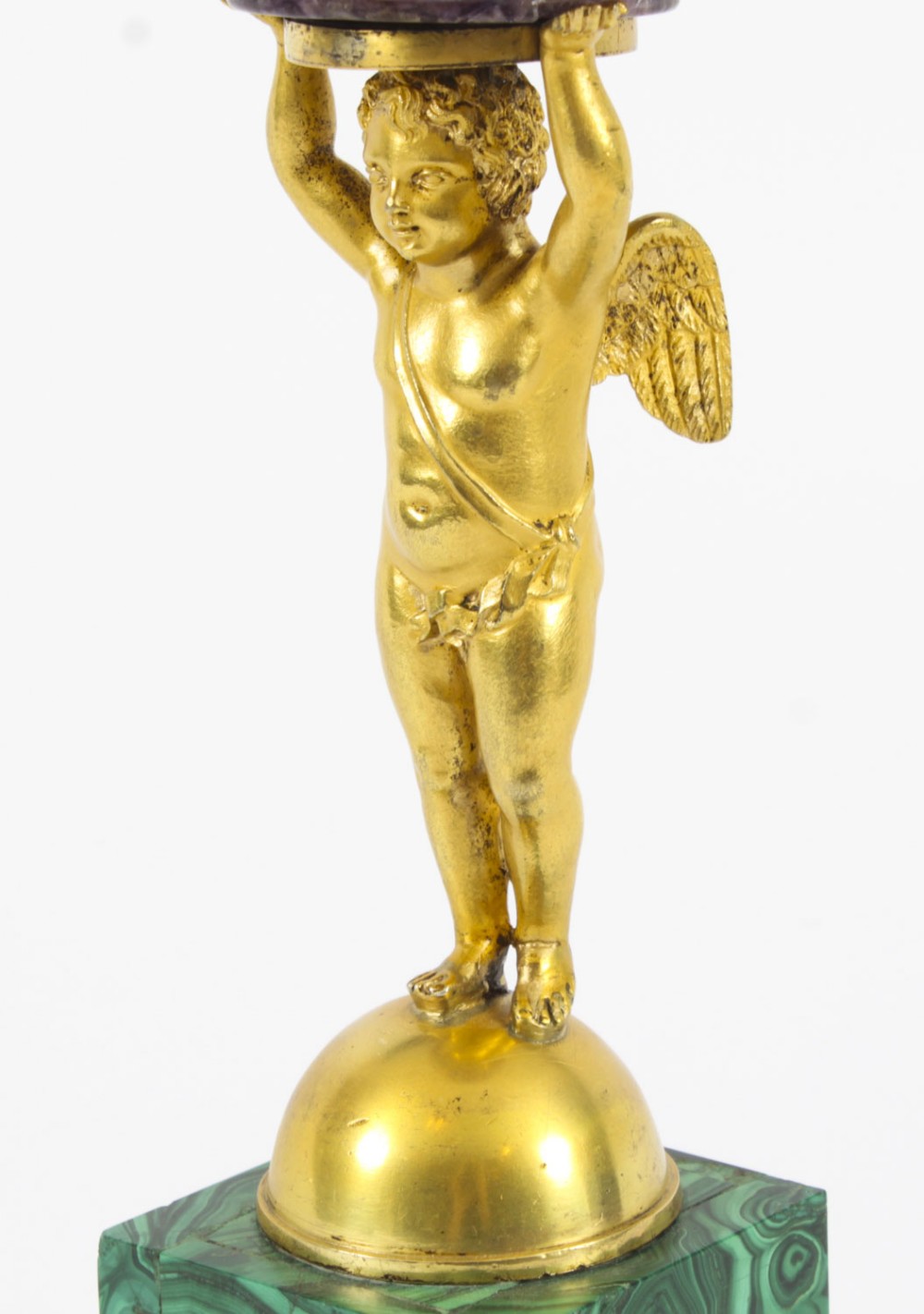
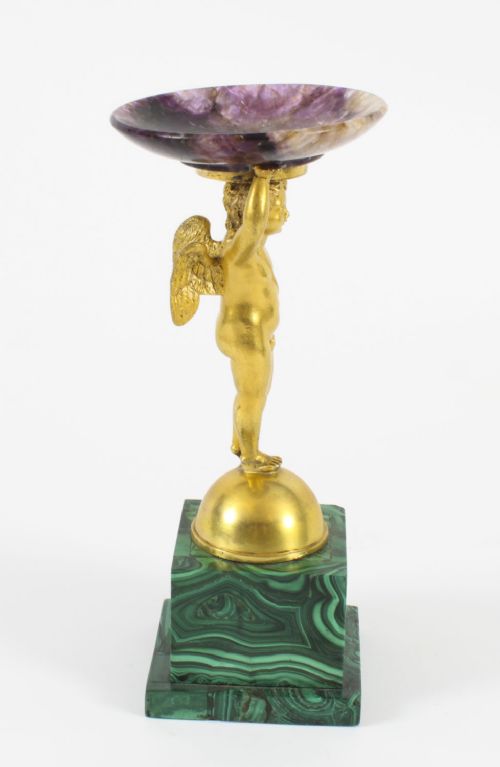
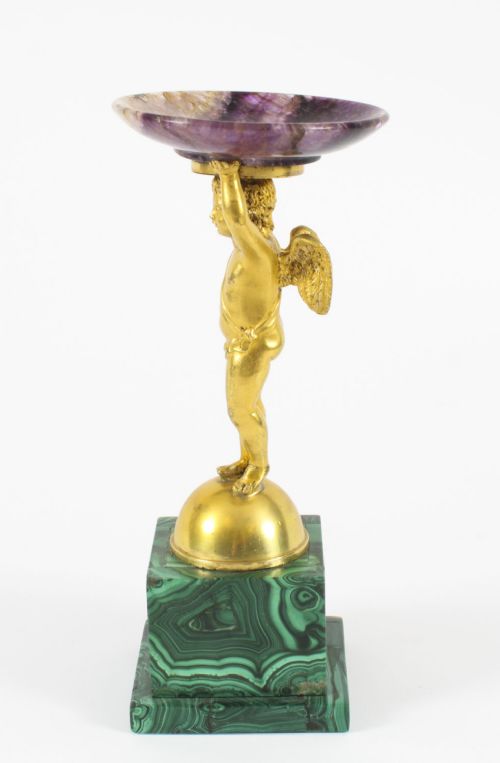
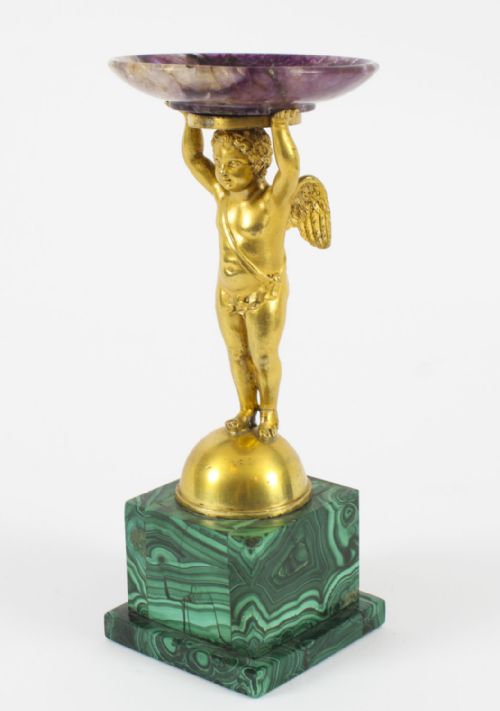
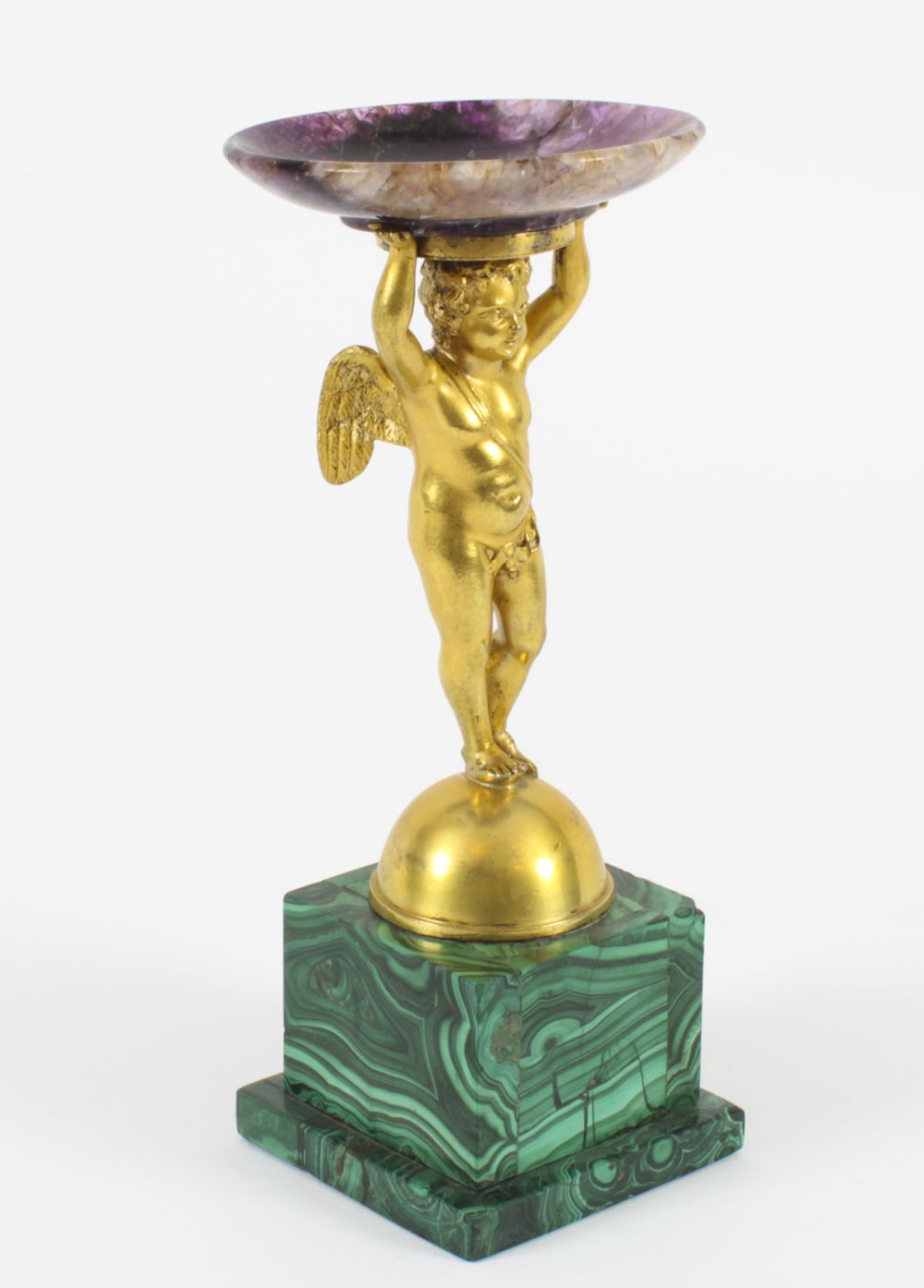
This is an impressive and highly decorative Regency Period ormolu, malachite and Blue John tazza, Circa 1820 in date.

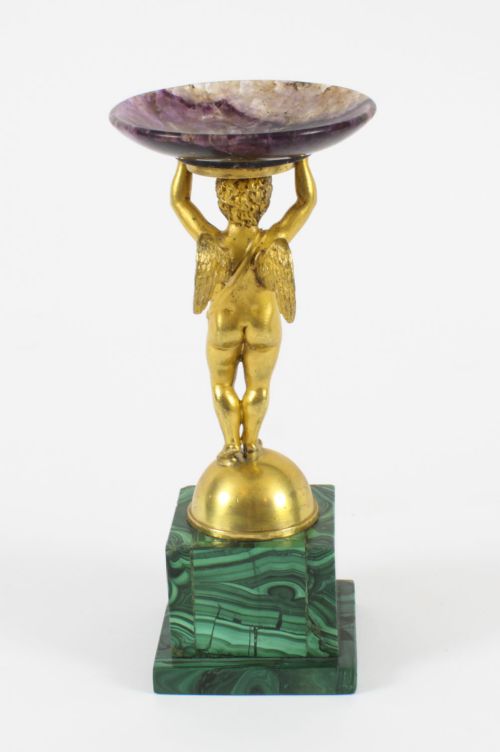
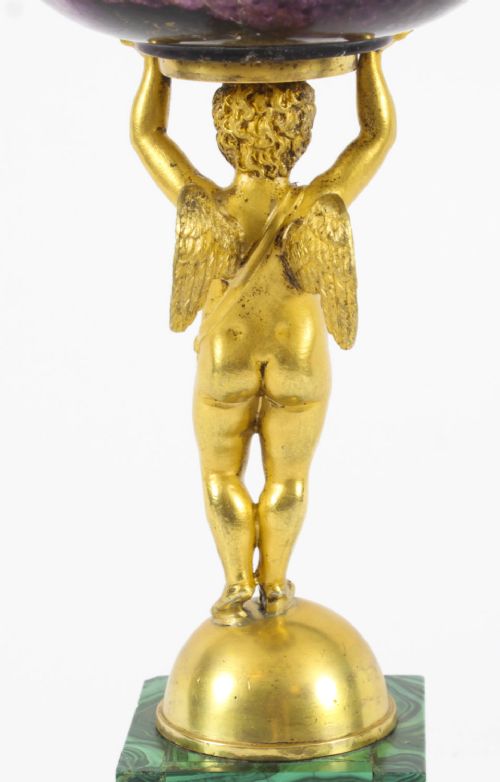
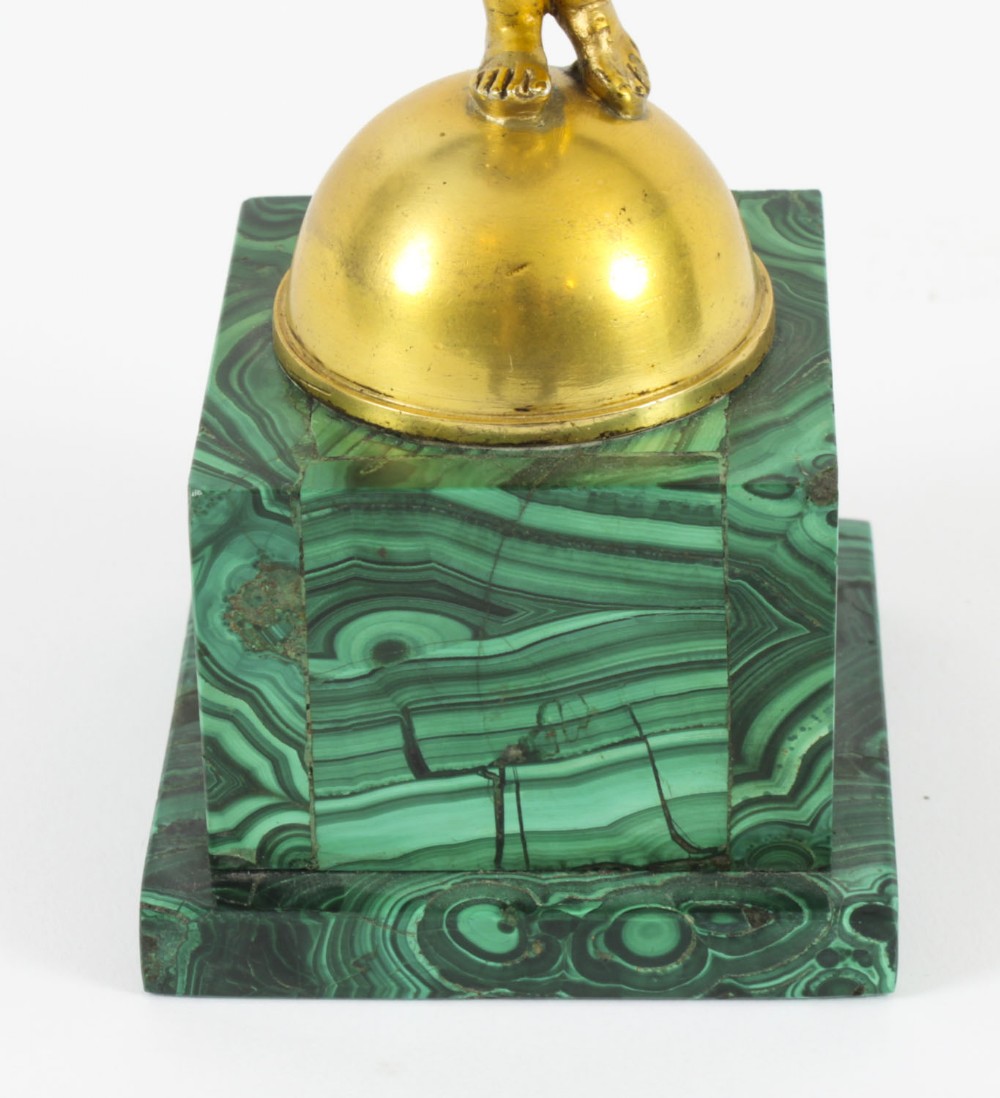
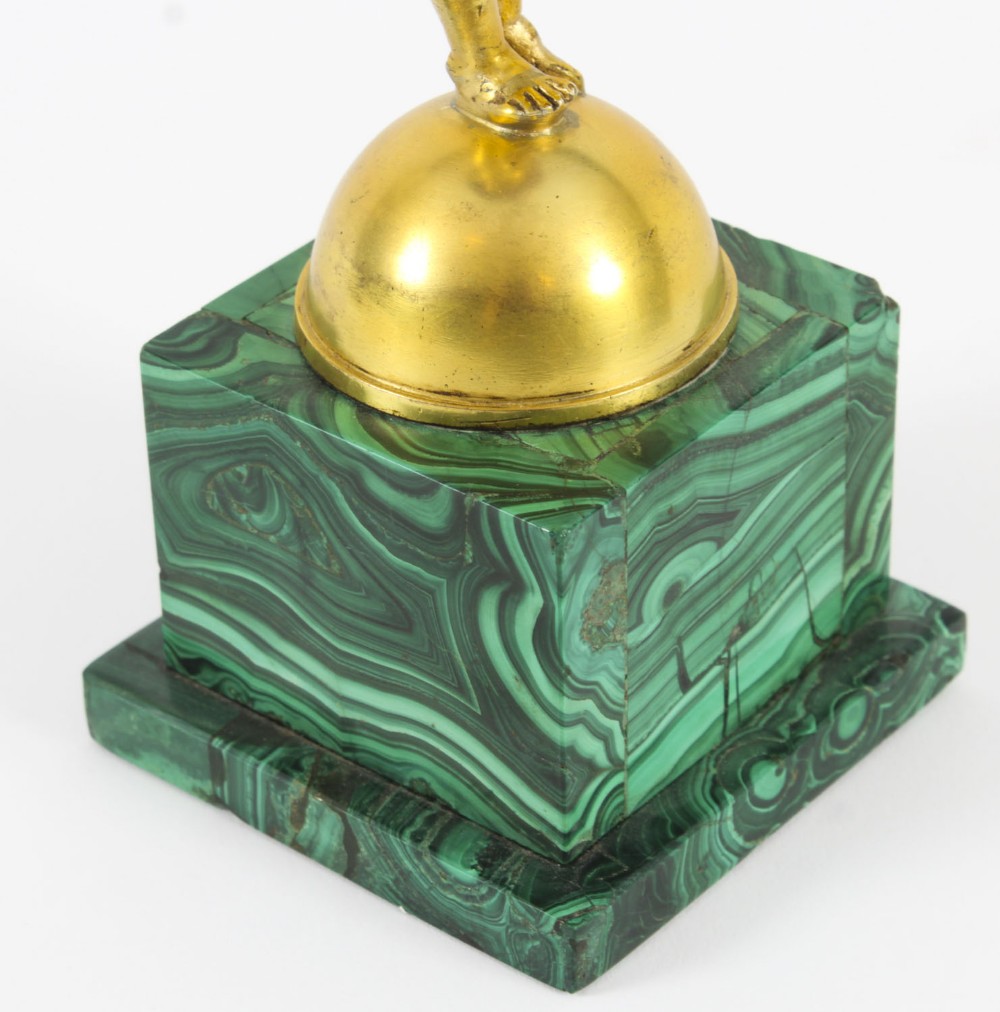
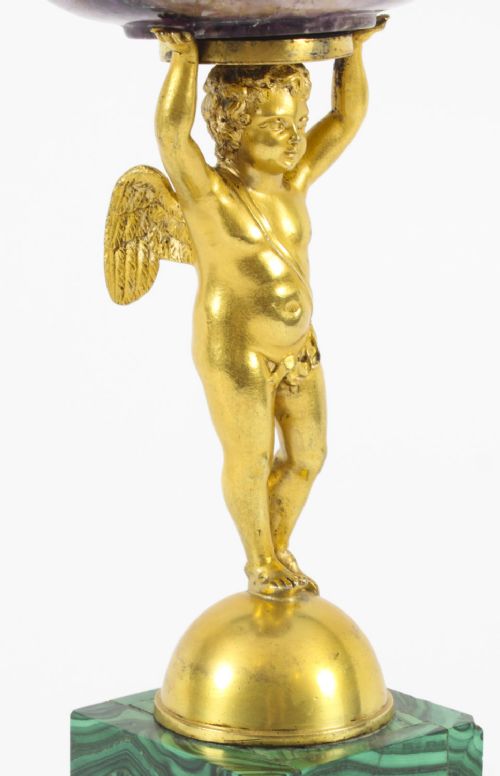
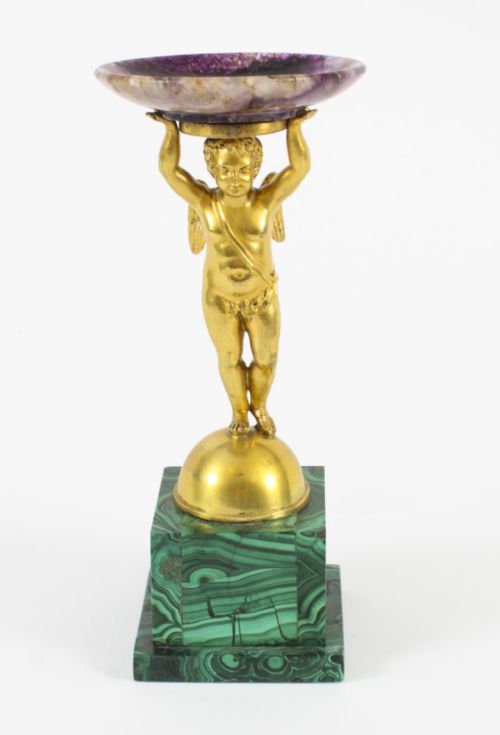
It features an ormolu winged cherub holding a Blue John tazza on a stepped Malachite base.
Add some Regency charm to your home with this beautiful sculpture.

Condition:

In really excellent condition with no dings or dents, please see photos for confirmation.

Dimensions in cm:

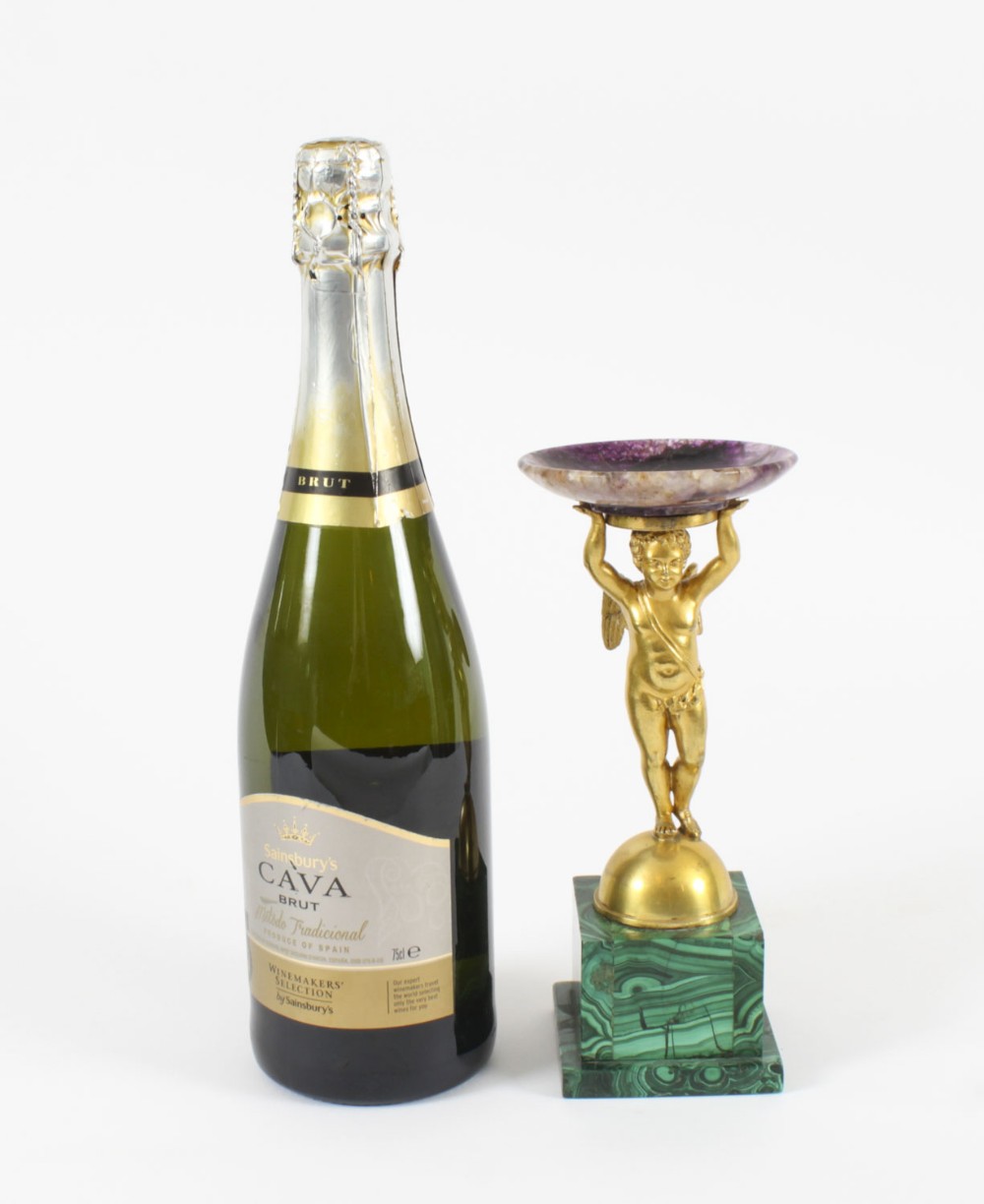
Height 22 cm x Width 9 cm x Depth 9 cm
Dimensions in inches:

Height 9 inches x Width 3 inches x Depth 3 inches

Malachite is a bright green copper carbonate hydroxide mineral contain 57.48% Cu in the purest form. The commercial quantity of malachite occurs worldwide including Congo, Gabon, Zambia, Namibia, Mexico, Australia, and with the largest deposit/mine in the Urals region, Russia.

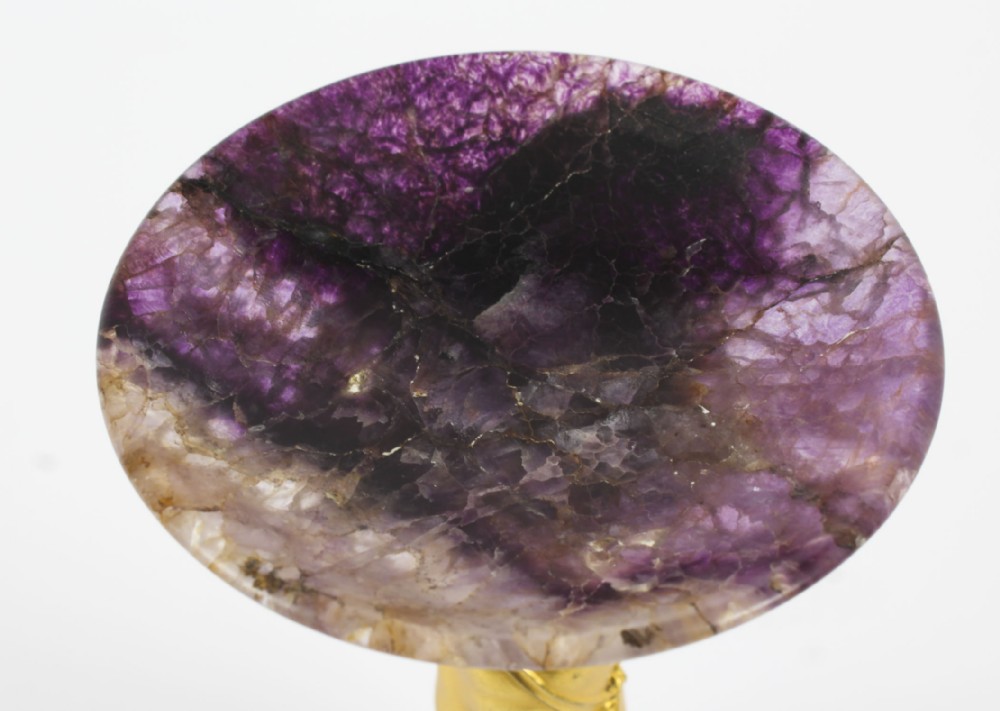
Blue John (also known as Derbyshire Spar) is a semi-precious mineral, a rare form of fluorite with bands of a purple-blue or yellowish colour. In the United Kingdom it is found only at Blue John Cavern and Treak Cliff Cavern at Castleton in Derbyshire. During the 19th century, it was mined for its ornamental value, and mining continues on a small scale.

The most common explanation for the name is that it derives from the French bleu-jaune, meaning 'blue-yellow'. The story goes that Blue John was exported to France where it was used by ormolu workers during the reign of Louis XVI (1774–91). However, there is no archival record of any Blue John being exported to France and the early ormolu ornaments which use Blue John were being manufactured by Matthew Boulton of Birmingham in the 1760s.

An alternative origin of the name derives from an old miners' name for the zinc ore sphalerite, which they called "Black Jack". Thus, the unique blue stone mined in these caverns could easily have become known as "Blue John".

Another derivation comes from the Cornish miners who began working the Derbyshire lead mines in the 1740s. The name "Blue John" is used for several rocks in Cornwall, including fluorspars, and derives from the Cornish language word bleujenn, in Old Cornish blodon, a flower, bloom or blossom.

Ormolu - Gilt Bronze (from French 'or moulu', signifying ground or pounded gold) is an 18th-century English term for applying finely ground, high-carat gold in a mercury amalgam to an object of bronze.The mercury is driven off in a kiln leaving behind a gold-coloured veneer known as 'gilt bronze'.

The manufacture of true ormolu employs a process known as mercury-gilding or fire-gilding, in which a solution of nitrate of mercury is applied to a piece of copper, brass, or bronze, followed by the application of an amalgam of gold and mercury. The item was then exposed to extreme heat until the mercury burned off and the gold remained, adhered to the metal object.

Our reference: A3893

Physical Dimensions
Height
22cm (8.66")
Width
9cm (3.54")
Depth
9cm (3.54")
Declaration

Regent Antiques has dated this Regency Ormolu Cherub Tazza to the Regency era.

Reference Numbers
Sellingantiques Reference
SA1104194
Dealers Internal Reference
A3893
Description
This is an impressive and highly decorative Regency Period ormolu, malachite and Blue John tazza, Circa 1820 in date.

It features an ormolu winged cherub holding a Blue John tazza on a stepped Malachite base.

fig 1. A 19th-century Regency ormolu tazza featuring a gilt cherub figure supporting a purple stone dish, raised on a stepped green malachite base.
fig 1. Antique Regency Ormolu Cherub Tazza with Malachite & Blue John 19th Century

Add some Regency charm to your home with this beautiful sculpture.

Condition:

In really excellent condition with no dings or dents, please see photos for confirmation.

Dimensions in cm:

Height 22 cm x Width 9 cm x Depth 9 cm

fig 2. A 19th-century Regency ormolu tazza featuring a gilt cherub figure supporting a purple stone dish, raised on a stepped green malachite base.
fig 2. Antique Regency Ormolu Cherub Tazza with Malachite & Blue John 19th Century

Dimensions in inches:

Height 9 inches x Width 3 inches x Depth 3 inches

Malachite is a bright green copper carbonate hydroxide mineral contain 57.48% Cu in the purest form.
The commercial quantity of malachite occurs worldwide including Congo, Gabon, Zambia, Namibia, Mexico, Australia, and with the largest deposit/mine in the Urals region, Russia.
Regent Antiques
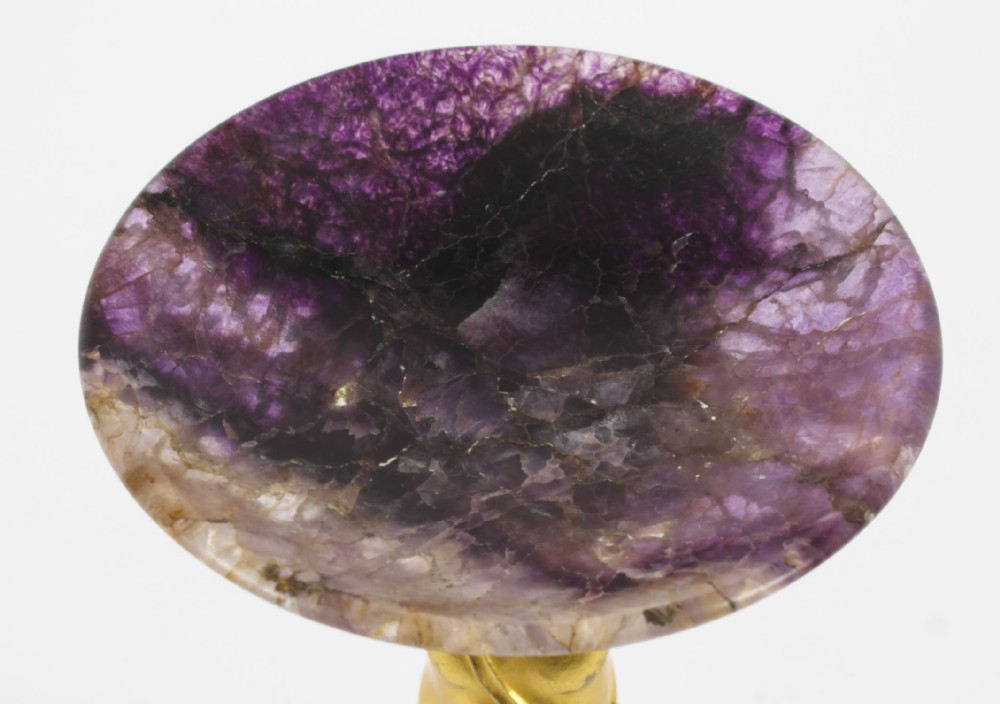
fig 3. A 19th-century Regency ormolu tazza featuring a gilt cherub figure supporting a purple stone dish, raised on a stepped green malachite base.
fig 3. Antique Regency Ormolu Cherub Tazza with Malachite & Blue John 19th Century

Blue John (also known as Derbyshire Spar) is a semi-precious mineral, a rare form of fluorite with bands of a purple-blue or yellowish colour. In the United Kingdom it is found only at Blue John Cavern and Treak Cliff Cavern at Castleton in Derbyshire. During the 19th century, it was mined for its ornamental value, and mining continues on a small scale.
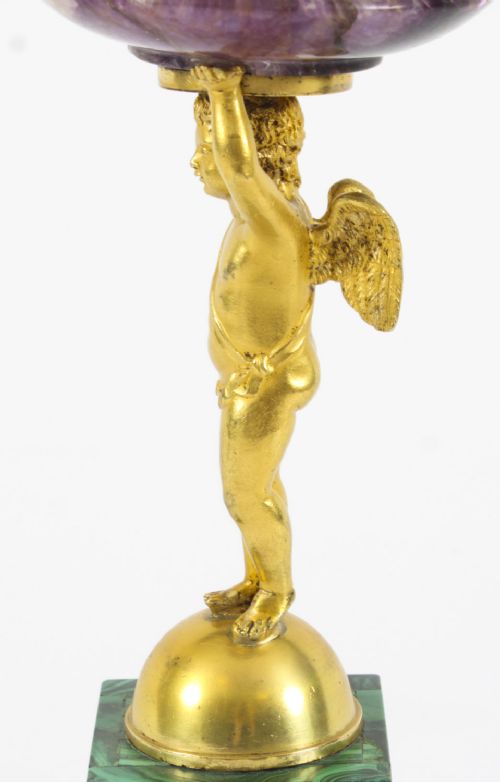
fig 4. A 19th-century Regency ormolu tazza featuring a gilt cherub figure supporting a purple stone dish, raised on a stepped green malachite base.
fig 4. Antique Regency Ormolu Cherub Tazza with Malachite & Blue John 19th Century

The most common explanation for the name is that it derives from the French bleu-jaune, meaning 'blue-yellow'. The story goes that Blue John was exported to France where it was used by ormolu workers during the reign of Louis XVI (1774–91). However, there is no archival record of any Blue John being exported to France and the early ormolu ornaments which use Blue John were being manufactured by Matthew Boulton of Birmingham in the 1760s.
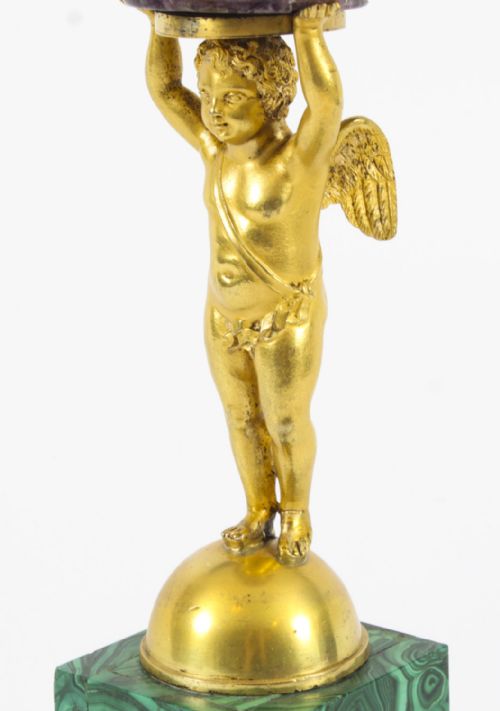
fig 5. A 19th-century Regency ormolu tazza featuring a gilt cherub figure supporting a purple stone dish, raised on a stepped green malachite base.
fig 5. Antique Regency Ormolu Cherub Tazza with Malachite & Blue John 19th Century

An alternative origin of the name derives from an old miners' name for the zinc ore sphalerite, which they called "Black Jack". Thus, the unique blue stone mined in these caverns could easily have become known as "Blue John".
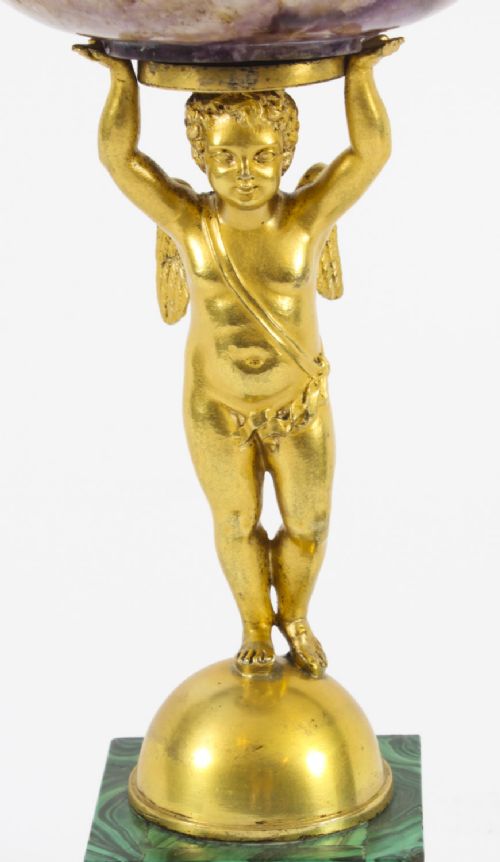
fig 6. A 19th-century Regency ormolu tazza featuring a gilt cherub figure supporting a purple stone dish, raised on a stepped green malachite base.
fig 6. Antique Regency Ormolu Cherub Tazza with Malachite & Blue John 19th Century

Another derivation comes from the Cornish miners who began working the Derbyshire lead mines in the 1740s. The name "Blue John" is used for several rocks in Cornwall, including fluorspars, and derives from the Cornish language word bleujenn, in Old Cornish blodon, a flower, bloom or blossom.
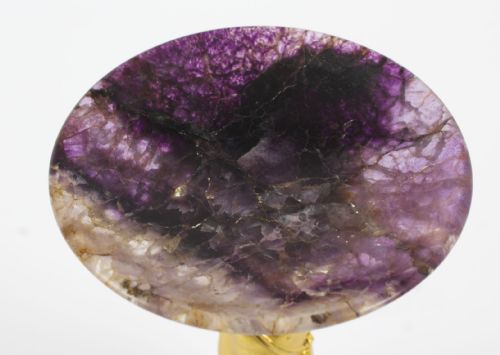
fig 7. A 19th-century Regency ormolu tazza featuring a gilt cherub figure supporting a purple stone dish, raised on a stepped green malachite base.
fig 7. Antique Regency Ormolu Cherub Tazza with Malachite & Blue John 19th Century

Ormolu - Gilt Bronze (from French 'or moulu', signifying ground or pounded gold) is an 18th-century English term for applying finely ground, high-carat gold in a mercury amalgam to an object of bronze.The mercury is driven off in a kiln leaving behind a gold-coloured veneer known as 'gilt bronze'.
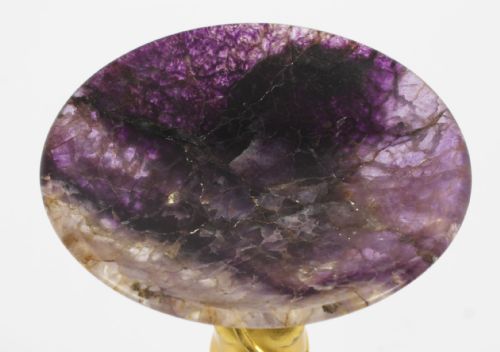
fig 8. A 19th-century Regency ormolu tazza featuring a gilt cherub figure supporting a purple stone dish, raised on a stepped green malachite base.
fig 8. Antique Regency Ormolu Cherub Tazza with Malachite & Blue John 19th Century

The manufacture of true ormolu employs a process known as mercury-gilding or fire-gilding, in which a solution of nitrate of mercury is applied to a piece of copper, brass, or bronze, followed by the application of an amalgam of gold and mercury. The item was then exposed to extreme heat until the mercury burned off and the gold remained, adhered to the metal object.

Our reference: A3893

Height
22cm (8.66")
Width
9cm (3.54")
Depth
9cm (3.54")
Date of Manufacture

Regent Antiques has dated this Regency Ormolu Cherub Tazza to the Regency era.

Reference Numbers
Sellingantiques Ref
SA1104194
Dealers Internal Ref
A3893
Regent Antiques
Regent Antiques
Sellingantiques verified Since Sep 2016

We specialise in english and continental furniture, silver, porcelain and decorative items.

Dealer Profile

You can view the stock and full dealer information on the Regent Antiques Profile Page

Trade Associations

Regent Antiques is a registered member of LAPADA  CINOA
PDF SHARE
SAVE
A 19th-century Regency ormolu tazza featuring a gilt cherub figure supporting a purple stone dish, raised on a stepped green malachite base.
1 / 16
Archive I A 19th-century Regency ormolu tazza featuring a gilt cherub figure supporting a purple stone dish, raised on a stepped green malachite base.

Antique Regency Ormolu Cherub Tazza with Malachite & Blue John 19th Century
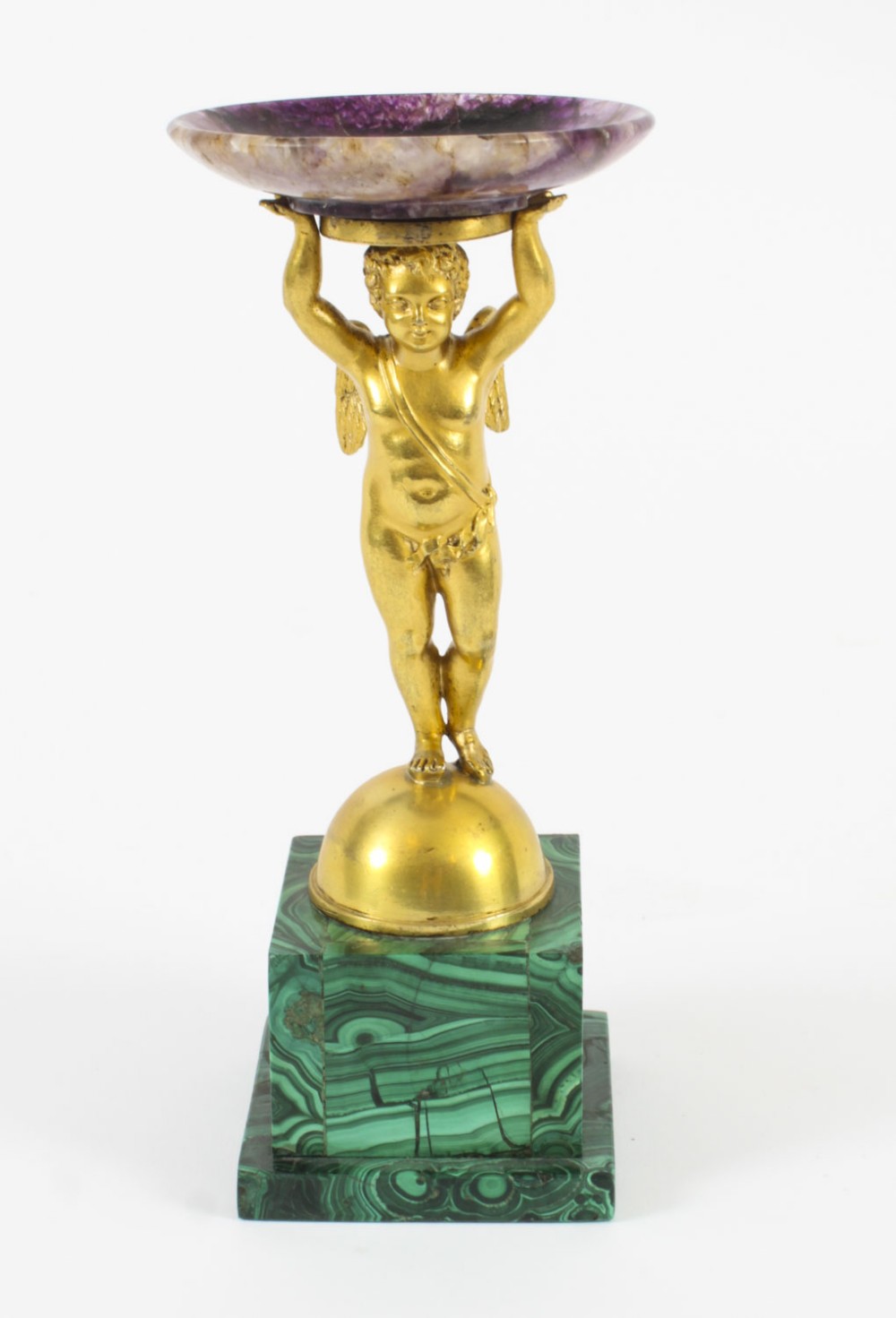
Archive II A 19th-century Regency ormolu tazza featuring a gilt cherub figure supporting a purple stone dish, raised on a stepped green malachite base. View II
Archive III A 19th-century Regency ormolu tazza featuring a gilt cherub figure supporting a purple stone dish, raised on a stepped green malachite base. View III
Archive IV A 19th-century Regency ormolu tazza featuring a gilt cherub figure supporting a purple stone dish, raised on a stepped green malachite base. View IV
Archive V A 19th-century Regency ormolu tazza featuring a gilt cherub figure supporting a purple stone dish, raised on a stepped green malachite base. View V
Archive VI A 19th-century Regency ormolu tazza featuring a gilt cherub figure supporting a purple stone dish, raised on a stepped green malachite base. View VI
Archive VII A 19th-century Regency ormolu tazza featuring a gilt cherub figure supporting a purple stone dish, raised on a stepped green malachite base. View VII
Archive VIII A 19th-century Regency ormolu tazza featuring a gilt cherub figure supporting a purple stone dish, raised on a stepped green malachite base. View VIII
Archive IX A 19th-century Regency ormolu tazza featuring a gilt cherub figure supporting a purple stone dish, raised on a stepped green malachite base. View IX
Archive X A 19th-century Regency ormolu tazza featuring a gilt cherub figure supporting a purple stone dish, raised on a stepped green malachite base. View X
Archive XI A 19th-century Regency ormolu tazza featuring a gilt cherub figure supporting a purple stone dish, raised on a stepped green malachite base. View XI
Archive XII A 19th-century Regency ormolu tazza featuring a gilt cherub figure supporting a purple stone dish, raised on a stepped green malachite base. View XII
Archive XIII A 19th-century Regency ormolu tazza featuring a gilt cherub figure supporting a purple stone dish, raised on a stepped green malachite base. View XIII
Archive XIV A 19th-century Regency ormolu tazza featuring a gilt cherub figure supporting a purple stone dish, raised on a stepped green malachite base. View XIV
Archive XV A 19th-century Regency ormolu tazza featuring a gilt cherub figure supporting a purple stone dish, raised on a stepped green malachite base. View XV
Archive XVI A 19th-century Regency ormolu tazza featuring a gilt cherub figure supporting a purple stone dish, raised on a stepped green malachite base. View XVI
Enlarged Archival View
Location
Manor Warehouse
318 Green Lanes
London
N4 1BX
United Kingdom
Verified Since Sep 2016
Items For Sale 650
Items Sold 2,630
Regent Antiques
Regent Antiques
Verified Since Sep 2016
View Dealer Info
Location: Manor Warehouse, 318 Green Lanes, London, N4 1BX, United Kingdom
Verified
Sep 2016
For Sale
650
Sold
2,630
A 19th-century Regency ormolu tazza featuring a gilt cherub figure supporting a purple stone dish, raised on a stepped green malachite base.
Antique Regency Ormolu Cherub Tazza with Malachite & Blue John 19th Century
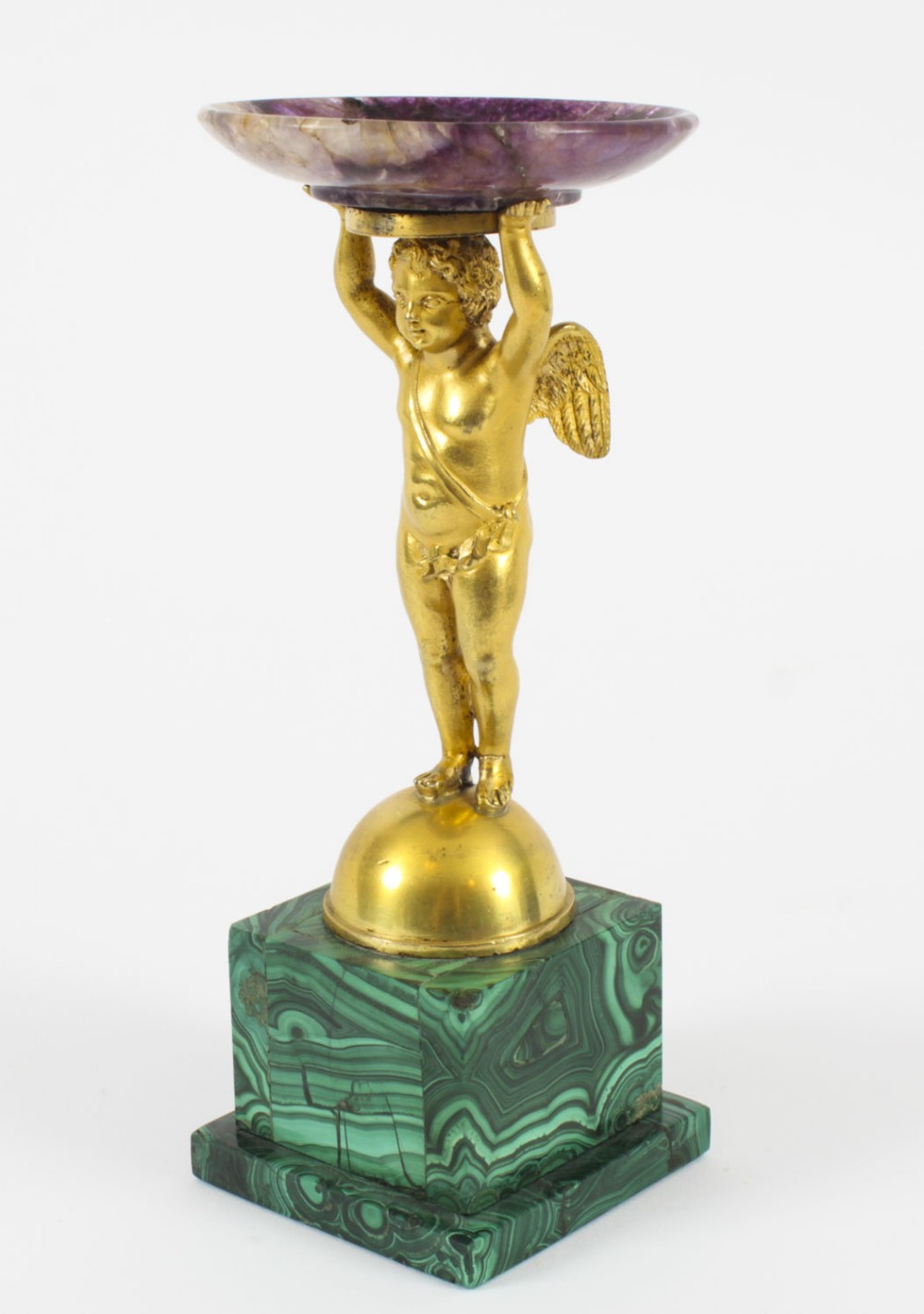
Ref: SA1104194
A 19th-century Regency ormolu tazza featuring a gilt cherub figure supporting a purple stone dish, raised on a stepped green malachite base.
Detail View 1
Detail View 2
Detail View 3
Detail View 4
Detail View 5
Detail View 6
Detail View 7
Detail View 8
Detail View 9
Detail View 10
Detail View 11
Detail View 12
Detail View 13
Detail View 14
Detail View 15
Archival Detail
Every single antique dealer on our platform is individually approved by our internal team. We verify their professional trade history, ethical standards, and photographic quality to ensure a secure, high-standard buying environment. Upon joining, every dealer agrees to a strict 9-point code of conduct. While issues can occasionally arise, our dealers typically resolve them swiftly and directly with the buyer. In fact, since our founding in 2002, Sellingantiques has only had to step in to help resolve an issue on roughly five occasions—a true testament to the quality of our dealers and their dedication to your happiness.
Our dealers are highly experienced in packing and shipping fragile, high-value antiques. Because you are in direct contact with the dealer, you will be able to easily go through all available shipping and insurance options together to ensure your item arrives safely.
Antiques are the ultimate green purchase. By choosing historical pieces over newly manufactured goods, you completely eliminate the carbon footprint of modern mass production while preserving exceptional, timeless craftsmanship.

A tazza is a shallow, wide dish supported by a central stem or figure, traditionally used during the Regency period to display fruit or sweetmeats, or serve as a decorative table centrepiece.

Tazzas from this era frequently combined mercury-gilded bronze, known as ormolu, with natural minerals such as malachite, marble, alabaster, or fluorite such as Derbyshire Blue John.

Authentic period pieces display detailed hand-chasing, natural oxidisation in crevices, heavy casting weight, and crisp hand-carved detailing on stone components.

Place the object centrally on a console table, mantelpiece, or sideboard to allow its classical silhouette and mineral colours to function as a focal point.

Dust gently with a dry, soft microfiber cloth, avoiding liquid cleaners or harsh chemicals that could strip the original gilded surface or erode mineral bases.
items
Add keywords to the filter
Price
£100
£250000
Era
Movements
Material
Origin
Stock Location
Freshness
Online Payments
Categories