

A 2026 Guide by Sellingantiques
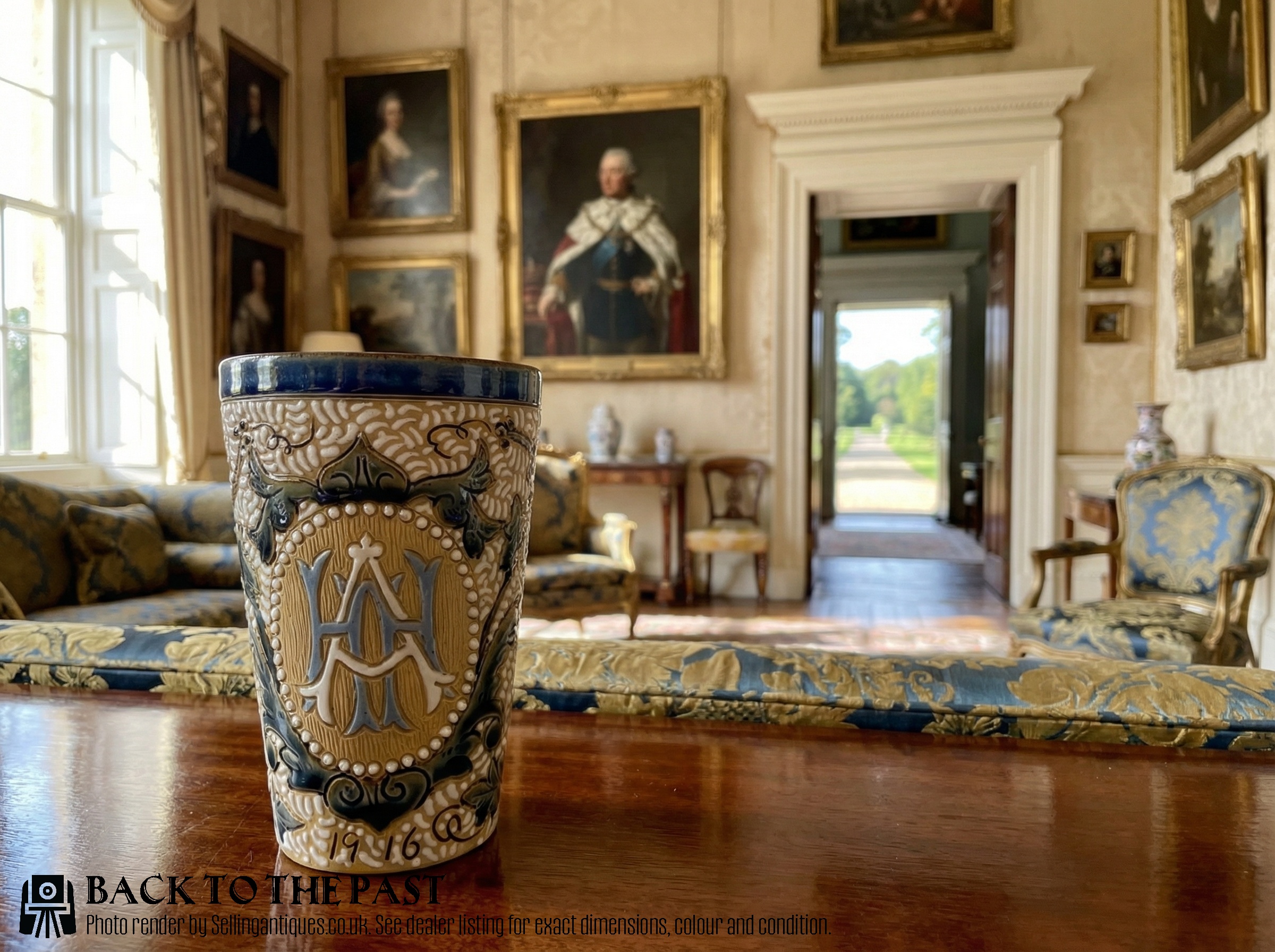
Fulham Pottery Arts and Crafts Beaker, 1920
Priced at £225 from In A Nutshell Antiques and Interiors
Early examples turn up in the sixteenth century as simple travelling cups.
Look for regional variations. Northern European countries favoured them heavily for domestic drinking over stemmed goblets.
Wealthier households kept nested sets of silver beakers in leather cases for hunting trips.
A staple of the tavern trade. Horn vessels offered a cheap, durable alternative.
Antique beakers eventually lost ground to handled mugs when hot drinks like tea swept through Europe.
Paul de Lamerie produced highly decorated silver pieces during the early eighteenth century in London.
Watch for early Dutch silversmiths like Adam van Vianen, who shaped domestic vessels with distinct auricular designs.
Unmarked provincial workshops made most of the surviving base metal stock used in ordinary homes.
The 2026 retail price guide for Antique Beakers is drawn from a proprietary archive of over 1.1 million retail prices indexed by Sellingantiques since 2003. This guide relies exclusively on their own internal data; no external sources or auction records are used.
Analysing nearly 25 years of UK antique market history alongside current retail values, the data indicates that typical UK retail prices for Antique Beakers range between £200 and £1,300. Entry-level prices generally fall under £200 and premium examples upwards of £1,300.
Flaring rims. Almost universal across these items, helping the liquid flow smoothly to the mouth.
Tapered bodies allow multiple vessels to stack inside one another.
Note the applied foot rings on later metal examples.
Silversmiths raised early cups by hand from a single flat sheet over a stake.
Notice the crisp geometric patterns. Engine-turning lathes changed production in the late eighteenth century.
Glassmakers blew molten material into ribbed moulds before expanding it to create subtle optical patterns.
"Many plain silver forms were originally given as christening gifts to be used throughout adulthood."
"Assayers scraped a tiny zigzag line into the underside of the metal to test silver purity."
"Natural horn drinking vessels soften the harsh taste of strong local ales."
Based on almost 25 years of Sellingantiques UK antique market data, Antique Beakers appeared 949 times (out of 1,100,000 antiques) which gives it a rarity score of 83/100.
This score measures scarcity within the Sellingantiques archive only and is not a survey of the entire antiques market, so these statistics may not be indicative of the general availability of Antique Beakers elsewhere.
Those small stamped marks are hallmarks applied by the assay office. They tell you the purity of the silver alongside the testing city and date.
You will usually find a maker's mark next to them. This consists of initials that identify the specific workshop responsible for raising the metal.
Wash them by hand in lukewarm water with mild soap. Sudden temperature changes crack old glass.
Dry the piece immediately to prevent hard water stains.
You have described a traditional campaign set. Officers and wealthy travellers carried these nested cups during military campaigns or long hunting trips to save space in their baggage.
The leather cases were usually made of boiled leather. This provided a tough shell that stopped the silver from being dented while rattling around in horse-drawn coaches.
That gold wash is called parcel-gilding. Silversmiths applied it to the interior bowl to create a physical barrier between the silver and the drink.
Wine is acidic and reacts badly with bare silver. The chemical reaction leaves a metallic taste in the mouth and causes the interior to tarnish quickly. The gold layer prevents both problems.
Please note: This Antique Beakers guide and its associated pricing data are provided for general informational purposes only. It does not constitute formal financial, investment, or appraisal advice and should not be relied upon as the sole basis for any commercial activity, purchasing, or sales decisions. Sellingantiques.co.uk accepts no liability for any actions taken in reliance on this information. Always consult with a qualified professional or independent appraiser.
