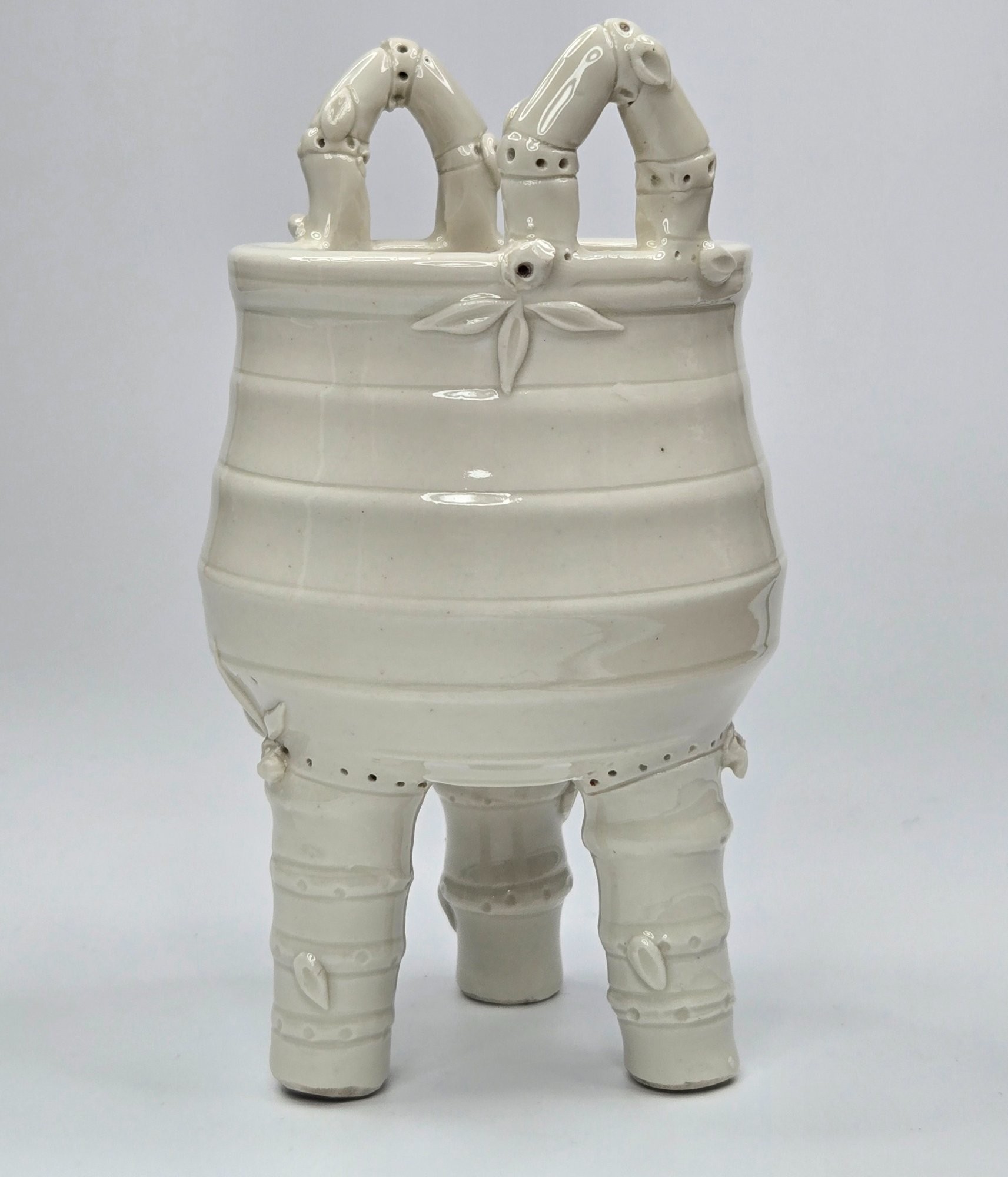
Sandbanks Antiques has dated this Dehua Blanc De Chine Censer to the 18th Century.
Qing Dynasty, 18th Century
Bears an incised seal mark for Zheng Hezhou to the base.
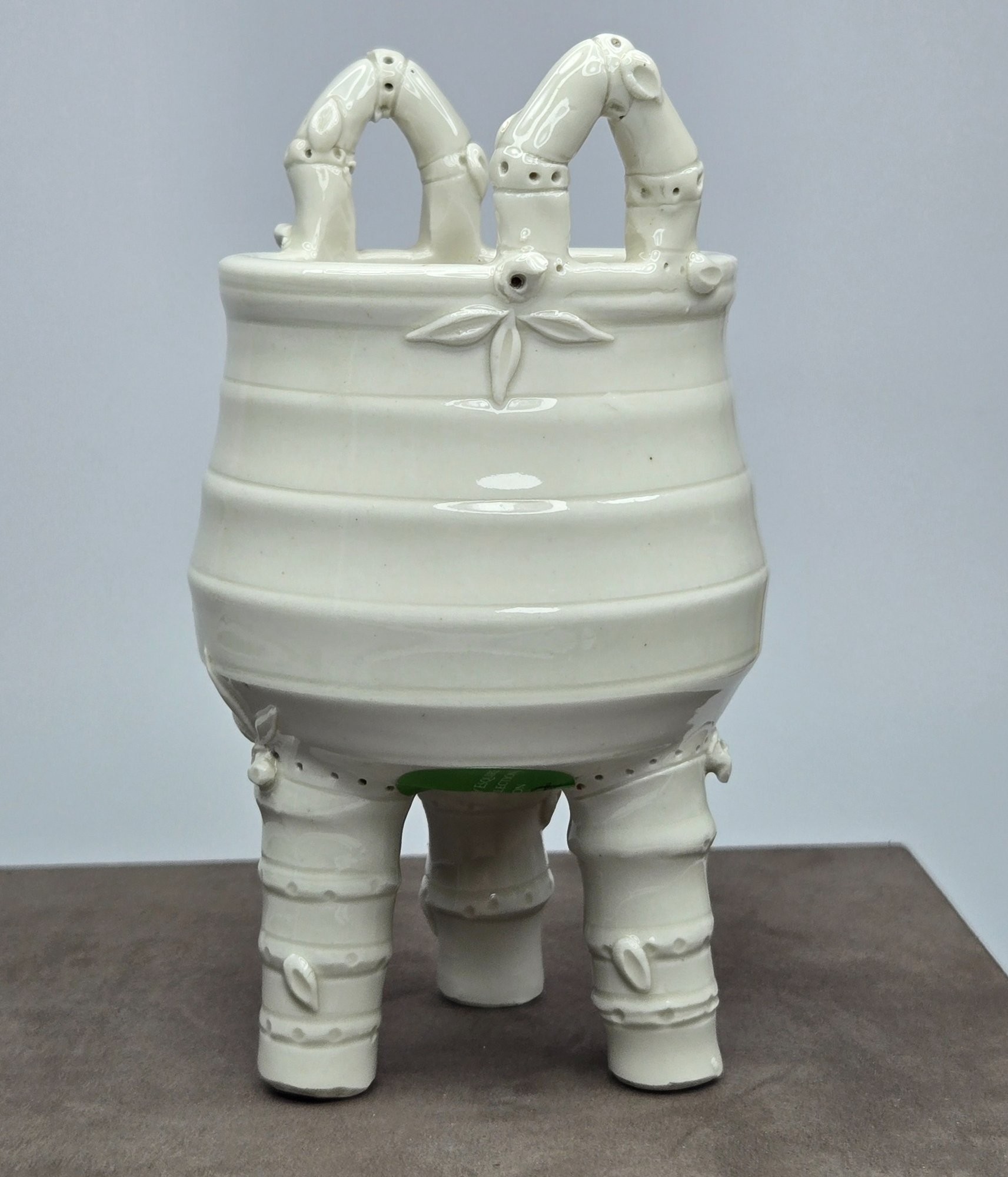
This remarkably refined white-glazed tripod censer (ding) is a superlative testament to the sophisticated "scholar’s taste" (wenfang) that dictated the elite Chinese art market of the Ming and Qing Dynasties. Beautifully potted from fine-grained Dehua clay, the vessel is masterfully structured around a naturalistic bamboo motif—a plant deeply revered by the literati as a symbol of resilience, humility, and moral integrity.
It is flanked by two elegantly arched, openwork handles modeled to resemble bent, node-segmented bamboo branches. The vessel is supported by three stout, upright tripod legs carved in identical fashion as thick bamboo stalks, displaying prominent horizontal nodes. At the structural junctions where the legs and handles meet the main body, delicate, sprig-moulded bamboo leaves have been individually fashioned and applied to the surface with immaculate precision.

Glaze & Potting Character
The censer is enveloped in a flawless, highly luminous, and tactilely rich glaze of a warm, creamy ivory-white tone characteristic of the finest 18th-century Dehua kilns. The glaze pools softly around the applied foliage and recessed nodes, giving the piece a brilliant sculptural depth. The vessel exhibits an incredibly thin-walled and technically pure potting construction; weighing a mere 272.6 grams, it possesses a remarkably light volume-to-weight ratio that instantly indicates a master-handed creation rather than a heavy, slip-cast modern reproduction. The interior reveals clean, honest firing lines and a naturally seasoned patina, consistent with historical use as a functioning scholarly incense burner.

Mark & Elite Provenance
The base features a cantered, faintly incised oblong seal mark attributing the lineage of the piece to the celebrated late-Ming master potter Zheng Hezhou (Zheng Ho Zhaou), whose rigorous technical standards were continuously honoured on exceptional tribute pieces throughout the 18th century.

Crucially, the object retains an ironclad, prestigious provenance chain that elevates its academic and commercial profile.
The underside preserves its original acquisition labels, documenting its trajectory from the premier Manhattan gallery Imperial Oriental Art, New York, directly into the renowned holding of The G. S. May Esquire Private Collection, London (Number 341). This seamless, documented chain of custody completely removes the market ambiguity often associated with early white wares, making it an ideal acquisition for discerning private connoisseurs or institutional collections.

Technical Specifications
Culture / Style: Dehua Ware (Blanc de Chine)
Period: Qing Dynasty, 18th Century
Mark: Incised seal mark for Zheng Hezhou (Zheng Ho Zhaou) to the base
Height: 15.0 cm
Width: 8.0 cm (handle to handle)

Weight: 272.6 g
Provenance:
Imperial Oriental Art, New York (Exhibited/Sold).
The G. S. May Esquire Private Collection, London (Inv. No. 341).
Condition: Excellent museum grade; glaze matches original firing profile with minor iron-spotting and firing characteristics to the unglazed interior consistent with age and scholarly use.
Sandbanks Antiques has dated this Dehua Blanc De Chine Censer to the 18th Century.
Specialising in antique silver, gold boxes, gold coins and objects de vertu. Rare fine-quality imperial chinese porcelain, jades, cloisonné
You can view the stock and full dealer information on the Sandbanks Antiques Profile Page
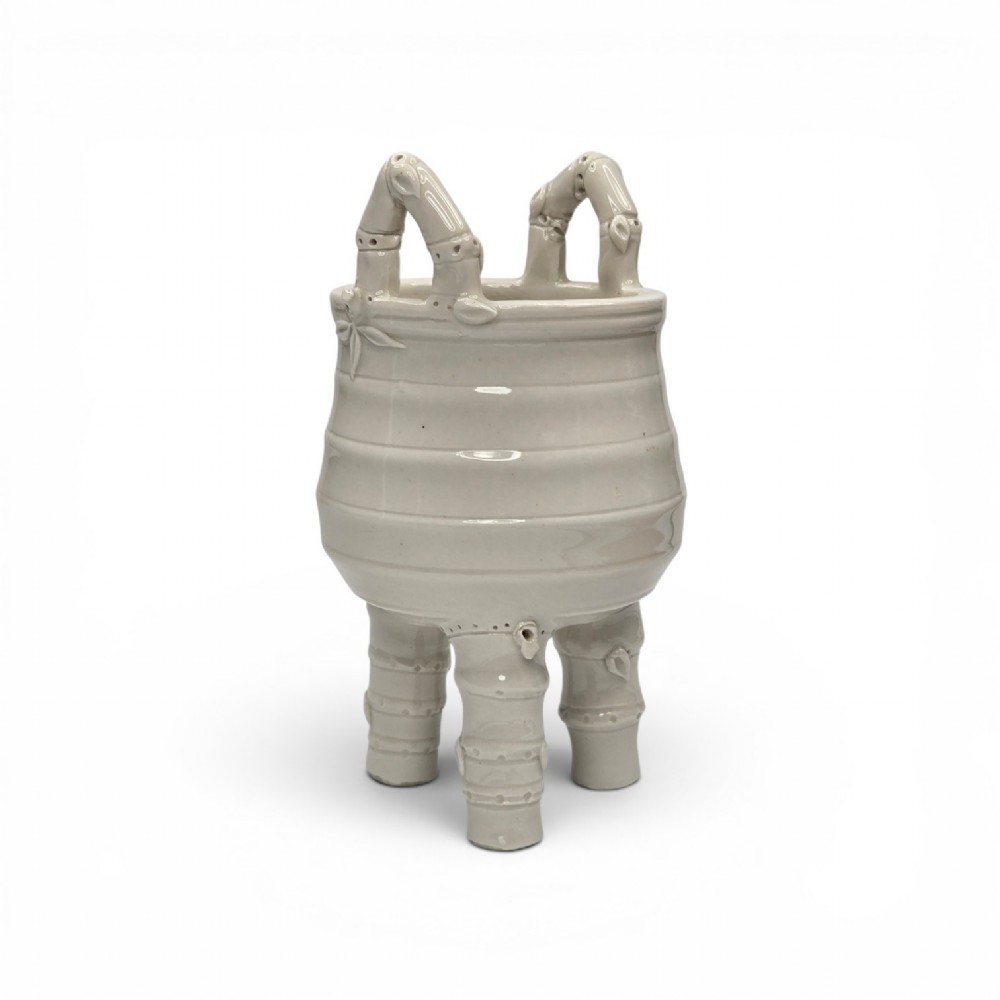

An Important and Elegantly Potted Dehua ‘Blanc De Chine’ ‘Bamboo’ Tripod Censer (Ding) Qing Dynasty, 18th Century