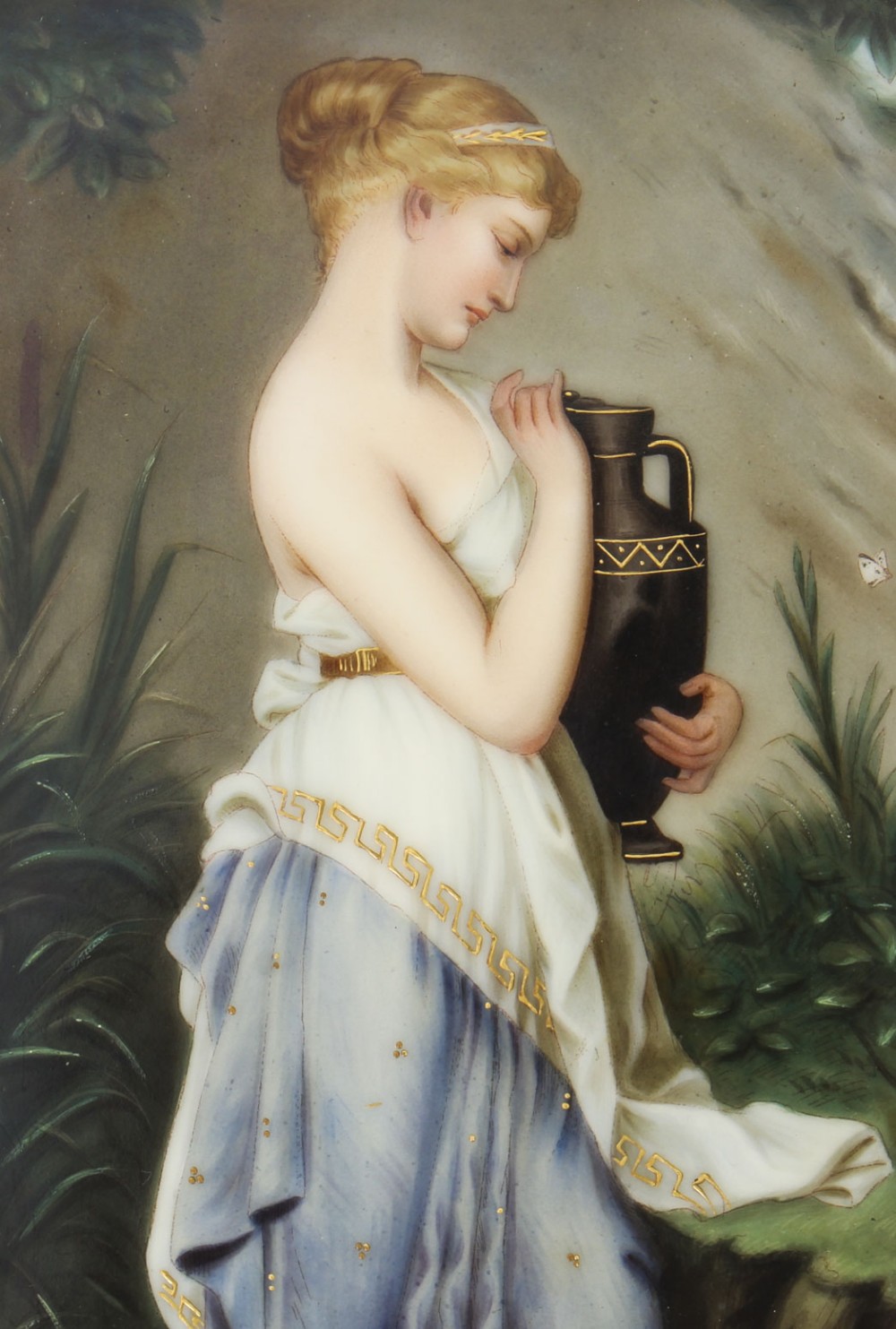
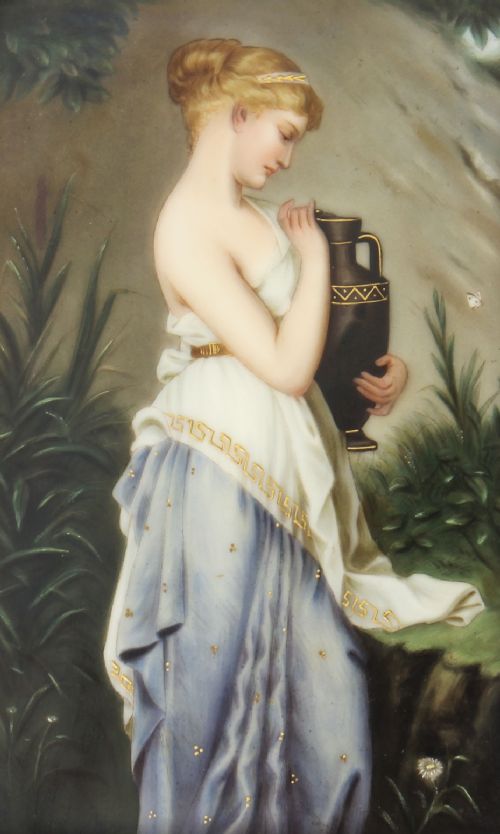
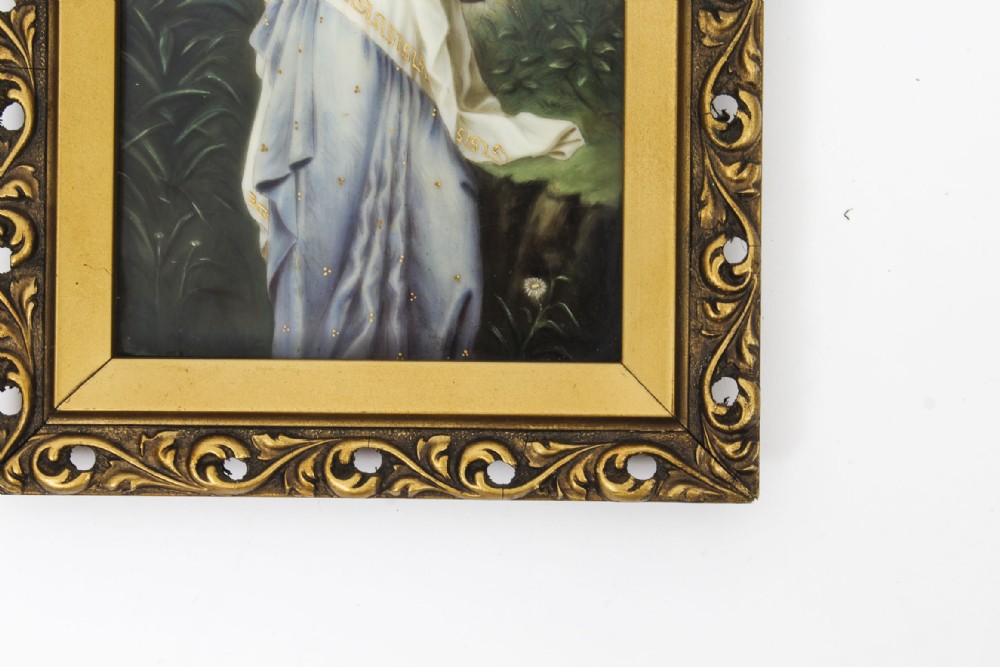
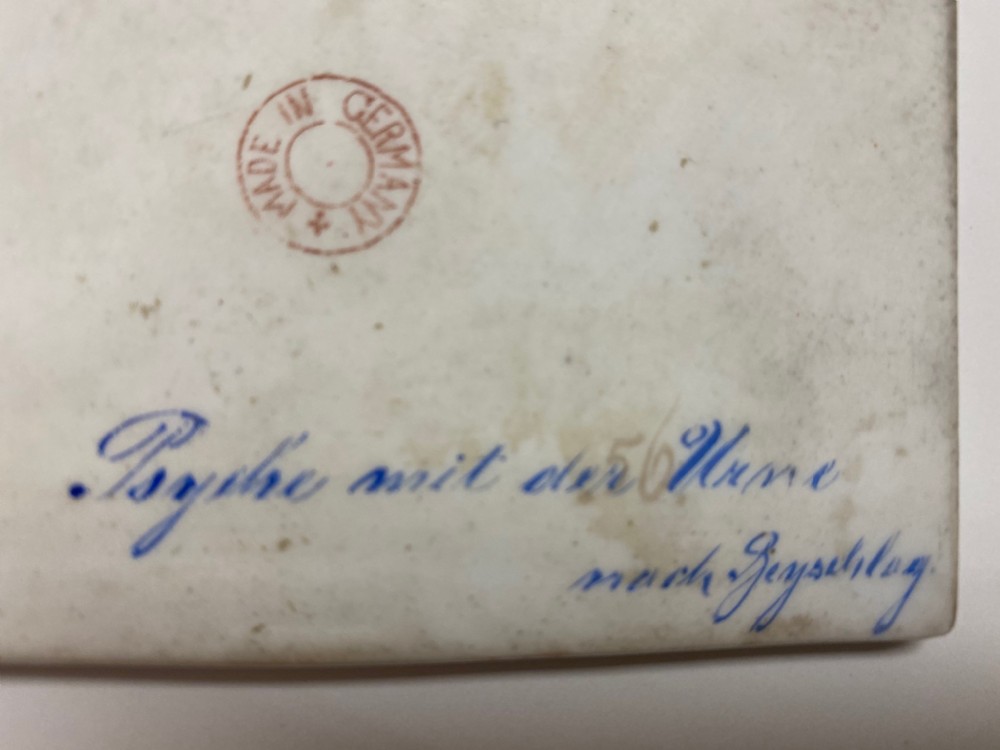
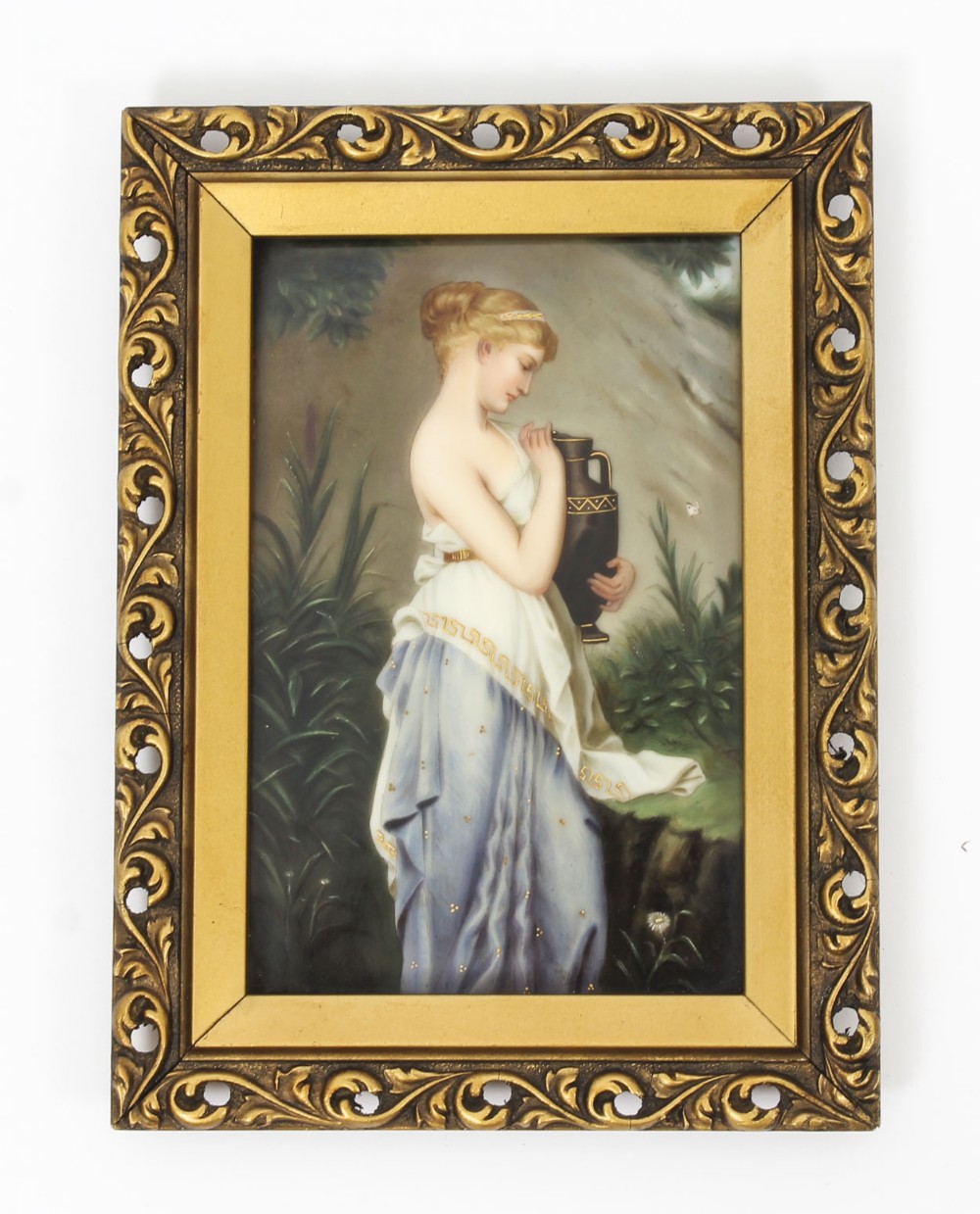
This is an absolutely stunning and finely painted KPM Berlin Plaque of Psyche with an Urn, after Robert Julius Beyschlag, circa 1880 in date.
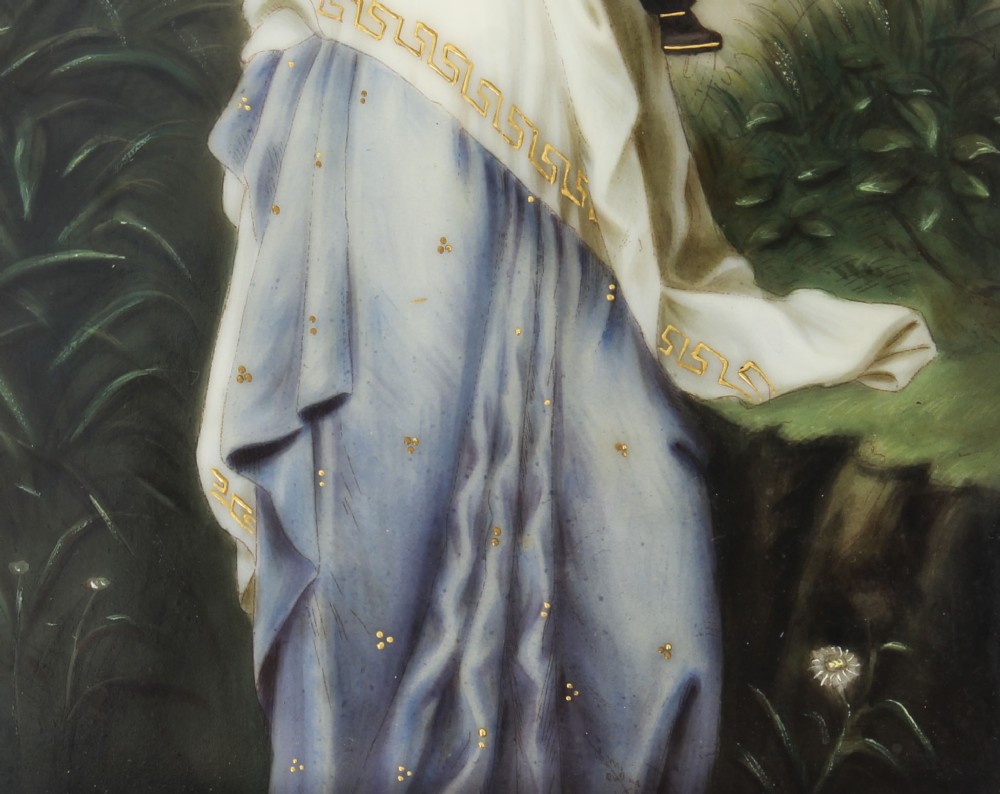
This magnificent plaque is portrait in shape and depicts the Princess of outstanding beauty, Psyche, holding a black urn of classical shape in her hands. She is wearing a celestial and graceful white and light blue robe, which is further enhanced by gilded greek key patterns at the borders.
Psyche is depicted standing tall against a naturalist background including trees, bushes, a flower and a flying butterfly.
The appropriate distribution of contrasting colours from light (Psyche) and dark (the landscape) conveys a sense of harmony and serenity to this outstanding work of art.
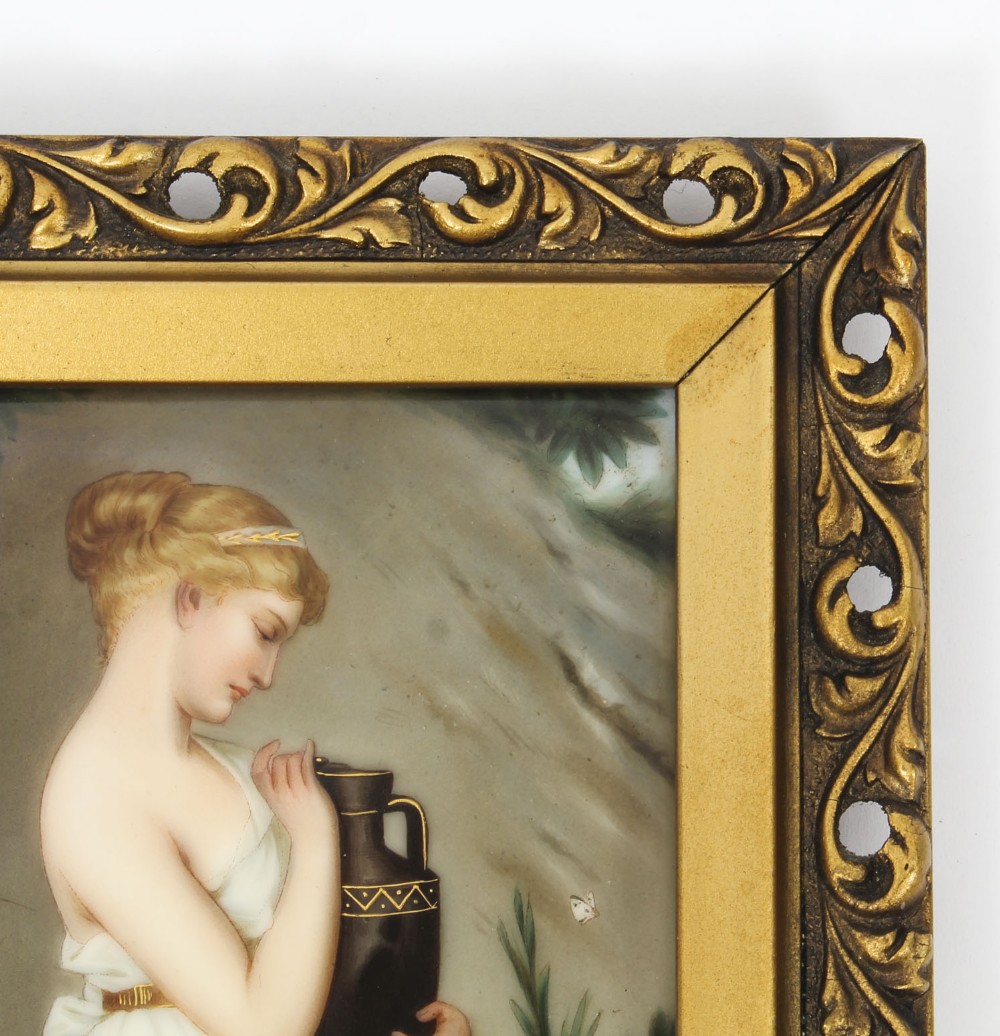
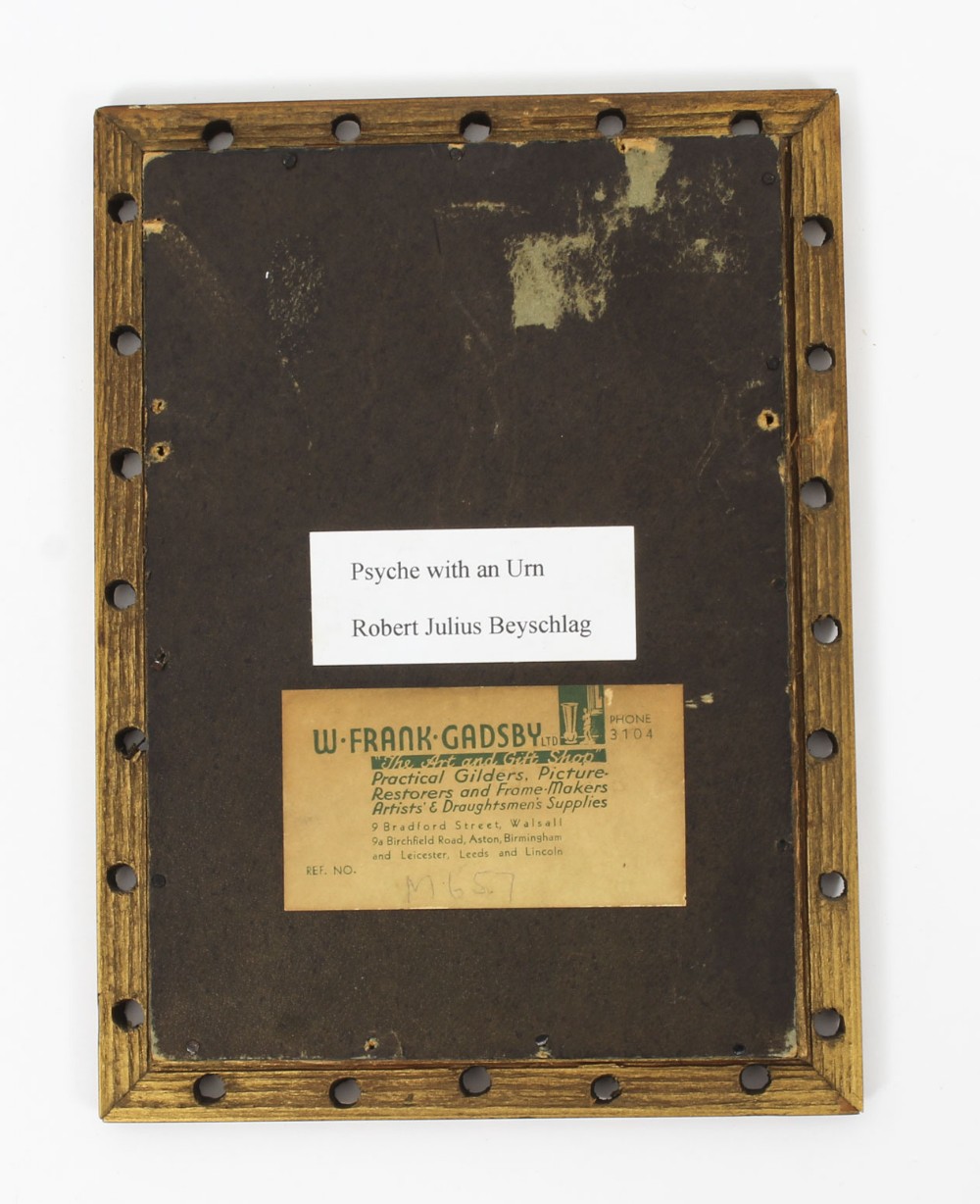
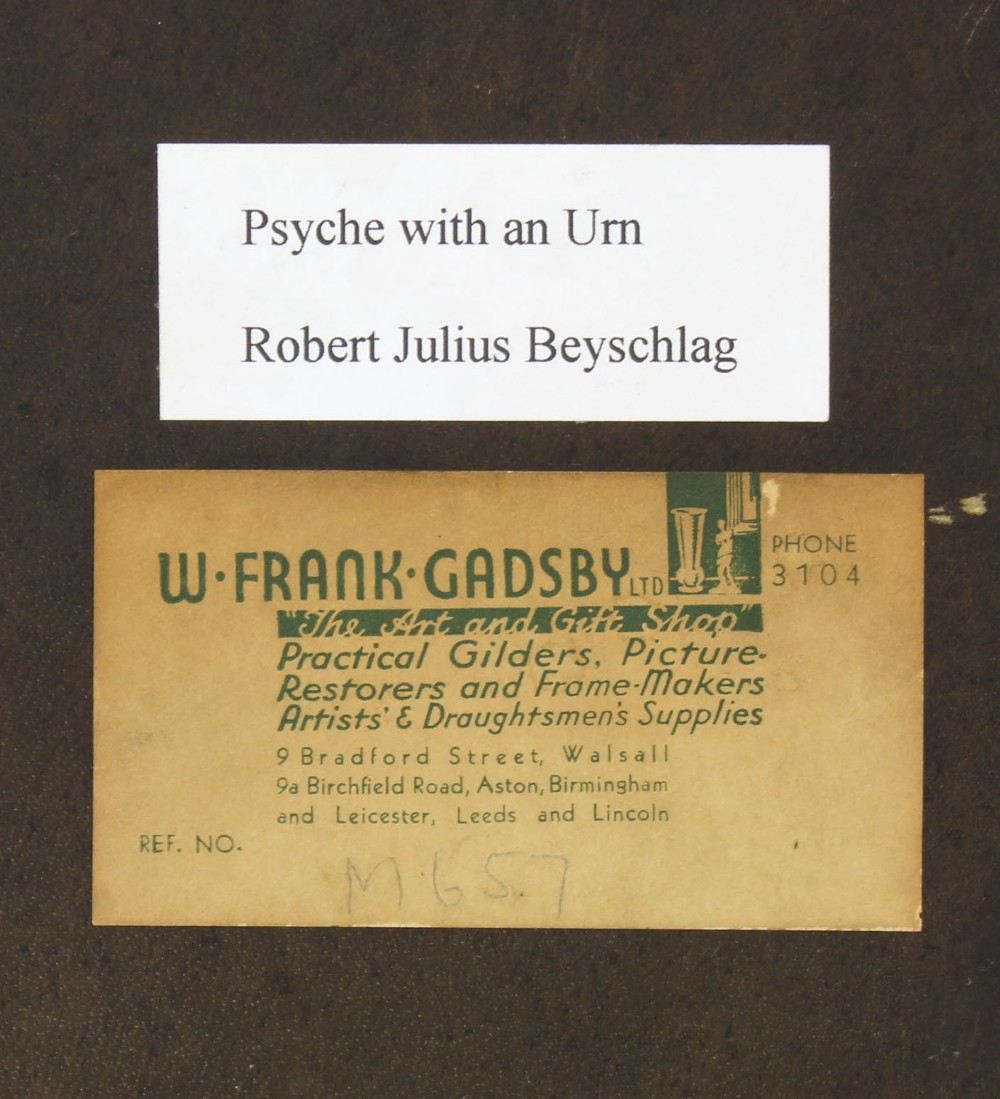
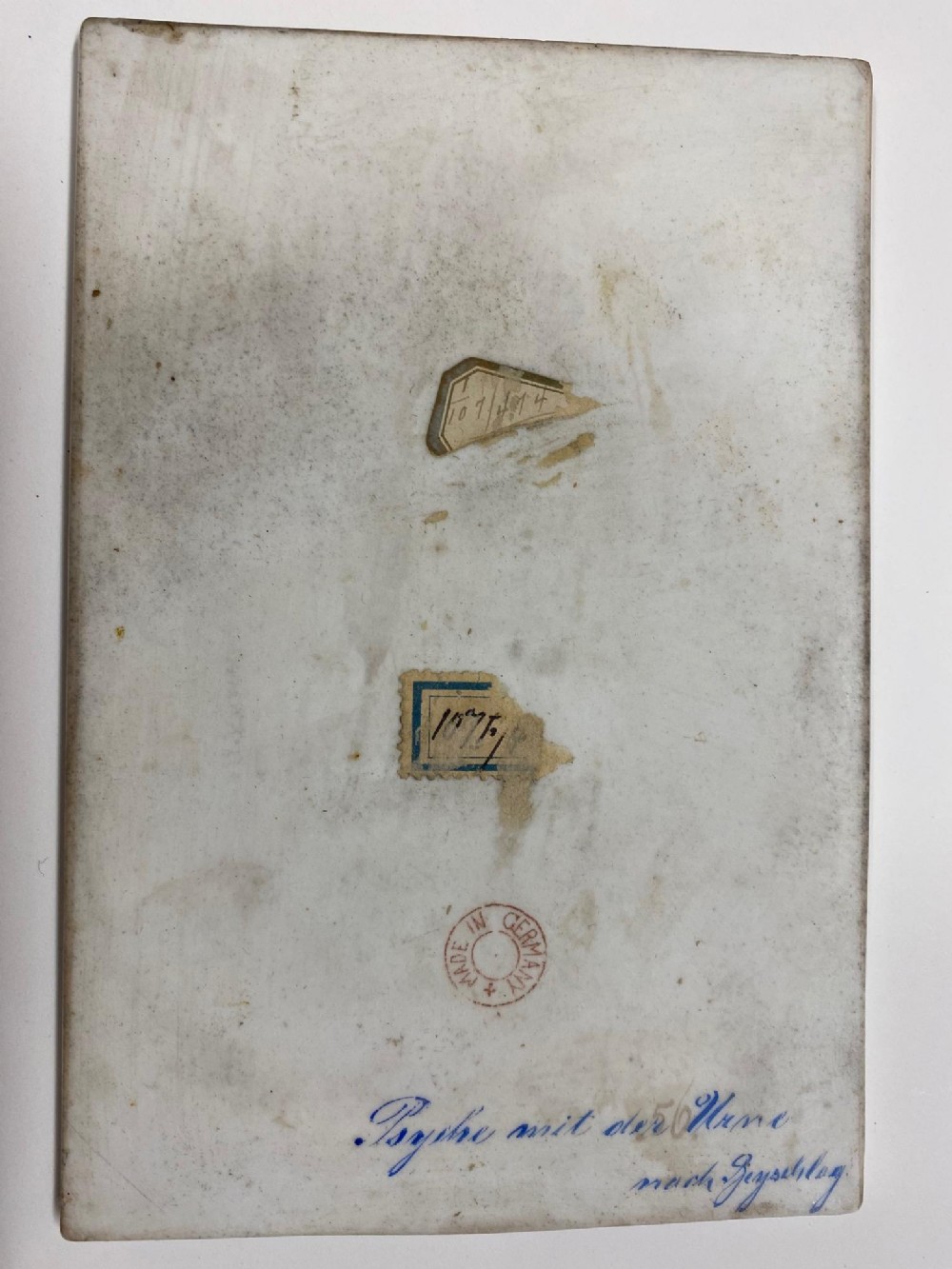
It is titled "Psyche with an Urn" on the reverse and it is set within the original antique giltwood frame, which adds extra elegance to this splendid piece.
Add this splendid antique plaque to a very special wall in your home.
Condition:
The plaque and the gilded frame both in excellent condition, please see photos for confirmation.
Dimensions in cm:
Height 21 x Width 16 x Depth 2
Dimensions in inches:
Height 8.3 x Width 6.3 x Depth 0.8
The Royal Porcelain Factory in Berlin (German: Königliche Porzellan-Manufaktur Berlin, abbreviated as KPM), also known as the Royal Porcelain Manufactory Berlin and whose products are generally called Berlin porcelain, was founded in 1763 by King Frederick II of Prussia (known as Frederick the Great). Its actual origins, however, lie in three private enterprises which, under crown patronage, were trying to establish the production of "white gold" (i.e. porcelain) in Berlin from the mid-18th century onwards.
Before KPM was founded, two attempts had already been made to establish a porcelain manufactory in Berlin. In 1751, the Berlin wool manufacturer Wilhelm Caspar Wegely was granted the royal privilege to set up a porcelain manufactory in Berlin. Furthermore, Frederick II of Prussia granted him exemption from duties for the import of essential materials and assured him of the exclusion of all competition.
Wegely hired first-class craftsmen from his competitors, and appointed the porcelain sculptor Ernst Heinrich Reichard to the post of chief modeller. However, technical difficulties and the Seven Years' War between Prussia and Saxony soon proved to be the enterprise's downfall. In 1757, he dissolved his company and sold its inventories, equipment and materials to the Berlin businessman Johann Ernst Gotzkowsky.
In 1761, the second porcelain manufactory in Berlin started its operations. Gotzkowsky concluded an agreement with Wegely's chief modeller, Ernst Heinrich Reichard, who was in possession of the secret formula known as the arcanum. Reichard received 4,000 thaler for the arcanum, and another 3,000 for the stock of porcelain and other materials. Furthermore, he undertook to work for Gotzkowsky as a keeper of the arcanum and as the manager. Gotzkowsky also agreed to take over Reichard's eight workers.
Appreciated and supported by the King of Prussia, Gotzkowsky managed to attract important artists and qualified employees. Right at the start, Gotzkowsky appointed Friedrich Elias Meyer, a pupil of Johann Joachim Kändler who came from Meissen, to the post of chief modeller, and Carl Wilhelm Boehme to the post of head of the porcelain-painting department. Gotzkowsky bought another building next to his own property at Leipziger Straße 4, and he began to build a manufactory on the site.
Nevertheless, Gotzkowsky's finances began to deteriorate. Since the royal exchequer was in the red on account of the war, Gotzkowsky believed that he stood little or no chance of obtaining assistance from the king. The end of the war also signalled the end for Gotzkowsky's manufactory.
Today, the porcelain pieces from the early