



A 2026 Guide by Sellingantiques

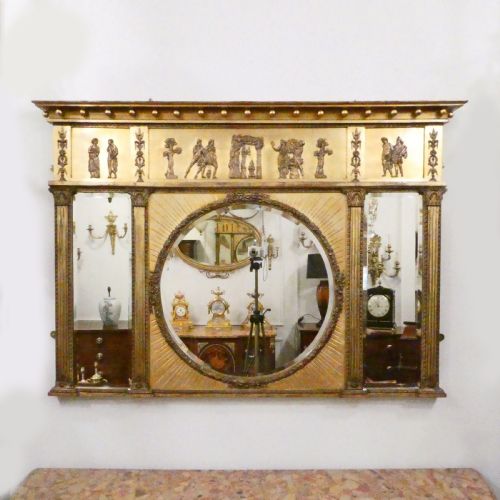
Regency Triptych White Painted Gilt Overmantle Mirror, Regency
Priced at £2,450 from Baggott & Co.
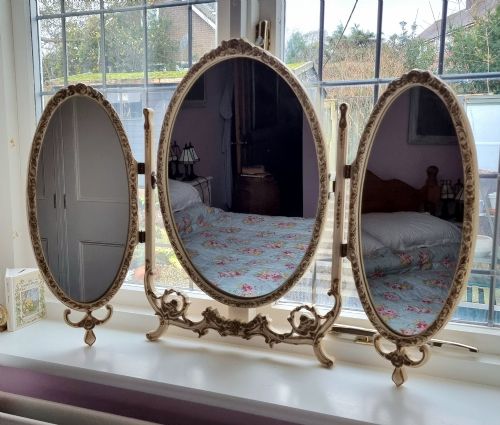
They evolved from religious altarpieces. Cabinetmakers adapted the three-panel folding design for domestic dressing rooms during the late nineteenth century.
Turn of the century dressing tables often integrated these directly into the carcase. Standalone versions grew popular for travel.
The Edwardian period saw a boom in silver-backed triptych mirrors.
Look for Art Deco variants. Many discarded heavy wooden frames for frameless bevelled glass and minimal chrome clips.
Very few bear a cabinetmaker stamp. Most are unsigned trade pieces produced by regional workshops for department stores.
Silversmiths like William Comyns & Sons made silver-clad triptych mirrors in London between the 1880s and 1930s.
The Goldsmiths & Silversmiths Company retailed high-end vanity mirrors. Their mark usually appears stamped directly into the silver border.
Edwardian Wall Mirror with Prints, Victorian
Priced at £414 from Elmgarden
The 2026 retail price guide for Antique Triptych Mirrors is drawn from a proprietary archive of over 1.1 million retail prices indexed by Sellingantiques since 2003. This guide relies exclusively on their own internal data; no external sources or auction records are used.
Analysing nearly 25 years of UK antique market history alongside current retail values, the data indicates that typical UK retail prices for Antique Triptych Mirrors range between £500 and £2,300. Entry-level prices generally fall under £500 and premium examples upwards of £2,300.
The two outer panels fold flat across the centre section. This protects the glass during transport.
A bevelled edge. Grinding the glass edge catches the light and hides the joint where it meets the frame.
Some have a chain or cord stretched across the back. This stops the side panels opening too wide and stressing the hinges.
Victorian makers set the glass deeply into heavy wooden rebates.
Frameless construction arrived by the 1920s. Manufacturers drilled directly through the glass to attach metal clips and decorative rosettes.
Notice the transition in edge finishing. Hand-ground bevels have slight inconsistencies, whereas later machine-polished edges are uniform.
"The folding design catches cross-illumination effectively. Setting one near a window bounces daylight across a dark dressing room."
"Travelling versions of these folding mirrors often retain their original tooled leather cases."
"Some frameless Art Deco designs use peach or blue tinted glass for the outer wings to soften the reflection."
Based on almost 25 years of Sellingantiques UK antique market data, Antique Triptych Mirrors appeared 255 times (out of 1,100,000 antiques) which gives it a rarity score of 95/100.
This score measures scarcity within the Sellingantiques archive only and is not a survey of the entire antiques market, so these statistics may not be indicative of the general availability of Antique Triptych Mirrors elsewhere.
Resilvering is the only way to remove foxing. A specialist strips the old backing and applies a new chemical silver layer.
Most dealers advise leaving the spots alone. Newly silvered glass often looks bright and out of place in an aged wooden frame.
Replacing a single piece of glass is straightforward for a glazier. They cut a new mirror plate to match the dimensions of the broken panel.
The challenge lies in matching the bevel and the reflection. Modern glass reflects light differently than old mercury or early silver nitrate glass.
The new panel will look noticeably newer than the original centre glass. Some buyers prefer to replace all three panels at once to keep the look consistent.
Spray cleaner onto a cloth rather than the mirror itself. Liquid runs down the pane and pools at the base.
Moisture behind the frame rots the silvering. Dry dusting is safer.
Musty odours usually mean the backboard absorbed dampness during storage. Airing the mirror out in a dry room for several weeks often resolves mild cases.
If the leather itself feels dry, a sparing application of neutral leather cream stops it flaking. Avoid using saddle soap on old hide bindings.
Please note: This Antique Triptych Mirrors guide and its associated pricing data are provided for general informational purposes only. It does not constitute formal financial, investment, or appraisal advice and should not be relied upon as the sole basis for any commercial activity, purchasing, or sales decisions. Sellingantiques.co.uk accepts no liability for any actions taken in reliance on this information. Always consult with a qualified professional or independent appraiser.
