


A 2026 Guide by Sellingantiques
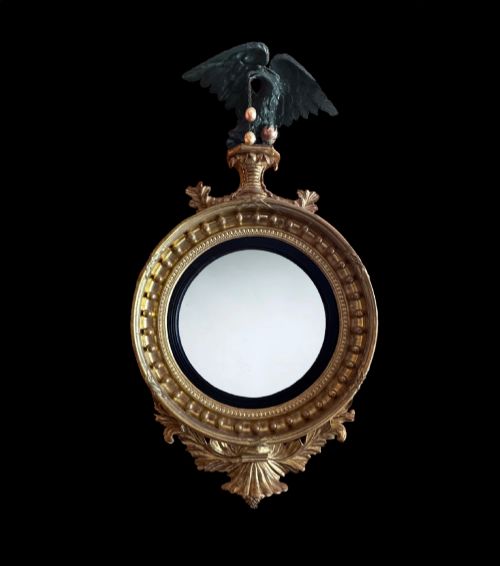
19th Century Regency Gilt Mirror, 1800
Priced at £2,750 from Elmgarden
The period spans roughly 1800 to 1830. War with France cut off imported glass, meaning English makers had to rely on domestic glasshouses.
Look at the scale of later pieces. As production techniques improved, larger plates became feasible for the domestic market.
Convex glass became a defining feature. They hung high in dining rooms to offer a panoramic view of the table and staff.
Classical antiquity heavily influenced the forms. Roman and Egyptian motifs appear regularly following naval campaigns.
Thomas Fentham worked in the Strand and produced many convex Regency mirrors. His labeled pieces turn up occasionally.
John Linnell supplied heavy carved examples. He operated earlier but his classical designs set a template for the early Regency era.
Most provincial examples carry no maker's mark at all. The carving trade relied on outworkers supplying standard motifs to frame workshops.
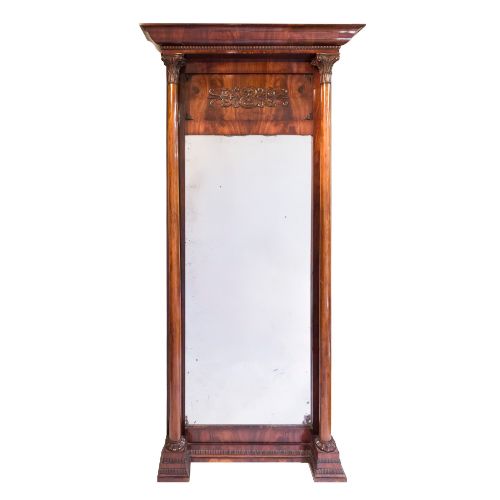
Regency Gilt Wood Egyptian Water Gilded Pier Console Wall Cheval Mirror, Regency
Priced at £2,250 from CJ Antiques
The 2026 retail price guide for Regency Mirrors is drawn from a proprietary archive of over 1.1 million retail prices indexed by Sellingantiques since 2003. This guide relies exclusively on their own internal data; no external sources or auction records are used.
Analysing nearly 25 years of UK antique market history alongside current retail values, the data indicates that typical UK retail prices for Regency Mirrors range between £500 and £3,000. Entry-level prices generally fall under £500 and premium examples upwards of £3,000.
Ebonised reeded slips often frame the glass. This dark border creates a sharp visual break before the gilded frame begins.
Check the crest. Carved eagles perched on rockwork or plinths dominate the circular convex designs.
Sconces frequently flank the lower edge. These candle arms reflect light back into the room and are usually brass or carved wood.
Regency Mahogany Cheval Mirror, Regency
Priced at £3,450 from Baggott & Co.
Frame construction shifted over the decades. Early examples use carved solid timber, while later ones rely on applied composition ornament pressed from moulds.
Wire armatures support the delicate outstretched wings of carved eagles. This hidden skeleton prevents the wood from snapping along the grain.
Study the water gilding process. Craftsmen burnished the gold leaf with agate stones to pick out highlights on the acanthus leaves.
"Convex glass concentrates the light of a single candle, illuminating dark corners of an evening dining room surprisingly well."
"Some bases feature a carved pineapple. This motif served as a symbol of hospitality and wealth in fashionable households."
"The black reeded slip on a convex mirror acts as a lens border. It actively draws the eye toward the miniature reflected room."
Based on almost 25 years of Sellingantiques UK antique market data, Regency Mirrors appeared 3403 times (out of 1,100,000 antiques) which gives it a rarity score of 51/100.
This score measures scarcity within the Sellingantiques archive only and is not a survey of the entire antiques market, so these statistics may not be indicative of the general availability of Regency Mirrors elsewhere.
Dealers call this an ebonised slip. It is usually a separate ring of timber, ribbed with shallow reeding, sitting between the mirror plate and the gilded frame.
This dark band creates a visual pause. It helps manage the harsh reflection of candlelight bouncing off the convex glass and the gold frame.
Woodcarvers can replace missing sections of eagle wings. They carve a new piece of pine to match the curve and pin it into the surviving timber.
Once the structural repair is done, they apply gesso and gild the new addition. The restorer will tone down the fresh gold leaf to blend with the original patinated surface.
The curved glass gathers more light. It reflects a much wider angle of the room than a flat plate could manage.
This allowed a host to see the entire dining table. They could easily check if guests needed attending to without turning around.
They did. The candle arms are called sconces or girandoles, and they were designed specifically to hold wax candles for evening entertaining.
Placing a flame directly in front of the mirror plate doubled the light output in the room. The polished gold frame and the silvered glass caught every flicker.
The wax would sometimes drip onto the lower frame. You often find scorch marks or old wax residue on the lower mouldings of surviving pieces.
Please note: This Regency Mirrors guide and its associated pricing data are provided for general informational purposes only. It does not constitute formal financial, investment, or appraisal advice and should not be relied upon as the sole basis for any commercial activity, purchasing, or sales decisions. Sellingantiques.co.uk accepts no liability for any actions taken in reliance on this information. Always consult with a qualified professional or independent appraiser.
