



Antique Tunbridge Ware Boxes
Small lidded wooden boxes surfaced in the wood mosaic of Tunbridge Wells, made as souvenirs and domestic wares for stamps, tea, sewing and letters.

What Tunbridge Ware Boxes Are
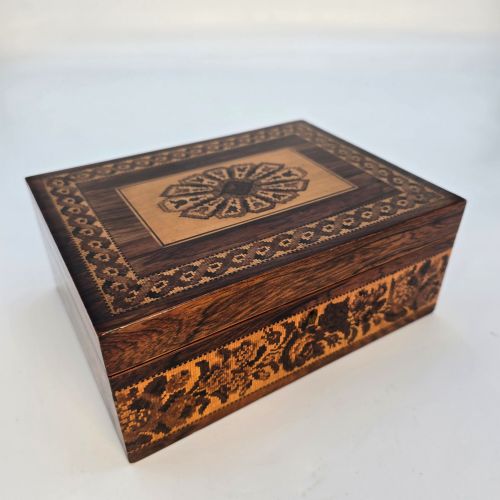
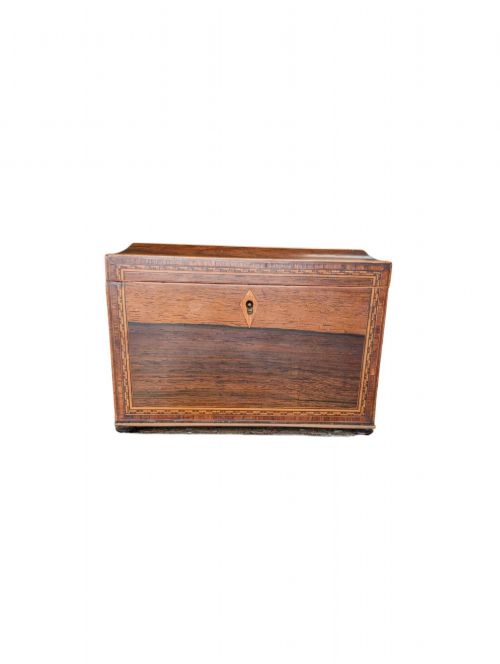
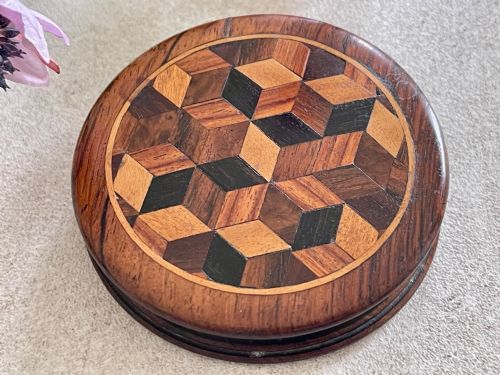
Tunbridge ware is a decoration rather than a shape. Hundreds of tiny coloured wood rods were glued into a block, sliced into veneers, and laid down as geometric bands, perspective cubes, floral sprays or small picture panels. The technique grew up in and around Tunbridge Wells in Kent, sold to visitors to the spa town, and the mosaic work belongs to the nineteenth century.
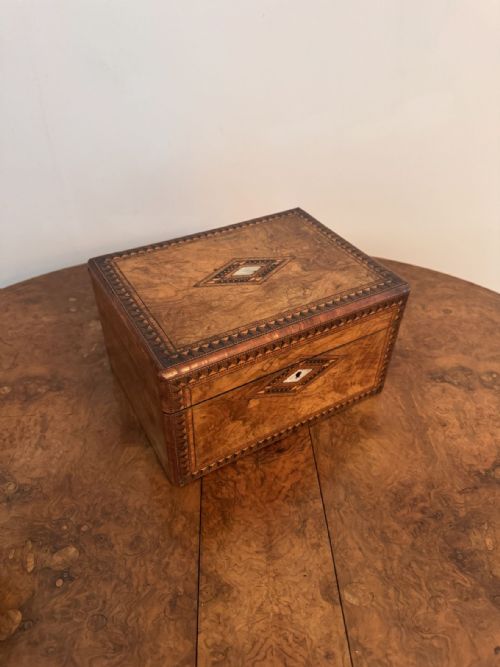
The box under the mosaic is usually walnut or rosewood. The version you'll meet most often on Sellingantiques is a Victorian mosaic-inlaid table or trinket box in walnut, burr walnut in a good many of them. Sizes run roughly 8 to 25cm, from stamp and pin boxes at the small end through glove, jewellery and work boxes in the middle.
Beyond the plain lidded box, the named forms repeat. Tea caddies are the largest single group after boxes as such, and they take odd shapes: a cube, an eight-sided one, a dome top, a double caddy. Writing slopes and lap desks make up a similar slice, along with sewing and work boxes, some still fitted with their trays and reels.
Dating is broad rather than precise. Dealers file the great majority as Victorian or simply 19th Century, with a smaller Georgian group and a handful called Regency. Where a clean year is given it falls between 1800 and 1900, clustering in the 1860s to 1890s. Titles and period labels sometimes pull apart, so read the circa in the title alongside the label.
What Sets Them Apart
Form does most of the work. Stamp, pin, postage and trinket boxes sit at the bottom of the range and account for much of it. Fitted writing slopes, lap desks, sewing and work boxes, caddies and the occasional games box hold the top. Interiors matter alongside form: trays, reels, secret drawers, triple sections and lined compartments push a box up.
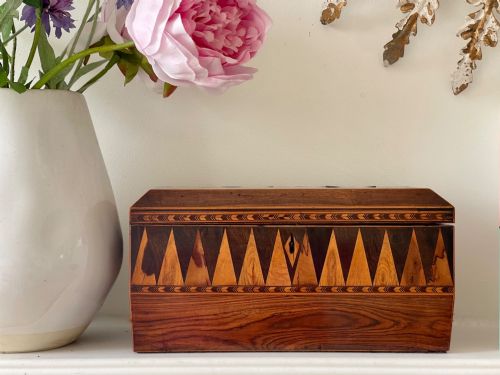
Then the mosaic itself. Boxes covered in full mosaic work, or carrying a named pattern such as perspective cube or Van Dyke, stand apart from those described only as having Tunbridge ware inlay on a walnut or rosewood ground, or as parquetry, which is blocked geometric veneer rather than rod mosaic.
A pictorial view panel of an identified building lifts a box into the upper half. Eridge Castle, Hever Castle, Muckross Abbey, Shakespeare's birthplace and Mansion House all turn up. So does a name: titles that cite a maker's label or signature cluster above the middle, and attribution here rests on the printed label inside the lid rather than on style.
Retail Price Guide 2026
Typical UK retail prices for tunbridge ware boxes, calculated from the Sellingantiques database of over a million retail prices indexed since 2003. This retail price guide relies exclusively on Sellingantiques data; no external sources or auction records are used, so the figures do not describe the wider market.
Tunbridge ware boxes have been listed on Sellingantiques since 2010, with over two hundred recorded since then.
Edmund Nye
The Antique Tunbridge Ware Boxes Glossary
- Tunbridge ware
- Wood mosaic made from bundles of coloured rods sliced into patterned veneer, used as a surface decoration on boxes rather than as the box itself.
- Perspective cube
- A three-colour geometric pattern that reads as stacked three-dimensional cubes. Named in titles often enough to be worth knowing by sight.
- Writing slope
- A hinged box opening to a sloped writing surface, in leather or veneer. Sometimes called a lap desk, and one of the recurring larger forms.
- Burr walnut
- Figured walnut cut from a burr growth on the tree, and the commonest carcase veneer under the mosaic in these listings.
- Van Dyke
- A zig-zag or chevron banded pattern, named only occasionally in titles among the geometric work.
- Whitewood
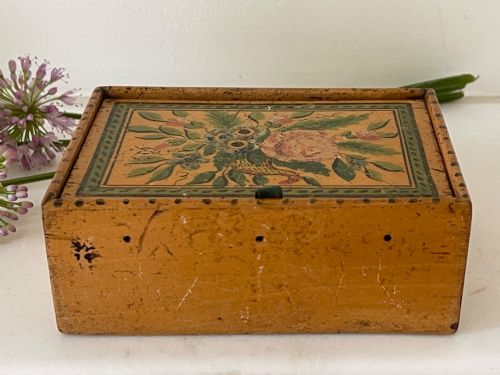
- Pale undyed wood grounds, sometimes carrying penwork decoration in place of mosaic.
Frequently Asked Questions
What was Tunbridge ware made for?
It was made in and around Tunbridge Wells in Kent, sold to visitors to the spa town as souvenirs and small domestic wares.
That shows in the forms. Stamp boxes, trinket boxes, tea caddies, sewing boxes and writing slopes, all things a household used or a visitor carried home.
Which forms turn up most often?
Plain lidded table and trinket boxes dominate, most of them Victorian and many in walnut or burr walnut.
After those, tea caddies are the most-named specific form, followed by writing slopes and lap desks, then sewing and work boxes. Small stamp, pin and postage boxes make up roughly a fifth of listings.
How are these boxes dated by dealers?
Mostly by broad label. Victorian and 19th Century between them cover the great majority, with a smaller Georgian group and only four listings called Regency.
About sixty listings carry a clean year, and those run from 1800 to 1900, bunching in the 1860s, 1870s, 1880s and 1890s.
Titles and period fields sometimes disagree, so the label reads as approximate.
Do Tunbridge ware boxes carry maker's names?
Some do, through a printed paper label pasted inside the lid, or a signature. That is the usual basis for attribution in these listings.
Only three dealers name Edmund Nye across the archive. The rest are sold unattributed, since style alone doesn't place an unlabelled box with a workshop.
What is a castle-top or view panel?
A pictorial mosaic panel showing an identified building, set into the lid.
Eridge Castle appears twice in the archive, and Hever Castle, Muckross Abbey, Shakespeare's birthplace and Mansion House each once. Boxes with a named view sit in the upper half of the range.
Are unusual shapes ever listed?
Yes, though singly. A miser's snuff box, a receipt box, a cribbage box, a scent-bottle box, a letter rack box, a cigar box and a chess and table bagatelle games box each appear once.
There is also a Tunbridge ware chest of drawers in walnut, which isn't a box at all in the usual sense.