


Antique Games Boxes
A games box is a lidded case, usually wooden, fitted to hold the equipment for parlour games: playing cards, cribbage pegs and boards, chess and draughts men, backgammon, dice and counters.
What Are Games Boxes?
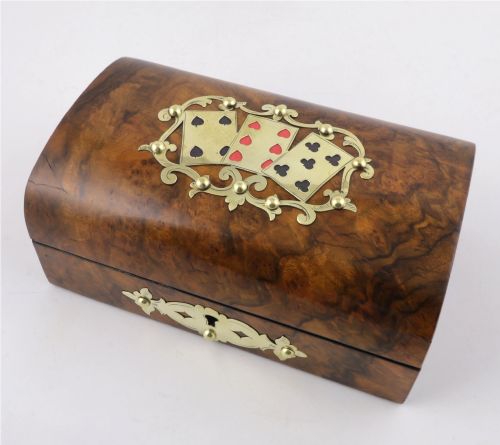
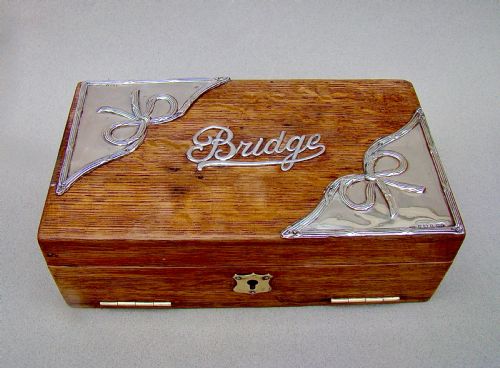
The category runs from small single-purpose card and cribbage boxes up to fully fitted compendiums with several trays and boards, and at the top end it touches cases that pair a tantalus or decanters with a games fitment. Material does the heavy lifting in the titles: coromandel, rosewood, walnut and burr walnut, amboyna, olive, mahogany and oak, often with brass mounts or inlay.
The commonest thing you'll meet is a mid-to-late 19th-century box in figured or exotic hardwood, fitted for cards and a board game or two. Of 101 titles on Sellingantiques, 23 say Victorian, 20 say compendium and 19 say card. Walnut leads the timbers at eleven titles, with coromandel and rosewood tied at eight each.
Dating is loose by convention rather than accident. Forty-five listings carry a clean year, and the dated field runs 1800 to 1940; the rest are labelled Victorian (28) or 19th Century (13). Where decades are given they bunch in the second half of the 19th century, with Regency at the early end and Edwardian and the 1920s at the late.
Beyond the English mainstream sit smaller groups: brass, brass-bound and hardstone-mounted boxes, around one in eight of the titles, and East Asian and Anglo-Indian work including mah-jong sets, Chinese lacquer gaming boxes, Vizagapatam sandalwood and Indian specimen woods. Only about seven games boxes are listed in a year, yet 42 separate dealers have handled one.
Where The Range Splits
The first divide is how many games the box holds. Single-purpose cribbage, bezique and card boxes cluster at the bottom of the range; compendiums fitted for cards, chess, draughts, backgammon and cribbage together cluster at the top. Dealers escalate the wording for the fitted ones, from fitted to fully fitted, and those titles sit in the upper half.
The second is what the case is made of and what has been applied to it. Coromandel, burr walnut, amboyna, kingwood and olive recur on the dearer pieces, with mahogany and oak across the middle. Brass appears in thirteen titles, and hardstone and metal enrichment, agate, malachite, tiger eye, pietra dura, ormolu and silver mounts, turns up on examples well above the midpoint.
Named decorative work pushes a box up in the same way. Penwork on Regency examples, parquetry, marquetry, hand-painted papier mâché, Tunbridge ware, Mauchline tartan ware and specimen-wood banding each sit above the plain-box level. Size counts too: boxes described as oversized or large sit well up the range.
Retail Price Guide 2026
Typical UK retail prices for games boxes, calculated from the Sellingantiques database of over a million retail prices indexed since 2003. This retail price guide relies exclusively on Sellingantiques data; no external sources or auction records are used, so the figures do not describe the wider market.
Dates on Sellingantiques games boxes run from 1800 to 1940, the earliest a Regency penwork box of about 1820, the latest an Italian Art Deco card box.
The Antique Games Boxes Glossary
- Compendium
- A games box fitted to hold several games at once, cards, chess, draughts, backgammon and cribbage, rather than one. It appears in a fifth of the titles.
- Fitted
- The interior is divided or trayed to its original contents. Eight titles use the word, and dealers often stretch it to fully fitted.
- Coromandel
- Dark striped exotic hardwood, one of the commonest luxury casings in this category and named in eight titles.
- Burr walnut
- Walnut cut from a burr, giving swirled figure. Walnut in all its forms is the most-named timber in the sample.
- Penwork
- Black-and-gold pen-drawn decoration on a light ground, seen on Regency boxes here.
- Tunbridge ware
- Minute wood mosaic used as banding or panels, a Kentish speciality. Two sampled boxes carry it.
Frequently Asked Questions
What is a games compendium?
It's a single case fitted to hold several games at once, typically cards, chess, draughts, backgammon and cribbage, with trays and folding boards stacked inside.
The word appears in one in five titles on Sellingantiques, and those are the boxes that reach the top of the range. The fully fitted burr walnut examples in particular.
Which woods turn up most often?
Walnut leads, counting its plain, figured and burr forms, at eleven titles. Coromandel and rosewood tie at eight each.
Amboyna, olive, kingwood, mahogany and oak also appear. Mahogany and oak sit across the middle of the range, while the exotic and figured timbers recur on the dearer boxes.
Are these boxes always English and Victorian?
That's the dominant form. Twenty-three of 101 titles say Victorian and ten say English, and the decades that carry a clean date bunch in the second half of the 19th century.
There's a persistent minority from elsewhere: mah-jong sets in teak and hardwood, Chinese lacquer gaming boxes, Vizagapatam sandalwood and ivory, and Indian specimen woods from Travancore. An Italian Art Deco amboyna and silver card box of about 1935 is the latest sampled piece.
Why do so many listings just say Victorian?
Because that's how the trade labels them. Twenty-eight listings are dated Victorian and thirteen as 19th Century, four in ten of the total.
The remaining 45 carry a clean year, and those run from 1800 to 1940. Treat the reign and century labels as approximations rather than research.
What makes one box cost more than another?
Number of games held, casing timber, and applied decoration. Compendiums sit above single-game boxes, exotic and figured woods above plain, and metal or hardstone work above bare veneer.
Size is the other lever. Boxes titled oversized or large sit well up the range.
Do tantalus and games cases exist as a type?
They do, though only as a handful. Three sampled titles pair a tantalus or decanters with a games compartment in one case, in oak and in compendium form.
The hybrid turns up at the upper-middle of the range rather than at the very top.