
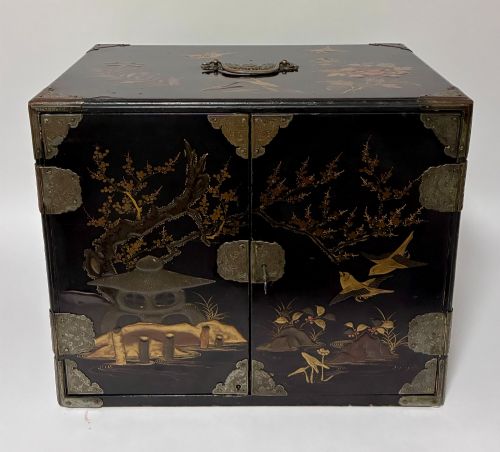
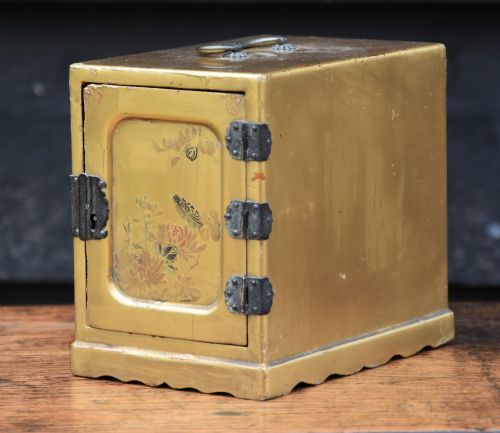


Antique Japanese Boxes
A lidded Japanese container, in lacquered wood, iron or enamel, made to hold writing kit, documents, incense or trinkets.
What Are Japanese Boxes?
Lidded boxes for brushes and inkstones, letters, documents, incense, tea and cosmetics are long-standing Japanese domestic forms. From the mid-19th century, once Japan reopened to foreign trade, workshops turned them out in quantity for Western buyers alongside home use, which is the wave that reaches the UK market.
The box you are most likely to meet in a listing is a Meiji lacquered wooden one, black and gold, rectangular, of writing- or document-box type. Meiji is named in 56 titles, more than any other period, and lacquer terms run through roughly half the category. Suzuribako, bunko and fubako titles all turn up.
The second seam is metalwork: iron, bronze, silver and mixed metal, much of it damascened or onlaid with gold and silver. Cloisonné enamel boxes form a smaller group, with ginbari, moriage and gold-wire types among them. Inlaid work in shibayama, mother-of-pearl and yosegi marquetry appears steadily rather than in numbers.
Dates in the archive run from 1850 to 1940, and the largest single entry is the broad '19th Century'. Only two listings are given as 18th century, so pre-1800 lacquer is genuinely scarce on Sellingantiques. Seven Japanese boxes are catalogued as 'Victorian', which tells you about a dealer's habit of dating by the British reign rather than about the box.
Where The Range Splits
Material sets the shape of the range. Iron and mixed-metal boxes, shakudo, shibayama and gold-wire cloisonné occupy the entire upper reach; plain lacquered and simply described wooden boxes, often with no clean date, sit at the bottom. Lacquer dominates by number, metalwork by standing.
A name in the title lifts a box. Komai appears in 13 titles, usually as damascened or onlaid iron from Kyoto, and other workshop and artist names cluster in the upper part of the range: Nogawa, Okuno, Inoue, Miyao Eisuke, Ando Jubei, Kajima Ikkoku, Miyabe Atsuyoshi, Heian Zohiko, Fujii. Names appear stamped, signed or as attributions.
Gold in the decoration counts, whether 24k gold damascene, solid gold inlay or gold wire in enamel. So does completeness: a suzuribako paired with its ryoshibako, a box with its matching tray, three-tier forms and fitted insert trays all stand above single boxes. Large examples push upward too.
Retail Price Guide 2026
Typical UK retail prices for japanese boxes, calculated from the Sellingantiques database of over a million retail prices indexed since 2003. This retail price guide relies exclusively on Sellingantiques data; no external sources or auction records are used, so the figures do not describe the wider market.
19th Century is the period label used most on Sellingantiques for Japanese boxes, with 1900s next and 1890s third.
The Antique Japanese Boxes Glossary
- Meiji
- The Japanese era of 1868 to 1912, named in more titles in this category than any other period.
- Suzuribako
- A writing box, made to hold an inkstone, brush and water bottle. Eight titles use the word.
- Bunko / Ryoshibako
- A document or stationery box, usually a flat rectangular lidded form.
- Fubako
- A letter box, long and narrow, with a fitted overlapping lid.
- Kobako / Kodansu
- A small box; a kodansu is a miniature cabinet of drawers, lacquered or in metal.
- Maki-e
- Decoration made by sprinkling metal powder onto wet lacquer. Takamaki-e is the raised version, where the design stands up in built-out lacquer.
Frequently Asked Questions
How many Japanese boxes come up each year?
Around 21 reach this market in a year, and 37 different dealers have listed one. No single specialist controls the supply.
That spread means the mix shifts from listing to listing rather than following one dealer's taste.
What does damascened iron mean on these boxes?
Gold and silver worked onto an iron or bronze ground. It is the technique behind most of the iron boxes recorded in this category.
Iron is named in 21 titles and mixed metal in 15. Sampled titles specify 24k gold damascene and solid gold inlay at the upper end of the range.
Which maker name appears most often?
Komai, in 13 titles, usually described as damascened or onlaid iron from Kyoto.
Other names in the archive include Nogawa, Ando Jubei, Heian Zohiko and Miyao Eisuke. They appear signed, stamped or as attributions, and they cluster in the upper part of the range.
Are cloisonné boxes common in this category?
Less so than lacquer or metalwork. Cloisonné appears in 12 titles, under a tenth of the whole.
Within that group the samples include ginbari, worked over silver or metal foil, moriage and gold-wire types.
Is 18th century Japanese lacquer found here?
Barely. Only two listings in the whole archive are dated to the 18th century, making pre-1800 the rarest date band by a wide margin.
The weight sits in the later 19th and early 20th centuries: 1900s, 1890s and 1910s all outnumber it many times over.
What unusual forms turn up in this category?
Once in a while something appears that is barely a box: a manju netsuke, a monkey tonkotsu tobacco container, a leather pillow box, a zenibako money box, a pair of Edo helmet boxes.
Ryukyu Islands lacquer, in red and gold, shows up only a handful of times and is the rarest regional origin recorded.