




Antique String Boxes
A string box is a small counter or desk vessel that holds a ball of twine and pays it out through a hole in the lid, sometimes past a fitted cutter.
Antique String Boxes
Twine became a household and shop necessity, and the string box was the answer: a ball kept clean inside a lidded vessel, drawn off through a hole in the top and cut off at the counter. Turned wooden ones were made for shops, offices and desks. Metal and novelty versions came later.
The version you are most likely to meet on Sellingantiques is a plain turned hardwood barrel or ball, made from one block on a lathe, with a screw or lift-off top. Lignum vitae is the house material, named in a fifth of all titles, and "treen" appears in over a quarter. Boxwood, sycamore, walnut, fruitwood, rosewood and birch turn up as well.
Brass runs as a quiet parallel to the wood, in embossed boxes and a spherical ball holder, all carried under Victorian labels. Beyond that sit the curiosities: a polychrome folk-art thatched cottage, a beehive, a football-shaped English piece around 1900, and single regional or imported examples including a Kashmiri box and a Russian one dated 1910.
Dating is loose. Thirty-three of the seventy listings say only "19th Century", and just twenty-one commit to a year, those running from 1750 to 1910. Decade labels bunch in the mid to late 19th century. Read "19th Century" as dealer shorthand for an undated turned piece rather than as a datable form; one title reads 18th century while the same listing's date field says 1850.
Where The Range Splits
Form does most of the work. The plain lignum barrel is the base of the category, and it is a large cluster. Cottages, beehives, a football and hand-carved fruitwood pieces sit well above it, because the novelty is the whole point of them and the turning is not.
Surface is the second lever. Where a box is titled for polychrome paint, painted treen or a tartan covering rather than for its wood, the decoration has survived and the listing leads with it. Scale pulls the same way: titles reach for "Large", "Huge Size" and "Shop Counter" to mark the trade-sized dispensers against desk pieces.
Smaller things separate the rest. A cutter still fitted at the string exit is named in a title where most are not. And two entries are offered as pairs or near pairs, unusual for an object made to be used one at a time.
Antique String Boxes Retail Price Guide 2026
Typical UK retail prices for string boxes, calculated from the Sellingantiques database of over a million retail prices indexed since 2003. This retail price guide relies exclusively on Sellingantiques data; no external sources or auction records are used, so the figures do not describe the wider market.
Titles on Sellingantiques often flag scale - LARGE, HUGE SIZE, Shop Counter - which sets the trade dispensers apart from the desk-sized ones.
The Antique String Boxes Glossary
- String barrel
- The barrel-shaped turned form, and the commonest silhouette in this category. Dealers use the word in place of "box" without meaning anything different by it.
- String dispenser, string holder
- Alternative title words for the same object, used interchangeably. A search on one word will miss pieces titled with another.
- Lignum vitae
- A very dense, dark, close-grained tropical hardwood, and the signature material here. It turns crisply and takes a deep polish.
- Treen
- Small domestic objects turned or carved from wood, covering the boxwood, sycamore, walnut, fruitwood and rosewood bodies as well as the lignum ones.
- Cutter
- A small blade fitted at the string exit for trimming the twine off. Named in one sampled title; the rest are plain holes or slots.
- Stringing
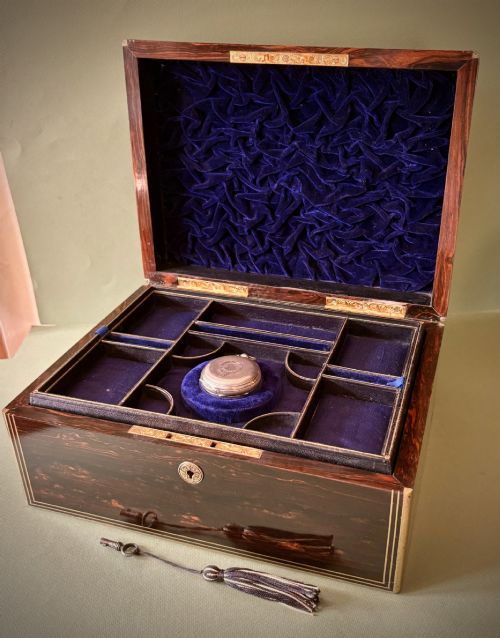
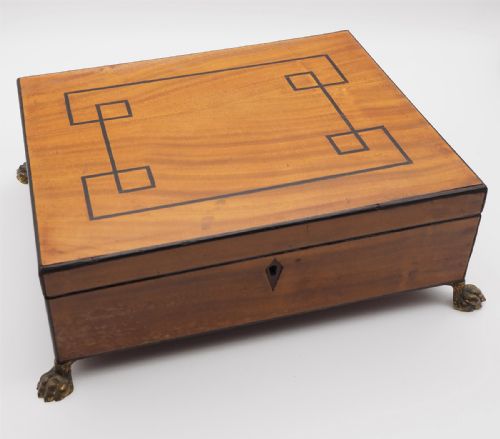
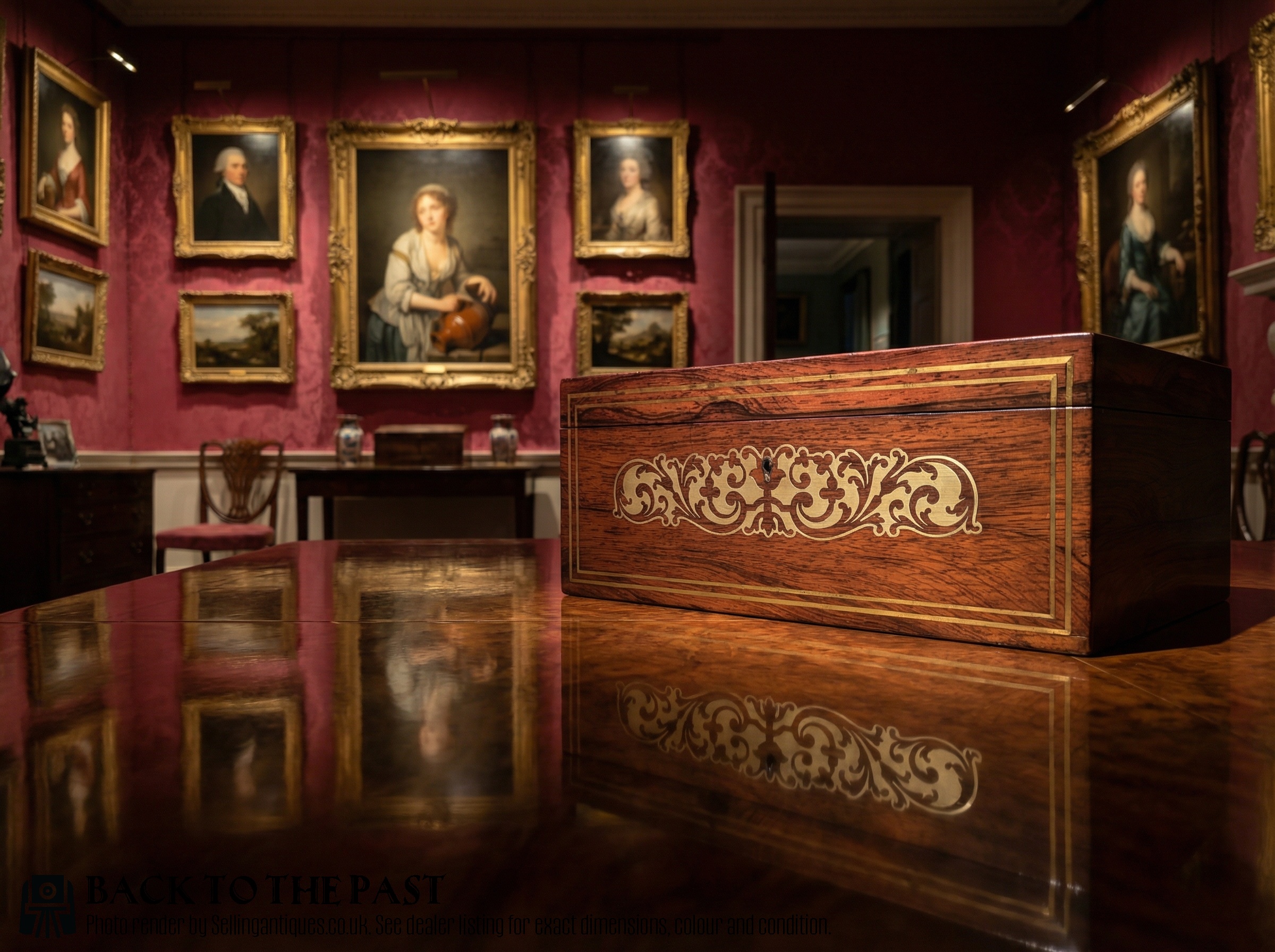
- A thin line of contrasting inlay, a wholly different sense of the word. It is why the odd tea caddy, workbox or writing slope appears under this heading without being a string dispenser at all.
Antique String Boxes: Frequently Asked Questions
What wood are string boxes usually made from?
Lignum vitae dominates. It is named in a fifth of all titles on Sellingantiques, and the broader word "treen" in over a quarter, so a dark dense turned hardwood is the default.
Other woods appear across the archive: boxwood, sycamore, walnut, fruitwood, rosewood and a birch example. Brass boxes and holders form a small parallel group.
How often do string boxes come up for sale?
Only about seven a year reach the market on Sellingantiques.
That said, thirty-four different dealers have listed one. Almost nobody carries them as a line, so they turn up singly rather than in runs.
Why are so many listed simply as 19th century?
A plain turned barrel gives little to date by. Thirty-three of the seventy listings use "19th Century" as their date, and only twenty-one give a clean year.
Those years spread from 1750 to 1910, with decade labels bunching in the 1850s, 1870s and 1880s. Named-reign labels such as Georgian, Victorian and Regency are thinly scattered.
Are there novelty string boxes?
A handful, and they are the archive's curiosities. A polychrome folk-art thatched cottage, another cottage form, a beehive, and a single football-shaped English piece dated around 1900.
These sit toward the top of the range, above the plain barrels. Painted treen belongs with them, titled for its surface rather than its wood.
What does shop counter mean in these titles?
It marks size. Some string boxes were made for trade use behind a counter, and they are much larger than the desk-sized ones.
Titles boast of bulk more than refinement, with "Large" and "Huge Size" doing the same job. The unqualified examples sit below them.
Do string boxes come in pairs?
Rarely, but it happens. Two sampled entries are offered as pairs or near pairs, including a set of Edwardian boxes and a treen barrel near pair.
A near pair means two matched but not identical pieces. It is an unusual way to sell an object made to be used one at a time.