



Antique Glove Boxes
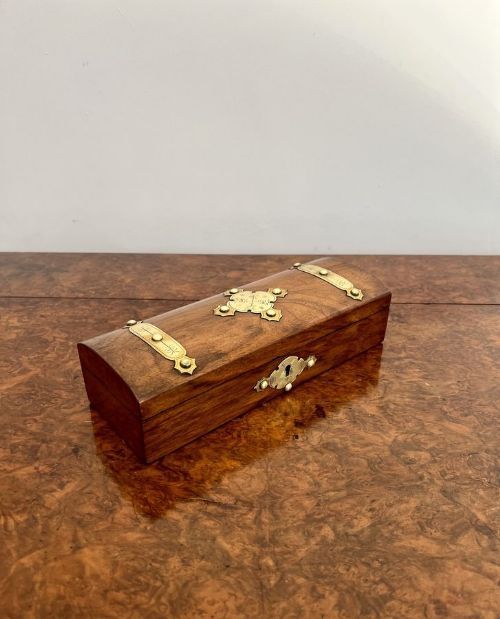
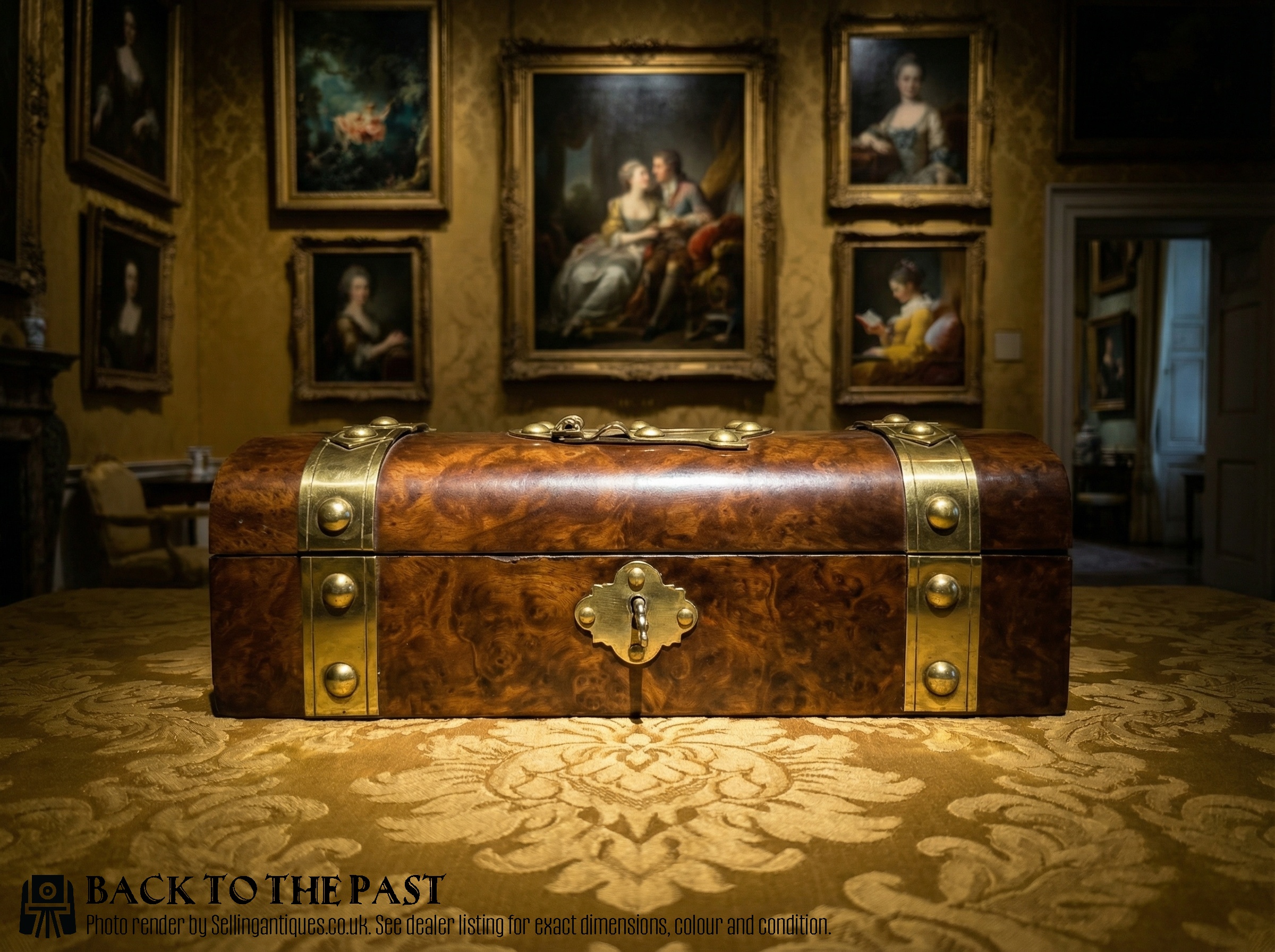
A long, shallow lidded box made to keep a lady's dress gloves flat and clean on a dressing table.
Antique Glove Boxes
Gloves were a formal necessity in the 18th and 19th centuries, and they needed keeping flat. That gave the form its shape: long, narrow, shallow, with a lid. The shape carried on into the Edwardian years alongside jewellery and keepsake boxes of much the same proportion.
The box you are most likely to meet on Sellingantiques is Victorian and veneered. Rosewood leads, with walnut, amboyna, kingwood, satinwood and maple behind it, and decoration in mother of pearl, brass or Tunbridge mosaic. Lids are flat, domed or hinged to drop forward.
Tunbridge ware is the most distinctive presence in the category, named in eleven of fifty-four titles, including one castle-top panel and one mosaic-inlaid box. French boxes account for ten titles and bring amboyna, burr cedar, bevelled glass panels and drop fronts with them. Beyond the veneered cabinetwork sit a few lacquer, papier mâché, carved oak and oriental pieces.
Titles hedge the function constantly: glove/jewellery, glove/pen, glove/pencil, keepsake, reception key case. The form clearly wasn't always bought for gloves alone. Dating is loose too. Only eighteen listings carry a clean year, the run goes 1800 to 1915, and Victorian does the work of a bracket rather than a date.
Where The Range Splits
Decoration sorts the category more than anything else. Tunbridge mosaic and pictorial panels sit at the upper end, with the castle-top box and a large English Tunbridge ladies' box among the higher-placed pieces. Plain mahogany, pen-work and papier mâché sit at the bottom of the same range.
Veneer choice follows the same line. Amboyna, kingwood, burr walnut, burr cedar and birds eye maple cluster above the plain woods, and mounts push a box further again: brass bound, brass mounted, agate mounted and mother of pearl inlaid recur on the higher-priced titles.
Two smaller things move a box up. Interiors that have survived get named in the title, whether original tufted silk or velvet lining. So do multiples, since pairs and matching glove and jewellery boxes turn up as offerings in their own right.
Antique Glove Boxes Retail Price Guide 2026
Typical UK retail prices for glove boxes, calculated from the Sellingantiques database of over a million retail prices indexed since 2003. This retail price guide relies exclusively on Sellingantiques data; no external sources or auction records are used, so the figures do not describe the wider market.
Victorian is the period label used most on Sellingantiques for glove boxes, with the 1860s next and 19th Century third.
The Antique Glove Boxes Glossary
- Tunbridge ware
- Decoration built from bundles of coloured wood rods, glued up and sliced across to give a mosaic pattern. Named in eleven of the fifty-four titles.
- Drop front
- A lid or front panel hinged to fall forward rather than lift. It shows up on several French and amboyna boxes.
- Domed
- A curved lid rather than a flat one, called out on rosewood and Tunbridge examples.
- Mother of pearl
- Shell inlay set into the veneer, usually paired with rosewood or mahogany in this category. Often shortened to MOP in titles.
- Amboyna
- A golden burr-figured tropical veneer. It appears on three of the French boxes.
- Castle-top
- A Tunbridge mosaic panel showing a named building. One example turns up in the archive.
Antique Glove Boxes: Frequently Asked Questions
What wood are they usually made from?
Rosewood is the most named single wood, in nine of fifty-four titles. Walnut, amboyna, kingwood, satinwood and maple all appear behind it.
A smaller group steps outside veneered cabinetwork altogether: lacquer, papier mâché, carved oak and oriental caskets.
How common are Tunbridge ware examples?
Tunbridge is named in eleven titles, about a fifth of the category, which makes it the most distinctive strand in it.
The samples include mosaic-inlaid boxes, a castle-top panel and rosewood boxes combined with Tunbridge banding. They sit in the upper part of the range.
Why are they called glove and jewellery boxes?
Because dealers hedge the function. Titles run glove/jewellery, glove/pen, glove/pencil, keepsake and reception key case.
The long shallow shape suited gloves, but it suited other dressing table clutter just as well, and the boxes seem to have been bought for both.
What period do most of them come from?
Victorian is the single largest label, on twenty-one listings, with thinner bands for the 1860s, 1870s, 1880s and 1850s.
Regency, Georgian, 18th century and Edwardian sit at the edges. The dated field runs 1800 to 1915, and some titles disagree with their own dated field, so read it as an approximation.
Do French glove boxes differ from English ones?
French boxes make up ten titles and carry their own vocabulary: amboyna, burr cedar, bevelled glass panels set into the lid, and drop fronts.
The English side runs to rosewood, burr walnut with brass mounts, satinwood, birds eye maple and kingwood, often with mother of pearl inlay.
Are original interiors often still present?
When a lining has survived, dealers put it in the title. Original tufted silk and velvet lined both appear that way.
One box in the archive still came with its gloves.