




Antique Knife Boxes
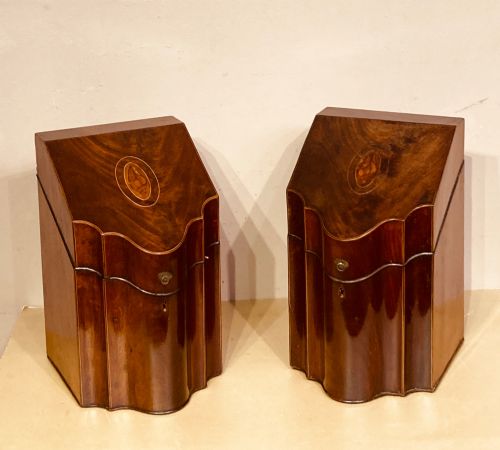
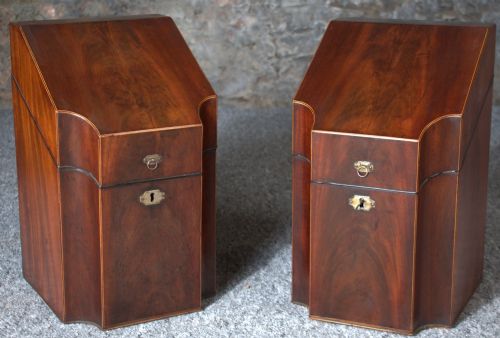
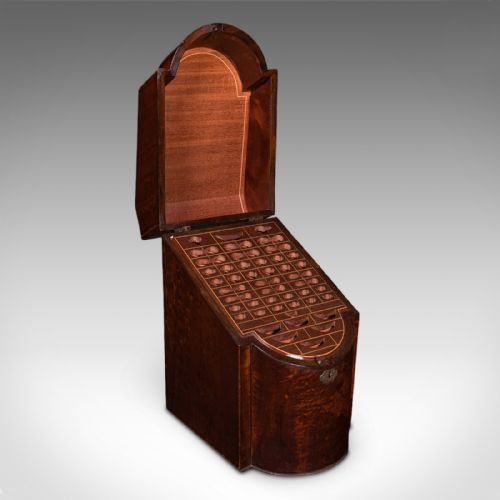
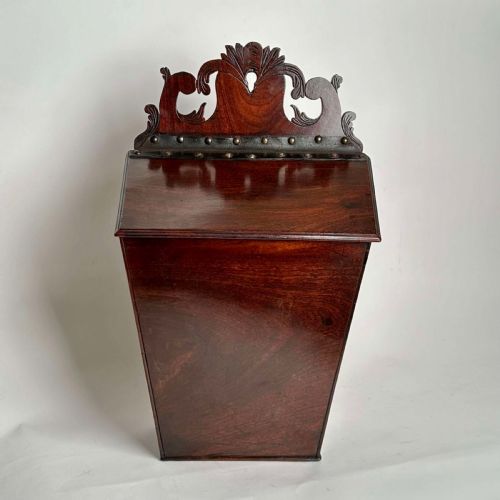
A sloping-lidded mahogany case, made to stand on a Georgian sideboard and hold table knives, forks and spoons upright in a slotted fitted interior.
Antique Knife Boxes
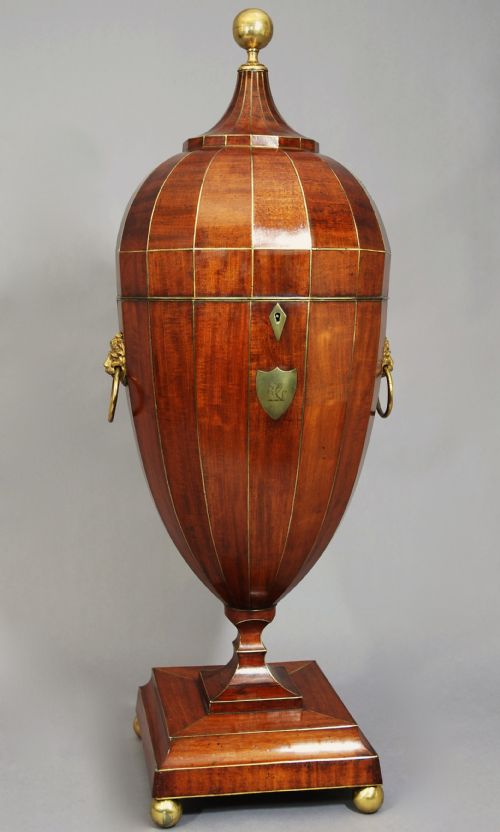
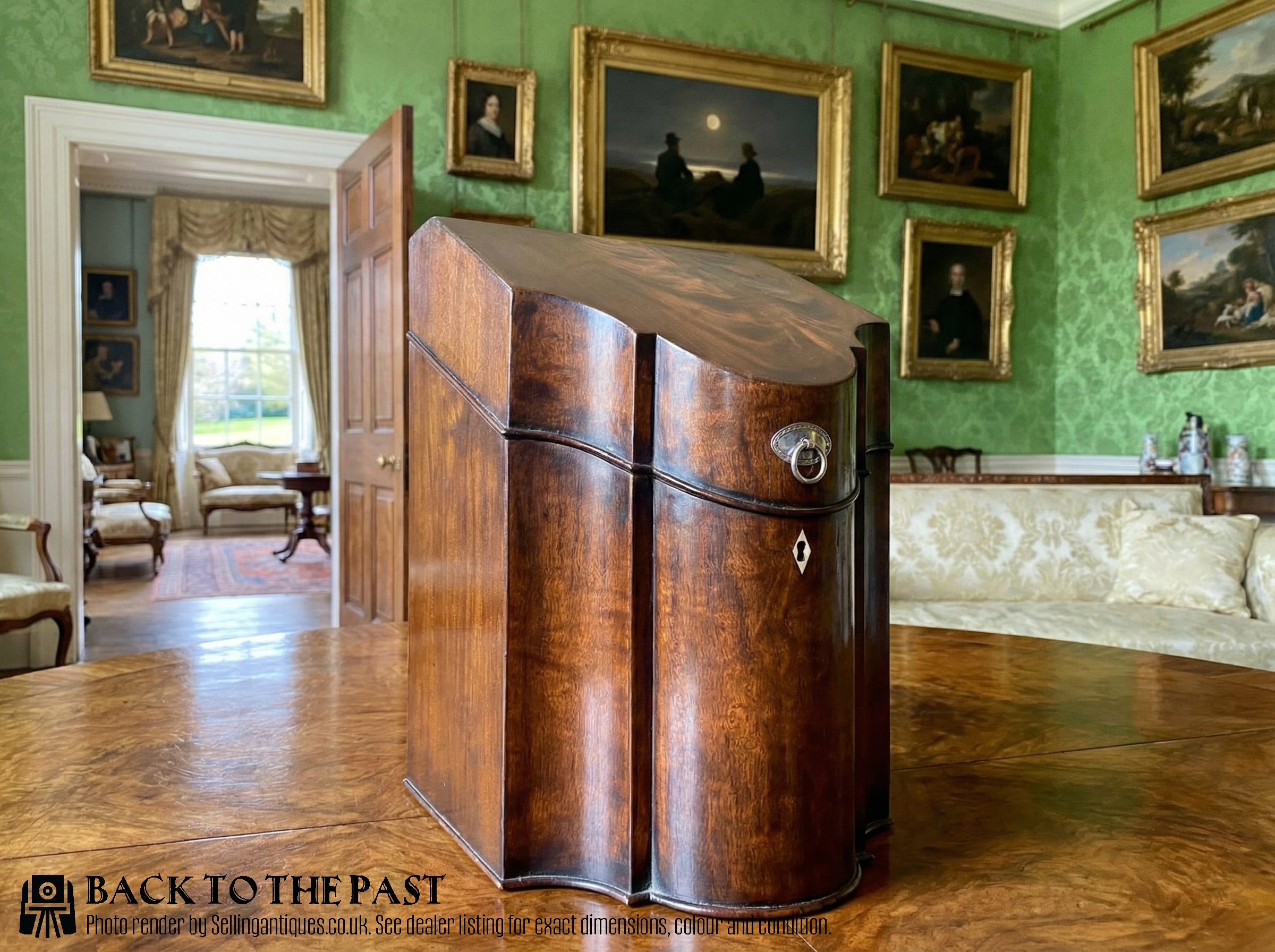
Knife boxes came into use in Britain in the 18th century as sideboard furniture. Cutlery stood upright in a slotted tray inside, so a set could be kept on show and carried through to the dining room. They were commonly made in pairs to flank a sideboard, and later in the century as pedestal urns.
The form you'll meet most often on Sellingantiques is a single mahogany case of George III date. Mahogany is named in around two thirds of titles, and roughly four in five listings are singles rather than pairs. Titles like "Georgian Mahogany Knife Box" recur word for word across many dealers.
Beyond the plain sloping case, three variants turn up throughout. Serpentine and bow fronts account for a visible minority. Inlaid and Sheraton-period cases, with satinwood banding or shell motifs, run to roughly one in six titles. Cutlery urns, the pedestal form with a rising lid, appear only four times in the whole archive.
About one listing in ten is now sold as a stationery or letter box, the fitted interior having been converted or taken out. Dating is loose: only twenty of the 111 listings carry a clean year, and the dealers' own labels run from Georgian and 18th century through to a single 1880s entry.

Where The Range Splits
Pairs sit at the top. Every listing in the upper part of the range that isn't an urn is a pair, and the highest-priced entry in the archive is a pair of George III mahogany boxes. One is described as a matched pair rather than an original set. Singles cluster low, and that is where the bulk of the category lives.
After that it's shape and surface. Serpentine and bow-fronted cases sit above plain fronts. Inlaid work, satinwood, painted decoration and flame or figured mahogany veneers all push a box up the range, and silver mounts or fittings do the same, though silver appears on only four pieces and never as marked plate.
The interior decides a good deal. Boxes described as complete, with the original fitted tray still in place, sit above cases converted to stationery use or sold with the fittings gone. Urn-form cutlery pedestals, scarce here, all fall in the upper range.
Antique Knife Boxes Retail Price Guide 2026
Typical UK retail prices for knife boxes, calculated from the Sellingantiques database of over a million retail prices indexed since 2003. This retail price guide relies exclusively on Sellingantiques data; no external sources or auction records are used, so the figures do not describe the wider market.
Among the one-offs to pass through: a tantalus built in the guise of a knife box, and a mahogany letter holder catalogued in with them.
The Antique Knife Boxes Glossary
- Knife box
- A sloping-lidded case for storing table cutlery upright on a sideboard, the form that dominates this category.
- Fitted interior
- The slotted internal tray holding each knife, fork or spoon. Titles that call it original, or say complete, are telling you it survives.
- Serpentine front
- A front shaped in a shallow S-curve. One of the two commonest shaped profiles in the archive, alongside the bow front, which sweeps outward in a single convex curve.
- Sheraton
- Used in titles as a late-Georgian style label for lighter, inlaid or satinwood cases. It is not a maker's name here.
- Cutlery urn
- The vase- or urn-shaped pedestal version with a rising lid, rather than the sloping-lid case. Four examples across the whole archive.
- Shagreen
- Rayskin covering used instead of veneer. Two boxes in the archive are shagreen-covered, one of them dated by its dealer to 1740-60.
Antique Knife Boxes: Frequently Asked Questions
Are knife boxes usually sold in pairs?
No. Roughly four in five listings are single boxes. Pairs account for about a fifth of titles, and they take up almost the whole top half of the range.
One is listed as a matched pair, meaning two boxes brought together rather than made as a set.
What wood are they made from?
Mahogany, in around two thirds of titles. It is the default to the point that anything else stands out.
Satinwood, walnut, oak, shagreen and coromandel turn up only at the edges of the archive, sometimes as inlay or banding rather than the whole case.
How old are Georgian knife boxes?
The dealers' own dating is Georgian in the loose sense, which covers anything from the middle of the 18th century to the 1820s. Only twenty of the 111 listings carry a clean year.
Where a circa date does appear in a title, it runs from about 1740 to 1820. The dated field as a whole spans 1750 to 1890.
Why are some described as stationery boxes?
About one in ten cases in the archive has been repurposed. Three titles say "Converted" outright, and one pair is described as former cutlery boxes.
The slotted cutlery tray has been altered or removed in these, leaving an open case suited to letters and paper. Listings that say complete, or original fitted interior, are describing the opposite.
Do knife boxes carry a maker's name?
Not in this category. A scan across all 111 listings returned no cabinetmaker, retailer or workshop name at all.
Where "Sheraton" appears in a title, it is a period style label for a lighter, inlaid look, not an attribution.
What is a cutlery urn?
The pedestal form: a vase or urn shape on a base, with a lid that rises on a central stem to bring the cutlery up. It came in later in the 18th century than the sloping case.
On Sellingantiques it appears four times, and all four sit in the upper part of the range.